If your ad report looks healthy but your cash flow doesn't, you're not looking at the right metric.
A lot of business owners get stuck in the same loop. The agency sends over charts full of impressions, clicks, traffic, and engagement. Everyone sounds optimistic. Then you check sales, booked jobs, or margin, and nothing meaningful changed.
That's not a marketing win. That's expensive activity.
The useful question is simpler: did the ad spend produce revenue, and did that revenue justify the spend? That's where Return on Ad Spend, or ROAS, stops being marketing jargon and starts becoming a management tool.
If you've been burned before, good. Skepticism helps here. ROAS gives you a cleaner way to hold advertising accountable, but only if you understand what it is, what it isn't, and how to tie it back to your business model.
Tired of Paying for Clicks Instead of Revenue
Clicks are not the business. Revenue is the business.
That sounds obvious, but plenty of companies still let their ad partner hide behind soft metrics. You'll hear that traffic is up, cost per click is improving, or engagement looks strong. None of that matters if the campaign isn't creating sales, booked appointments, or customers worth keeping.
Business owners usually notice the problem before marketers admit it. You feel it when ad spend goes out every month, but your sales team says lead quality is shaky. You feel it when your store gets traffic but conversion stays flat. You feel it when the report says “performance improved” while your bottom line says otherwise.
The real issue with vanity reporting
Vanity metrics aren't useless. They're just incomplete.
Impressions can tell you whether people saw the ad. Clicks can tell you whether the message got attention. But neither tells you whether the campaign produced enough revenue to justify the spend. If you stop the analysis there, you're grading the ad on activity, not outcome.
That's how businesses keep funding campaigns that look busy but don't produce much.
Practical rule: If a report makes the campaign sound successful without showing the revenue tied to ad spend, the report is protecting the marketer more than the business.
What a skeptical owner should ask instead
A smart operator cuts straight to a short list of questions:
- Revenue question: How much revenue came from this campaign?
- Efficiency question: How much ad spend did it take to produce that revenue?
- Profit question: After costs, did the campaign help the business?
- Decision question: Should we scale, fix, or cut it?
ROAS answers the second question well. That's why it matters.
It gives you a direct way to judge whether ad dollars are turning into revenue efficiently. Not perfectly. Not completely. But far better than click volume ever will. Once you start using ROAS correctly, weak campaigns become easier to spot, strong campaigns become easier to scale, and marketing conversations get a lot less fuzzy.
What Is Return on Ad Spend and Why It Matters More Than Clicks
You open the ad report and see plenty of activity. Traffic is up. Clicks look strong. Then you check sales, and the numbers do not justify the spend. That is the moment ROAS becomes more useful than any click-through rate chart.
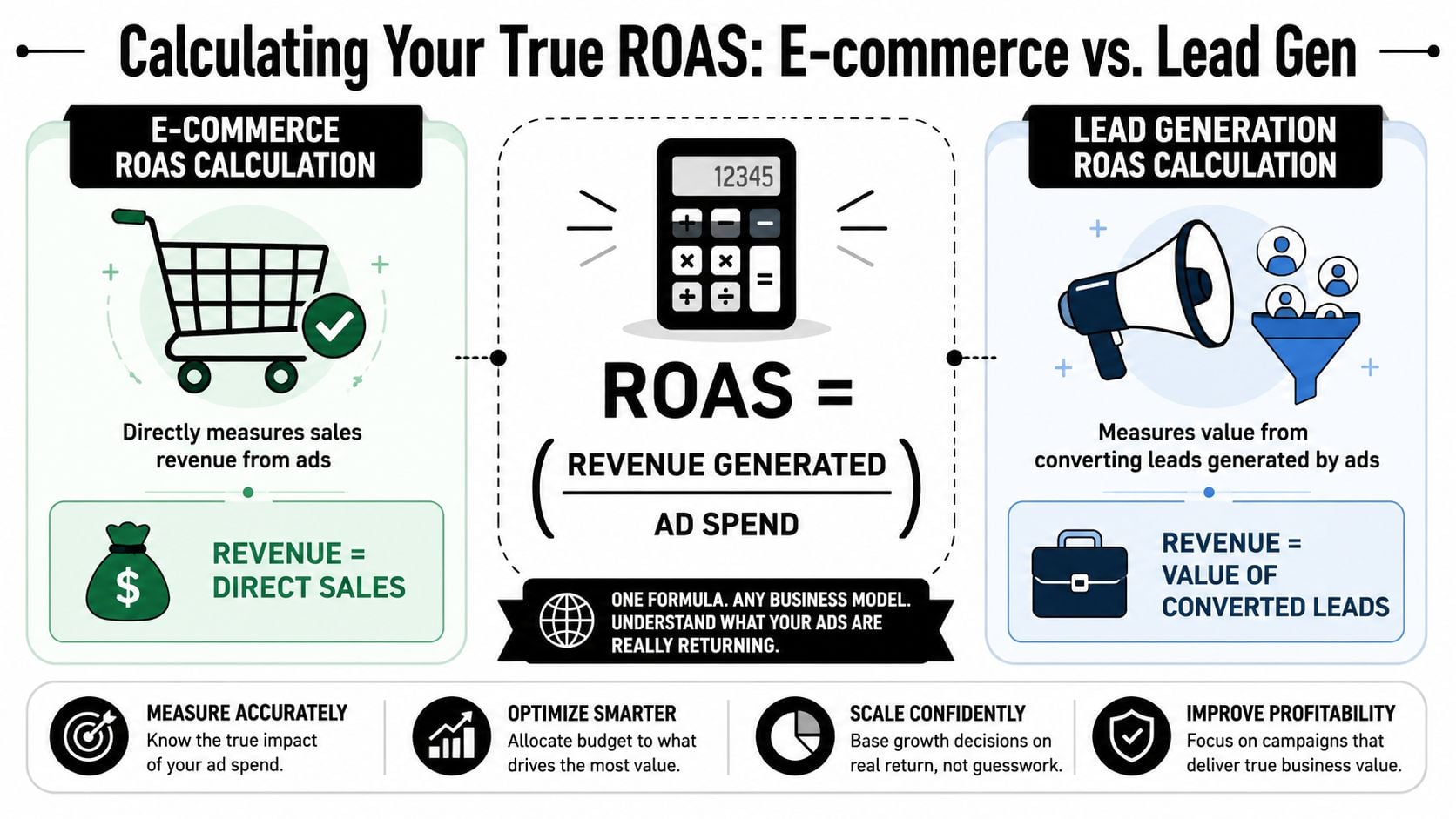
What is return on ad spend? It is revenue generated from ads divided by the cost of those ads. In plain terms, it shows how many dollars of revenue you got back for each dollar spent. GrowthLoop's explanation of ROAS notes that a 4:1 ROAS means every advertising dollar generates four dollars in revenue.
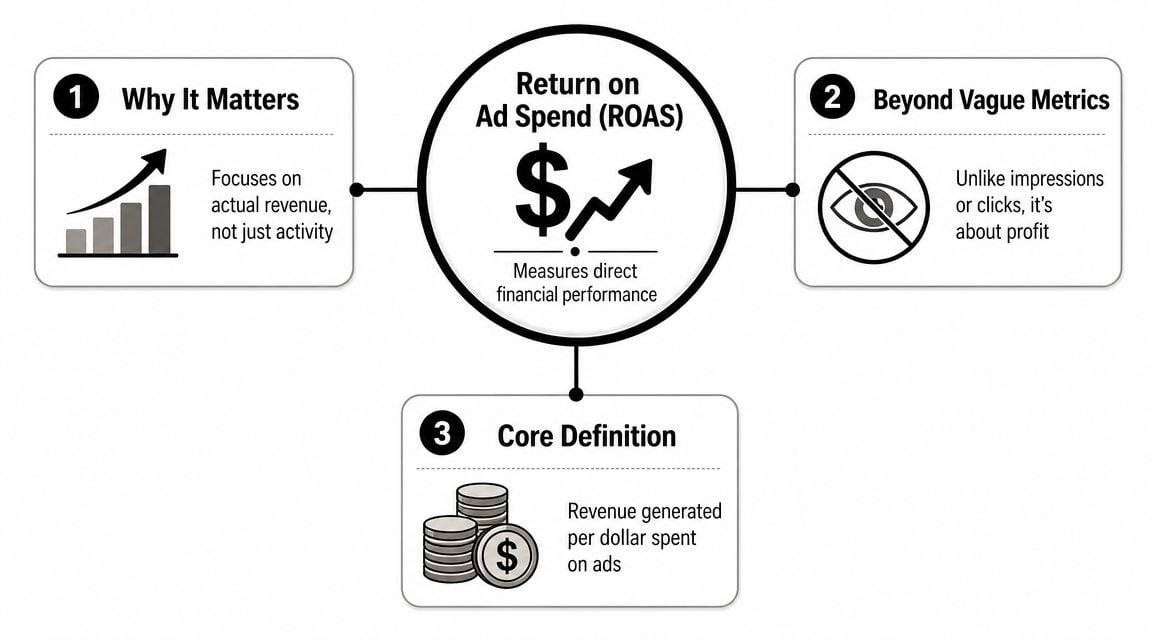
That makes ROAS a useful operating metric because it forces marketing back into business terms. A founder can look at it. A finance lead can look at it. Both can quickly judge whether the campaign is producing enough revenue to earn more budget.
Why ROAS beats click obsession
Clicks show response. ROAS shows revenue efficiency.
That gap matters because clicks are easy to buy with loose targeting, curiosity traffic, and weak offers. Revenue is harder to fake. If a campaign keeps generating attributable purchases, booked jobs, or qualified lead value, something in the offer, audience, and conversion path is working.
Use ROAS to answer the questions that affect budget decisions:
- By channel: Which source produces revenue efficiently enough to keep funding?
- By audience: Which segment buys instead of browsing?
- By creative: Which message attracts buyers, not cheap clicks?
- By offer: Which promotion creates commercial value instead of low-intent traffic?
This is a significant shift. ROAS moves the conversation from "Did people engage?" to "Did this spend create revenue at a level the business can support?"
What ROAS does not tell you
ROAS is a revenue metric. It is not a profit metric.
That distinction matters more than many ad accounts admit. A 4:1 ROAS can be excellent for one business and weak for another. If you sell high-margin digital products, that return may leave plenty of room. If you sell physical products with tight margins, shipping costs, returns, discounts, and fulfillment can wipe out the gain fast. The same logic applies to lead generation. A lead gen campaign can show strong front-end ROAS and still fail if lead quality is poor or close rates are weak.
A clean ROAS number helps you judge ad efficiency. Without margin context, it can still push you into bad decisions.
Treat ROAS as the first filter, not the final verdict. It tells you whether the ad engine is producing enough top-line revenue to deserve attention. The core decision is whether that revenue fits your margin structure and business model. That is where skeptical owners separate useful ad spend from expensive noise.
Calculating Your True ROAS for E-commerce and Lead Gen
You spend $10,000 on ads. The dashboard says revenue came in. The agency calls it a win. If you run an e-commerce brand with slim margins or a lead gen business with weak close rates, that same campaign can still lose money.
That is why “revenue divided by ad spend” is only the starting point. True ROAS depends on how your business gets paid.
E-commerce ROAS
E-commerce gives you the cleaner version of ROAS because revenue usually shows up fast. A customer clicks, buys, and the platform records a sale. That makes reporting easier. It does not make the economics safer.
Start with the basic math:
- Pull revenue attributed to the campaign.
- Pull ad spend for the same period and attribution window.
- Divide revenue by ad spend.
- Compare the result to your break-even ROAS for that product or product category.
That last step is where smart operators separate signal from noise. If your gross margin is healthy, a lower ROAS can still work. If you sell physical products with freight, discounts, payment fees, and returns eating into every order, a “good” ROAS in the ad account can still be a bad business outcome.
Use product-level margin data whenever possible. A blended account-wide ROAS hides too much. Your hero product, clearance product, and first-order offer should not be judged by the same threshold.
Lead generation ROAS
Lead gen needs tighter operational discipline because the click does not create revenue on the same day. It creates a lead, and then your sales process decides whether that lead becomes money.
That changes how you calculate ROAS in practice.
A better process looks like this:
- Track the original source: Know which campaign, ad set, or keyword produced the lead.
- Follow the lead through the pipeline: Measure booked calls, qualified opportunities, closed deals, and revenue.
- Assign value from actual outcomes: Use closed revenue, not assumed lead values pulled from a spreadsheet six months ago.
- Review by cohort: A lead source that looked good last month can fall apart if close rates drop or sales follow-up slips.
If your reporting stops at cost per lead, you are not measuring return on ad spend. You are measuring how cheaply you can create admin work.
Calculate break-even ROAS first
Break-even ROAS is the number that matters because it ties ad performance to margin. It answers a hard business question. How much revenue must this campaign produce before advertising stops being a loss?
WeWork's break-even ROAS explanation shows the logic clearly. If profit margin is 71%, break-even ROAS is 1 / 0.71 = 1.41. That means the campaign must generate at least $1.41 in revenue for every $1 of ad spend just to cover direct costs before overhead.
Use that framework by business model:
| Business model | What to measure | What usually goes wrong |
|---|---|---|
| E-commerce | Attributed sales revenue against product-level margin | Revenue looks strong, but fulfillment, returns, and discounts erase profit |
| Lead gen | Revenue from qualified leads that actually close | Lead volume looks strong, but low-quality leads never turn into customers |
Same formula. Different economics. If you want ROAS to mean anything, calculate it in a way your margin structure can survive.
Putting ROAS in Context with CAC LTV and ROI
A campaign can post strong ROAS and still be a bad bet for the business.
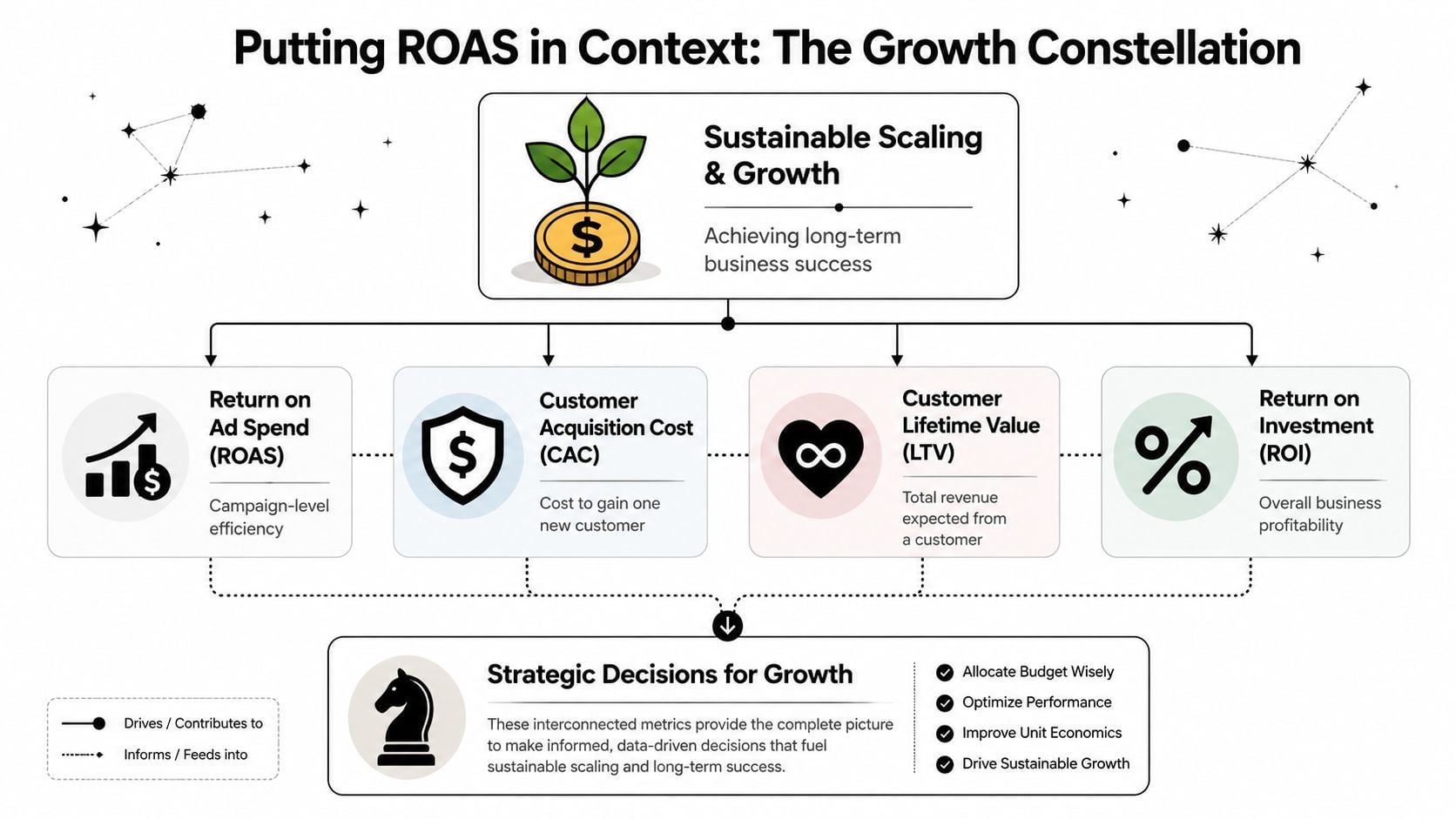
That happens when owners treat ROAS like the final verdict instead of one input. Ad efficiency matters. Customer economics matter more. If the customers coming through paid channels are expensive to close, slow to repay, or unlikely to buy again, a pretty ROAS number will not save the business.
What each metric is really for
Use each metric for a different job.
- ROAS measures how efficiently ad spend produces revenue.
- CAC measures what it costs to acquire one customer.
- LTV measures how much gross profit or revenue that customer generates over time, depending on how you track it.
- ROI measures whether the full investment pays off after broader costs are included.
Mix those up and you will make bad scaling decisions.
An e-commerce brand might hit target ROAS on first purchase and still lose money if repeat rate is weak, return rates are high, or average order value came from heavy discounting. A lead gen company can have acceptable ROAS on paper while sales burns time on junk leads and closes too few deals to justify the spend.
Why context beats benchmarks
Generic ROAS benchmarks are a shortcut for people who do not know their numbers. Ignore them until you understand your own margin structure.
Goodway Group's ROAS benchmark discussion notes that a widely cited benchmark is 2.87:1, while many guides use 4:1 as a common threshold for “good” ROAS. The useful takeaway is not the benchmark itself. What counts as good depends on your margins, payback window, and business model.
That is why skeptical owners should ask two blunt questions before approving more budget: Is this campaign acquiring customers efficiently, and are those customers worth acquiring?
A better way to judge performance
ROAS belongs at the campaign level. CAC and LTV belong at the customer level. ROI belongs at the business level.
That structure matters because each metric can improve while the business gets weaker. A campaign can lower CAC by attracting lower-intent buyers. LTV can look healthy in aggregate while a new channel brings in worse cohorts. ROAS can rise because you pushed an offer that trained customers to wait for discounts.
Here is the practical filter:
- Use ROAS to compare campaigns, creatives, offers, and audiences.
- Use CAC to decide whether paid acquisition is getting more expensive than your model can support.
- Use LTV to judge customer quality, especially for subscriptions, repeat-purchase brands, and long sales cycles.
- Use ROI to decide whether the whole effort improves profit after ad spend, labor, tools, fulfillment, and sales costs.
If ROAS goes up while CAC, LTV, or ROI move in the wrong direction, do not scale. Diagnose the mismatch first.
That is how you keep advertising accountable to revenue, not dashboard optics.
Why Your Reported ROAS Might Be a Vanity Metric
You approve more ad spend because the dashboard says the campaign is producing a strong return. Then cash gets tighter anyway. The usual reasons show up fast. Ecommerce brands eat the loss through returns, discounts, shipping, and fulfillment. Lead generation companies pay for leads that never close, or close so slowly that the reported win means nothing this quarter.
That is how owners get fooled by a clean number.
Reported ROAS is only useful if it matches how your business makes money. If it ignores margin, sales quality, or attribution inflation, it is a vanity metric with better branding.
Three reasons reported ROAS gets inflated
Attribution inflation is the first problem. Ad platforms credit themselves using their own rules, not your P&L. One sale can be claimed by multiple channels, especially when a buyer sees an ad, returns later through search, then converts through branded traffic or direct visits. The dashboard looks efficient. The business may not be.
Missing costs are the second problem. Standard ROAS uses revenue divided by ad spend. That leaves out the expenses that decide whether a sale was worth buying in the first place. For ecommerce, that usually means returns, shipping, discounts, payment fees, and fulfillment. For lead gen, it often means sales payroll, follow-up time, no-show rates, and close rates by source.
Bad inputs are the third problem. Weak CRM hygiene, inconsistent lead stages, delayed revenue reporting, and offline sales that never get matched back to campaigns will distort the number. If the tracking is sloppy, ROAS becomes a polished estimate, not a management metric.
When “good ROAS” is still bad business
HubSpot's glossary on return on ad spend makes a point many businesses ignore. A “good” ROAS can still be unprofitable once returns, shipping, fees, and fulfillment are included, which is why break-even ROAS has to be calculated separately.
That matters because a campaign can look efficient while weakening the company underneath. An ecommerce brand may report a healthy ROAS on a low-margin product line that barely survives discounting and returns. A lead gen firm may celebrate strong ROAS on booked appointments even though too few of those leads become paying customers.
Ask a harder question: what did this campaign produce after all the friction, leakage, and labor were counted?
Questions worth asking your marketing team
If you want to know whether reported ROAS is real or cosmetic, ask these:
- Attribution: What attribution window are we using, and does it match how customers buy?
- Revenue: Are we reporting gross revenue, net revenue, collected revenue, or pipeline value?
- Margin: Have we compared campaign ROAS against break-even ROAS by product, offer, or service line?
- Lead quality: For lead gen, which leads became customers, and what was the close rate by campaign?
- Hidden costs: Which costs are excluded from this report that reduce profit?
Vague answers are a warning sign.
A useful ROAS metric should hold up outside the ad platform. If it only looks good inside the dashboard, it is not helping you make better decisions. It is helping you justify bad ones.
Six Battle-Tested Ways to Increase Your ROAS
You can buy more traffic and still make less money.
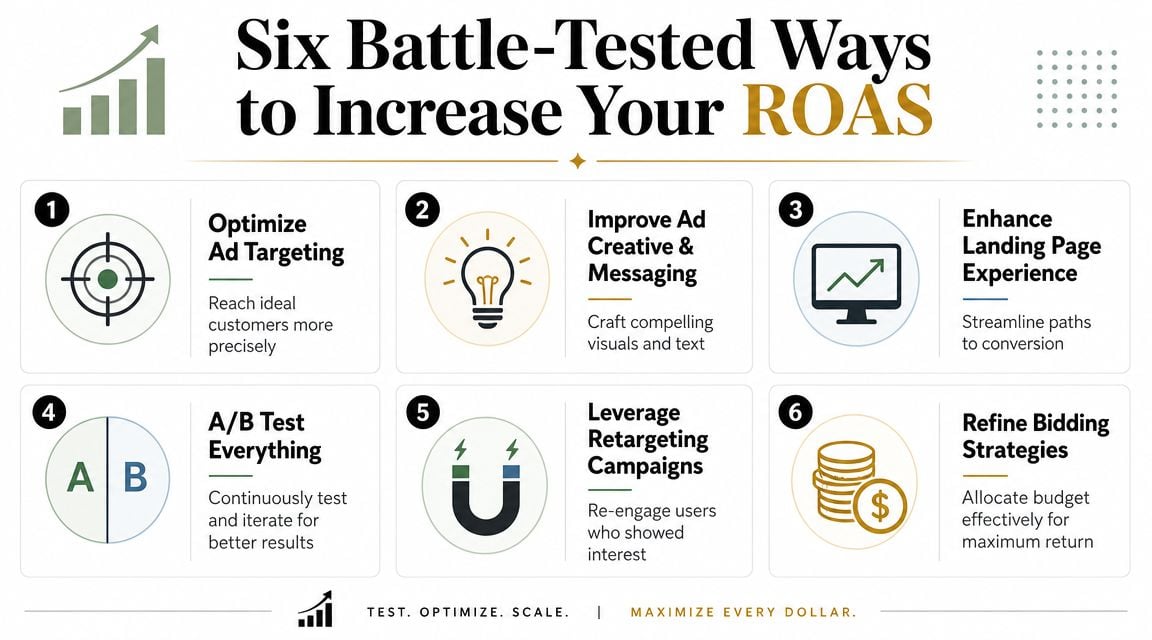
That usually happens when a business treats ROAS like a platform score instead of a management standard. Perion's ROAS definition frames ROAS as a revenue-efficiency metric, and that is the right starting point. The primary task is to improve that efficiency in ways that hold up against margin, close rate, and customer quality.
The six levers that actually move ROAS
- Cut low-intent traffic
Cheap clicks are expensive when they do not buy. Tighten targeting around buying behavior, search intent, offer fit, and exclusions. E-commerce brands should filter out broad audiences that browse but rarely convert. Lead gen teams should stop paying for leads that fill out forms and never answer the phone.
- Pre-qualify with the ad itself
Your ad should attract the right buyer and repel the wrong one. Clear pricing signals, specific outcomes, strong offer framing, and direct language improve lead quality before the click. If click-through rate drops a little but conversion quality rises, that is a win.
- Fix the post-click experience
Good traffic dies on weak pages. Match the landing page to the ad promise, remove distractions, speed up load time, and make the next step obvious. For e-commerce, that means cleaner product pages, stronger merchandising, and less checkout friction. For lead gen, it means fewer form fields, tighter copy, and a reason to act now.
- Raise average order value or lead value
Better ROAS does not always require cheaper acquisition. Sometimes the faster path is making each conversion worth more. E-commerce brands can use bundles, upsells, subscription offers, or threshold-based incentives. Lead gen businesses can improve intake, qualification, and sales process so more leads turn into higher-value customers.
- Retarget by behavior, not by default
One retargeting pool is lazy marketing. Segment people by what they did. Product viewers, cart abandoners, repeat visitors, and qualified lead form starters need different follow-up. The closer the behavior is to purchase intent, the more aggressively you can bid.
- Set budget rules tied to contribution, not hope
Stop increasing spend because a campaign had one strong week. Scale campaigns that stay above your acceptable ROAS after returns, discounts, fulfillment, sales labor, and close-rate reality are accounted for. Cut campaigns that miss the mark. Fix campaigns that are close. That discipline protects margin.
Better ROAS comes from better filtering, better conversion, and better economics.
Where to look first
Use this order. It keeps teams from wasting time on cosmetic tweaks.
| Priority | What to examine | What you're looking for |
|---|---|---|
| First | Traffic quality | Are you paying for buyers or just visitors? |
| Second | Offer and message | Does the ad attract qualified demand? |
| Third | Landing and checkout or form flow | Can the visitor convert without friction? |
| Fourth | Sales and fulfillment feedback | Did those conversions become profitable customers? |
The best improvement usually comes from the weakest link. If your targeting is loose, creative testing will not save you. If your sales team closes poorly, more leads will not rescue ROAS. Fix the bottleneck that sits closest to revenue loss, then measure again.
How to Turn ROAS Insights into a Revenue Engine
Most businesses don't struggle because they've never heard of ROAS. They struggle because they never operationalize it.
They look at the number. They react to it. Then they go back to running ads the same way. That's not a system. That's dashboard watching.
A revenue engine needs three things working together:
- Clean tracking: Revenue has to connect back to the campaign, not stop at the click or lead.
- Decision rules: You need clear standards for when to cut, fix, or scale.
- Operational feedback: Sales outcomes, customer quality, and reputation signals need to feed back into ad decisions.
Without that structure, ROAS remains an interesting metric instead of a management tool.
The businesses that scale more confidently usually do one thing better than everyone else. They close the loop. They connect ad spend to sales behavior, customer experience, and retention quality. That's what turns reporting into action.
If your current setup still treats marketing, sales, and follow-up like separate departments with separate data, you're going to keep getting fragmented answers. And fragmented answers lead to expensive confidence.
ROAS works best when it becomes part of an operating rhythm. Review the number, pressure-test it against margin, compare it by audience and offer, then push the lesson back into creative, landing pages, sales process, and customer follow-up. That's how advertising stops being a recurring expense and starts acting like a predictable growth system.
If you want that system built properly, The Advertising Suite is worth a look. We operate as a growth-focused partner, not a vanity-metric vendor, combining strategy with a built-in CRM and reputation ecosystem so ad decisions tie back to actual revenue. Our membership also includes a 25% discount on services and provides access to the software layer that helps close the loop. If you're done paying for activity and want accountability instead, request a demo, book a growth consult, or explore the membership and see how we can act as an extension of your team.