Most landing page split testing advice is backwards. It obsesses over button colors, traffic splits, and tidy little rules, then leaves founders guessing about the only question that matters, what should you test first to move revenue?
The hard truth is that split testing is not a design hobby. It's a measurement system for deciding whether your page deserves more of your paid traffic, and whether the copy, offer, and form are helping or hurting the bottom line. When a page is already leaking at the top of the funnel, polishing pixels is just expensive procrastination.
Why Split Testing Is a Revenue Engine, Not a Design Exercise
Landing page split testing became a standard CRO method because it compares two versions of a page and measures conversion differences with statistical confidence. That makes it a decision tool, not a decoration contest. If a founder treats it like a quick facelift, the business usually ends up with prettier friction.
The financial reason is simple. Independent benchmark work shows that landing page conversion rates often sit in low single digits, with global averages around 2.35% and median dedicated landing pages around 4.02%, while top-quartile pages can go well above that (benchmark report). In that environment, a small improvement on a page with real traffic can matter more than a complete visual refresh.

Start with a revenue question, not a design opinion
If a test doesn't answer a revenue question, it's probably vanity work. Ask whether the change should improve qualified leads, increase purchase intent, or reduce form abandonment. That framing keeps the team honest when somebody wants to “make it feel cleaner” without proving anything.
A disciplined test program also exposes weak thinking fast. If you're spending time on a page that already performs well while another high-intent step is bleeding conversions, you're optimizing comfort, not growth. That's how teams lose margin while congratulating themselves on tasteful hero images.
Practical rule: Every test should name the business outcome first, then the design change second.
The best teams use split testing to force clarity. They learn which messages attract serious buyers, which forms create friction, and which trust signals help the sale. That's why a test calendar should be tied to pipeline and revenue, not internal preferences.
For a structured way to plan experiments, use the experiment design framework. If the test can't be linked to a measurable business question, don't launch it.
A/B and Multivariate Testing Fundamentals
A/B testing is the right move when you have one clear question and limited traffic. You compare one version against another, isolate the change, and see whether the difference matters. Multivariate testing is for pages with enough volume to handle multiple element combinations without turning the analysis into noise.
Use the four inputs before you launch anything
Every test needs four inputs, and skipping any of them is how teams end up with messy conclusions.
- Variant change. Decide exactly what you're changing, such as headline, CTA, form length, or privacy copy.
- Audience segment. Decide who sees the test, because a paid visitor and an organic visitor don't arrive with the same intent.
- Exposure window. Decide how long the test runs, so weekday and weekend behavior don't distort the read.
- Success metric. Decide what winning means before launch, not after the numbers start moving.
A strong hypothesis is blunt. Use a Because, If, Then structure. Because visitors hesitate when the offer feels vague, if we rewrite the hero headline to name the specific outcome, then qualified conversions should rise. That's much better than “let's try a new headline and see what happens.”
| Choosing Between A/B and Multivariate Testing | A/B Test | Multivariate Test |
|---|---|---|
| Best use case | One clear change | Multiple interacting elements |
| Traffic need | Lower | Higher |
| Decision speed | Faster | Slower |
| Risk | Easier to control | Easier to confuse the read |
| Best for SMBs | Usually yes | Only when traffic and discipline are strong |
Don't make multivariate testing your default
Multivariate testing can be useful when elements interact, but it earns its complexity only when traffic supports it. For most SMBs, the smarter move is to test the highest-variance element first, then move to the next one after learning something real. One-variable-at-a-time rules are neat on paper, but they can hide the fact that your headline and form are working against each other.
The cleanest way to choose is to ask, “What can we learn from this test that will change the next decision?” If the answer is vague, the test is probably too ambitious for your current traffic level. For a broader CRO lens, see the conversion rate optimization guide.
Sample Size, Significance, and Stopping Rules
Most founders want the test to tell them the truth quickly. The problem is that the truth takes traffic, and traffic takes patience. Valid landing page tests often need 100 to 200 conversions per variant, and at a 3% conversion rate that usually means about 3,000 to 6,000 visitors per variant, or 6,000 to 12,000 total visitors, before you can trust the result (practical experimentation guidance).
That's why sample size planning matters. It depends on the baseline conversion rate, the minimum detectable effect, the desired power, and the significance level. One published example says a page converting at 3% may need about 13,000 visitors per variation to detect a 20% relative improvement at standard confidence levels (sample-size example).

Stop peeking and start respecting the math
A lot of bad CRO comes from founders checking results every morning and calling winners too early. That's how false positives get baked into the roadmap. The cleaner approach is fixed-horizon testing, where you wait for the planned sample size and the planned exposure window before drawing a conclusion.
Statistical significance is often set at 95% confidence, which means there's only a 5% chance of seeing a gap that large if both versions are really equal (statistical threshold overview). That's the default for most landing page decisions because it balances caution and practicality. It's also the reason “it looks better after three days” is not a strategy.
A result can be statistically real and commercially useless.
That's the difference between statistical significance and practical significance. A tiny lift that barely changes business outcomes might not justify added friction, developer time, or risk. If the gain won't change revenue in a meaningful way, don't ship it just because the chart turned green.
For a different angle on test design and how complex setups can change the math, use the multivariate testing guide. Then keep your stopping rule simple, written down, and enforced before the test launches.
Tooling, Setup, and Implementation Workflow
The right setup is the one your team can maintain without breaking pages or drowning in admin. You need three things, a way to split traffic, a way to track outcomes, and a way to keep the page stable while the variation loads. Fancy tooling is optional. Reliable execution is not.
Build the stack around your traffic and team size
For some teams, a lightweight setup is enough. For others, a full experimentation platform is worth it because it reduces implementation mistakes and makes analysis easier. What matters is whether the stack supports audiences, event tracking, QA, and clean reporting inside your existing analytics flow.
| Split Testing Tools Compared for SMBs | Best For | Min Traffic | Key Strength |
|---|---|---|---|
| Experiment platform | Teams that want controlled experiments | Moderate to high | Clean traffic allocation and analysis |
| Tag-based redirect setup | Tight budgets and simple page swaps | Lower | Fast deployment with minimal overhead |
| Custom JavaScript toggles | Technical teams with dev support | Varies | Flexible control over page behavior |
| Analytics event-based setup | Teams focused on measurement discipline | Varies | Better visibility into what users do |
A few implementation details deserve respect. Install the test snippet, define the audience, QA every device, and make sure your event tracking fires the same way on both variants. If the page flickers before the variation loads, users notice, and your test gets noisy. Cookie consent state also matters, because a page that behaves differently before and after consent can pollute the read.
Treat privacy copy as a test variable
A lot of teams get lazy here. They assume privacy reassurance always helps, but independent testing summarized by a CRO publication found that adding explicit reassurance like “100% privacy, we will never spam you!” reduced conversions by 18.7% with 96% significance (privacy-copy testing summary). That's a useful correction to the usual “more trust language is always better” reflex.
Use the same tools to test consent banner wording, trust badges, and form microcopy. Sometimes reassurance lowers anxiety. Sometimes it creates another decision at the exact moment you need momentum. The only honest answer is the one your test produces.
The setup checklist often skipped is boring, which is exactly why it matters:
- Consent handling. Make sure the variant works before and after cookie permission.
- Bot filtering. Keep junk traffic out of the test.
- Device QA. Check mobile tap zones, desktop spacing, and layout shifts.
- Event validation. Confirm conversions fire once and only once.
For a broader view of how testing fits into the rest of the stack, use the marketing technology stack overview. The goal is not to collect more tools. The goal is to make the experiment trustworthy.
Metrics That Matter Beyond Conversion Rate
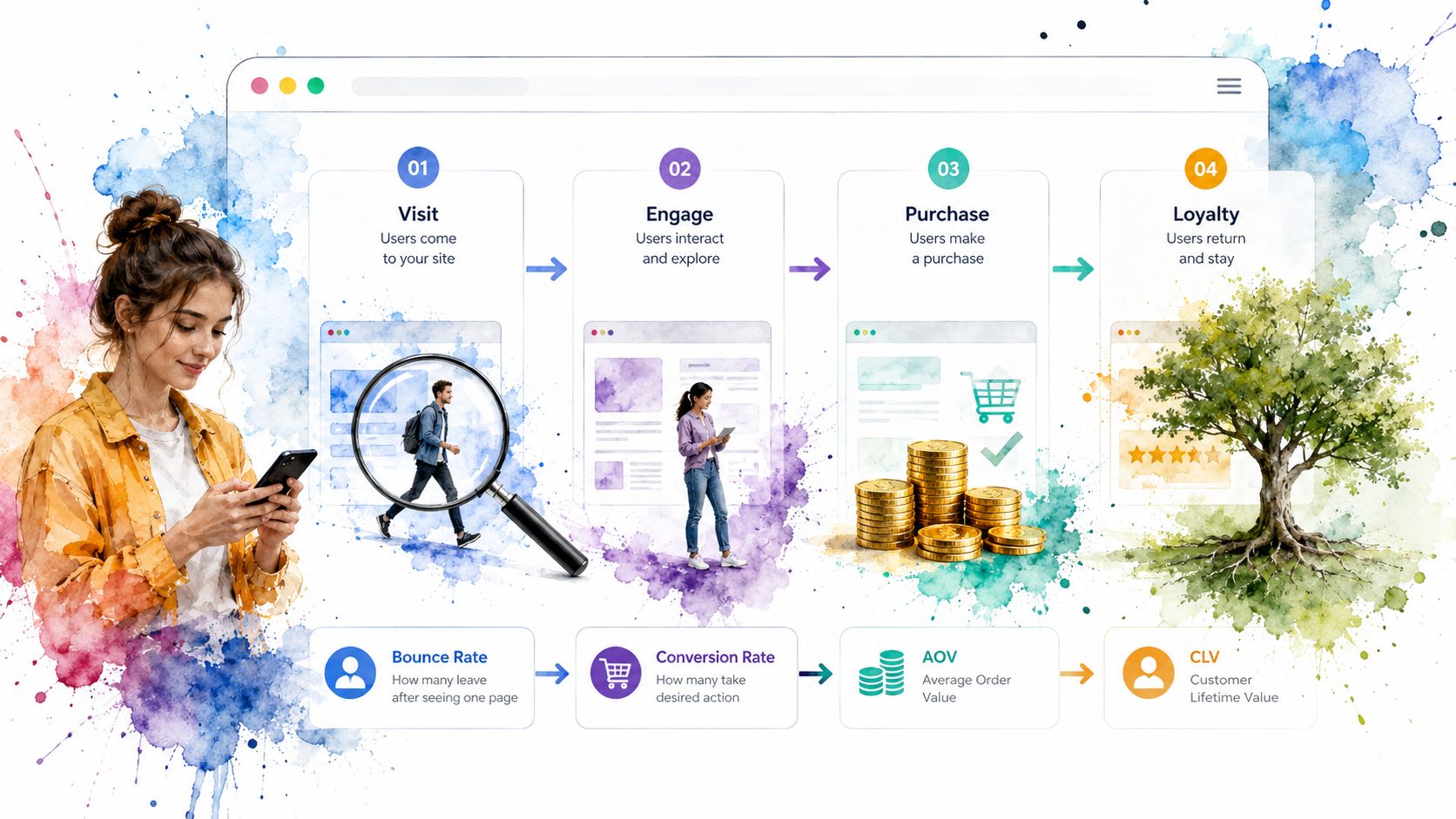
Conversion rate gets the headline, but it shouldn't get the whole story. A page can win on raw conversions and still deliver worse customers, worse orders, or weaker downstream revenue. If you only watch one number, you'll eventually optimize the wrong behavior.
Match the metric to the business model
For ecommerce, the metric mix should include revenue per session, add-to-cart rate, and average order quality. For SaaS, raw signups matter less than trial-to-paid behavior and long-term customer value. For lead gen, a form submission is only useful if sales can work the lead.
| Metric | What It Tells You | Best Fit |
|---|---|---|
| Conversion rate | How many visitors complete the primary action | All models |
| Customer lifetime value | Whether the traffic quality holds up over time | SaaS and recurring revenue |
| Average order value | Whether the offer framing changes purchase size | Ecommerce |
| Bounce rate | Whether the page is losing attention early | All models |
| Scroll depth | How far people engage with the page | Content-heavy pages |
| Micro-conversions | Whether users are moving toward the main action | Low-volume tests |
When conversion volume is low, engagement signals become useful leading indicators. They won't replace the primary metric, but they can tell you whether the new headline is holding attention, whether the form is scaring people off, or whether the offer is getting ignored. That's especially useful when you can't get to significance quickly.
Segment before you celebrate
Blended conversion rate hides useful differences. You need to break results down by traffic source, device, and new versus returning users, because the same page can behave differently across those groups. If a change helps paid traffic but hurts organic, the average can mislead you into shipping the wrong version.
That's also why guardrail metrics matter. They protect the business from a “win” that creates a downstream problem. If the primary metric improves but engagement collapses or lead quality falls, you don't have a clean win. You have a tradeoff that needs a better hypothesis.
For a deeper lens on how top-of-funnel changes affect downstream outcomes, read the incrementality testing perspective. Then define your primary metric, your guardrails, and your segments before you hit launch.
Real-World Examples and a Repeatable CRO Workflow
The best tests look ordinary until they pay off. They target one real point of friction, isolate the change, and leave the team with a lesson worth reusing. That is what a serious experimentation program does, it turns one good test into a better next test.
Three examples that show where the revenue impact hides
A B2B SaaS team tested privacy copy on a page where visitors stalled over data handling. The hypothesis was straightforward, less uncertainty should reduce hesitation. The result was even more practical, the team saw a 12% lift in qualified demo requests after tightening the privacy language. The takeaway is simple, privacy copy is not a checkbox. It should lower fear without creating more reading.
An ecommerce team reframed a set of separate items as a bundle. Buyers understood the offer faster, and average cart value moved up because the value was easier to see. This is the key lesson. Structure affects buying speed.
In lead gen, another team moved testimonials closer to the form and added trust badges near the field set. That shortened the gap between proof and action, which is exactly where many pages lose people. If the form feels risky, fix the trust story first.
Test the thing that makes people hesitate, not the thing that looks easy to redesign.
Run the same workflow every quarter
A repeatable CRO workflow starts with research. Use heatmaps, session recordings, and a friction audit to identify where visitors slow down or drop off. Then prioritize the page element with the highest variance, because traffic is too limited to waste on low-impact tweaks.
Write the hypothesis as a business change, not a design preference. Launch one test at a time. Record the result in a shared repository, and note the segment differences that matter. If you skip that record, the same debate will come back next quarter with different wording and the same bad instincts.
A workable 90-day cadence looks like this:
- Weeks 1 to 2. Audit the highest-traffic page and collect friction signals.
- Weeks 3 to 4. Prioritize one high-variance element and write the hypothesis.
- Weeks 5 to 8. Run the test to the planned sample size.
- Weeks 9 to 10. Review the result, segment it, and document the learning.
- Weeks 11 to 12. Roll the insight into the next test or roadmap item.
Do not just celebrate winners. Keep track of the ideas that lost, the ones that were inconclusive, and the ones that never should have launched. That is how a CRO workflow gets sharper instead of noisier.
Turning Tests Into Predictable Growth
Split testing should sit inside a revenue-first growth partnership, not off to the side as a design utility. The winning tests become playbooks, the losing tests become filters, and the inconclusive ones keep you from wasting more traffic on weak ideas. Over time, that creates a test repository that tells your team what to do next instead of letting opinions fill the gap.
The smarter operating model is simple. Map each test to the funnel stage it affects, then fold the result into your quarterly roadmap. Sales, product, and marketing should all read from the same backlog, because if each group is optimizing a different story, the customer gets the mess.
Stakeholders also need a different briefing style. Don't ask them to judge a variant by taste. Show them the friction point, the hypothesis, the planned sample size, and the business outcome you expect if the change wins. That shifts the conversation from “what do you like?” to “what does the revenue system need?”
Founder directive: Pick the highest-traffic page, identify one real friction point, write one hypothesis, set the sample size, and commit to a four-week sprint.
That single sprint is the beginning of a compounding asset. Each test should make the next one smarter, faster, and more relevant to the buyer. If your team treats experiments like isolated events, you'll keep relearning the same lessons. If you treat them as part of a revenue system, you'll build momentum that lasts quarter after quarter.
If you want a team that treats split testing like a revenue lever, not a cosmetic exercise, The Advertising Suite can help you build the experiment backlog, tighten the funnel, and turn the right page changes into predictable growth. Visit The Advertising Suite to book a Growth Consult and see how our revenue-first framework fits into your team.