The most popular advice on how to reduce CAC is to chase cheaper clicks, tighten targeting, and cut expensive campaigns. That advice can make your dashboard look better while your business gets worse. A lower platform cost per acquisition can raise your true customer acquisition cost when you're paying for people who would've bought anyway or attracting customers who never generate enough margin.
Don't approve a budget cut just because reported CPA falls. Approve the cut and reallocation only when incremental customers and post-purchase contribution both improve. Your job isn't to buy the cheapest customer. It's to acquire customers worth serving, recover your investment within your cash limits, and keep profitable revenue coming back.
Build a CAC Scorecard Before You Cut Spend
Start with the actual levers: fix measurement, remove proven waste, convert more purchased traffic, and grow repeat revenue. Each lever needs a financial measure. Otherwise, someone will celebrate cheaper leads while the sales team spends longer qualifying people who won't buy.
CAC is a management calculation, not an automatically objective number. Your cost rules, customer definition, and conversion window determine whether it helps you make decisions or merely decorates a report.
Build the scorecard around paying customers
Use this sequence before changing budgets:
- Define the qualifying event. Count a new paying customer or completed paid job, not a click, inquiry, or unfulfilled booking. For services, distinguish booked appointments from completed work.
- List acquisition costs. Include media, creative production, acquisition-related sales labor, software allocation, and acquisition onboarding. Keep retention spending separate, and don't count onboarding again in contribution costs.
- Reconcile the records. Match advertising records to CRM contacts, invoices, payments, cancellations, and refunds. Deduplicate customers across channels and locations.
- Match spend to customers. Calculate channel and cohort CAC using the customers that spending produced, including delayed sales.
- Add the economics. Put contribution margin, repeat rate, lifetime value, and payback beside CAC. Use a consistent contribution margin analysis so discounts, fulfillment, and variable service costs don't disappear.
- Set the allocation rule. Move money only when the receiving channel can generate economically viable customers within your cash constraints.
The warning isn't theoretical. MIT Sloan's analysis of 626 publicly traded B2B companies and 4,105 customers, described in the Harvard Business School publication record, associated cost cutting without customer value with the weakest gross margins, while cost reduction combined with high customer value produced the highest margins.
Which CAC number should drive the budget
| CAC type | Formula | Use it to | Trap |
|---|---|---|---|
| Blended | Total acquisition sales and marketing cost / new customers | See the company-level cost | Hides one bad channel inside a healthy average |
| Channel | Channel acquisition cost / customers matched to that channel | Compare search, social, and other sources | Last-touch over-credits the final click |
| Marginal | Next dollar of spend / extra customers that dollar adds | Decide whether to scale | Assumes efficiency holds despite saturation and rising auction prices |
| Incremental | Incremental acquisition cost / customers caused by the ads | Cut or scale with causal evidence | Reported CPA includes people who would convert anyway |
| Payback | CAC / monthly contribution margin per customer | Protect cash by estimating months to recovery | Ignores value after the payback window |
| Cohort | Spend matched to a cohort / customers in that cohort | Judge customer quality over time | Breaks if conversions are delayed or refunded |
Payback is a time measure, not another dollar-denominated CAC. Keep it on the same scorecard because an affordable customer on paper can still take too long to fund.
For a hypothetical business, $30,000 / 150 new paying customers = $200 blended CAC. Say a channel accounts for $12,000 / 80 customers = $150 channel CAC, but only 20 return to buy again. Its acquisition spend per repeat customer is $600, a quality diagnostic rather than a replacement for CAC.
The headline looks attractive. Whether the channel deserves more money still rests on what those customers contribute.
How to Measure Incremental CAC
A platform can accurately record an interaction without proving that the interaction caused a sale. Last-touch attribution is particularly weak as a budget authority: it assigns credit to the final touch, not necessarily the activity that created demand.
That's how a seemingly cheap channel can consume demand another campaign generated. Cut the demand creator, expand the demand catcher, and you may acquire fewer new customers.
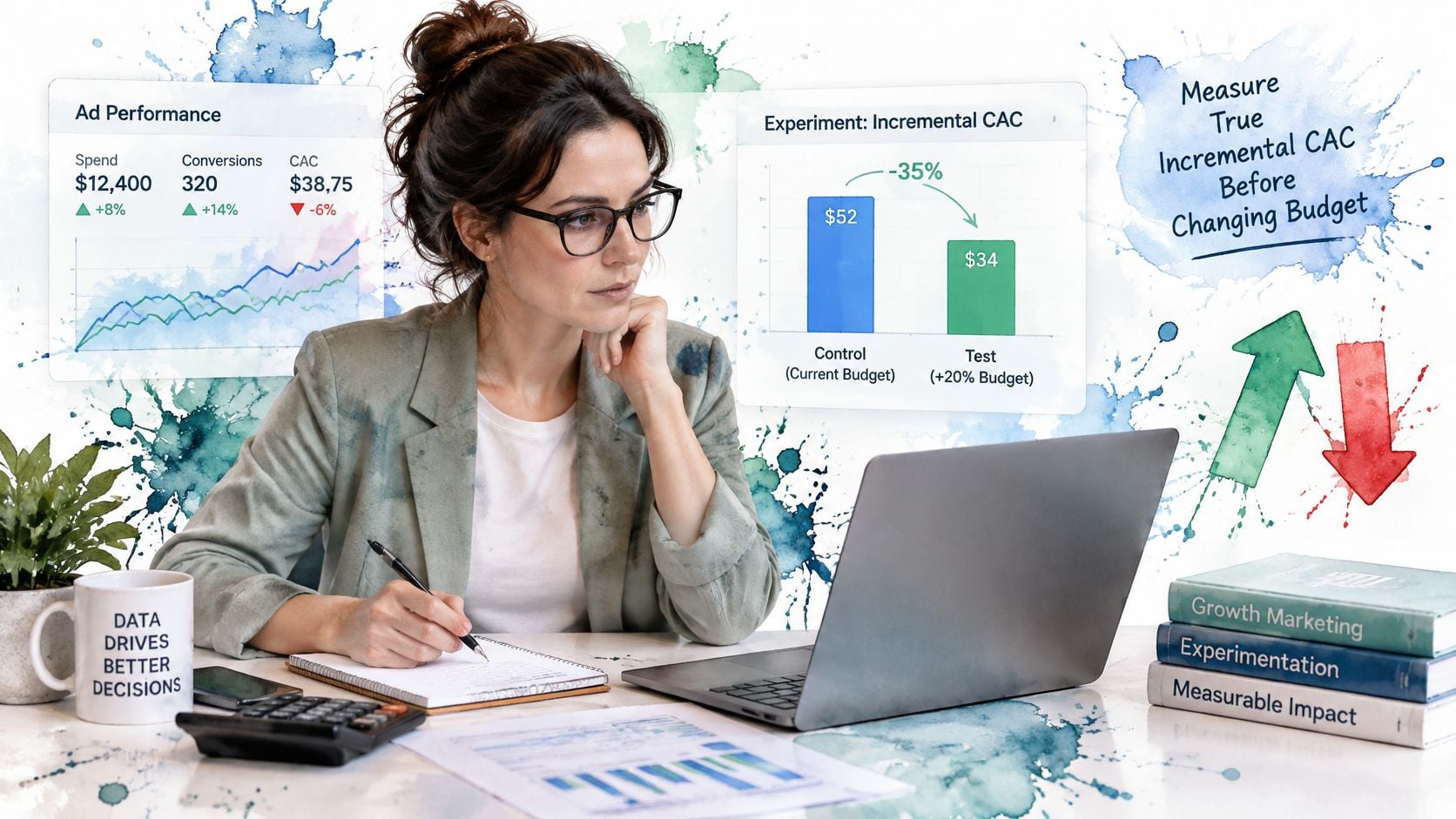
Run a holdout before moving meaningful budget
Use a controlled experiment, not a comparison of unrelated reporting periods. The Journal of Accountancy's guidance on optimizing marketing and sales supports using experiments to distinguish advertising's causal contribution from attributed activity.
- Choose the primary outcome. Use incremental paying customers, contribution revenue, or incremental CAC. Record new-customer profit as a financial guardrail rather than treating attributed conversions as the finish line.
- Randomize eligible groups. Assign users, geographic areas, or suitable time blocks to treatment and holdout. Treatment receives the advertising intervention; holdout doesn't.
- Keep conditions comparable. Hold the offer, eligibility rules, measurement window, and operating conditions steady. Don't compare a fully staffed service territory with one that can't answer calls.
- Estimate incremental customers. Subtract expected control conversions from treatment conversions, adjusting for group size and the experimental design.
- Calculate incremental CAC. Divide the incremental acquisition cost of the intervention by the incremental customers it generated. Include the relevant creative and sales costs, not just media.
- Apply the stopping rule. Decide the test duration, sample requirements, and decision criteria before results arrive. Scale only when the finding is statistically credible and financially worthwhile.
For a smaller business, geographically separated areas can offer a practical starting point. Choose comparable territories, check historical customer patterns, and prevent campaigns from spilling into the holdout.
In 2025, Google announced incrementality experiments supporting a minimum budget of $5,000 using Bayesian methodology, according to PPC Land's measurement coverage. That's a platform-specific capability, not a guarantee that your business has enough customer volume for a decisive test.
Set a financial stop rule, not a dashboard target
Before launch, define the longest acceptable payback from available cash and the contribution required to justify the investment. A practical incrementality-testing process should also specify who can authorize a change when the result is uncertain.
Avoid tiny holdouts and repeated checking for a favorable result. Both can produce false winners. Separate overlapping audiences where possible; when overlap can't be removed, test the combined channel intervention rather than pretending each channel operates alone.
Delayed conversions need a mature reporting window. Keep modeled outcomes distinguishable from reconciled sales, and don't compare a fully matured control period with incomplete treatment results.
Budget rule: A lower reported CPA isn't permission to cut. The cut and reallocation must improve incremental customer acquisition and post-purchase contribution together.
Pause a channel that looks strong on reported return when incremental contribution is thin or negative after media, creative, sales, onboarding, and fulfillment. If incremental acquisitions aren't positive, don't manufacture a useful-looking CAC ratio. Treat the experiment as a failure to establish profitable acquisition.
Tighten Audiences Creatives and Bids
Hunting cheaper clicks is a weak response to rising media prices. A 2026 benchmark of 2025 advertising reports average Meta ad prices rising 9%, impressions rising 12%, and Google Ads CPA rising 12.35%, according to Adwave's small-business advertising review.
Those figures set context for your account, not a target. Rising auction prices punish weak customer economics faster than any bargain placement can rescue them.

Fix audience inputs before expanding reach
Build acquisition audiences from consented first-party customer records, not an undifferentiated pile of leads. Clean duplicate contacts, remove refunded transactions, and distinguish profitable buyers from discount-only purchasers before creating modeled audiences. That last split decides whether a lower platform CPA produces better customers or pushes true CAC higher.
Use high-lifetime-value seeds only when the underlying value measure is credible. A large invoice means little if delivery, servicing, or refund costs consume the margin.
For prospecting, apply clear audience rules:
- Exclude customers already acquired. Route existing customers into separately measured retention campaigns instead of paying to label them new.
- Separate open opportunities. Keep active sales prospects out of general prospecting where feasible, and measure any nurture advertising against its actual purpose.
- Use context when identity is limited. Match placements and messages to the problem being solved rather than forcing unreliable person-level targeting.
Privacy calls for consent-aware collection, reliable customer records, and a clearer distinction between observed outcomes and inferred credit.
Cheap reach and profitable reach are different purchases.
Make creative qualify the buyer
Test a single meaningful variable at a time: the hook, offer, or proof. Keep the destination and audience stable enough to interpret the result.
A local service advertisement should make its service area, eligibility, and reason to book clear. An ecommerce advertisement should establish product fit and relevant purchase conditions. Hiding the information buyers need may increase clicks while creating expensive disappointment later.
Reject a creative winner that produces cheaper traffic but fewer qualified buyers. Check completed jobs, collected revenue, refunds, and cohort contribution before promoting it. A winner earns more budget when the customers it adds contribute more after purchase, not when the click costs less.
Say an HVAC campaign attracts homeowners who want maintenance and return for service, while another attracts inquiries outside the service area. The second ad doesn't deserve more budget because its form submissions cost less. A clinic and an online store face the same decision, even though their conversion events differ.
Give bidding systems an outcome worth pursuing
Move toward cost or value targets only after the account has a dependable stream of real conversion outcomes. An arbitrary numerical threshold that ignores the platform's requirements and your sales cycle buys cheap actions, and cheap actions alone raise true CAC.
Send reconciled CRM outcomes back through lawful, consent-aware integrations. Where supported, use contribution-based values; otherwise, use a clearly defined revenue proxy and retain margin checks outside the bidding system.
Keep the decision criteria concrete:
- Customer quality: Qualified-to-paid conversion and refund behavior remain acceptable.
- Financial quality: Marginal acquisition cost fits the contribution available to recover it.
- Operational quality: Your team can fulfill the additional demand without degrading service.
An algorithm trained on cheap form fills will seek cheap form fills. Give it a better objective, or accept the customers it delivers.
Repair Checkout Leaks That Raise CAC
You don't need more traffic to diagnose a payment page that loses ready buyers. Start with the friction customers encounter after you've already paid to reach them.
Post-click leaks that inflate CAC
| Leak | Who leaves | Change that recovers them | Source |
|---|---|---|---|
| Cart never becomes an order | 70.19% average cart abandonment | Treat checkout fixes as CAC work | Baymard's checkout usability benchmark |
| Extra shipping, tax, or fees | 48% of surveyed U.S. shoppers cited this reason | Show the full price before payment | Baymard's checkout UX statistics |
| Forced account creation | 24% of surveyed U.S. shoppers cited this reason | Offer guest checkout | Baymard's checkout UX statistics |
| Slow delivery | 22% of surveyed U.S. shoppers cited this reason | State a real delivery or arrival window up front | Baymard's checkout UX statistics |
| Card-trust doubts | 18% of surveyed U.S. shoppers cited this reason | Show payment security and a clear return path | Baymard's checkout UX statistics |
| Checkout too long or complicated | 17% of U.S. online shoppers cited this reason | Cut unnecessary default form elements | Baymard's checkout usability benchmark |
Baymard's checkout usability benchmark reports the table's 70.19% average cart abandonment and 17% complexity-related abandonment, an average U.S. checkout displaying 23.48 form elements versus an ideal flow requiring 12 to 14, and a potential conversion improvement of 35.26% for large ecommerce sites that fix checkout design. The remaining abandonment shares come from Baymard's checkout UX statistics.
Treat these reasons as a priority list for investigation, since abandoning shoppers cite several of them at once and the shares overlap. Then measure your own completed purchases, because your baseline decides which fix pays back first.
Fix price surprises before polishing the page
Reveal shipping charges, taxes, and mandatory fees as early as they can be calculated accurately. If an exact total requires an address, explain that before asking for payment details.
For local services, disclose the call-out fee and explain what an estimate includes. A prospect who finishes a long form and then meets a charge your advertisement avoided mentioning is a buyer you paid for twice: once for the click, once for the lost trust.
Judge price disclosure on completed sales and contribution. Checkout starts can climb while paid orders stay flat.
More informed customers are preferable to more surprised ones.
Remove unnecessary work and establish trust
Offer guest checkout and postpone optional account creation until after purchase. Remove fields that don't affect fulfillment, payment, or a genuine legal requirement. Splitting the same questions across more steps keeps the work and adds page loads.
State a delivery window you can meet. Show the payment methods available, an accessible returns policy, and working contact information. Decorative badges do none of that work.
Apply the same logic to service booking:
- Shorten the request. Ask only for the information needed to route and qualify the job.
- Clarify the commitment. Tell people whether they're requesting a quote, reserving an appointment, or paying for a visit.
- Confirm the handoff. Record the assigned owner, booking status, and completed paid job in the CRM.
A practical cart-abandonment reduction process ties each change to the purchase outcome. For services, compare form starts with booked appointments and completed work, since a cheap lead source can conceal a broken handoff and still report a lower CPA.
Fix a documented conversion leak before commissioning another round of creative to send more people into it.
Keep acquisition spending stable enough to judge the change. If more new customers complete profitable purchases from the same acquisition investment, true CAC fell. That is the only cut that counts: incremental buyers up, contribution per buyer up. A lower platform CPA pointing at the same leak does neither.
Use Retention to Shrink Effective CAC
Stop making every growth target depend on another newly acquired customer. You've already funded the first sale. The next job is to make that relationship valuable enough to continue.
A 2014 Harvard Business Review analysis reported that acquiring a customer can cost 5 to 25 times more than retaining one, with the ratio varying by industry, business model, and study; it also cited research associated with Frederick Reichheld and Bain & Company showing that a 5-percentage-point retention increase can raise profits by 25% to 95%, depending on the industry. Treat those findings as a reason to investigate avoidable churn, not a promise for your business.

Separate acquisition cost from the value it earns
Retention doesn't retroactively reduce historical CAC. It improves the contribution earned from that acquisition investment and reduces the pressure to replace lost revenue.
Keep first-order economics distinct from blended acquisition CAC across channels. Then evaluate cumulative contribution for each acquisition cohort rather than dividing acquisition spend by repeat orders and calling the result a new CAC.
Run these cohort checks:
- Repeat-purchase rate: Customers who buy again divided by customers in the eligible cohort. Compare cohorts at the same age.
- Days between orders: Use actual reorder behavior to time follow-up, excluding customers who haven't had a realistic chance to return.
- Churn: Define what departure means for the business, whether cancellation, nonrenewal, or inactivity beyond a justified purchase window.
- Contribution after fulfillment: Subtract discounts, refunds, product or service delivery costs, and relevant variable support costs from cohort revenue.
For irregular services, don't force every customer into a subscription-style churn measure. Track repeat work, referrals, and profitable relationship value over an appropriate observation period.
Build follow-up around the next useful action
An ecommerce business can send a replenishment reminder before the customer's typical reorder gap. Service businesses can confirm the next appropriate appointment, provide care or maintenance instructions, and make referrals easy without pressuring customers into unnecessary work.
For HVAC, legal, and medical providers, the follow-up must fit the service and applicable professional obligations. A repeat appointment isn't the right outcome for every legal matter; a clear closeout, genuine feedback, or appropriate referral may be.
Review requests need the same discipline. The FTC's Consumer Reviews and Testimonials Rule, effective October 21, 2024, prohibits fake reviews and incentives conditioned on positive or negative sentiment, among other deceptive practices.
Ask for honest feedback after completed service. Don't script praise, buy star ratings, or suppress criticism through threats. A review system should help you identify service failures, not conceal them.
Use customer lifetime value improvements to set a defensible acquisition ceiling based on contribution you can reasonably expect. Don't fund current spending with imaginary repeat purchases.
Cash constraint: If a cohort takes longer to repay acquisition spending than your business can finance, fix onboarding and follow-up before increasing media.
Assign an owner to unresolved customer issues, missed follow-ups, and failed renewals. Retention becomes an operating discipline when someone is accountable for the next customer action, not just the next campaign send.
Decide When to Add a Growth Partner
Keep the work in-house when your team can reconcile the scorecard, run credible experiments, ship conversion fixes, and act on cohort economics. Complicated advertising alone is a weak reason to buy help.
Bring in a growth-focused partner when these problems exist together:
- Conflicting acquisition signals: Channel CAC and incremental CAC point to different budget decisions, and nobody can explain the gap.
- Broken sales handoffs: Leads stall between the advertisement, the response, and the completed paid job.
- Missing revenue ownership: Marketing reports inquiries, sales reports activity, and finance cannot reliably match either to collected revenue.
Treat those as coordination and execution problems that another reporting dashboard will not solve. Use a structured digital marketing agency selection process to test whether a prospective partner can own the work.
Require an operating plan before a contract
Ask the partner to walk through an actual account's cost definitions, customer matching, conversion delays, and contribution calculations. They should separate a measurement problem from a sales-capacity problem before recommending more media. Be direct about the standard: a lower platform CPA only counts when incremental customers and post-purchase contribution both improve.
A useful engagement should produce:
- Named responsibility: Someone owns each handoff from inquiry to paid outcome.
- Financial decision rules: Budget changes require evidence of incremental customers and contribution; engagement metrics alone cannot justify them.
- Usable infrastructure: The CRM and review-management system support the operating process and avoid becoming abandoned subscriptions.
An internal hire, a specialist consultant, or a growth-tech hybrid can each be appropriate. Choose based on the capability gap. A growth-tech hybrid such as The Advertising Suite combines human-led advertising strategy with built-in CRM and review-management software.
Bring your scorecard to the first conversation. Ask what the partner would stop, what they would test, and what evidence would change their recommendation. If the answer protects spend before it protects contribution, keep looking.
Visit The Advertising Suite to book a growth consult or request a demo, and bring an account's CAC scorecard so we can examine acquisition, follow-up, and customer contribution together. Explore the Membership if integrated CRM access and coordinated execution address your operating gaps. Work with us as an extension of your team, accountable for profitable growth and visible revenue outcomes.