Bad advertising advice usually fails in the same way. It hands small businesses a list of channels before it answers the only question that matters: what turns ad spend into revenue?
If your ads have produced clicks, likes, and very little cash, the problem usually is not effort. The problem is structure. Too many campaigns start with traffic, skip tracking, and hope sales appear later. That burns budget fast, especially for local service businesses and owner-led teams that cannot afford waste.
The fix is a system. Choose channels based on buyer intent, local demand, sales cycle, and margin. Then connect each tactic to a landing page, a follow-up process, a CRM, and a clear revenue target. That is how you stop buying activity and start buying outcomes.
At The Advertising Suite, we use a Growth-Tech Hybrid model because isolated tactics underperform. Search ads capture demand. Retargeting recovers warm prospects. CRM tracking shows which leads turn into booked jobs and closed deals. Landing pages, email follow-up, reviews, and local visibility all support the same goal: profitable customer acquisition.
That is the frame for this list.
These 10 advertisement ideas for small business owners are not random tips. Each one earns its place based on budget control, targeting precision, speed to launch, and ability to tie spend back to real revenue.
1. Performance-Based Google Search Ads with Conversion Tracking
Google Search Ads work when you stop treating them like a visibility play and start treating them like a demand-capture machine. If someone is actively searching for your service, your job isn't to get cute. It's to show up with the right offer, on the right keyword, with tracking in place before the first dollar goes out the door.
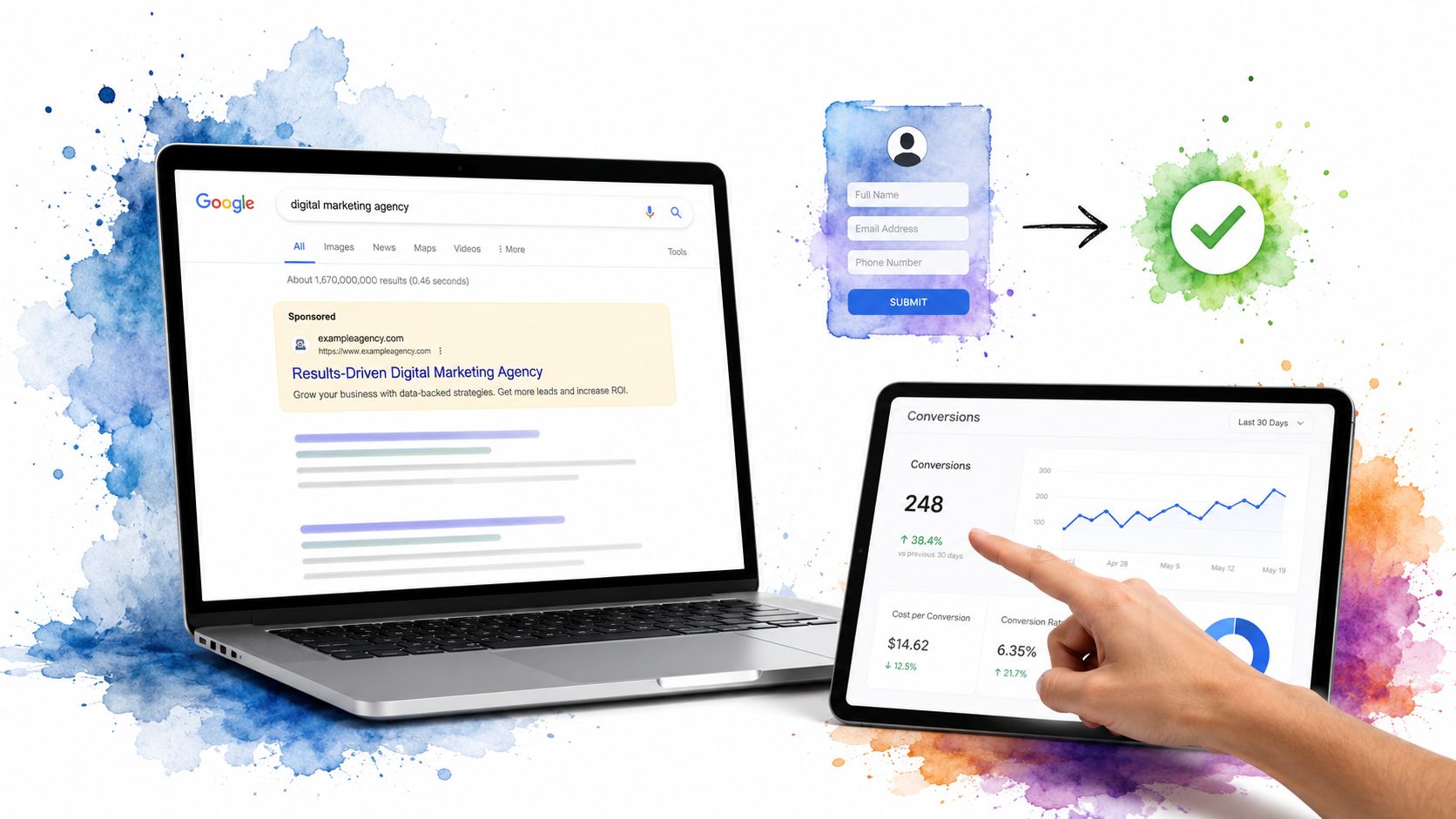
A local roofer, estate attorney, or med spa doesn't need broad awareness first. They need to intercept buyers with intent. That's why local demand businesses should prioritize Google Search Ads and Google Business Profile, and keep keyword targeting narrow with exact and phrase match on a focused list of 5 to 15 high-intent keywords, as noted in the SBA's local marketing guidance.
Set this up like you expect accountability
Don't launch on clicks alone. Connect Google Ads with Google Analytics, set up conversion tracking, and build a negative keyword list so irrelevant searches don't eat your budget. That practical setup matters more than fancy ad copy because constrained budgets don't forgive sloppy targeting.
- Track leads first: Count calls, forms, booked appointments, and purchases. If you can't measure a result, you can't optimize it.
- Keep keywords tight: Use a small set of high-intent terms tied to your actual offer.
- Block junk traffic: Add negative keywords early and keep refining them.
Practical rule: If your search campaign isn't tied to a real conversion event, you don't have an advertising strategy. You have an invoice.
SUNY Empire's marketing guidance also points to the advanced layer most small businesses skip: analytics setup, customer segmentation, predictive analytics, automation, and machine-learning optimization. That's where search campaigns stop being a guessing game and start becoming a controllable acquisition channel.
2. Meta Retargeting for Warm Traffic
Stop paying to meet the same prospect like it's the first time.
If someone visited your site, watched your video, or clicked through to a product page and didn't buy, they already raised a hand. Meta retargeting gives you a cheaper, smarter way to bring them back and finish the sale. For small businesses, that's one of the few ad plays that can improve results fast without inflating spend.
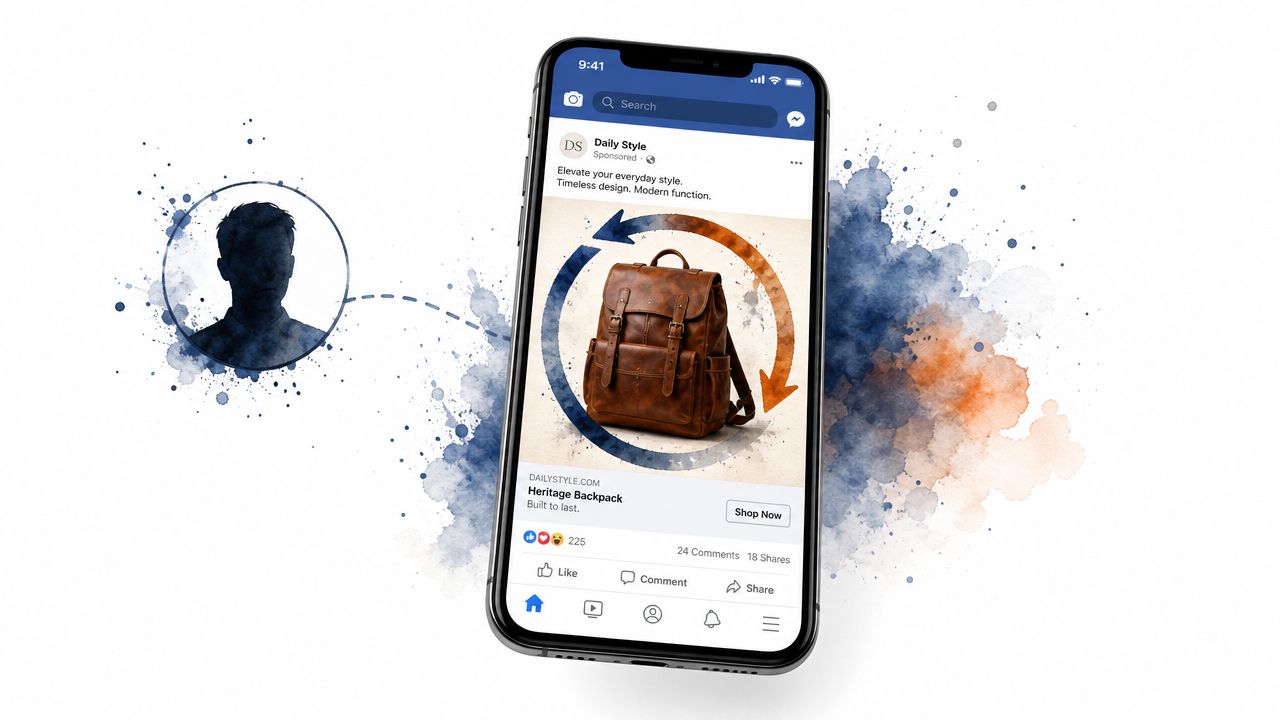
A boutique furniture shop should retarget people who viewed dining tables but never requested a quote. A cosmetic clinic should follow up with visitors who landed on injectables pages and left without booking. A B2B consultant should stay in front of pricing-page visitors who disappeared after showing clear buying interest. Same channel. Different buying signals. Different message.
What to show warm audiences
Retargeting should match the objection, not repeat the first ad. If they viewed a service page, remind them what they looked at. If they stalled near checkout or booking, show proof that lowers risk and makes the next step feel obvious.
- Use proof: Show reviews, before-and-after visuals, case outcomes, or a specific result.
- Use relevance: Match the ad to the exact product, service, or page they viewed.
- Use a real reason to act: Limited availability, a deadline, or a timely offer works. Fake urgency kills trust.
This works best inside a connected system, not as a random add-on. Organic content, search traffic, direct visits, and referral traffic all create warm audiences. Retargeting then turns that attention into booked calls, quote requests, purchases, and return visits. That is the Growth-Tech Hybrid approach in practice. One channel creates demand. Another channel captures it. Retargeting closes gaps that would otherwise waste paid and earned traffic.
Focus on converting existing traffic before chasing more reach. A second impression aimed at the right person usually beats a first impression aimed at a stranger.
3. CRM-Integrated Advertising That Tracks Real Revenue
Lead volume can fool you fast.
If your ad reporting stops at form fills, you are making budget decisions with half the picture. Small businesses do not need more leads. They need more closed jobs, booked appointments, signed retainers, and repeat customers. A CRM connection gives you that view.
A home services company might run search ads for high-intent demand and paid social for offer testing. Both can produce leads. But if only one channel turns into booked estimates and paid work, that channel should get the budget. The same rule applies to law firms, clinics, franchises, and multi-location businesses. Track the lead source, sales outcome, follow-up status, and revenue in one system, or you will keep rewarding cheap conversions that never turn into cash.
What a connected setup changes
The Growth-Tech Hybrid model at The Advertising Suite ties ad data, CRM activity, and reputation signals into one operating system. That changes how decisions get made.
- Sales gets context: Reps can see the ad, offer, keyword, or audience that produced the lead.
- Marketing gets revenue feedback: Campaigns are judged by qualified opportunities and closed business, not vanity metrics.
- Leadership gets budget clarity: Weak channels stand out fast, and profitable campaigns earn more spend.
That matters even more now because attribution is less clean than it used to be. Smart advertisers respond by tightening conversion tracking, connecting ad platforms to CRM outcomes, and testing offers based on revenue feedback, as explained in QuickBooks' guidance on small-business advertising and measurement.
Measure what happens after the click. Track calls, appointments, deal stage movement, close rates, average sale value, and follow-up quality. Perfect attribution is rare. Revenue-linked attribution still beats guessing.
4. Local Google Business Profile Optimization
A lot of small businesses chase ads while neglecting the thing buyers check before they ever call. That's your Google Business Profile.
For local service businesses, this profile often acts like your real homepage. People search, scan reviews, check hours, look at photos, and decide whether you're worth contacting. If your profile is neglected, your ads have to work harder to overcome that trust gap.
A dentist, HVAC company, or auto shop should treat profile optimization like revenue infrastructure. Complete the service categories. Add current photos. Keep hours accurate. Answer questions. Make sure the phone number and website are right. Then pair it with review generation and local intent ads.
Local intent wins over broad reach
The shift in modern SMB advertising is simple. Choose channels based on buyer intent and geography, not hype. Tightly geographic businesses, especially those operating in a radius under 10 miles, often get better results from local print, direct mail, and Google Business Profile than broad digital campaigns. That's a strong reminder that local demand doesn't always need flashy scale. It needs relevance.
- Own your listing: Fill out every core profile field that affects trust and discoverability.
- Use local proof: Add photos of your actual team, work, and location.
- Support with ads: Run search campaigns that match local service intent, not generic awareness terms.
When founders ask for advertisement ideas for small business, this is one of the least glamorous and most profitable answers. Buyers looking for a nearby provider don't need a brand story. They need confidence that you can solve the problem fast.
5. Landing Pages Built to Convert, Not Just Exist
Sending paid traffic to your homepage is lazy. It forces the visitor to do the sorting, and most won't bother.
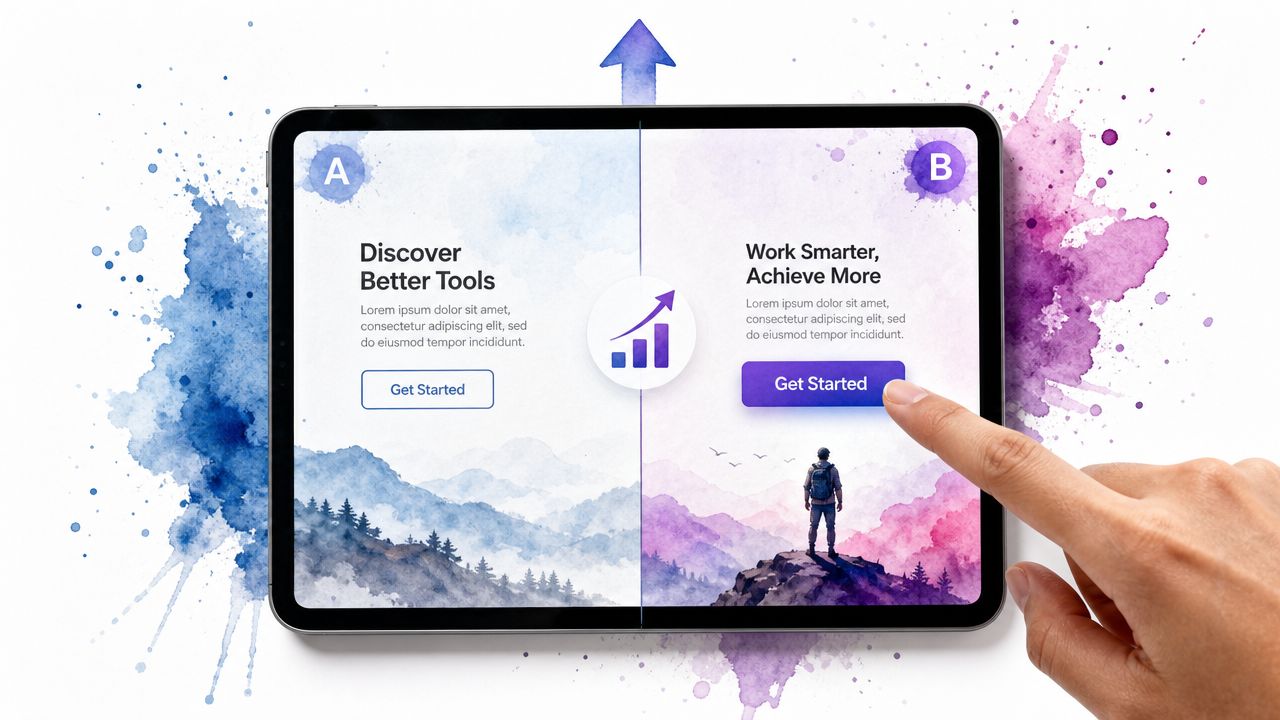
A landing page should match the ad, remove friction, and make the next step obvious. If you're advertising emergency plumbing, don't dump people on a general services page. If you're advertising med spa consultations, don't send them to a homepage slider from three years ago. Build a page for the offer.
What good landing pages do
They don't try to say everything. They try to get one action.
- Match the promise: The headline should reflect the ad people clicked.
- Remove drag: Ask only for the information you need to move the sale forward.
- Show trust fast: Use reviews, service guarantees, photos, or proof of work near the call to action.
A law firm landing page might focus on one practice area and one consultation action. A contractor page might focus on one service and one service area. An ecommerce landing page might focus on one collection with one buying angle. Different business models, same rule. Relevance converts better than clutter.
Good ads don't rescue weak pages. Good ads expose weak pages.
This is why CRO belongs inside your advertising strategy. You don't scale spend into a leaky funnel. You fix the leaks first.
6. Email Sequences That Follow Up Like a Sales Pro
Most small businesses don't have a traffic problem. They have a follow-up problem.
Some leads aren't ready on day one. Some buyers abandon carts. Some past customers would buy again if anyone bothered to ask at the right time. Email handles all three. It's one of the most durable advertisement ideas for small business growth because it keeps turning paid attention into repeat opportunities.
A salon can follow up with no-show prevention, rebooking reminders, and review requests. A B2B firm can send a short lead nurture sequence after a consultation request. An online store can recover abandoned carts, promote related products, and bring back previous buyers.
Use sequences, not random blasts
Random newsletters don't build revenue. Triggered sequences do.
- Welcome new leads: Send a clear introduction, your best proof, and the next step.
- Recover missed conversions: Follow up after cart abandonment, quote requests, or partial bookings.
- Reactivate customers: Reach out after the service window or repurchase cycle passes.
The reason this matters now is measurement discipline. In a privacy-constrained environment, marketers are leaning harder on first-party data, testing, and systems they control. Your email list and CRM records are part of that control. You own them. Platforms don't.
At The Advertising Suite, this is why the tech stack matters. When email, pipeline status, ad source, and review follow-up live in one ecosystem, teams stop improvising and start compounding.
7. Content Marketing That Pulls In High-Intent Demand
Good content is an asset. Bad content is a blog graveyard.
If you want organic traffic that helps revenue, write for buyer intent. Not for random topic volume. A family law practice should answer the questions real clients search before hiring counsel. A pest control company should create local service pages and practical articles tied to urgent homeowner problems. A product brand should publish buying guides that help shoppers choose.
Content should support paid media too
The best content strategy doesn't sit off in a separate corner. It feeds the whole system.
- Answer sales questions: Turn common objections into articles, videos, and FAQ-style resources.
- Build retargeting pools: Use content to attract visitors you can later retarget with paid offers.
- Support search intent: Create pages around services, locations, and decision-stage questions.
A strong article can rank, build trust, and act as a warm-up touch before a retargeting ad or email sequence. That's how you stop treating content as a branding side project and start using it as a conversion asset.
One more thing. Organic social still has value here. If you're posting consistently, you're not just staying visible. You're testing messages, gathering audience signals, and feeding paid social with ideas that already got traction.
8. Review Generation and Reputation Management
If you're in a trust-sensitive category, reviews are part of the ad.
That includes home services, legal, healthcare, beauty, fitness, franchises, and local retail. People don't just click your ad and convert in a vacuum. They check whether other customers had a good experience, whether you reply to complaints, and whether your business looks alive or neglected.
The SBA recommends managing search listings, registering in local directories, and following up with customers to generate testimonials. That's basic, and it works. A steady review system does two jobs at once. It improves local visibility and improves conversion when people compare options.
Build a review engine, not a one-time push
Review collection shouldn't depend on memory. Build it into your process.
- Ask after a good experience: Service completion, successful delivery, or positive support interaction are your best windows.
- Make it easy: Use direct links and simple instructions.
- Respond to everything: Thank happy customers and handle complaints without getting defensive.
A two-location dental practice can automate review requests after appointments. A remodeling company can trigger them after project milestones. A franchise brand can centralize monitoring so no location drops the ball. This is exactly why review management software matters. It protects conversion across the funnel, not just reputation in isolation.
Buyers trust the pattern, not the promise. A polished ad can't beat a messy review profile for long.
9. Local Partnerships and Community-Based Advertising
Not every good ad lives on a screen.
If your business depends on a tight service radius, local partnerships, direct mail, and print can outperform broad digital campaigns. That's especially true when customers buy based on proximity, familiarity, and immediate need. A neighborhood gym, pediatric clinic, florist, or contractor can get more traction from the right local presence than from chasing cold traffic outside the buying zone.
A good example is a business that serves a defined local radius. Pair a targeted Google Business Profile presence with local print placement, referral partnerships, and direct mail in the neighborhoods you serve. That's not old-school. That's efficient.
How to make offline channels pay off
Offline works when it's specific and trackable enough to judge.
- Choose complementary partners: Think realtor plus cleaner, dentist plus orthodontist, gym plus physical therapist.
- Tie to a clear offer: Use one service, one audience, one next step.
- Track response paths: Use unique calls to action, dedicated landing pages, or location-specific messaging.
This is the part many founders miss. Local advertising isn't about being everywhere. It's about being obvious in the places where your best buyers already pay attention.
10. Paid Social for Creative Testing and Offer Validation
Paid social gets abused because businesses expect it to work like search. It doesn't.
Search captures demand that's already active. Paid social often creates or accelerates interest. That means your creative, offer, audience, and follow-up matter more. If you run Facebook, Instagram, LinkedIn, or TikTok ads with weak positioning, you'll get what most founders get from social ads. Noise.
The right use case is different. A visual product brand can test product angles on Instagram and Facebook. A B2B company can test thought-leadership hooks and lead magnets on LinkedIn. A service business can use paid social to stay in front of local prospects until they're ready to book.
Stop boosting and start testing
The platform matters less than the structure behind it.
- Test the offer first: Discount, consultation, free estimate, bundle, or new customer incentive.
- Test creative angles: Proof, pain point, urgency, transformation, and comparison all speak differently to buyers.
- Segment by intent: Cold audiences need education. Warm audiences need proof. Hot audiences need a reason to act.
Visual products should prioritize Instagram and Facebook. That's a practical recommendation because those channels fit discovery and product presentation well. But don't confuse visibility with profitability. Your social ads need tracking, retargeting, and a destination page built for action.
At this point, skeptical founders usually relax a little. Not because social suddenly became magic, but because it finally has a job beyond "get our name out there."
10-Point Ad Strategy Comparison
A 10-item list does not need a bloated comparison chart full of agency jargon. It needs a decision tool.
Use this as a practical scorecard. The goal is simple: pick the right starting point, then connect it to the rest of your revenue system. That is the Growth-Tech Hybrid approach in plain English. Every tactic earns its place by driving leads, improving conversion, tightening follow-up, or proving revenue.
| Strategy | Difficulty to implement | What it needs | What you should expect | Best fit | Why it earns budget |
|---|---|---|---|---|---|
| Performance-Based Google Search Ads with Conversion Tracking | Medium | Monthly ad spend, search campaign setup, call and form tracking, time to collect conversion data | Qualified leads faster than most channels, with clear proof of what terms drive revenue | Local services, professional services, e-commerce, SaaS with active demand | Captures buyers already looking. Easy to tie spend to calls, forms, and sales when tracking is set up correctly |
| Meta Retargeting for Warm Traffic | Medium | Ad creative, audience setup, tracking, enough site traffic to retarget | Better conversion rates from people who already know you, with lower wasted spend than cold traffic campaigns | E-commerce brands, service businesses, and any company getting steady site traffic | Brings back visitors who did not act the first time. Strong support channel for search, content, and email |
| CRM-Integrated Advertising That Tracks Real Revenue | High | Clean CRM data, campaign tracking, attribution rules, sales team follow-through | Clear view of lead quality, closed revenue by source, and where budget should move next | Businesses with longer sales cycles, multiple channels, or high-value deals | Stops you from judging campaigns by cheap leads. Shows which campaigns produce actual customers |
| Local Google Business Profile Optimization | Low to Medium | Updated profile, service details, photos, review process, regular management | More visibility in local searches, stronger trust, and more calls from nearby buyers | Local businesses, multi-location brands, appointment-based services | Often one of the highest-return local plays because it improves discovery and conversion at the same time |
| Landing Pages Built to Convert, Not Just Exist | Medium to High | Clear offer, strong copy, trust signals, fast load speed, testing process | Higher conversion rate from the traffic you already pay for or earn | Any business sending traffic to a generic homepage or weak service page | Traffic is expensive. Better pages make every click worth more |
| Email Sequences That Follow Up Like a Sales Pro | Low to Medium | Email platform, lead segmentation, offers, follow-up logic, clean list management | More booked calls, more repeat purchases, and fewer leads going cold | Businesses with inbound leads, quote requests, abandoned carts, or long consideration cycles | Good follow-up prints money. It also protects ad spend by giving every lead more chances to convert |
| Content Marketing That Pulls In High-Intent Demand | Medium | Editorial plan, subject expertise, search-focused topics, consistent publishing | Slower start, then compounding inbound traffic and better lead quality over time | Service businesses, B2B companies, and brands selling considered purchases | Builds demand you do not have to rent every month. Also improves performance in search and retargeting |
| Review Generation and Reputation Management | Low to Medium | Ask process, response workflow, owner oversight, steady collection of fresh reviews | Higher trust, better local visibility, and stronger conversion on every channel | Local businesses, healthcare, home services, legal, hospitality | Prospects check reviews before they call. Strong ratings make all your other advertising work harder |
| Local Partnerships and Community-Based Advertising | Medium | Outreach, offer alignment, referral tracking, shared promotion plan | Lower-cost exposure, referred leads, and trust borrowed from established local relationships | Brick-and-mortar businesses, local service companies, event-based brands | Cuts through ad fatigue. Works best when you track partner-driven leads instead of calling it brand awareness |
| Paid Social for Creative Testing and Offer Validation | Medium | Creative production, audience segmentation, clear offer, landing page, tracking | Fast feedback on offers and messaging, plus scalable traffic if the economics work | E-commerce, local services, B2B with strong hooks, brands testing new positioning | Useful for testing what gets attention and what gets action. It should inform your wider ad system, not run in a silo |
A founder reading this should see the pattern fast. Search captures intent. Retargeting and email recover missed demand. Landing pages and reviews raise conversion. CRM tracking tells you what produced revenue. Content and partnerships lower dependence on paid traffic over time.
That is the point. These are not random ad ideas. They are connected growth assets, and the businesses that win treat them that way.
From Ideas to Integrated Growth Your Next Step
A few ads can get you leads. A connected system gets you revenue you can predict.
That distinction matters. Search traffic means little if the landing page leaks conversions. Retargeting does not rescue a weak offer. Email follow-up will not fix a slow team or a messy CRM. Reviews build trust, but only if you have a repeatable process that asks for them, tracks them, and responds to them. Real growth comes from connecting these parts so each one makes the next one perform better.
That is how The Advertising Suite operates. We build around the full revenue path: acquisition, conversion, follow-up, and reputation. The Growth-Tech Hybrid model ties strategy to the systems that carry it out. Without that connection, campaigns drift, leads get mishandled, and ad spend starts funding avoidable mistakes.
For scale-ready SMBs, the cost of fragmentation rises fast. Bad tracking turns into wasted budget. A weak handoff between marketing and sales turns into missed pipeline. Ignored reviews lower close rates across every channel. Founders who care about revenue build around three things: buyer intent, accurate measurement, and fast follow-through.
Our approach aligns Google, Meta, landing pages, CRM workflows, and reputation management around one goal. More qualified revenue. Less guesswork. Clear accountability across the whole system.
The tech matters because execution breaks without it. The Ad Suite Membership includes our proprietary CRM and review management software, plus a 25% discount on all services. Your advertising and customer experience start working together instead of pulling in different directions. Lead sources are visible. Review requests go out after the job is done. Cold prospects get timely follow-up instead of sitting untouched in the database.
Proof still matters. More than 10,000 satisfied customers have used this methodology to replace guesswork with a more predictable growth model. That track record matters because it reflects real businesses under real revenue pressure, not theory dressed up as strategy.
If you want growth, stop collecting tactics. Build the system.
The fastest way to turn these ideas into a working revenue engine is to book a Growth Consult with The Advertising Suite. If you want the software layer too, explore the Membership for access to the proprietary CRM, automated review management, and a 25% discount on services. We work like part of your team because that is what serious growth demands.