Most small business ad advice is bad because it starts with platforms instead of profit.
You've heard the usual script. Be everywhere. Post constantly. Boost a few posts. Run search ads, social ads, display ads, retargeting, maybe video too. If the dashboard looks busy, call it progress. Meanwhile, the phone isn't ringing enough, sales follow-up is sloppy, and nobody can tell which dollars turned into customers.
That isn't an advertising strategy for small business. It's expensive activity.
The better approach is blunt. Ads should be judged by revenue created, not attention rented. Clicks don't pay payroll. Impressions don't fix cash flow. Even leads can lie if they never close. If your ad spend isn't connected to pipeline, sales conversion, and customer value, you're not running marketing. You're buying hope.
Founders who've been burned by agencies usually have the same complaint. They got reports full of reach, traffic, engagement, and jargon, but no clear answer to one basic question: did the campaign make money? If your current setup can't answer that, start over with a system that can. A useful starting point is understanding how to calculate marketing ROI before you buy another click.
Stop Wasting Money on Ads That Don't Drive Revenue
The myth that hurts small businesses most is “get your name out there.”
Brand visibility matters. But visibility without conversion infrastructure is leakage. If people notice you and then hit a weak landing page, a slow response time, or a broken follow-up process, you paid to create demand for your own inefficiency.
What usually goes wrong
Small businesses rarely fail because they picked the “wrong” ad platform first. They fail because they:
- Buy attention without a sales path. The ad gets traffic, but there's no clear next step.
- Celebrate cheap leads. Low-cost inquiries look good until the sales team can't close them.
- Ignore lead handling. A prospect submits a form, then waits too long for a response.
- Treat marketing and customer experience as separate. They aren't. The handoff determines whether ad spend becomes revenue.
Practical rule: If you can't trace a campaign from click to closed revenue, you're not measuring performance. You're measuring motion.
The standard playbook wastes cash
The “be everywhere” advice sounds impressive because it spreads effort across channels. In reality, it usually spreads a small budget too thin to learn anything useful. A founder ends up funding multiple mediocre tests while none of them get enough focus to prove profitability.
A serious advertising strategy for small business starts with one hard standard. Every dollar must earn the right to stay in market. That means financial guardrails first, channel focus second, creative discipline third, and a conversion system behind all of it.
That's the only way ads stop feeling like gambling.
Your Revenue-First Foundation Before You Spend a Dollar
Set your revenue target first. Then decide what ad budget your business can justify.
Small businesses get into trouble when they open an ad account before they know the math. A platform will spend every dollar you allow. It will not tell you whether your margins, close rate, follow-up speed, and customer value can support that spend. That job is yours. Or better, it should be handled by a system built to connect spend to revenue, which is exactly how The Advertising Suite approaches growth. Ads are only one part of the engine. The CRM, lead handling, and reputation layer decide whether those clicks turn into cash.

The U.S. Small Business Administration recommends that many businesses allocate a portion of gross revenue to marketing, often cited in the 7 to 8 percent range for firms under growth pressure. That benchmark is useful as a starting point, not a permission slip to spend blindly. Your real budget should come from unit economics.
Build your budget from the outcome you need
Start with four numbers:
- Average sale value
- Lead-to-customer close rate
- Gross margin
- Customer lifetime value
Those inputs tell you how much you can afford to pay for a lead and still make money.
For example, if a new customer is worth $3,000 in lifetime revenue and your close rate is 20%, every qualified lead carries an expected revenue value of $600 before costs. If your margins and operating model only support a $150 acquisition cost, then any campaign producing leads above that threshold is a bad buy, no matter how pretty the click-through rate looks.
That is the standard. Revenue first. Platform metrics second.
Define the audience before you fund the campaign
A budget without audience clarity gets burned fast. If you are still targeting broad age ranges, vague interests, or a service area that is too wide to support profitable delivery, fix that before launch. Use a sharper buyer persona process and tie each persona to a specific offer, margin profile, and likely close rate.
One audience can produce volume while another produces revenue. Those are not the same thing.
The Advertising Suite builds this into execution from day one. The ad strategy, CRM pipeline, and follow-up logic are connected, so you are not judging campaign quality by form fills alone. You are judging it by whether the right prospects move through the pipeline and become customers.
Track the three numbers that actually decide performance
Ignore vanity dashboards. Your operating scorecard needs three core metrics:
Cost per Lead
What you pay to generate a real inquiry from the right buyer.Close Rate
The percentage of those leads that become customers.Customer Lifetime Value
The total revenue a customer produces over the relationship, not just the first sale.
These three numbers tell you whether ad spend works. Clicks, impressions, reach, and engagement can help diagnose problems, but they do not prove profitability.
Cheap leads are expensive when your team cannot close them.
A revenue-first business also needs clean attribution. That means every lead source, follow-up attempt, appointment, sale, and repeat purchase must be tracked inside one operating system. The Advertising Suite's Growth-Tech Hybrid model solves that problem by connecting campaign data to CRM activity and reputation signals, so spend is judged on revenue produced, not surface-level activity.
KPIs That Drive Revenue vs. Vanity Metrics
| Revenue KPI (What Matters) | Vanity Metric (What Doesn't) | Why It's Different |
|---|---|---|
| Cost per Lead | Clicks | Clicks show interest. Cost per Lead shows what it costs to create a sales opportunity. |
| Close Rate | Traffic | Traffic measures visits. Close Rate shows whether leads turn into customers. |
| Customer Lifetime Value | Impressions | Impressions show exposure. Lifetime Value shows the revenue potential of a customer relationship. |
| Revenue by source | Engagement | Engagement can signal attention, but it does not prove economic return. |
| Qualified lead quality | Reach | Reach says how many people saw you. Qualification says whether the right people responded. |
Set hard financial rules before launch
Use clear guardrails:
- Set a maximum acceptable Cost per Lead from your margins and close rate.
- Define a qualified lead in writing before any campaign goes live.
- Require source tracking through the CRM so every opportunity can be tied back to spend.
- Review lead response time because slow follow-up destroys good campaigns.
- Include sales and finance in performance reviews so reporting stays tied to revenue.
Disciplined advertisers differentiate themselves from busy ones. If your ads are not connected to conversion systems, follow-up workflows, and customer value tracking, you do not have a marketing strategy. You have media spend.
Choosing Your Battlegrounds for Maximum Impact
Small businesses do not lose on ads because they lack options. They lose because they spread limited budget across too many channels, collect weak data, and then call the result a strategy.
That approach burns cash fast.
The right move is simpler. Pick the battleground that matches buyer intent, connect it to a system that tracks lead quality and follow-up, and force every dollar to justify itself in revenue. That is the point of The Advertising Suite's Growth-Tech Hybrid model. Ads create demand. The integrated CRM and Reputation Management system turns that demand into booked jobs, closed deals, repeat buyers, and measurable return.
Why broad channel testing hurts more than it helps
A small budget cannot support five experiments at once. You do not get diversification. You get noise.

If you split spend across search, social, local placements, retargeting, and a few impulse tests, each channel gets too little budget, too little data, and too little operational focus. Then the actual problem starts. Your team cannot tell whether the issue is targeting, follow-up speed, offer quality, close rate, or channel fit.
Focus fixes that.
If you want a wider presence later, earn it after one channel proves it can produce profitable customers inside The Advertising Suite's tracking and follow-up system. If you are tempted to launch everywhere at once, read this omnichannel marketing strategy guide for revenue-focused growth.
Pick your first channel by intent, not popularity
The first question is not, “Where can we get attention?”
It is, “Where does our buyer show buying intent clearly enough to justify spend?”
Use this lens:
| Business type | Best opening battleground | Why it tends to work |
|---|---|---|
| Service-based local business | Search-driven local demand | Buyers are often looking for help now and ready to contact someone. |
| E-commerce brand | Product discovery or high-intent product search | The right choice depends on whether demand already exists or needs to be created. |
| B2B provider | Intent-rich search or tightly targeted demand generation | Revenue comes from qualified conversations, not broad awareness. |
This choice gets sharper when your ad channel connects directly to The Advertising Suite CRM. You can see which source produced qualified leads, which ones got contacted fast, which ones booked, and which ones turned into revenue. Without that loop, channel selection turns into opinion.
What the smart first move looks like
Local service business
Start where urgency already exists. A homeowner with an immediate problem is not waiting to be charmed by a clever brand campaign. They want a provider now. Put budget into high-intent local demand, route every lead into the CRM, and use automated follow-up so good leads do not rot in an inbox.
E-commerce brand
Choose one path first. If shoppers already know the product category, capture existing demand. If the product needs explanation, education, or stronger visual selling, use a discovery channel with a clear offer and tight audience. Running both from day one usually creates muddy attribution and weak learning.
B2B service
Skip broad awareness unless you have the budget, sales team, and long sales cycle discipline to support it. Start with channels that surface active problems and serious buyers. Then use The Advertising Suite's CRM to track lead stage movement, sales response, and deal creation, not just form fills.
Your first channel is a testing ground for revenue efficiency.
The rule that saves budget
Stay concentrated until one channel consistently brings in customers at an acceptable cost and your backend system proves those customers are real revenue, not empty leads.
Once that happens, expand carefully. Add the next battleground with the same standard. Tracking first. Follow-up in place. Reputation protected. Revenue visible.
Anything else is media spend pretending to be growth.
Designing Ad Creative and Offers That Convert
Most ads fail before the click. The message is weak, the offer is generic, or the creative tries to be clever instead of clear.
Your ad isn't there to entertain the market. It has one job. Get the right person to take the next profitable step.
Write to pain, urgency, and outcome
Good ad copy doesn't recite features. It names the problem, sharpens the consequence, and offers a direct path forward.
Use this simple creative brief every time:
Audience
Who is this ad for, specifically?Problem
What frustration are they trying to solve?Desired outcome
What result do they want?Offer
What are you giving them that feels worth acting on now?Single action
What should they do next?
If your team struggles to turn that into persuasive messaging, study a few strong ad copy examples and notice the pattern. Clear problem. Clear promise. Clear action.
Use the rule of three in the message
People remember grouped benefits better than a rambling list. Keep the promise tight.
For a local service business, that might look like:
- Fast response
- Clear pricing
- Reliable follow-through
For an e-commerce offer, it might be:
- Solves a specific frustration
- Easy to use
- Worth buying now
That's enough. You don't need twelve selling points. You need the right three.
If the buyer has to work to understand the offer, the ad is already losing.
Match the landing page to the ad
A click is a continuation of a conversation. If the ad promises one thing and the landing page says something else, conversion drops because trust breaks.
Your landing page should do four things well:
Repeat the core promise immediately
The headline should confirm the visitor landed in the right place.Show proof or credibility
Use direct evidence, process clarity, or customer reassurance.Reduce friction
Short forms, clean layout, one obvious action.Keep one CTA
Don't ask visitors to book, call, subscribe, browse, and compare all at once.
Two examples that outperform “brand awareness” fluff
HVAC-style local offer
Weak version: “Trusted service for your home comfort needs.”
Better version: “Get fast help for heating and cooling issues with clear scheduling and a simple next step.”
Why it works: it speaks to urgency and certainty, not vague professionalism.
E-commerce offer
Weak version: “Premium quality you'll love.”
Better version: “Solve one clear problem with one clear product, then make checkout easy.”
Why it works: the buyer understands the benefit and the next action immediately.
Creative discipline beats creative ego
Founders often approve ads based on taste. That's a mistake. The market doesn't care which version sounds smarter in a meeting. It responds to relevance, clarity, and timing.
Test different hooks. Test different offers. Test different landing page angles. But don't test random ideas. Test structured variations against the same commercial goal.
If the ad gets attention but not action, rewrite it. If the landing page gets visits but not leads, rebuild it. Creative should be measured by conversion quality, not by how proud the team feels after launch.
The Tech Advantage That Closes the Loop on Ad Spend
Ads do not fail in the ad account. They fail in the gap between the click and the sale.
That gap is where small businesses burn budget, then blame targeting, creative, or platform choice. Usually, the problem is simpler. No system tracks the lead, no one follows up with discipline, and no one can tie the original campaign to actual revenue. The Advertising Suite fixes that with a Growth-Tech Hybrid model built to connect marketing, sales activity, and customer value in one place.
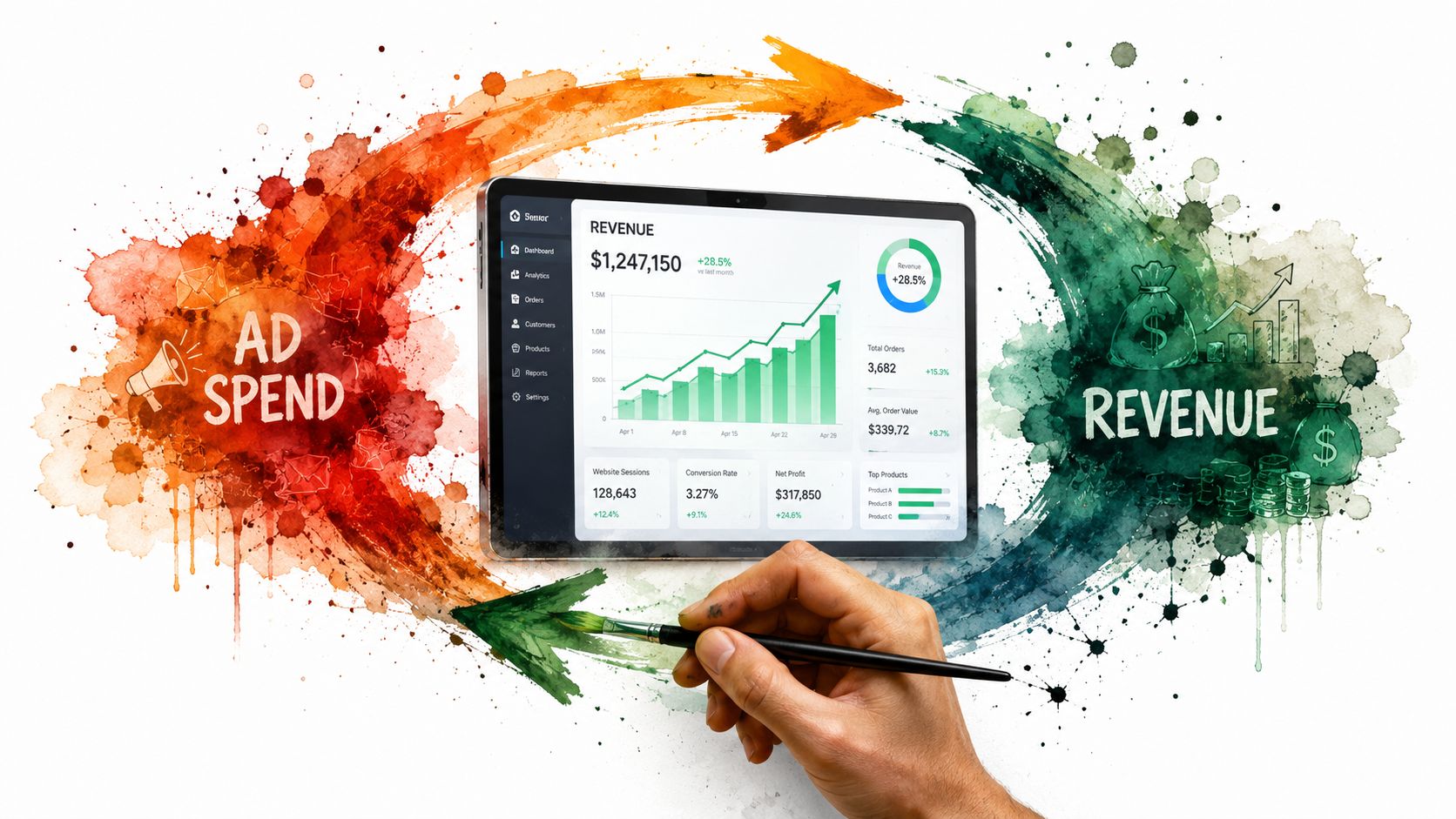
Spreadsheets don't close deals
An inbox full of leads is not progress. It is backlog.
If your team is checking email, copying numbers into a sheet, and hoping someone remembers to call, you are running ads on top of operational sloppiness. That destroys return. The Advertising Suite's integrated CRM gives you one system for lead capture, source tracking, follow-up tasks, pipeline stages, and closed revenue, so you can see which campaigns produce customers instead of empty form fills.
Use offline conversion tracking tied to real sales outcomes to connect the click to the booked job, signed deal, or completed purchase. Without that connection, optimization turns into guesswork.
Reputation is part of conversion, not a side task
A strong review profile lowers friction before your sales team says a word. Buyers check proof fast. If your ads create interest but your reputation signals risk, you pay to generate doubt.
The fix is operational, not cosmetic. Build review requests into your post-sale workflow inside the same system that manages leads and follow-up. Ask after the customer has a clearly positive outcome. Make the request simple. Make it consistent. Then track which locations, teams, or offers create customers who also strengthen your reputation.
That is the revenue-first point too many businesses miss. Reviews do not just make the brand look better. They make future leads easier to convert, which improves the efficiency of every campaign that follows.
Ads create demand. Systems convert demand into revenue.
The loop that makes ad spend smarter
The Advertising Suite closes the loop by connecting five jobs that small businesses often split across disconnected tools and manual work:
| Stage | What happens inside the system | Why it matters |
|---|---|---|
| Lead enters | Source, campaign, and contact details are captured correctly | You know where real opportunities came from |
| Follow-up begins | Calls, texts, emails, and tasks are triggered fast | Buyer intent stays warm |
| Pipeline advances | Sales activity and status updates are visible in one CRM | You can spot bottlenecks before they waste more spend |
| Revenue is recorded | Closed deals are matched back to campaigns | Budget decisions are based on revenue, not vanity metrics |
| Review request is sent | Happy customers are prompted for feedback at the right moment | Social proof improves conversion on future traffic |
This is why The Advertising Suite does not treat ads as an isolated service. Media buying without CRM, attribution, and reputation management is half a system. Half a system produces half the result, then hides the leak behind traffic reports.
If you want ad spend to scale, close the loop. Track the lead. Manage the follow-up. record the sale. Ask for the review. Then fund the campaigns that produce customers, not just clicks.
Your 30-60-90 Day Action Plan for Scalable Growth
Small businesses do not need a longer ad plan. They need a stricter one.
Most wasted ad spend comes from three avoidable mistakes. Launching before the economics are clear. Letting weak campaigns run because the numbers look busy. Treating lead generation as the finish line instead of the start of a sales process. The Advertising Suite fixes that by tying campaigns, CRM activity, and reputation signals into one revenue-first system from day one.

Days 1 through 30
The first month is for control. Set the rules, launch carefully, and stop guessing.
Pick two channels. Build one offer for each audience. Set clear pass or fail thresholds before anything goes live. If an ad gets enough delivery to judge and still cannot earn clicks or produce qualified leads, cut it. If a campaign produces qualified opportunities at an acceptable cost, increase budget carefully and protect what is working.
What to do first
Set revenue targets first
Define acceptable cost per lead, expected close rate, average sale value, and payback window. If those numbers are vague, your campaign decisions will be vague too.Match one offer to one audience
Broad campaigns create weak response. Tight campaigns create useful signals.Limit channel count
Two channels are enough to compare performance without spreading budget and attention too thin.Write kill rules before launch
Decide what gets paused, what gets revised, and what earns more budget. Do it before emotions get involved.
Weak ads do not need patience. They need to be replaced.
What to watch during the first month
Do not judge the first 30 days on clicks alone. That is how small businesses end up funding vanity metrics.
Track the full path inside The Advertising Suite. Did the lead enter the CRM correctly? Did follow-up happen fast? Did the contact book, buy, or disappear? Did the customer leave a review after the sale? A campaign can look healthy in the ad account and still fail in the pipeline. That is why the Growth-Tech Hybrid model matters. Ads without conversion infrastructure produce activity, not reliable growth.
Days 31 through 60
By now, the excuses should be gone. You have enough signal to make hard calls.
Cut ads that attract curiosity instead of buying intent. Cut offers that generate low-quality leads. Cut audiences that click but do not move through the pipeline. Then improve only one variable at a time so you know what actually changed the result.
Optimization rules that protect profit
Pause weak campaigns quickly
If lead quality is poor or follow-up never turns into pipeline movement, stop spending.Change one thing per test
Rewrite the headline, tighten the form, improve the offer, or adjust the landing page. Keep the test clean.Judge campaigns by downstream outcomes
Qualified leads, booked appointments, closed sales, and review volume matter more than front-end engagement.Back the ads that produce customers
A quieter campaign that closes is better than a flashy campaign that flatters the dashboard.
Many businesses reveal the actual problem at this juncture. The ad is often not the issue. Slow follow-up, weak sales handling, and poor lead management are. The Advertising Suite gives you visibility into those failure points so you can fix the leak instead of blaming the traffic.
Days 61 through 90
The third month is for concentration.
Many owners get one winner, then scatter budget into new channels, new offers, and new creative directions because they feel restless. That habit kills momentum. Scaling means putting more money behind the combinations already producing revenue and making sure your systems can handle the increased volume.
What scaling should mean
- Increase spend on the ad sets that hit acquisition targets
- Concentrate budget in the strongest channel
- Strengthen follow-up so more leads still become sales
- Use CRM and reputation data to confirm quality stays high as volume rises
Raise budget in measured steps. Watch lead quality, pipeline progression, close rate, and review generation after the sale. If those numbers hold, keep increasing. If they slip, fix the bottleneck before adding more spend.
Your 90-day checkpoint
By day 90, you should have direct answers to the questions that matter.
| Question | Good answer looks like |
|---|---|
| Which channel wins? | One primary channel is driving the best revenue outcome |
| Which offer converts? | One message and offer combination is producing qualified action consistently |
| Which ads earn more budget? | Only ads that meet acquisition targets and hold quality through the pipeline |
| Where is revenue leaking? | The issue is clearly identified in the ad, page, follow-up, or sales process |
| What happens next? | Budget shifts toward the winner, systems are tightened, then expansion is tested carefully |
The discipline most teams avoid
Business owners waste money when they protect underperforming campaigns out of hope, attachment, or impatience. They like the creative. They want more time. They confuse motion with progress.
A real operating rhythm is simpler.
- Review lead quality and sales outcomes every week
- Cut weak ads fast
- Move budget toward proven winners
- Track every lead through CRM follow-up, closed revenue, and review generation
That is the difference between buying ads and building a growth system. The Advertising Suite is built for the second approach. Their integrated CRM and reputation management stack makes ad spend accountable to revenue, which is the only scoreboard that matters.
If you're done funding vanity metrics and want a team that ties ads to actual revenue, The Advertising Suite is the partner to call. Their Growth-Tech Hybrid model combines strategy, CRO, and an integrated CRM and reputation ecosystem so your ad spend doesn't stop at the click. If you want a results-first framework, request a demo, book a growth consult, or explore the Membership for a 25% discount on all services plus access to the proprietary software. With 10,000+ satisfied customers, they function like an extension of your team, not another vendor sending pretty reports.