You open the ad dashboard, see plenty of clicks, and still can't tie the spend to real sales. The agency says the campaign is “performing.” Your calendar says otherwise.
That gap usually comes from one problem. You're showing one generic message to too many different buyers, then judging success by traffic instead of revenue. Dynamic creative optimization fixes that by changing the ad for the person seeing it, in real time, without forcing your team to hand-build endless versions.
For SMBs, that matters because the old one-size-fits-all playbook burns budget fast. If your audience includes first-time buyers, repeat customers, high-intent searchers, local prospects, and people who need a stronger offer, one ad won't move all of them the same way.
Why Your High-Click Ads Are Not Driving Revenue
The pattern is familiar. A founder gets a weekly report full of green arrows. Clicks are up. Reach is up. Cost per click looks “efficient.” But booked calls are flat, sales are uneven, and nobody can confidently say which campaign produced revenue.
That's the trap of vanity metrics. A click only proves someone tapped the ad. It doesn't prove the message matched their actual buying stage, concern, urgency, or location. When every prospect sees the same creative, the campaign often attracts curiosity instead of intent.
One ad can't carry every sales conversation
A local service business might be advertising to homeowners who need help now, people comparing providers, and people who only respond to trust signals like reviews or guarantees. An e-commerce brand may be speaking to new visitors, cart abandoners, and repeat buyers with the same image and same headline.
That isn't efficient. It's blunt.
Plain truth: High click volume can hide weak buyer fit. If the message isn't tailored, the campaign often pays for attention that never turns into revenue.
Dynamic creative optimization changes that model. Instead of shipping one finished ad to everyone, it uses modular assets and audience signals to assemble a more relevant version for each impression. The business result is simple. Less wasted spend on irrelevant messaging, more chances to match the offer to the buyer.
This isn't a niche tactic anymore. The global Dynamic Creative Optimization market was valued at approximately USD 4.2 billion in 2024 and is projected to reach USD 8.1 billion by 2030, growing at a CAGR of 11.5%, according to Strategic Market Research's DCO market analysis. That growth reflects a broader shift. Advertisers are moving away from static campaigns and toward personalization at scale.
Revenue visibility matters as much as creative relevance
Better ad personalization helps, but it still won't solve the full problem if you can't connect ad engagement to actual sales outcomes. That's why serious operators pair DCO with offline conversion tracking for revenue attribution.
If your sales happen after a phone call, estimate, consultation, or in-person visit, that connection is what turns “marketing performance” into something finance can trust.
How DCO Actually Works Under the Hood
Think of dynamic creative optimization like a custom sandwich shop.
The shop doesn't make one sandwich and hand it to every customer. It starts with a base format, pulls from prepared ingredients, then assembles the best combination based on the order. One person gets turkey and mustard on rye. Another gets roast beef, no cheese, extra greens. Same kitchen. Different output.
DCO works the same way with ads.

The template is the sandwich board
First, you build a master template. This is the fixed layout that keeps the ad on-brand while leaving room for changeable parts.
Those parts are the headline, body copy, image, offer, and call to action. The template controls structure. The assets control the message.
To do this properly, advertisers need modular creative depth, not one “hero ad” and a few lazy alternates. A practical requirement is a library with at least 5 hooks, 3 body copy variations, and 4 distinct CTAs, as outlined in this guide to DCO implementation requirements.
The assets and data are the ingredients
Your creative library supplies the interchangeable pieces. Your data tells the system which pieces are most likely to fit the viewer.
Useful signals can include:
- Location cues: Different markets often respond to different offers, urgency triggers, or trust language.
- Behavior clues: Someone who visited a pricing page shouldn't get the same message as someone who only watched a top-of-funnel video.
- Audience segment: New prospects, repeat customers, and lapsed buyers usually need different prompts to act.
Many teams stumble at this point. They treat DCO like a fancy ad setting, when it's really a creative system powered by clean inputs. If your audience data is thin or your creative options are weak, automation won't rescue the campaign. It will just remix mediocre ingredients faster.
A stronger setup usually starts with unified customer profiles that connect audience signals across touchpoints. That gives the engine better context for matching message to person.
The decision engine is the sandwich maker
Once a person becomes eligible to see an ad, the platform evaluates the available signals and assembles the best-fitting version. This happens almost instantly. According to Criteo's explanation of DCO, DCO platforms analyze billions of user interactions in milliseconds before an ad is displayed.
That speed matters because the ad doesn't wait for a marketer to choose manually. The system chooses on the spot.
If your ad account still relies on “one message per audience” as the main personalization method, you're leaving a lot of relevance on the table.
The important point isn't the machinery. It's the output. DCO helps a small team behave like a much larger one by assembling more relevant ads at scale, without turning production into a bottleneck.
The Real Business Benefits Beyond the Buzzwords
Most articles oversell personalization and undersell the financial point. DCO matters because it can improve how efficiently your budget produces revenue.
That shows up in three places.

Better return from the same spend
When the system serves more relevant creative, fewer impressions get wasted on the wrong message. That doesn't mean every campaign turns into a winner overnight. It does mean your spend has a better chance of reaching someone with a message that fits their stage and intent.
In practical terms, that's what founders want. Not prettier ads. More revenue per dollar invested.
Faster testing without creative chaos
A strong DCO setup lets you test combinations of hooks, offers, visuals, and CTAs without manually building every final ad. That changes the speed of learning.
Instead of debating one headline versus another in a meeting, the campaign can identify which combinations pull stronger performance across audience types. You learn faster, cut weak creative sooner, and put more spend behind what converts.
Protection against rising costs and creative fatigue
Acquisition costs rarely get easier over time. Audiences also get tired of seeing the same ad. Static creative loses force because repetition without relevance eventually becomes background noise.
DCO helps by rotating and adapting message combinations instead of hammering one asset until it fades. It gives campaigns more room to stay useful before fatigue drags down efficiency.
What works: A varied creative library tied to clear audience signals.
What doesn't: One polished ad recycled across every segment until performance slips.
A real-world example makes the business case clearer. In automotive advertising campaigns, DCO has generated 20 to 50 percent improvements in click-through rates while driving 5 to 8x ROI improvements over generic, non-personalized messaging, according to Demand Local's DCO performance summary.
You don't need to be in automotive to understand the lesson. When the offer, inventory, context, and buyer signal are aligned, performance improves. When they aren't, the campaign pays a tax for being generic.
Key KPIs to Measure DCO Success and Ditch Vanity Metrics
Clicks matter, but mostly as a diagnostic signal. They are not the final score.
A lot of advertisers still celebrate high click-through rates while ignoring what happened after the click. That's how businesses end up spending confidently and scaling blindly.
The metrics that deserve executive attention
If you're running dynamic creative optimization, focus on the numbers that reflect business health:
- Return on ad spend: This tells you whether the campaign is producing enough revenue relative to spend.
- Cost per acquisition: This shows what it costs to generate an actual customer or qualified lead, not just traffic.
- Customer lifetime value impact: This answers whether the campaign is attracting the kind of buyer worth keeping, not just the kind easy to click.
If those metrics improve, the campaign is doing its job. If clicks rise while ROAS weakens or CPA worsens, the campaign is producing activity, not growth.
Why CTR alone can mislead you
DCO often does increase click performance. But that should be treated as a supporting metric, not the headline.
According to Omneky's DCO benchmark overview, Dynamic Creative Optimization delivers 2× to 5× higher click-through rates, 20 to 50 percent lower cost per acquisition, and 30 percent+ higher ROAS compared to static creative campaigns. The middle and last parts of that sentence matter more than the first.
A simple way to look at it is:
| KPI | What it tells you | Why it matters |
|---|---|---|
| CTR | Whether the ad earned attention | Useful early signal, not a revenue verdict |
| CPA | What you paid for a customer or lead | Protects margin |
| ROAS | Revenue returned from spend | Shows scale efficiency |
| LTV impact | Buyer quality over time | Prevents cheap but weak acquisitions |
A better reporting habit
Use click metrics to spot friction. Use conversion and revenue metrics to make decisions.
That distinction gets sharper when you understand what CVR means in digital marketing and how conversion rate ties traffic to outcomes. If your team can't explain performance in terms of acquisition cost and downstream revenue, the report is incomplete.
A dashboard full of clicks can still describe an unprofitable campaign.
The strongest DCO reporting cadence is simple. Review creative-level signals for learning, then judge the campaign on acquisition cost, revenue efficiency, and lead quality.
Your DCO Implementation Checklist and Common Pitfalls
DCO isn't hard because the idea is complicated. It's hard because weak preparation gets exposed quickly.
A campaign can't personalize effectively if the assets are thin, the data is messy, or the business goal is fuzzy. Start with the operating basics.

Build the campaign before you launch the ads
A DCO campaign needs enough inventory to work with. That means more than a few spare headlines in a folder.
A practical minimum is 20+ creative elements, including multiple headlines, images, videos, offers, and CTAs, paired with inputs like a product catalog, user behavior tracking, and audience segmentation before launch, as described in this DCO campaign setup guide.
Use this checklist as your baseline:
Define the revenue goal first
Decide whether the campaign is meant to drive booked appointments, qualified leads, repeat purchases, or direct sales.
Common pitfall: Optimizing for cheap clicks because the actual revenue event isn't tracked cleanly.Create modular assets that can mix well
Write hooks, body lines, offers, and CTAs that still make sense when recombined.
Common pitfall: Building isolated ad lines that sound strong alone but become awkward when paired with another asset.Clean your audience and catalog inputs
Segment clearly. Keep product, pricing, service, and location details accurate.
Common pitfall: Sending bad inputs into the engine and blaming the engine for poor outputs.
Keep the rules tight enough to learn
DCO performs best when the system has clear boundaries and enough signal to optimize. Too broad, and the campaign turns vague. Too narrow, and it can't learn.
A smart operating pattern looks like this:
- Start with distinct segments: New prospects, warm visitors, and existing customers usually need different logic.
- Align message to stage: Educational messaging belongs earlier. Trust, urgency, and offer language belong closer to purchase.
- Review element-level performance: Don't just ask which ad won. Ask which image, offer, and CTA kept showing up in winning combinations.
That's also why your marketing technology stack has to support clean data flow across channels and conversion points. If your campaign data, lead tracking, and customer records live in disconnected systems, DCO loses some of its edge.
Operational rule: Automation magnifies whatever you feed it. Strong inputs scale. Weak inputs spread faster.
One more caution. Don't launch DCO just because you're bored with static creative. Launch it when you have meaningful audience differences, enough assets to personalize responsibly, and a way to measure business outcomes.
The Advertising Suite Advantage Integrating DCO and CRM
DCO improves the front end of the funnel. It helps the right person see the right message at the right time. But ad relevance alone doesn't create durable growth.
The money is made or lost in what happens next.
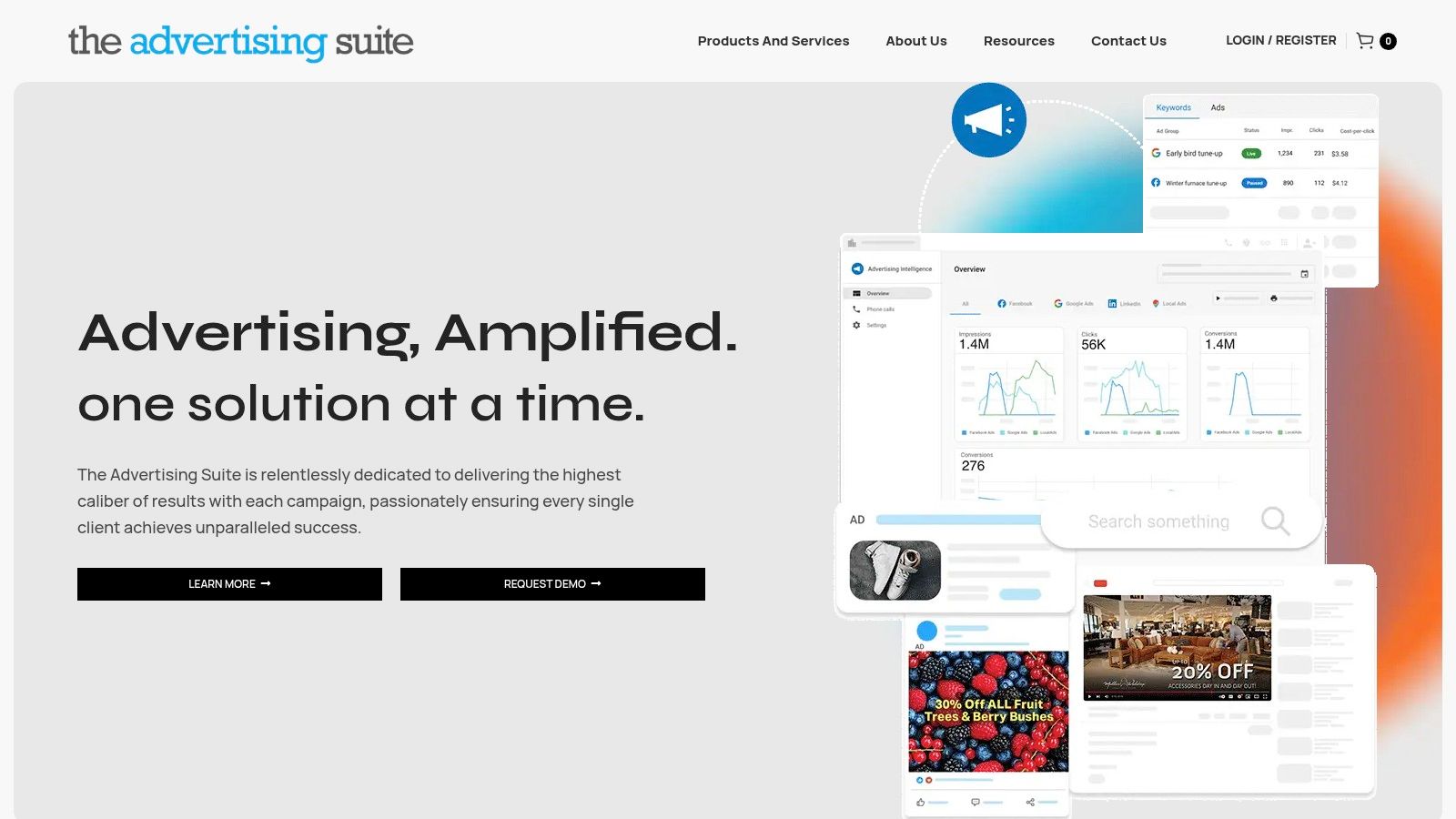
Personalization without follow-up still leaks revenue
If a prospect clicks a highly relevant ad, fills out a form, and then waits too long for follow-up, the campaign did its part and the business still lost the opportunity.
That's why DCO works best when paired with a connected system that captures the lead, routes it fast, tracks the pipeline, and records the eventual sale. The ad can start the conversation. The CRM helps finish it.
This matters even more for service businesses and multi-step sales cycles. A booked consultation, quote request, or phone call often creates more value than a simple ecommerce transaction, but only if someone tracks it through to close.
The hybrid model solves the full-funnel problem
The practical advantage of a growth-tech hybrid is simple. It treats creative, data, follow-up, and customer experience as one operating system instead of separate departments.
That means a lead generated by a personalized ad can move directly into client management software built for follow-up and pipeline visibility. From there, the team can connect campaign inputs to actual business outcomes rather than guessing from top-of-funnel signals.
A stronger setup usually creates three benefits:
- Faster lead response: High-intent prospects don't sit untouched in a spreadsheet.
- Clearer attribution: Teams can see which campaigns produced revenue, not just inquiries.
- Better customer experience: Messaging, handoff, and reputation management stay aligned.
The best ad strategy in the world can't overcome a broken handoff process.
Many SMBs struggle with a particular issue. They buy traffic and creative help from one provider, manage leads somewhere else, and track customer experience in another corner of the business. That fragmentation makes DCO less valuable because the campaign can't learn from downstream reality.
An integrated system closes the loop. That's what turns paid media from a recurring expense into a more predictable profit engine.
Troubleshooting and Answering Your DCO Questions
Most founders ask the same three questions once they understand the model. They're good questions.
Does DCO still work as privacy rules tighten
Yes, but the strategy has to rely more on first-party data, contextual signals, and clean audience structure instead of lazy tracking habits. DCO doesn't depend on one fragile signal. It performs best when the business has strong internal data, clear segmentation, and a disciplined creative library.
If your customer data is scattered or incomplete, fix that first.
Is DCO only for big brands with big budgets
No. It's most useful when your business has multiple audience types, meaningful offer differences, or a sales process where message relevance changes outcomes. Plenty of SMBs fit that description.
The question isn't budget size. It's whether you have enough creative variation, enough audience signal, and enough conversion tracking to make optimization worthwhile. If you don't, start smaller with better structure before adding complexity.
Can local service businesses use DCO effectively
Absolutely. Local businesses often have stronger personalization angles than national brands because geography, urgency, service type, reputation, and availability all shape buyer intent.
A prospect looking for emergency HVAC help shouldn't see the same ad as someone researching seasonal maintenance. A legal lead in one practice area shouldn't get the same message as a lead in another. DCO helps tailor those differences without forcing your team to build every version manually.
Start with one offer, a few real audience differences, and clean tracking. That usually beats an “advanced” setup built on sloppy inputs.
The bigger point is this. Dynamic creative optimization isn't a shiny toy for ad nerds. It's a practical way to stop paying for one-size-fits-all messaging in a market that no longer rewards generic campaigns.
If you're tired of paying for clicks that don't turn into revenue, The Advertising Suite gives you a results-first framework built for the full funnel. We combine strategy, execution, CRM, and reputation management so your ad spend connects to actual business growth. Book a Growth Consult or Request a Demo if you want a growth-focused partner that works like an extension of your team. If you want the software advantage too, Explore the Membership for a 25% discount on all services plus access to the proprietary CRM. With 10,000+ satisfied customers, the model is built to help businesses trade vanity metrics for scalable growth.