You've probably lived this already.
A report lands in your inbox. Clicks look healthy. Traffic is up. Cost per click seems “efficient.” Everyone acts like the campaign is working. Then you open your bank account, check closed deals, or look at actual collections, and the obvious question hits: where's the revenue?
That disconnect is why skeptical founders stop trusting marketing reports. Fair enough. Most reporting stacks are built to celebrate activity, not prove profit. Impressions don't pay payroll. Click-through rates don't rescue a bad month. Leads without sales follow-up are just expensive form fills.
If you care about calculating marketing ROI, start with one rule: marketing only counts when it connects to cash. Everything else is supporting data. Useful, sometimes. Decisive, no.
That's also why teams that want real accountability eventually move past surface-level reporting and into conversion systems, sales tracking, and funnel repair. If your campaigns are generating traffic but not sales, the problem often sits in the conversion path, not the ad account. That's the practical reason to understand conversion rate optimization and what it fixes.
Beyond Vanity Metrics From Clicks to Cash
A founder spends months hearing the same story.
Traffic increased. Social engagement improved. The campaign reached more people. The ads got attention. On paper, that sounds like momentum. In the business, it often feels like drift.
That's the vanity metric trap. A metric becomes vanity the moment it looks impressive but doesn't help you make a revenue decision. Clicks can matter. Reach can matter. Leads can matter. But if they never connect to booked jobs, signed contracts, purchases, retained customers, or collected revenue, they're just noise dressed up as progress.
What smart founders get wrong
The mistake isn't tracking top-of-funnel numbers. The mistake is stopping there.
A smart operator should absolutely care about the path to revenue. But the path is not the destination. If your team reports awareness, engagement, and traffic without showing what happened next, they're describing motion, not outcome.
Practical rule: If a metric can't help you decide whether to scale, cut, or fix a campaign, it doesn't belong at the center of your report.
A revenue-first business treats marketing like an investment in a profit engine. That changes the conversation fast.
Instead of asking:
- How many people saw the ad
- How many people clicked
- How many likes did we get
You ask:
- Which campaigns created qualified opportunities
- Which channels influenced actual sales
- Which spend produced profitable growth
The report your business actually needs
Founders don't need prettier dashboards. They need clearer truth.
A useful marketing report should answer three questions:
| Question | Bad answer | Useful answer |
|---|---|---|
| Did people engage? | “Yes, clicks increased.” | “Some engaged, but only certain campaigns produced sales activity.” |
| Did leads come in? | “Yes, form fills are up.” | “Leads came in, but only a subset became real pipeline.” |
| Did the business make money? | “We had strong visibility.” | “This investment did or didn't create revenue.” |
That's the shift from clicks to cash. It's not glamorous. It is how grown-up businesses allocate budget.
How to Set Goals That Actually Drive Revenue
Most bad ROI reporting starts before the campaign even launches.
The business says it wants “more leads.” Marketing says it wants “better visibility.” Sales says it wants “higher-quality prospects.” None of those are operational goals. They're vague wishes. You can't calculate marketing ROI against a wish.

A disciplined workflow starts by defining objectives and KPIs, then centralizing all costs, then mapping revenue from a sales or CRM system instead of relying only on platform conversions, as outlined in this marketing ROI workflow reference. That sequence matters because it keeps your reporting tied to the business, not the ad platform.
Start with the business outcome
If you're calculating marketing ROI, your campaign goal needs to sit close to money.
Good goals usually connect to one of these:
- New customer acquisition
- Sales-qualified opportunities
- Booked appointments that can close
- Revenue from a specific offer or campaign
- Retained or repeat customer value
Weak goals sit too high in the funnel. Strong goals reflect commercial intent.
For example, “increase followers” is not an ROI goal. “Generate more demand” is still too loose. A better goal names the business event you want and where it lands in your pipeline.
Build KPIs in layers
Not every KPI has to be revenue itself. But each KPI should support a path to revenue.
Use a simple hierarchy:
Core outcome KPIs
These are your decision metrics.
- Revenue produced: The cleanest output if your sales cycle is short.
- Closed customers: Useful when deal value is fairly consistent.
- Qualified pipeline: Better for longer sales cycles.
- Booked consultations or appointments: Useful for service businesses when sales happen after the booking.
Efficiency KPIs
These tell you whether the campaign is getting expensive or staying healthy.
- Cost per qualified lead
- Cost per booked appointment
- Cost per customer
- Sales conversion rate from lead to close
Diagnostic KPIs
These help you troubleshoot, not celebrate.
- Landing page conversion rate
- Lead response time
- Show-up rate for appointments
- Sales follow-up completion
Goals should move from campaign activity to business outcome. If they stop at “traffic” or “engagement,” you're tracking effort, not return.
A founder's pre-launch checklist
Before you spend a dollar, make sure your team can answer these questions:
- What exactly counts as success? A sale, a qualified opportunity, a booked call, or something else tied to revenue.
- Where will revenue be recorded? In your CRM, point-of-sale system, scheduling flow, or sales ledger.
- Who owns attribution? Someone needs to reconcile marketing data with sales outcomes.
- What costs are being included? Not just media. Everything tied to execution.
- What time window matters? Some campaigns close quickly. Others need a longer view.
- What happens after the lead comes in? If lead handling is broken, your ROI math will be garbage no matter how good the ads are.
A lot of teams also realize they need cleaner attribution logic across channels. If leads touch search, paid social, email, and direct visits before buying, a founder needs a better framework than “the last click got the credit.” That's why understanding marketing attribution and how credit gets assigned is part of serious ROI work.
Set goals your team can actually manage
Founders should insist on goals that are controllable.
Your team can influence:
- targeting
- offer clarity
- landing page quality
- follow-up speed
- pipeline tracking
- sales handoff discipline
Your team cannot control fantasy outcomes with no measurement plan attached. Don't approve campaigns with fuzzy success criteria. That's how businesses fund confusion.
Calculating the True Cost of Your Marketing
If you're only counting ad spend, your ROI number is probably flattering you.
That's the oldest trick in marketing reporting. It's not always malicious. Sometimes it's just lazy. But the effect is the same. The campaign looks profitable because the accounting is incomplete.
A foundational rule in calculating marketing ROI is to include all campaign costs in the formula ((Revenue – Marketing Cost) / Marketing Cost) × 100, not just media spend. That means agency fees, software costs, internal salaries, and creative production expenses belong in the total, as explained in this marketing ROI breakdown.
What belongs in marketing cost
Most founders already know media spend belongs in the equation. The problem is everything else gets ignored.
Your true marketing cost usually includes:
- Ad spend: Paid search, paid social, display, local ads, or any direct media investment.
- Creative production: Design, video, copywriting, landing page builds, photo work, editing.
- Agency or contractor fees: Strategy, campaign management, reporting, implementation.
- Software and platform costs: CRM, analytics, scheduling, call tracking, reporting, automation.
- Internal labor: The portion of your team's time spent building, managing, reviewing, and following up on the campaign.
Why partial cost tracking wrecks decisions
A campaign can look healthy when you isolate media spend and still lose money overall.
That's because the business didn't just buy clicks. It paid for execution. It paid for systems. It paid for people. It paid for assets. If those costs disappear from the report, the report becomes fiction.
Most ROI inflation doesn't come from bad math. It comes from incomplete inputs.
This matters even more for service businesses and sales-led teams. When the offer needs human follow-up, booking coordination, nurturing, and sales work, the cost of generating demand is larger than the platform invoice.
An honest cost audit
Use this quick review before trusting any ROI figure:
| Cost category | Usually included | Commonly forgotten |
|---|---|---|
| Media spend | Yes | Rarely |
| Creative work | Sometimes | Often |
| Outside management fees | Sometimes | Often |
| Software stack | Rarely | Often |
| Team time | Rarely | Very often |
If your report ignores the right-hand column, don't call it ROI. Call it media efficiency and keep it in its lane.
There's also a practical reason to separate this from simpler ad metrics. Return on ad spend can be useful for judging media performance, but it's narrower. ROI is the harder number. It tells you whether the whole effort made financial sense.
The ROI Formulas That Separate Guesswork From Growth
Once you've got real costs and real revenue, the math becomes useful.
The standard formula is straightforward: ((Revenue – Marketing Cost) / Marketing Cost) × 100. Simple is good. Organizations don't need more complexity at the start. They need cleaner inputs.

A concrete example helps. A $1,000 campaign that generates $5,000 in sales growth produces 400% ROI using ((Sales Growth – Marketing Cost) / Marketing Cost) × 100. Another benchmark example shows that a campaign costing $50,000 and generating $150,000 in revenue yields 200% ROI, or $2 in profit for every $1 spent, as summarized in this overview of marketing ROI methods.
The baseline formula every founder should know
Here's the calculation in plain English:
- Start with revenue generated or sales growth tied to the campaign.
- Subtract the total marketing cost.
- Divide that number by the total marketing cost.
- Multiply by 100 to express it as a percentage.
That's your baseline ROI.
This formula is useful because it forces one hard question: did the campaign generate more value than it cost to run?
When the basic formula is enough
For short sales cycles, direct-response campaigns, and straightforward offers, the standard formula does the job.
It works well when:
- the sale happens quickly
- attribution is reasonably clear
- the customer buys soon after the campaign touch
- your team can connect campaign data to revenue without much delay
If you run a local service promotion, a straightforward lead generation campaign, or a limited-time offer, start here. Don't overcomplicate it.
When founders need a wider lens
Some businesses break the simple model because revenue doesn't show up right away.
That's where broader ROI methods matter. Demandbase describes methods beyond classic revenue-based ROI, including ROI per Touchpoint = (Revenue Influenced by Touchpoint / Cost of Touchpoint) × 100 and Pipeline ROI = [(Total Pipeline Influenced – Marketing Investment) / Marketing Investment] × 100 for longer B2B sales cycles. Those approaches are more honest when marketing influences a deal long before the contract is signed.
Here's the practical distinction:
- Revenue ROI helps when deals close quickly.
- Pipeline ROI helps when sales take time and influenced opportunities matter before revenue is booked.
- Touchpoint-level ROI helps when multiple campaign interactions shape the deal.
If your sales cycle is long, waiting only for closed revenue can make good marketing look invisible.
Use formulas to answer the right question
Different formulas solve different management problems.
| Formula type | Best use | What it answers |
|---|---|---|
| Standard ROI | Direct campaigns | Did this investment pay off? |
| Pipeline ROI | Longer sales cycles | Did marketing create commercial value before the close? |
| ROI per touchpoint | Multi-step journeys | Which interactions influenced the outcome? |
You can also look at customer lifetime value qualitatively when first-purchase ROI looks thin but retention is strong. If buyers stay, renew, return, or expand, first-sale math may understate real value. That said, don't pretend future value exists unless your business can track it. Hope is not a metric.
Common Pitfalls Why Your ROI Numbers Might Be Lying
The formula can be correct and the answer can still be wrong.
That's usually not a spreadsheet issue. It's a systems issue. Founders think they have an ROI problem when they really have an attribution problem, a follow-up problem, or a data-silo problem.

Last-click reporting hides the real journey
A customer rarely sees one ad and buys immediately.
They might discover you through one channel, return through another, compare options later, then convert through a branded search or direct visit. If you give all the credit to the final touch, your ROI report overstates some channels and erases others.
That's why last-click reporting often leads founders to cut the channels doing the early persuasion and overfund the channels collecting the final click.
Platform conversions are not revenue
Ad platforms are useful for campaign optimization. They are not your source of financial truth.
Platforms can show form submissions, calls, purchases, or lead events. Fine. But they still don't know:
- whether the lead was qualified
- whether sales followed up
- whether the appointment showed
- whether the deal closed
- whether the customer paid
If you stop at platform-reported conversions, your marketing team can claim success while your sales team isn't entirely convinced.
Fragmented systems create fake confidence
Here's the usual mess:
- ad data lives in one place
- web analytics lives somewhere else
- calls get tracked separately
- forms route through another tool
- sales updates live in a CRM
- invoice or payment data sits elsewhere
Then someone exports everything into a spreadsheet and starts reconciling by hand. That process is slow, fragile, and full of judgment calls.
Bad ROI reporting often looks polished because the dashboard is clean. The data underneath usually isn't.
The practical failure points
If your numbers feel off, inspect these first:
- Missing revenue mapping: Leads exist, but nobody tied them to actual sales.
- Duplicate conversion counts: The same customer action gets counted in multiple systems.
- Unclear qualification standards: Marketing counts every lead, sales only trusts a fraction.
- Broken follow-up: Campaigns generate demand, but the business responds too slowly.
- Attribution shortcuts: The final click gets all the glory.
One useful control metric is acquisition cost. If your reported ROI says campaigns are thriving but your target cost per acquisition keeps getting worse, your reporting model is probably hiding inefficiency somewhere.
From Spreadsheets to Scale Your Tech Advantage
Manual reporting works for a tiny business with simple channels. It breaks once the business starts growing.
The moment you have multiple campaigns, multiple touchpoints, a sales process, repeat buyers, call handling, review signals, and operational follow-up, spreadsheets become a liability. They don't just waste time. They distort decisions.
Why spreadsheets fail at scale
A spreadsheet can store numbers. It can't create alignment.
It won't automatically connect:
- campaign source
- lead record
- appointment status
- sales outcome
- customer experience signals
- retained revenue
That disconnect is why founders end up arguing with their own teams. Marketing says the campaign worked. Sales says the leads were weak. Operations says half the prospects never got proper follow-up. Finance says the margin isn't there. Everyone has a partial truth and no shared system.
The integrated stack is no longer optional
If you want accurate ROI, you need one operating view that ties marketing actions to sales outcomes. That usually means:
- a CRM that records the journey after the click
- consistent lead status definitions
- attribution that survives longer buying cycles
- a process for matching campaign activity to real revenue
- customer experience data that explains why conversions rise or stall
For service businesses especially, reputation data matters more than most agencies admit. Ads can generate demand, but poor reviews, weak follow-up, or broken scheduling will crush actual return. That's why an integrated marketing and CRM setup beats disconnected reporting every time.
What a real growth system should do
The system should help your team answer questions fast:
| Business question | Spreadsheet answer | Integrated answer |
|---|---|---|
| Which campaigns drove revenue? | “We think these did.” | “These opportunities and sales came from these campaigns.” |
| Where are leads getting stuck? | “We need to dig around.” | “They stall between inquiry and sales contact.” |
| Why did ROI drop? | “Traffic changed.” | “Lead quality, response time, or close rate changed.” |
That's the core tech advantage. Not shiny automation. Clarity.
A connected workflow also makes execution faster. Instead of exporting, cleaning, merging, and debating data, teams can act on it. That's the difference between reporting on growth and managing growth. If you want a clearer view of that operational side, this breakdown of a marketing automation workflow is a useful reference.
The businesses that win aren't the ones with the prettiest reports. They're the ones with the shortest distance between spend, signal, action, and revenue.
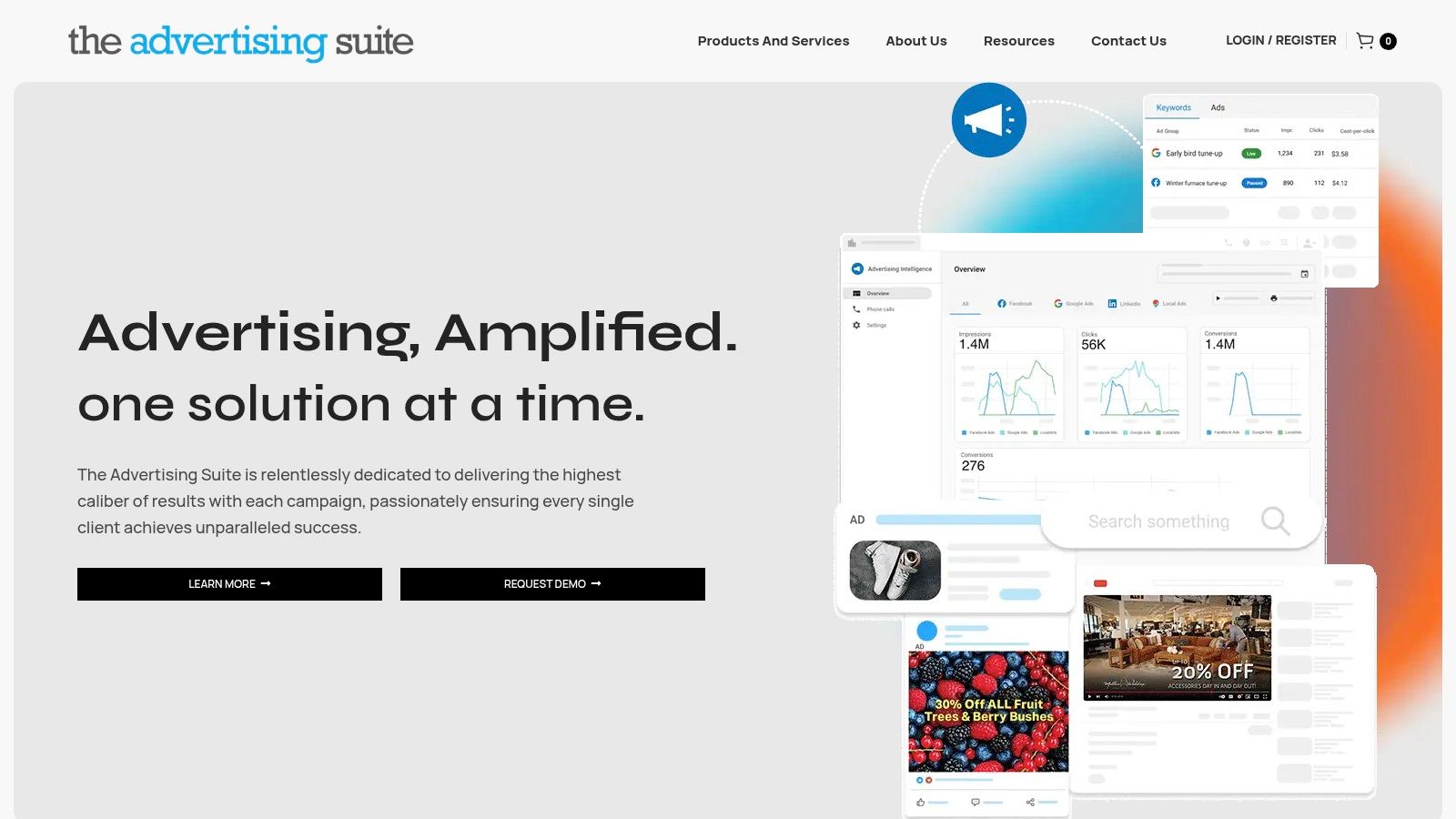
If you're done funding reports that look good but don't prove profit, it's time to tighten the system. The Advertising Suite helps businesses connect campaign execution, CRM visibility, and reputation management into one revenue-focused operating model. Through a growth-tech hybrid approach, members access the proprietary CRM, automated review management, and a 25% discount on all services. If you want marketing that functions like an extension of your team instead of another disconnected vendor, Request a Demo or Explore the Membership.