Most marketing budget allocation advice is backward. Teams start with channel percentages, argue over line items, and call it strategy, even though the job is to fund the next dollar where it creates the most incremental revenue. If your budget is still a once-a-year spreadsheet ritual, you're not allocating. You're guessing with nicer fonts.
The hard truth is that modern marketing is being asked to do more with less. Gartner's survey of 395 CMOs and marketing leaders found average marketing budgets fell to 7.7% of company revenue in 2024, down from 9.1% in 2023, while paid media rose to 27.9% of the total budget and digital grew to 57.1% of paid media budgets (Marketing Tech News). That's not a reason to freeze spend. It's a reason to stop funding channels by habit.
Practical rule: allocate budget as a recurring decision, not a yearly event. If the next dollar is not being sent to the highest verified return, the plan is already broken.
Why Most Marketing Budget Allocation Plans Fail
The biggest mistake is treating marketing budget allocation like accounting instead of portfolio management. Teams lock percentages in Q4, then act shocked when the market shifts, attribution lags, and the channel that looked efficient in January starts burning cash by May. That approach fails because it assumes spend efficiency stays fixed. It never does.
Static budgets reward the wrong channels
A channel that captures demand late in the funnel can look excellent in reported ROAS while contributing very little to demand creation. That is how teams overfund low-intent channels, then wonder why pipeline quality falls apart. A defensible allocation starts with incrementality, not historical comfort.
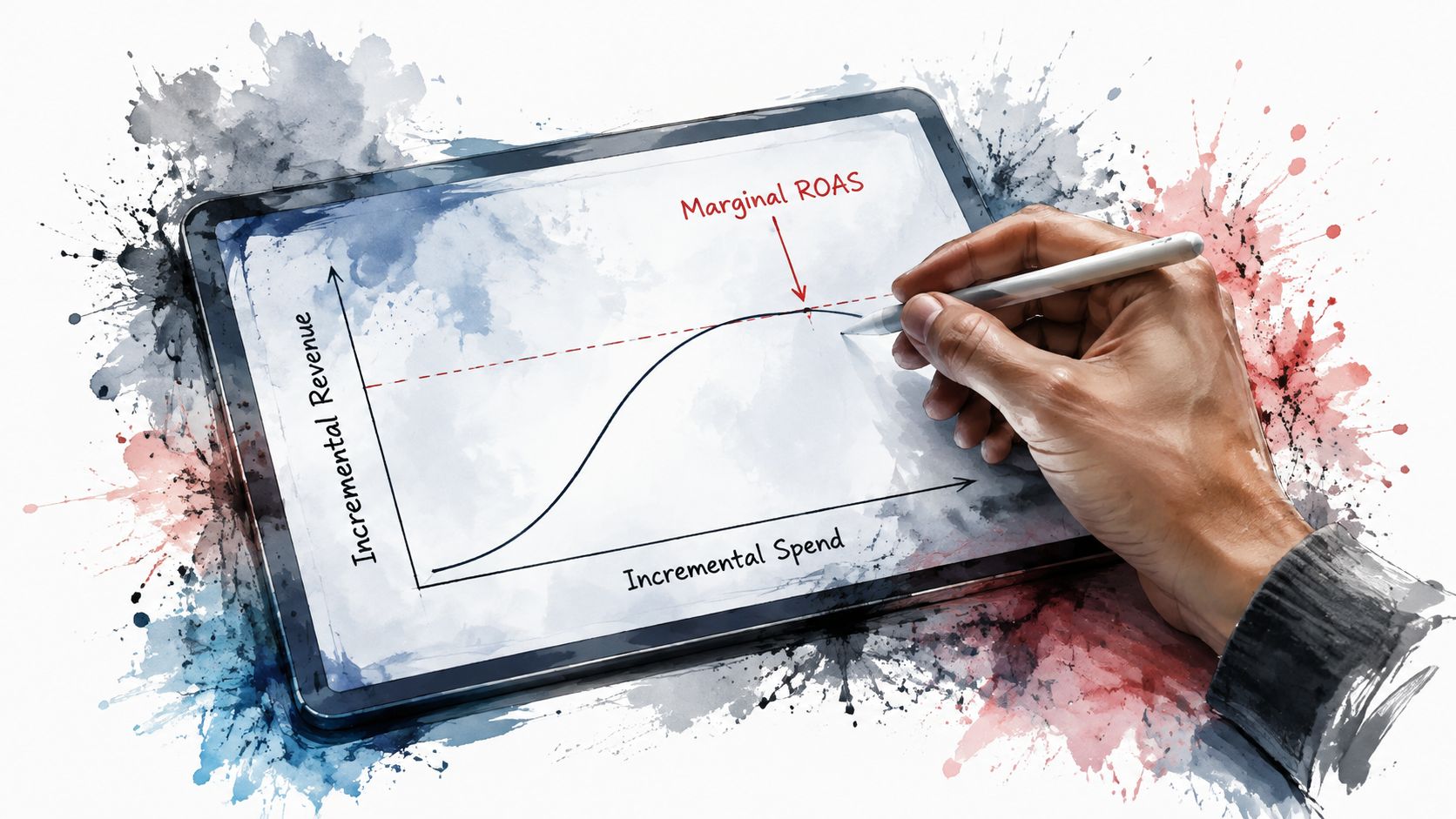
The operating logic is straightforward. Estimate each channel's incrementality baseline, fit saturation curves so you can see diminishing returns, then move the next dollar to the channel with the highest marginal ROAS. That is the rule that matters because it measures what changes when spend increases. If you still optimize from last-click snapshots, you are rewarding the channel that happened to show up last, not the one that caused the sale.
Measurement is where most plans drift off course. Attribution is useful, but only if you understand its limits and use it as one input, not the verdict. For a clear foundation, read this internal primer on marketing attribution.
The usual failure modes are structural
A useful benchmark from a budget-optimization guide says 68% of failed marketing plans over-allocate to low-intent channels, 52% ignore attribution lag, and 41% under-reserve for seasonality (Improvado). Those are not small mistakes. They warp the entire year's allocation logic.
Candid reality: if you ignore lag, you will cut the channels that create future demand and keep the channels that only harvest it.
The fix is to stop making large, emotional swings. Move money in 10% to 20% increments, review it monthly, and only change direction when the data has enough clean history to justify it. That matters even more when acquisition costs are climbing and privacy changes are making targeting less efficient.
Set the Revenue Goal and Reverse Engineer the Budget
Start with the revenue target, not the channel mix. Every serious marketing budget allocation plan should be built backward from the number the business cares about, which is revenue, not clicks, reach, or some presentation-friendly engagement metric. If the target is fuzzy, the budget will be fuzzy too.
Work backward from revenue to qualified opportunities
The clean sequence is straightforward. First, define the revenue goal. Second, estimate how many qualified opportunities you need. Third, apply your close rate and average deal value. Fourth, derive the marketing investment required to create that pipeline. If one of those inputs is missing, the whole budget is soft.
That also means setting a clear CAC ceiling before money leaves the account. If a channel can't live under that ceiling, it doesn't belong in the core plan unless it serves a strategic purpose such as market education or retention. Too many teams fund everything that can be measured and forget to ask whether the unit economics work.
A good budget also includes the whole operating stack, not just media. Planning guidance consistently reminds teams to include creative production, agency fees, analytics tools, martech, labor, and contingency. One 2026 breakdown summarized by Sender put average large-company budgets around 30.6% to 31% paid media, 22% martech, 22% labor, and 21% agencies (Sender). That's what most founders miss. Ads are only part of the bill.

Stress test the plan before you approve it
Run the budget through a downside scenario. Ask what happens if close rates slip, average deal size shrinks, or paid channels get more expensive. If the model only works in the best-case version of the quarter, it's not a plan. It's a wish.
Use contribution margin analysis to separate profitable growth from expensive activity. That distinction matters because a budget that grows top-line volume while crushing margin is not growth. It's expensive movement.
Best practice: approve the budget only after finance, sales, and marketing agree on the same revenue target, the same CAC ceiling, and the same downside case.
Benchmark Percentages by Industry and Funnel Stage
Benchmarks matter, but only as guardrails. The useful reading starts with the fact that marketing budgets averaged 7.7% of company revenue in 2024 in the Gartner survey, while Forrester's B2B benchmark also landed at 7.7%, with B2B product companies at 8.6% and B2B services companies at 6.9% (Gartner summary, Forrester benchmark summary). That spread matters because business model matters. The same budget ratio will fail one team and work fine for another.
Use the benchmark as a starting point, not a commandment
Forrester's B2B benchmark also shows 57.1% of spend into digital and about 29% of the budget into content (Forrester benchmark summary). That is a clear sign of where spend sits in practice. If your plan still divides budget evenly across channels with very different measurement quality, your operating model is behind the market.
The more useful read is simple. B2B product usually deserves more spend than B2B services because product teams often have to create demand, educate the market, and convert at scale. Services businesses can rely more on trust, referrals, and lower-volume demand capture. One should not copy the other blindly.
Match funnel stage to business reality
| Business Model | Awareness | Consideration | Conversion | Retention |
|---|---|---|---|---|
| B2B Product | Higher | Highest | Moderate | Moderate |
| B2B Services | Moderate | High | Moderate | Lower |
| E-commerce | High | Moderate | High | High |
| Local Service | Moderate | Moderate | High | Moderate |
The table is directional on purpose. It is not a rulebook. Growth mode usually needs more awareness and consideration, harvest mode puts more weight on conversion and retention, and pivot mode needs enough runway to rebuild demand without starving the core.
A target acquisition ceiling has to sit underneath that mix. If you need a practical way to set it, use this target cost per acquisition guide and anchor the benchmark to real revenue math instead of vanity reporting.
Sample Allocations for Three Common Business Scenarios
Benchmarks are reference points. Good allocation work comes from translating those points into a budget that matches the business model, not the fantasy version of the business model. An e-commerce brand, a B2B SaaS company, and a local service franchise should not look anything alike on paper.
Three allocation patterns that actually make sense
E-commerce brand. If the business is targeting a 4:1 ROAS, the budget should lean toward channels that can absorb spend quickly and turn it into orders. That usually means a heavier conversion-stage mix, with paid media and retention doing most of the work. You don't need endless awareness if purchase intent already exists, you need disciplined capture and efficient repeat revenue.
B2B SaaS company. This type of company should bias budget toward content, education, and conversion support. Pipeline contribution matters more than raw lead volume, which means the mix has to support longer evaluation cycles and multiple decision-makers. If the team over-funds demand capture too early, it ends up paying for clicks from buyers who aren't ready.
Local service franchise. This one lives on qualified calls, reputation, and fast response. The budget should support local demand capture, credibility-building, and conversion infrastructure. If the phone doesn't ring, nothing else matters. If the reviews are weak, the phone calls get more expensive.
| Scenario | Total Budget Logic | Channel Focus | Funnel Emphasis |
|---|---|---|---|
| E-commerce | ROAS-led | Paid media, retargeting, email | Conversion, retention |
| B2B SaaS | Pipeline-led | Content, search, nurture | Awareness, consideration, conversion |
| Local Services | Lead quality-led | Search, reputation, automation | Conversion, trust, retention |
Operator note: budget should reflect the bottleneck, not the vanity metric. If the bottleneck is trust, fund proof. If it's demand, fund education. If it's conversion, fix the leak.
The right lesson isn't to copy any single split. It's to use the same allocation logic and let the business model dictate the shape of the budget.
The Marginal ROAS Rule for Shifting Spend Between Channels
Channel-level ROAS is one of the most misused numbers in marketing. It looks clean, but it often hides saturation, attribution bias, and demand capture that should have been credited to earlier work. If you move money based on reported ROAS alone, you keep feeding the channel that closed the sale and underfund the one that created the demand.
Start with incrementality, then check saturation, then move to marginal return.
The right sequence is straightforward. Estimate the incrementality baseline for each channel first. Then map saturation curves so you can see where extra spend stops producing proportional return. After that, allocate the next dollar to the channel with the highest marginal ROAS.
That distinction matters most in mixed-channel accounts. One channel can look efficient because it captures demand that already existed, while another can look expensive because it creates demand earlier in the journey. Those are different jobs, and they deserve different standards.
To anchor the baseline, review our guide on how to calculate return on ad spend. Then compare that reported return against the return you would expect if the channel were only capturing demand instead of adding it.
A practical guide recommends shifting budgets in 10% to 20% increments and using the last 90 days of clean performance data to make the move (Cometly). That pacing is right. Big swings create noise, blur the signal, and make teams defend decisions they do not fully understand.
Use a monthly decision loop
Run the decision loop every month.
- Pull the last 90 days of spend, conversion data, and revenue.
- Check whether each channel is near saturation.
- Compare marginal return, not just reported return.
- Move only a small slice of budget.
- Review the effect before moving more.
Short rule: if you cannot explain why the next dollar belongs in one channel instead of another, the model is not ready.
Keep the cadence disciplined. A steady monthly review beats a dramatic annual reset because it responds to reality instead of protecting the original spreadsheet. The budget should follow observed marginal return, not a plan that was right at the start of the year and stale by the end.
Privacy Safe Measurement and the CRO Connection
Allocation breaks when the measurement layer is weak. That's even more true now, because privacy changes and device-level tracking gaps make many attribution reports look more confident than they really are. If the data is incomplete, the budget is not being reallocated. It's being guessed at with better dashboards.
Measure what you can trust
The first move is to audit tracking gaps across iOS traffic and privacy-focused browsers. Then shift toward server-side tracking and unify CRM, ad, and revenue data before you change spend materially. If those systems don't agree, the channel report is not ready for a serious budget decision.
A recent guide also recommends waiting at least 30 days of clean data and using multi-touch attribution rather than last click alone when making reallocation calls (Cometly). That's not overengineering. It's basic hygiene when spend changes have real financial consequences.
CRO changes the budget math
Conversion rate optimization is not a side project. Every CRO win changes the economics of every channel. If landing pages convert better, your paid search, paid social, and email budgets all stretch further. If the conversion path is weak, no amount of clever allocation can save it.
That means CRO deserves funding inside the same allocation conversation. A budget that ignores site friction is basically paying to pour water into a bucket with holes in it. Fix the bucket first, then argue about the hose.
Recommended measurement stack, in plain English:
- Unified source of truth for spend and revenue
- Server-side event capture where possible
- CRM-linked opportunity data
- Multi-touch attribution
- Landing page and conversion testing
- Regular audit of tracking gaps
Use first-party data strategy guidance to harden the measurement layer. Once the data is cleaner, the allocation decisions stop being political and start being operational.
Operationalizing the Allocation Plan With Tech and Cadence
A framework without cadence is a slide deck. The budget only becomes real when someone owns the monthly review, the alerts are wired in, and the tech stack gives you the full-funnel picture instead of last-click comfort food. That's where most plans fall apart, because nobody wants to manage the budget after the meeting ends.
Make the system repeatable
Set a monthly review rhythm and use automated alerts when a channel crosses its CAC ceiling. Keep a reserve for reallocation instead of spending every dollar on day one. Then connect CRM and reputation data so you can see how channels affect the entire customer journey, not just the first conversion.
That's also where a growth-tech hybrid model earns its keep. Strategy and software need to work together, because budget decisions are only as smart as the operating system behind them. If the team has to stitch together spreadsheets every month, the model will degrade.
Use the monthly cadence to ask three questions:
- What's outperforming?
- What's saturating?
- What needs to be cut before it burns margin?
The businesses that win don't treat allocation as theory. They treat it as operating discipline. They know which dollars are proving out, which are waiting for proof, and which need to be pulled back now.
If you're ready to turn marketing budget allocation into a revenue system instead of a guessing game, The Advertising Suite gives you the strategy, CRM, reputation management, and conversion support to run that process like an extension of your own team. Book a Growth Consult, and let's build a budget that funds profitable growth, not just activity.