You're running campaigns on search, social, email, and perhaps even direct mail. Leads arrive through different routes, sales follows up in another system, and customer reviews sit somewhere else entirely. Every channel appears active, yet the revenue line barely moves. That isn't a lack of effort. It's a broken operating model.
Omni-channel marketing solutions should connect advertising, customer data, sales follow-up, service, and reputation management into one revenue-focused system. Being visible in more places isn't the objective. The objective is to make each important customer interaction strengthen the next one, whether the buyer moves from a search result to a landing page, from a phone call to a sales conversation, or from an in-store visit to a review.
Why Being Everywhere Is Costing You Revenue
Businesses often confuse channel presence with customer continuity. They launch a search campaign, publish social content, send email, and call the work omnichannel. In reality, they may be operating several isolated marketing programs that compete for budget, repeat the same message, and lose customer context at every handoff.
The distinction matters. Multichannel marketing gives each channel its own task. Omnichannel marketing coordinates the customer journey across channels, so the message, offer, timing, and follow-up make sense together. A buyer shouldn't have to explain the same need repeatedly because your advertising platform, CRM, sales team, and service desk can't share information.
Practical rule: If your channels can't share customer context, you don't have an omnichannel system. You have a collection of campaigns.
Consumer behavior makes disconnected execution more expensive. One 2026 industry report says the average consumer uses 5–7 channels to research and purchase, 60% use a mobile device while in-store to check prices or availability, and 52% switch between devices during a single purchase journey, as reported in these omnichannel marketing statistics. Those movements create opportunities, but only for businesses that preserve context between touchpoints.
More channels can create more friction
A prospect might click an ad, submit a form, receive a generic email, call the business, and then encounter a sales representative who can't see the original inquiry. Each individual action may look reasonable in a dashboard. Together, they create delay, repetition, and doubt.
That's why the right omnichannel customer experience isn't defined by how many platforms you use. It's defined by whether customers receive a coherent experience and whether your team can connect marketing activity to qualified conversations, completed purchases, repeat business, and referrals.
Revenue is the organizing principle
Start with the commercial outcome and work backward. Identify the customer moments that influence revenue, then decide which channels support those moments. For many businesses, the priority is a focused combination of discovery, conversion, follow-up, and reputation, not an attempt to dominate every available platform.
The strongest omni-channel marketing solutions coordinate three things:
- Demand creation: Reach people with a relevant reason to consider the business.
- Conversion infrastructure: Remove friction from forms, calls, checkout, scheduling, and sales follow-up.
- Customer experience: Deliver the service, request the review, and retain the customer after the initial transaction.
Comparing the Four Omni-Channel Operating Models
There are four practical ways to build an omnichannel operating model. Each can work, but they create very different levels of cost, control, integration, and scalability.
| Model | Primary Cost | Tech Stack | Best For |
|---|---|---|---|
| In-house team | Salaries, management, training, and specialist coverage | Internally selected systems that require ongoing integration | Businesses with established marketing leadership and operational depth |
| Traditional agency | Retainer, campaign fees, and separate technology costs | Agency-managed execution connected to client-owned or third-party systems | Businesses needing campaign support without building a full team |
| Point-tool stack | Multiple subscriptions, setup, maintenance, and integration work | Separate tools for advertising, CRM, analytics, automation, and reviews | Teams with technical ownership and the discipline to maintain workflows |
| Growth-tech hybrid | Strategic partnership plus an integrated software ecosystem | Human-led strategy connected to CRM, reporting, and reputation workflows | Scale-ready businesses seeking accountability and operating leverage |
The in-house model offers control, not automatic coordination
An internal team gives you proximity to the business, direct access to sales and operations, and control over priorities. That control comes with a requirement to hire and manage the right mix of strategy, creative, media, analytics, lifecycle marketing, and technical operations.
The hidden cost isn't just payroll. It's the time required to align specialists and keep systems connected. If each person optimizes a separate channel, the business can still end up with siloed reporting and inconsistent customer follow-up.
The traditional agency model adds capacity
A traditional agency can bring expertise and execution speed without requiring you to recruit every specialist. The risk appears when campaign management and customer operations sit in different environments. An agency may report leads, impressions, and cost metrics while your team owns the CRM, sales process, reviews, and revenue data.
That division makes accountability blurry. If the agency can't see what happens after the lead arrives, it can optimize for activity rather than commercial quality.
Point tools create flexibility and maintenance debt
A stack of individual tools looks attractive because each product appears focused. One handles ads, another captures leads, another sends messages, and another manages reviews. The business then becomes responsible for integrations, duplicate records, inconsistent fields, broken automations, and reporting reconciliation.
Flexible doesn't mean integrated. The question is whether the stack gives your team one trustworthy view of the customer and one usable answer to the question, “What produced revenue?”
A growth-tech hybrid connects strategy with infrastructure
A growth-tech hybrid combines human judgment with an integrated technology layer. The partner sets the commercial strategy, manages execution, and uses connected systems to capture customer information, coordinate follow-up, monitor reputation, and evaluate performance.
That model addresses the central weakness of the other approaches. You aren't forced to choose between strategic guidance and operational infrastructure. You get both, provided the provider accepts responsibility for business outcomes rather than stopping at media delivery.
The performance case for coordinated execution is strong. Marketers using three or more channels in one campaign earned a 287% higher purchase rate than single-channel campaigns, while customer retention was 90% higher, according to these Omnisend-derived omnichannel findings. The lesson isn't to add channels indiscriminately. It's to coordinate the channels that support the same customer journey.
Before selecting a model, review your marketing technology stack as an operating system, not a shopping list. Ask who owns the data, who fixes failed handoffs, and who is accountable when a lead becomes a customer.
The Integration Gap Where ROI Disappears
A campaign can generate leads while your business remains unable to explain which investment produced revenue. The ad platform records a click, the form tool captures a name, the CRM stores a contact, sales records an outcome, and the review system collects feedback. Without connected records, the customer journey breaks into isolated reports.
That gap creates expensive decisions. Teams optimize the metrics they can see, even when those metrics have little connection to profit. A channel may claim a conversion because it recorded the final interaction, while earlier exposure created demand and human follow-up closed the sale.

Last-click reporting is too narrow
Privacy constraints have weakened the identifiers and tracking methods behind simple rule-based attribution. Recent research describes a shift toward probabilistic approaches that account for channel synergies and time lags. It also examines how collection, secondary use, unauthorized access, and data errors can affect trust and willingness to share information, as discussed in this research on omnichannel privacy and attribution.
SMBs need measurement that guides investment without pretending every customer journey is fully observable. The operating model must connect technology integration with revenue outcomes, not reward whichever channel has the easiest reporting interface.
Use four evidence layers:
- First-party signals: Leads, calls, appointments, purchases, repeat transactions, and customer status held by the business.
- Aggregated measurement: Media Mix Modeling and other privacy-safe methods that assess performance without user-level cross-site tracking.
- Controlled testing: Geo-based lift studies or comparable experiments that test whether additional exposure creates incremental business activity.
- Operational outcomes: Sales acceptance, close quality, customer value, cancellations, and review behavior.
Privacy-safe measurement increasingly uses aggregated modeling, geo-based lift studies, and first-party signals instead of third-party cookies or user-level identity resolution, according to this privacy-safe marketing measurement guidance.
The CRM is the connective tissue
A CRM must connect source information, conversation history, appointment status, purchase outcome, follow-up, and customer value. Contact storage alone cannot show whether an inquiry had buying intent or whether marketing delivered a customer worth retaining.
Build the supporting marketing data integration around clear ownership and usable workflows. Every handoff should preserve customer context, flag failures, and expose the next action to the responsible team.
Reputation management belongs in the same operating model. Reviews influence consideration, reinforce trust, and reveal whether the customer experience matches the promise made by campaigns.
The standard is straightforward. A lead enters a visible workflow, sales records the outcome, and the customer experience produces the next useful signal. If your systems cannot support that loop, another channel will create another leak instead of predictable growth.
Your Revenue-First Evaluation Checklist
Use this checklist before you sign with a provider, add another platform, or hire another specialist. The right answers should connect activity to commercial outcomes. If a provider keeps returning to clicks, reach, or impressions without explaining what happens after the lead arrives, keep asking harder questions.
Start with the forecast
How do you model projected ROI before we invest? A credible partner should begin with business economics, including offer, gross margin, sales capacity, conversion process, and customer value. The forecast won't eliminate uncertainty, but it should clarify which assumptions drive the decision and which results would justify scaling.
What counts as a qualified lead? A form submission isn't automatically a sales opportunity. Define qualification using business-specific criteria, then track whether sales accepts, contacts, schedules, and closes those inquiries.
Which outcomes will trigger a budget change? Agree on the decision rules before launch. This prevents emotional reactions to short-term platform fluctuations and keeps budget allocation tied to evidence.
Inspect the data foundation
Is the CRM and customer data ecosystem built in or bolted on? A built-in system reduces handoffs and gives the operating team a shared source of customer context. A bolted-on stack can work, but only when someone owns the integration, data hygiene, permissions, and failure recovery.
Can you connect ad performance to customer lifetime value? Acquisition efficiency matters, but a first transaction doesn't tell the whole story. Your reporting should distinguish one-time buyers, repeat customers, profitable accounts, and customers who create service or refund burdens.
Can the system connect online behavior with offline revenue? A 2025 multi-touch consumer journey study found that 83.8% of retail dollars are spent in-store, while consumers typically engage with brands across 3+ digital channels before purchase, as reported in this study of modern customer journeys. If your reporting stops at the online interaction, it misses the transaction that matters.
Test the operating discipline
Who owns follow-up? A marketing partner shouldn't call a lead generated if the business takes too long to respond or fails to document the outcome. Assign ownership, define service expectations, and review unworked inquiries regularly.
How do you measure incrementality under privacy constraints? Ask whether the provider can use first-party data, aggregated reporting, geo-based testing, and other privacy-safe methods. A dashboard that only repeats platform-reported attribution isn't a complete measurement system.
What happens when performance stalls? Look for a diagnosis process that examines offer, creative, audience, landing page, sales handling, customer experience, and reputation. Good partners don't move budget between channels and hope the problem disappears.
Use a cross-channel attribution framework to compare channel combinations and customer sequences. Published benchmark bands classify cross-channel conversion rates above 5.0%, multi-touch ROI above 400%, and channel synergy scores above 1.30 as excellent, according to this cross-channel performance benchmark. Treat those bands as reference points, not promises. Your own economics and measurement quality should determine the decision.
Recommended Solutions for Your Business Type
The right omni-channel marketing solutions depend on your bottleneck. A local service business doesn't need the same operating model as an e-commerce brand, and an agency-burned founder shouldn't accept another report that celebrates activity without explaining revenue.

Service-based franchises need local trust and central control
HVAC, legal, medical, and other high-intent local businesses often win or lose before a prospect speaks with sales. Search visibility, location pages, paid campaigns, phone handling, appointment availability, and reviews all shape the decision.
Reputation management must sit beside advertising, not beneath it. Research on independent restaurants found that a one-star increase in Yelp rating was associated with a 5% to 9% revenue increase, while the effect wasn't significant for chain restaurants, as detailed in this research on ratings and independent business revenue. The specific business context differs, but the operational lesson is clear: local trust deserves measurement and active management.
For franchise systems, use a shared framework with local execution:
- Central standards: Define brand messaging, campaign rules, response expectations, and reporting.
- Local signals: Track location-level leads, calls, appointments, revenue, and review trends.
- Closed-loop follow-up: Route every inquiry to the right location and record the outcome.
Scale-ready SMBs need leverage without chaos
A growing business typically needs more execution capacity, but adding employees and subscriptions can make coordination harder. Choose an operating model that standardizes repeatable workflows while preserving strategic flexibility.
Prioritize a unified CRM, clear lead routing, consistent campaign naming, reliable reporting, and a documented testing process. Your team should know which campaigns generate qualified demand, where prospects stall, and what customer experience changes would improve conversion.
Don't build a sprawling stack to compensate for unclear ownership. Build the smallest connected system that your team can maintain and expand.
Agency-burned founders need visible accountability
If you've spent heavily on campaigns and received impressive dashboards without dependable revenue, your next provider should start with an audit, not a pitch. Review tracking, lead quality, sales follow-up, customer retention, reviews, and the economics of your offer.
Demand access to the underlying data and a clear explanation of what the partner controls. A results-first relationship includes regular decisions, not just regular reports.
The best provider acts like an extension of your team. They help diagnose the leak, fix the workflow, and explain the commercial trade-off before asking for more budget.
E-commerce and multi-location brands should prioritize journey orchestration
For e-commerce, connect discovery, product consideration, checkout recovery, post-purchase communication, reviews, and repeat purchase behavior. For multi-location brands, add location availability, routing, appointment or store outcomes, and local reputation to the same measurement model.
In both cases, fewer coordinated touchpoints can outperform a larger collection of disconnected activities. Select channels based on customer behavior and operational capacity, then make the transition between them feel intentional.
Moving from Ad Spend to a Growth Partnership
Choosing an omni-channel marketing solution isn't a software purchase. It's a decision about who will connect demand generation to customer experience, sales execution, and profitable growth.
The wrong partner gives you channel reports. The right one gives you a system for making decisions. That system should unify strategy, creative, advertising, CRM workflows, reputation management, conversion optimization, and privacy-safe measurement.
Businesses that want sustainable growth shouldn't settle for a vendor that stops at lead delivery. Use this guide to choosing a digital marketing agency to test whether a potential partner can operate as part of your team, own the handoffs, and speak clearly about revenue.
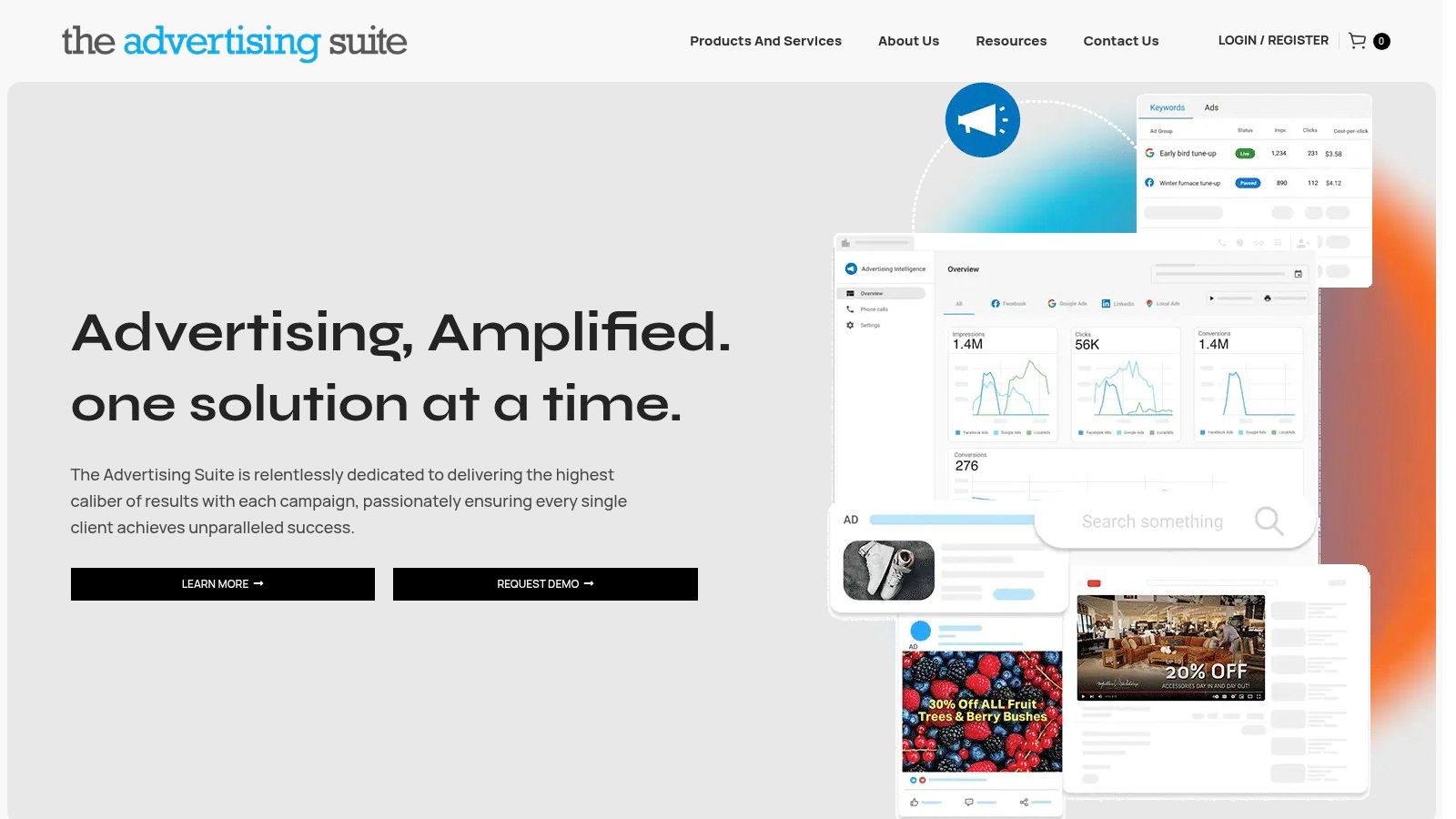
The Advertising Suite's growth-tech hybrid model combines human-led strategy with an integrated CRM and reputation management ecosystem. Its membership includes a 25% discount on all services and provides access to the proprietary CRM, while the company states that more than 10,000 satisfied customers have used its results-first framework.
Book a Growth Consult with The Advertising Suite to connect your advertising, CRM, reputation management, and conversion strategy around revenue. If you need ongoing infrastructure and strategic support, explore the Membership for the service discount and software access, and make a growth-focused partner an extension of your team.