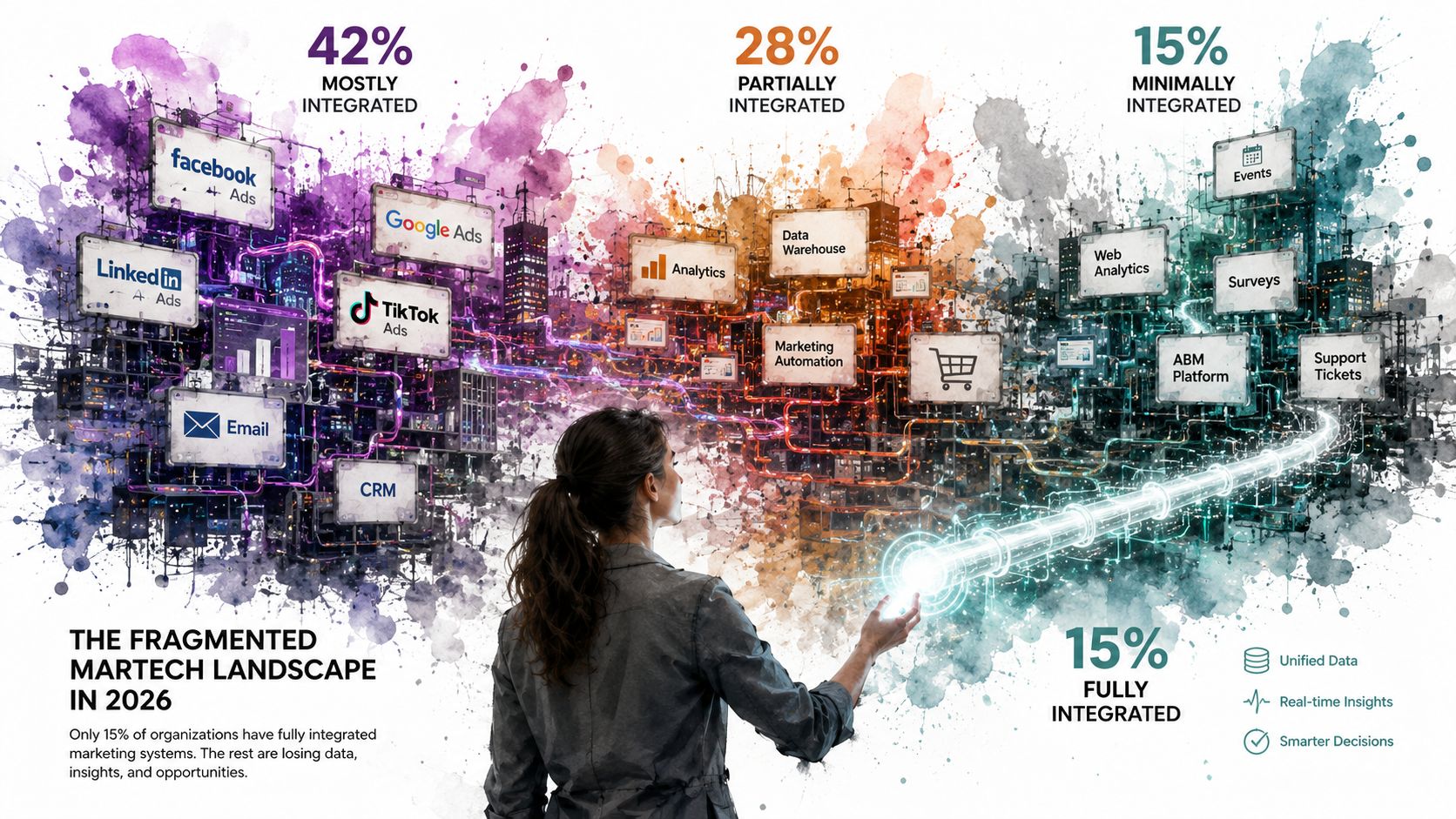
Only 15% of organizations said their systems were completely integrated in a 2024 data-driven marketing survey, while 42% were mostly integrated, 28% were partially integrated, and 15% had minimal or no integration (Ascend2 survey summary). That is the starting point for marketing data integration in 2026. Teams are not short on tools. They are short on a stack that agrees with itself.
When campaign names do not match across channels, CRM records do not line up with ad-platform conversions, and reporting shifts every quarter, the problem is not effort. It is fragmentation. The teams that perform better do not collect the most dashboards, they build the most trustworthy data path from source to revenue. The hard part is usually inside the fields, identity resolution under signal loss, offline-to-online attribution for local businesses, and a minimum viable data model that still holds up under privacy rules.
The market points in the same direction. One estimate places the global data integration market at $15.18 billion in 2026, with a projection to reach $30.27 billion by 2030 at a 12.1% CAGR, while another estimate in the same research set puts it at $14.33 billion in 2026 and $22.17 billion by 2031 at a 9.12% CAGR (market estimate). Those forecasts differ by methodology, but the direction is clear. Integration has moved from back-office plumbing to core infrastructure.
A useful way to think about it is simple. Integration maturity, not tool count, separates predictable revenue from guesswork. If your CRM, ad platforms, analytics, and automation tools do not share a clean model of identity and revenue, every optimization discussion starts with a fight over whose number is right.
Reviewing your martech stack before you buy another tool usually surfaces the same pattern. Teams do not need more connectors in the abstract. They need a narrower, better-governed flow that keeps definitions stable enough to trust.
Why Most Marketing Stacks Stay Fragmented in 2026
Fragmentation survives because stacks usually grow by accident. A team adds paid social, then email automation, then a CRM, then call tracking, and each system is judged in isolation. The result looks advanced on paper, yet the team still cannot answer a basic revenue question without manual cleanup.
What fragmentation feels like in the field
In practice, fragmentation shows up as small mismatches that eat time and trust. Meta and Google Ads can describe the same campaign in different ways, so one source reports it three ways. The CRM shows fewer closed-won records than the ad platform shows conversions, and finance rejects both because neither one ties cleanly to cash.
That is why many teams end up babysitting spreadsheets. They spend hours translating campaign labels, normalizing dates, and explaining why this month's dashboard disagrees with last month's. The operational tax is real, and it grows every time a source changes its schema or someone renames a field.
Practical rule: if a dashboard needs an apology before the meeting starts, the integration layer is already failing.
Reviewing your martech stack before you buy another tool usually surfaces the same pattern. Teams do not need more connectors in the abstract. They need a narrower, better-governed flow that keeps definitions stable enough to trust.
Why maturity matters more than tool count
A stack can have plenty of software and still produce disagreement. The core issue is whether the systems share the same meaning for identity, revenue, and conversion state. Six tools with one clean schema usually outperform twelve tools with three versions of the truth.
That lens matters for the rest of the build. The goal is not to connect everything at once. The goal is to create a system where each connection earns its place by improving attribution accuracy, audience consistency, or operational speed.
Auditing Your Sources and Standardizing KPI Definitions
Before any pipeline gets built, every source needs to be listed in one place. That means ad accounts, web analytics, CRM records, e-commerce events, call outcomes, appointment bookings, reviews, and POS data if the business has offline revenue. Each source should be tagged by owner, refresh cadence, and the identifier fields it carries.
Start with a source inventory, not a dashboard request
A strong source inventory answers three questions fast. Who owns the system, how often does it update, and what key can connect it to the rest of the stack. If those answers are fuzzy, the integration will be fuzzy too.
Once the inventory exists, define metrics before you move a single record. Lead, qualified lead, conversion, revenue event, and assisted touch need exact definitions, or every downstream report becomes a translation exercise. The same goes for currency, time zone, attribution window, and dedupe logic, because “almost aligned” still produces reporting drift.
The cleanest way to do this is to force each KPI into a business event. A booked appointment might matter to operations, but if revenue only happens when the job closes, then the booked appointment is not revenue. It's a stage in the journey, and confusing the two makes paid media look better than it really is.
Use one example to settle the argument
Consider a service business that sees three numbers in circulation. Google Ads reports conversions, the CRM reports closed-won deals, and the booking system reports appointments. Those numbers can all be useful, but they do not mean the same thing.
If the team defines a conversion as “appointment booked,” the media buyer will optimize for volume. If the CFO defines success as “closed revenue,” the same campaign may look weaker but be more profitable. Standardization prevents that argument from turning into a monthly ritual.
Best practice: write the KPI definition next to the field name, not in a separate doc nobody opens.
Aligning email workflows with CRM data becomes much easier once these definitions exist. The technical work is lighter when the business language is already fixed. Without that shared language, even a perfect pipeline just moves confusion faster.
Choosing Between a CDP, a Warehouse, and an ETL Layer
Architecture should follow the team's operating reality, not a vendor ideology. The right stack depends on how fast data needs to move, how much identity resolution you need, how much control your analysts want, and where the activation happens.
Pick the stack that fits the team
A warehouse-first setup works best when the team has analyst capacity and wants flexible modeling. Data lands in a central store, then gets shaped into the business logic the company uses. That's the highest-return choice for teams that care about custom reporting, channel blending, and durable ownership of their data model.
A customer data platform makes more sense when identity resolution and activation speed matter more than modeling freedom. It's the faster path if the team wants to push audiences and events into downstream tools without building much of the plumbing itself. The trade-off is that you accept the platform's logic, which is useful until it isn't.
A pure ETL layer is the most straightforward option when the goal is reliable movement between known sources on a schedule. It's operationally clean, especially for teams that know exactly which systems matter and don't want to maintain custom code. It's also more limited when you need deep modeling or broad activation.
| Architecture fit by team profile | Best for | Latency | Activation path | Watch out for |
|---|---|---|---|---|
| Warehouse-first with connectors | SMBs with analyst support and reporting ownership | Batch or near-real-time depending on setup | BI, revenue modeling, downstream exports | Requires disciplined schema design and ongoing governance |
| CDP | Teams that need identity resolution and quick audience activation | Fast | Audience syncs and event activation | Less modeling freedom, can lock you into its abstraction |
| ETL layer | Known-source movement and scheduled reporting | Scheduled | Warehouse, BI, and downstream syncs | Can become brittle if business logic keeps changing |
For most SMBs, a warehouse-first approach with pre-built connectors is usually the highest-default. It gives the team control without forcing a full engineering project. A CDP becomes worth the complexity when activation speed starts costing measurable revenue.
Building unified customer profiles is easier when the team knows which layer owns identity and which layer owns reporting. That division sounds boring. It's what keeps the stack from turning into a pile of duplicated logic.
Mapping Schemas and Building Pipelines That Do Not Break
Good pipelines fail less because they're clever and more because they're disciplined. The first durable decision is identity. Pick the keys that survive across systems, usually hashed email, phone, customer ID, or a persistent first-party ID, and treat everything else as secondary.
Normalize the meaning before you move the data
Event taxonomies need the same discipline. A “purchase,” a “closed deal,” and a “booked appointment” can all be valid outcomes, but they need to be mapped to different stages in the model. If one source says “conversion” and another says “lead,” you need a translation layer before you load anything into a central repository.
Currency and time zones belong in that same normalization pass. A revenue record in one currency and one calendar day cannot sit next to a record in another without a consistent transformation. If you skip that cleanup, the dashboard will not be wrong in an obvious way, which is worse.
A practical ETL-style sequence is still the cleanest backbone. Extract from each source, transform into a consistent format, then load into a central repository. That pipeline should include validation checks for missing fields and invalid formats, and it should run on a schedule or in streaming mode depending on the business need. A standard ETL sequence is the right starting point here.
Validate against a real source of truth
Serious backend integrations do not trust ad-platform conversions by default. They compare those conversions against CRM or payment-system truth, then keep both tracks running side by side for 2 to 4 weeks before full cutover. That window is long enough to catch missing identifiers, duplicate events, and delayed revenue updates.
During that period, teams often see improved lead quality within 2 to 4 weeks after enriched conversion data starts flowing back to ad platforms. That does not mean the setup is magical. It means better feedback loops give bidding systems better inputs.
Run the old and new paths in parallel long enough to catch the edge cases, not just the happy path.
The cheapest insurance policy a team can buy is a 30-day parallel run with clear validation rules. If the numbers line up closely enough and the business events survive the trip, then cut over. If they do not, keep the old path alive until the mapping is fixed.
Privacy, Consent, and the Case for Fewer Better-Governed Fields
More connections do not automatically produce better decisions. The trap in 2026 is trying to compensate for weaker last-click and user-level tracking with more fields, more joins, and more reporting noise. The stack that performs best is often the one with fewer fields, tighter definitions, and clearer governance.
Build a minimum viable data model
The daily dashboard should only carry fields that can change a budget decision. That usually means qualified lead, closed revenue, and marginal CAC by channel. Everything else belongs in a review layer or a quarterly analysis, not in the view the team checks every morning.
Many teams build themselves into confusion. They stitch identities too aggressively, fill reports with modeled conversions, and treat a polished dashboard as proof that the underlying data is sound. If consent was never granted, the model may still look clean and remain unreliable.
Server-side event forwarding, persistent first-party identifiers, and consent management are core primitives, not optional extras. So are role-based access control and encryption in transit and at rest, because integrated reporting is only as trustworthy as the way the data is handled, not just how fast it moves. For implementation detail, keep the handling rules aligned with guidance on data handling and security.
Use governance as a filter, not a formality
First-party data strategy only works when the fields you keep are fields you can defend. Every persistent identifier should have a documented source, consent state, and use case. If the team cannot explain why a field exists, it probably should not be in the daily model.
A narrow model also makes audits easier. It is simpler to spot a null spike, a missing consent flag, or a broken identity chain when the dashboard is not crowded with vanity fields. Fewer fields do not mean less intelligence. They usually mean less noise and fewer excuses when attribution breaks.
Practical rule: if a field cannot change a spend decision, do not let it shape the daily dashboard.
The strongest integration teams are honest about what they know and what they are inferring. That restraint can look conservative in a pitch deck. In live operations, it keeps the budget from chasing ghosts.
Connecting Offline Revenue Back to the Original Campaign
Most integration guides stop where the browser ends. That leaves the hardest attribution problem untouched, the one local and multi-location businesses live with. Phone calls, walk-ins, appointments, completed jobs, and reviews all matter, but they rarely arrive in one clean digital stream.
Preserve identifiers across the whole customer journey
The fix starts before the lead ever speaks to sales. Dynamic number insertion on landing pages can preserve source context for call tracking, while CRM fields need to hold lead source from first touch through closed deal. Branch-level rollups then turn local events into comparable reporting without erasing where the revenue happened.
Post-sale review events should also carry the original campaign ID when possible. That sounds small, but it lets the team see whether a lead source produces not just bookings, but happy customers who leave evidence behind. For a franchise, that link is a lot closer to profit than a click count ever will be.
A multi-location HVAC brand is a clean example. A Google Local Services lead comes in, the call is tracked, the appointment gets booked, the job gets completed, and the customer leaves a five-star review. If all of that is tagged back to the original keyword and campaign, the team can see which acquisition path created the actual job, not just the phone call.
Treat offline as part of the revenue model
Offline and online data integration is often described in broad terms, but the work is operational. You need lead-source persistence, branch-level reporting, and a way to map revenue stages across browser, phone, and in-person touchpoints without losing the original identifier. That's where attribution either becomes usable or falls apart.
For local service businesses, this is the difference between an ad account that looks busy and one that prints cash. If the original campaign can't survive the trip from ad click to field invoice, the data can't support budget decisions. That's not a reporting problem, it's a revenue problem.
The hardest 20% of attribution is usually offline, and it's the part most dashboards ignore.
The right hybrid model turns reviews, calls, and bookings into a single revenue story. That's the only version of attribution that matters when a service brand is judged by booked work, repeatability, and reputation.
Governing the Stack and Activating Data for Ads and Measurement
An integration stack isn't a project you finish. It's a system you keep honest. Once the data is clean enough to trust, work is governing it, activating it, and checking for drift before it becomes expensive.
Activate only what improves decisions
Enriched audiences should flow back into ad platforms only when the identity model is stable enough to support them. Server-side conversions can help platform optimization, but only if the CRM truth underneath them is clean. Otherwise you're just feeding noisy data into a system that's already guessing.
That's also why measurement loops matter. Spend needs to tie back to closed revenue, not to a screenshot-friendly dashboard. If the team can't trace ad cost to revenue stages, it doesn't have a performance system, it has a reporting ritual.
Multi-touch attribution in practice works best when the underlying pipeline can survive governance checks. The model matters, but the model only works if the data feeding it stays stable. A clever attribution layer can't rescue bad identity hygiene.
Put governance on a calendar
A lightweight cadence keeps the stack from drifting. Run a monthly schema-drift audit, a quarterly consent and access review, and a quarterly KPI definition check. Those meetings are boring in the best possible way, because boring is what data governance should feel like.
Watch for a sudden spike in null customer IDs. Watch for a drop in matched audiences. Watch for a gap between platform-reported and CRM-reported conversions. Those are the early warnings that the stack is losing its grip on reality.
Week one should focus on source inventory, KPI definitions, and identity keys. Week four should be about validation, parallel tracking, and reconciliation against CRM or payment truth. Quarter one should be where governance, audience activation, and reporting hygiene get reviewed as one operating system.
The best version of this stack doesn't need fireworks. It needs discipline, a clean CRM, reliable reviews, and someone willing to keep the model honest when the numbers get tempting. That's where The Advertising Suite's hybrid approach, human-led strategy plus a CRM and review-management tech stack, becomes useful as the operational layer that keeps the system working after the build.
If you want a stack that connects ad spend to real revenue without pretending every dashboard is truth, visit The Advertising Suite and book a growth consult. They can help you turn fragmented marketing data into a cleaner operating system for leads, reviews, and closed deals. Treat them like an extension of your team, not another vendor asking for another login.