Most advice about data-driven marketing solutions is wrong at the foundation.
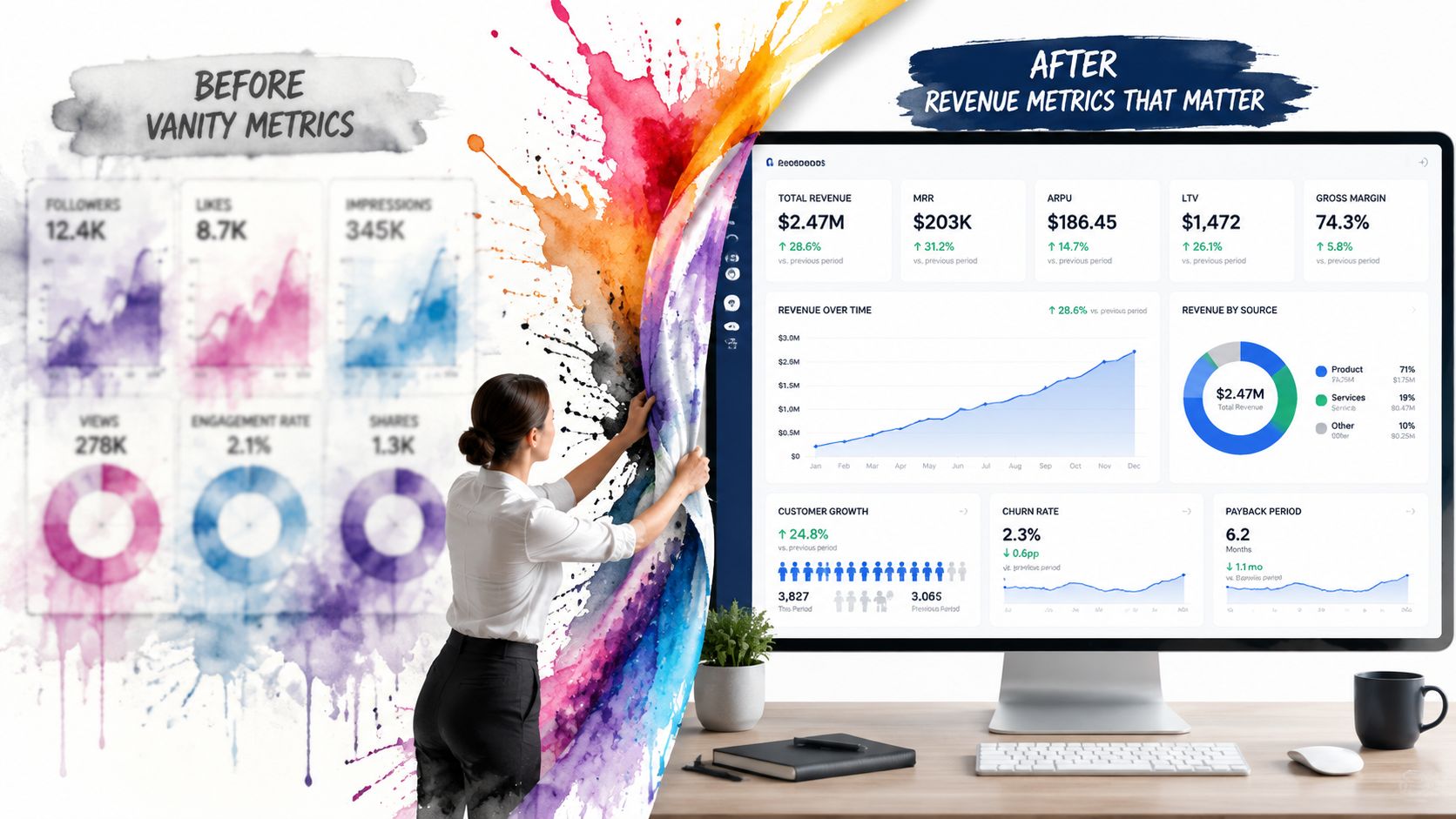
If your team is celebrating rising traffic, cheaper clicks, or a pretty dashboard while revenue stays flat, you are not running a data-driven system. You're running a reporting habit. Plenty of businesses have more charts than clarity. They can tell you which ad got attention, but not which campaign created qualified pipeline, closed deals, or repeat customers.
That's why so many founders feel burned. They paid for activity. They got screenshots, platform metrics, and monthly summaries full of motion. What they didn't get was a clean answer to the only question that matters. Did this investment produce profitable growth?
Old marketing tactics fail because they optimize the wrong layer of the problem. They treat media buying as the whole job. It isn't. Growth comes from the connection between targeting, message, conversion path, sales follow-up, and customer experience after the click. Break that chain anywhere, and your “performance” numbers become expensive fiction.
A revenue-first model fixes that. It starts by rejecting vanity metrics as the scoreboard and replacing them with business outcomes. If you want a better framework than campaign-first thinking, start with performance marketing solutions tied to revenue outcomes.
Moving Beyond Data-Driven Marketing Myths
The biggest myth is simple. If you track marketing data, you're data-driven.
No, you're not.
A business becomes data-driven when it uses connected information to make better revenue decisions. Tracking impressions, clicks, video views, and website sessions doesn't qualify on its own. Those are symptoms. They might matter. They might also be noise.
The vanity metric trap
Most underperforming programs share the same flaw. They optimize what platforms report easily instead of what the business needs urgently.
That usually looks like this:
- More traffic, same sales: The campaigns attract visitors who were never likely to buy.
- Lower click costs, weaker lead quality: Cheap attention replaces qualified demand.
- Higher engagement, no operational follow-through: Marketing creates interest, but sales, nurture, or booking systems drop it.
Practical rule: If a metric can rise while profit falls, it is not a primary KPI.
That's where old agency logic breaks down. It treats channel metrics as proof of success. A founder sees green arrows, hears that campaigns are “optimizing,” and still wonders why payroll feels heavier than growth.
What real accountability looks like
Real data-driven marketing solutions don't start with the ad account. They start with the business model.
Ask harder questions:
| Weak question | Useful question |
|---|---|
| Did clicks increase? | Did qualified demand increase? |
| Did reach expand? | Did revenue from the right customers grow? |
| Did cost per click drop? | Did acquisition become more efficient? |
A serious growth partner ties campaign decisions to what happens after the lead form, phone call, checkout, or booked appointment. That means sales data, CRM status changes, repeat purchase behavior, and lead quality all need to feed back into marketing decisions.
If that sounds more demanding than standard campaign management, good. It should. Marketing that isn't connected to revenue is just busy work with a budget.
What Data-Driven Actually Means for Your Bottom Line
Think of the difference like this. A bad doctor treats a cough and sends you home. A good doctor figures out what caused the cough in the first place.
Bad marketing teams treat clicks like the diagnosis. Good teams use data to find the underlying cause of growth or stagnation. They look at who converted, what message moved them, which channel introduced them, what happened after the first touch, and whether the sale was worth acquiring.

Data should answer revenue questions
The point of data is not accumulation. It's decision quality.
A useful system helps you answer questions like:
- Which audiences produce profitable customers
- Which offers convert without crushing margin
- Which channels assist conversion even when they don't get last-click credit
That's what separates random reporting from real operating intelligence. If your numbers can't tell you where profitable growth comes from, they aren't helping you lead.
Customer expectations make this even more urgent. Adobe's summary of McKinsey research on personalized interactions states that 71% of consumers expect companies to deliver personalized interactions, while 76% get frustrated when that does not happen. That's not a creative preference. It's an operating requirement. If your business can't connect behavior, purchase history, and engagement signals, your personalization stays shallow and your conversion path stays generic.
Personalization is not a gimmick
Good personalization is not “Hi first name” in an email subject line. It's using real customer signals to change what the business shows, says, and prioritizes.
That might include:
- Audience-specific offers: Returning buyers see different promotions than first-time visitors.
- Channel timing: Prospects who engage by email receive different follow-up than people who call directly.
- Sales prioritization: Higher-intent leads move faster because behavior signals show stronger purchase intent.
A revenue-first team doesn't ask, “How much data can we collect?” It asks, “What data helps us create and measure profitable customer movement?”
If your current reporting still lives mostly inside ad platforms, fix that next. Start by understanding how to calculate marketing ROI with actual business outcomes. Until you connect spend to revenue events, “data-driven” is just branding.
The Core Components of a Revenue-First Framework
Most businesses treat marketing like a row of disconnected tools. One system runs ads. Another sends emails. Another tracks leads. Another reports results. That setup creates fragmentation, duplicate effort, and bad judgment.
A revenue-first framework works differently. It behaves like a growth loop, where each component sharpens the next.
LeadingResponse's article quoting ZoomInfo data on data-driven marketing effectiveness reports that 78% of organizations say data-driven marketing increases lead conversion and customer acquisition. That only happens when the system is connected. Isolated tactics don't compound well.
The six parts that have to work together
Here's the framework I recommend for SMBs that want data-driven marketing solutions tied to real growth:
- Data collection: Capture the signals that matter from forms, calls, purchases, sales updates, and customer behavior. If the inputs are weak, every downstream decision gets worse.
- Analytics and insight generation: Raw data is useless until someone turns it into decisions. Teams need visibility into which campaigns create qualified movement, not just platform activity.
- Strategic creative: Creative should reflect what the data says about buyer intent, objections, and urgency. If the message ignores actual customer behavior, targeting alone won't save it.
- Omnichannel execution: Buyers don't move in a straight line. Search, social, email, direct visits, and offline interactions need to work together instead of competing for fake credit.
- Conversion rate optimization: Traffic without conversion discipline is a tax. Landing pages, forms, booking flows, and follow-up paths need constant pressure testing.
- CRM as the control center: This is the nervous system. It connects lead source, status, sales progression, customer history, and retention activity so the business can improve the whole funnel.
Why the CRM can't be an afterthought
Too many businesses bolt on a CRM after campaigns launch, then wonder why reporting is messy and sales feedback never reaches marketing.
A strong CRM setup changes the quality of every decision:
| Without CRM alignment | With CRM alignment |
|---|---|
| Leads get counted | Leads get qualified |
| Campaigns get judged by clicks | Campaigns get judged by outcomes |
| Sales and marketing argue | Sales and marketing work from one record |
This is why first-party data strategy matters. If your business wants cleaner targeting and stronger attribution, it needs a first-party data strategy built around connected customer records.
The loop is the strategy
The advantage isn't any single component. It's the feedback loop.
Creative improves because CRM data reveals what closes. CRO improves because campaign traffic exposes friction points. Retention improves because post-sale behavior informs future targeting. Better retention then improves customer value, which changes how aggressively you can acquire.
That's how modern marketing should run. Not as a pile of subscriptions. As one revenue system.
Your Practical Implementation Roadmap for Growth
Most SMBs make the same mistake when they try to become “more data-driven.” They start shopping for dashboards.
That's backward. Dashboards are the last layer, not the first. If your data is fragmented, mislabeled, and trapped across channels, a shiny reporting view just gives you faster confusion.
Start with data unification
The first move is to create a central source of truth. Improvado's guidance on warehouse-first marketing stacks explains that a technically sound data-driven marketing stack is usually warehouse-first, where campaign, CRM, and revenue data are centralized into governed pipelines and unified in a warehouse so teams can standardize schemas and enforce data quality.
If you're a smaller business, that principle still applies even if your setup is simpler. The structure matters more than the label. You need one core environment where marketing data and business outcomes meet.
Use this sequence:
Unify the sources
Pull campaign data, lead records, sales outcomes, and customer revenue into one governed system. Stop relying on disconnected exports and manual reconciliation.
Define shared business events
Agree on what counts as a qualified lead, booked appointment, sales opportunity, closed customer, repeat buyer, and lost deal. If marketing and sales use different definitions, your reporting will stay political.
Fix identity and handoff issues
Make sure leads can be matched from first touch through follow-up and revenue outcome. If handoffs break, attribution becomes fiction.
Your business does not need more tools first. It needs fewer blind spots.
Build tracking around decisions, not curiosity
Once the data core is in place, set up tracking that supports action.
That means focusing on:
- Source-to-revenue visibility: Can you see which campaigns produce valuable customers, not just leads?
- Stage progression: Can you track where prospects stall between inquiry and sale?
- Response speed and nurture paths: Can you measure whether operational lag is wasting paid demand?
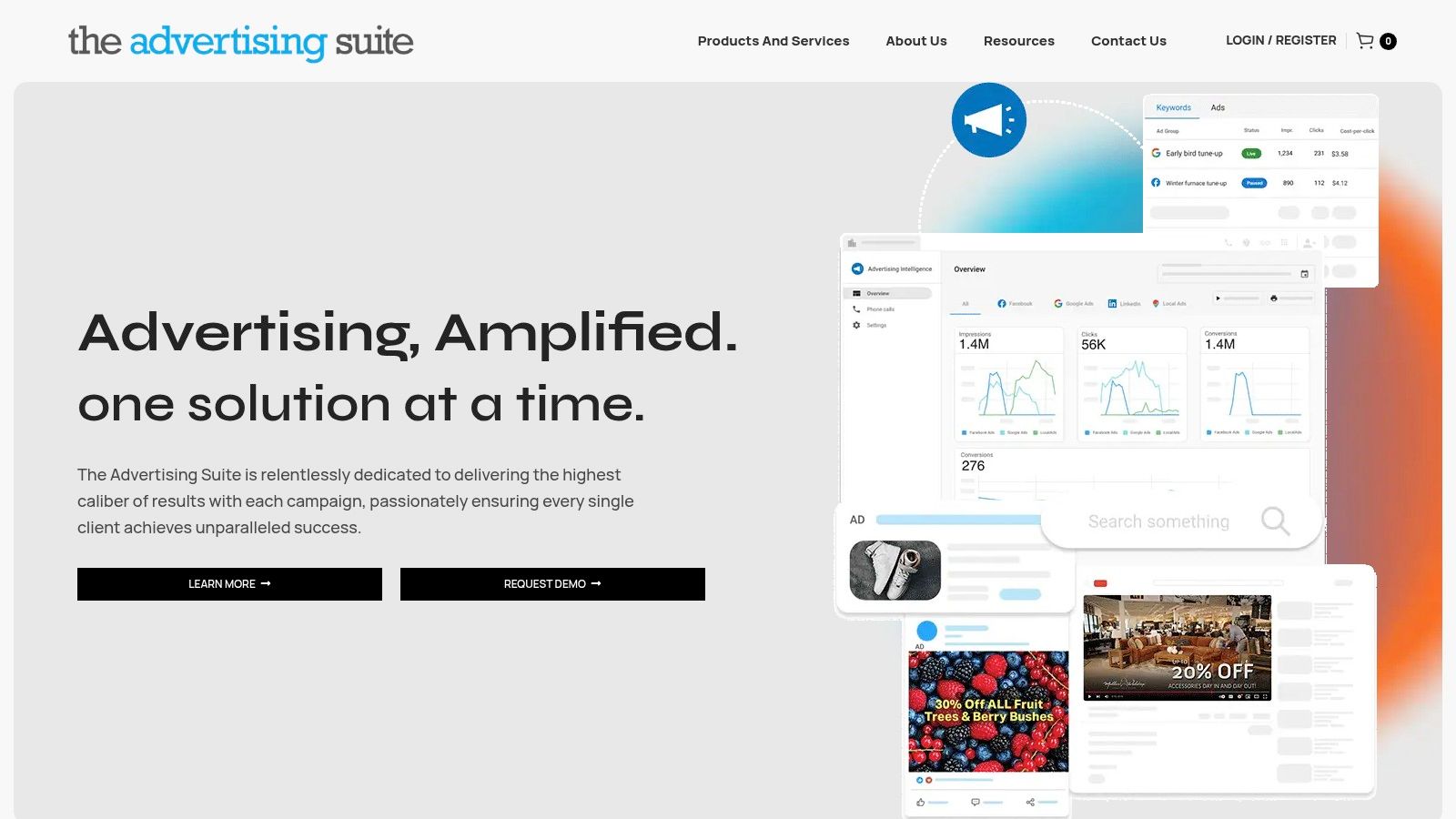
This is also where an integrated operating layer matters. One option is a setup that combines execution with CRM workflows and review management so marketing, follow-up, and customer experience feed the same system. The Advertising Suite provides that kind of integrated environment through its CRM and reputation workflow structure for businesses that want those pieces connected from the start.
Launch in controlled phases
Do not try to perfect every channel at once. Roll out in stages.
A practical rollout looks like this:
| Phase | Priority |
|---|---|
| Foundation | Unify data, standardize events, clean handoffs |
| Activation | Launch campaigns with revenue-linked tracking |
| Optimization | Refine creative, funnels, and follow-up using actual outcome data |
That sequence prevents a common disaster. Teams often scale spend before they've fixed sales visibility, landing page friction, or lead management. Then they blame the channel when the underlying problem is inside the funnel.
If you need process support at the handoff and nurture level, build marketing automation workflows that connect lead activity to follow-up actions. Automation should reinforce human decision-making, not replace it. The right sequence gives your team a repeatable growth engine instead of another quarter of guesswork.
How to Measure What Matters With Revenue-Focused KPIs
Clicks are not revenue. Impressions are not revenue. Likes are definitely not revenue.
Those numbers can be useful diagnostics, but they should never be the scoreboard. If your reporting starts and ends there, you're managing attention, not growth.
Replace surface metrics with business metrics
Here's the practical shift:
| What weak reporting emphasizes | What revenue-focused reporting emphasizes |
|---|---|
| Clicks | Customer acquisition cost |
| Impressions | Return on ad spend |
| Cost per click | Conversion rate |
| Engagement rate | Customer lifetime value |
This isn't semantics. It changes budget decisions.
A campaign with cheap traffic can still be a terrible investment if it produces low-intent leads, poor close rates, or one-time buyers with weak margins. A campaign that looks expensive on the surface can be the smarter play if it attracts better-fit customers and stronger long-term value.
Use measurement models that reflect reality
Last-click attribution has trained too many teams to believe the final touch deserves all the credit. That's lazy measurement.
The University of Minnesota's guide to advanced measurement in data-driven marketing notes that advanced measurement typically combines media mix modeling and multitouch attribution. MMM uses aggregated historical data to estimate how channels affect sales at a macro level, while MTA assigns fractional credit across touchpoints in the customer journey.
You don't need to become a statistician to use the logic behind that. You do need to stop pretending one click explains the whole sale.
When multiple channels influence the same customer, single-touch reporting gives clean numbers and bad decisions.
Audit your KPI stack
A useful KPI stack should tell you three things:
- Efficiency: Are you acquiring customers at a sustainable cost?
- Quality: Are those customers moving through the funnel and closing?
- Value: Are they generating enough revenue to justify continued investment?
If your dashboard can't answer those, it's decoration.
For businesses trying to make better channel decisions, marketing attribution guidance focused on conversion paths is a smarter starting point than another round of platform screenshots. Better measurement won't make weak strategy disappear, but it will stop weak strategy from hiding behind vanity metrics.
Why You Need a Growth Partner Not Another Agency
If you've been burned before, you already know the pattern. The agency talks about creativity, reach, and optimization. You ask about revenue. They respond with activity reports.
That's a vendor relationship, not a growth partnership.

The difference shows up in the questions they can answer
A real partner should be able to handle questions like these without dodging:
- How do you connect marketing activity to revenue outcomes?
- How do you handle fragmented data across channels, sales, and customer records?
- What happens when privacy changes reduce signal quality?
- Do you improve follow-up, conversion flow, and customer experience, or just buy media?
Those questions matter because modern measurement is messier than it used to be. Maryville University's discussion of privacy changes and signal loss in data-driven marketing highlights that realistic implementations require data integration, cross-team access, and modeling to replace incomplete signals. Generic agency setups usually don't solve that. They just report around it.
Vendor versus growth partner
Here's the blunt version:
| Typical vendor | Growth partner |
|---|---|
| Manages campaigns | Builds a revenue system |
| Reports platform metrics | Reports business outcomes |
| Works in channel silos | Connects media, CRM, sales, and follow-up |
| Reacts to results | Designs for measurement and scale |
The partner you want should make your business harder to misread.
That means integrated visibility, operational follow-through, and reporting that executives can use. It also means they should function like part of your team, not a detached media buyer who disappears after launch.
Why the model matters
The growth-tech hybrid approach proves more practical than the old agency model. Businesses need strategy, execution, CRM alignment, and reputation management working together. Treating those as separate add-ons usually creates delays, data gaps, and accountability fog.
The membership model matters for the same reason. If your team gains software access and service support in one structure, adoption gets easier and handoffs get cleaner. At The Advertising Suite, the Membership includes a 25% discount on services and provides access to the proprietary CRM. That setup is useful for businesses that want one operating rhythm instead of stitching together scattered providers.
If a prospective partner can't speak clearly about revenue, signal loss, and system integration, keep walking. You don't need another campaign manager. You need a team that can help run growth with you.
Your Next Step Toward Predictable Profit
Data-driven marketing solutions only work when they're connected to how your business makes money.
That means no more treating ads as separate from follow-up. No more celebrating top-of-funnel activity while the bottom of the funnel leaks. No more confusing reporting volume with strategic clarity. The businesses that grow sustainably build one system for acquisition, conversion, customer experience, and measurement.
That system doesn't need to be bloated. It needs to be disciplined.
If your current setup still runs on fragmented tools, vanity KPIs, and crossed fingers, fix the operating model before you scale the budget. The payoff isn't prettier reporting. It's a marketing engine you can trust when acquisition costs rise, signals weaken, and every dollar has to work harder.
The next move is straightforward. Get an outside view of where your funnel breaks, where your data disconnects, and where your measurement is lying to you. Then build from there.
If you're ready to replace scattered tactics with a revenue-first growth system, The Advertising Suite is worth a serious look. You can Book a Growth Consult to get a clearer view of what's blocking profitable scale, or Explore the Membership if you want the added benefit of the built-in CRM and the 25% discount on services. Either way, the goal is the same. Bring in a partner that operates like an extension of your team, not another vendor chasing clicks.