Views do not pay you. Revenue does.
A lot of advice about YouTube ads best practices still treats watch time, clicks, and engagement as proof of success. That thinking burns budget. A campaign can look strong inside the ad platform and still send low-quality leads, weak buyers, and poor close rates into your pipeline. If you cannot trace performance past the ad and into sales activity, booked calls, purchases, and customer value, you do not have a reliable acquisition channel.
YouTube works best when you run it like a revenue system. Build campaigns around qualified demand, clear buying stages, and conversion data that connects creative, targeting, follow-up, and sales outcomes. That means stronger hooks, tighter audience control, smarter exclusions, and a backend that shows what happened after the click. It also means using customer behavior analytics tied to your CRM and pipeline outcomes so you can see which ads produce real buyers instead of cheap traffic.
The platform gives you reach. Reach alone is worthless without control. What matters is whether your campaigns lower CPA, raise ROAS, and produce leads your team can close.
That is the filter for everything in this guide.
These best practices are built for operators who care about profit, not applause. They treat creative, bidding, audience strategy, CRM, and review management as one system because that is how YouTube becomes predictable. Done right, it does more than generate attention. It produces measurable growth.
1. Implement Data-Driven Creative Testing with Conversion Tracking
Often, teams test creative like amateurs. They swap three things at once, glance at the click rate, then call a winner. That's how budgets disappear.
Test one meaningful variable at a time. Change the opening line, the offer framing, the product demo angle, or the call to action. Then track what happened after the ad, not just inside it. A product-focused video might drive fewer clicks than a lifestyle cut and still generate better buyers. A testimonial ad might look less flashy and produce stronger sales calls.
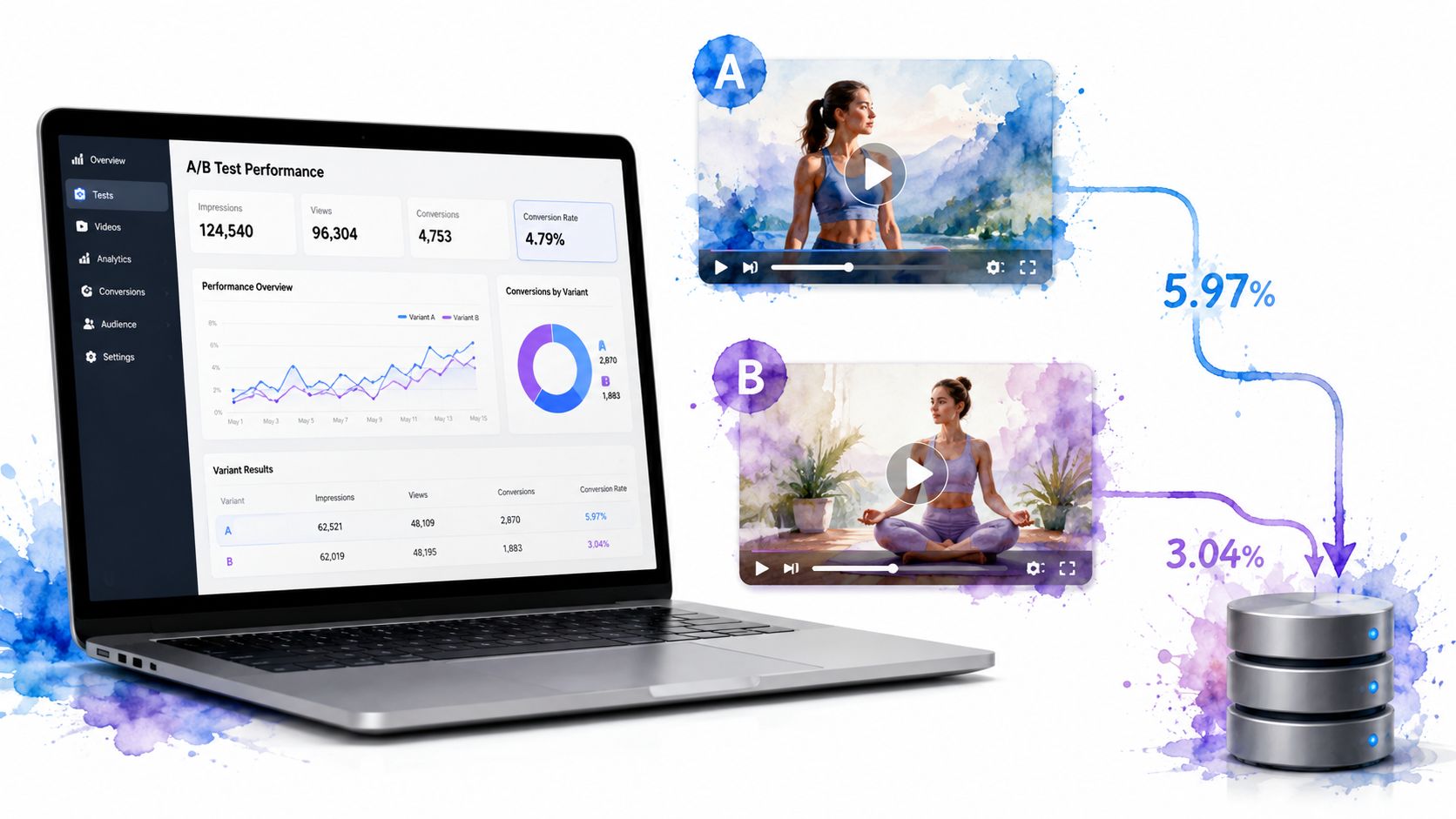
An ecommerce brand should test product-in-use footage against founder-led explanation. A SaaS company should compare demo-first creative against problem-agitation creative. A local service business should test emergency pain-point messaging against trust-and-reputation messaging. The point isn't to “improve the ad.” The point is to learn which message creates revenue.
Connect the ad to the sale
YouTube ad testing gets serious when ad data flows into your CRM. If a campaign sends leads that never answer the phone, that matters. If a different ad sends fewer leads but more booked jobs, that matters more.
Use customer behavior analytics to connect creative inputs to downstream outcomes like qualified appointments, closed deals, repeat purchases, and customer value. That's where YouTube stops being a media expense and starts acting like an accountable acquisition channel.
- Test one variable only: Keep the audience, offer, and landing page stable while you change a single creative element.
- Label assets clearly: Name videos by hook, angle, audience, and CTA so your team can spot patterns fast.
- Document winners: When a structure works, reuse the pattern across new offers and audiences.
Practical rule: If you can't explain why one creative beat another, you didn't really test it.
2. Leverage Audience Segmentation With Custom Intent-Based Targeting
Broad targeting makes lazy marketers feel efficient. It usually makes profitable marketers poorer.
Strong YouTube campaigns start with intent. Who is actively researching the problem you solve? Who has moved beyond casual interest? Who is close enough to buying that your video can accelerate the decision instead of introducing the category from scratch?
A home services brand shouldn't lump everyone into one campaign. Someone searching service-plus-location terms behaves differently from someone watching general home improvement content. A B2B software company shouldn't treat all business viewers the same either. Decision-makers researching workflow pain points need one message. General awareness audiences need another.

Build segments around buying behavior
Segment by search intent, customer stage, service line, geography, and exclusions. Then write creative for each group. That's one of the most overlooked YouTube ads best practices because it requires actual strategy, not just campaign setup.
For example:
- High-intent prospects: Use direct problem-solution messaging and a clear next step.
- Consideration audiences: Use demonstrations, proof, comparisons, and objection handling.
- Awareness audiences: Lead with the pain point and the stakes of inaction.
Don't let “reach” seduce you. Narrower audiences often produce better unit economics because the message fits the moment. Add negative keywords and audience exclusions where needed so you stop paying for the wrong curiosity.
A franchise brand can break audiences out by territory. An ecommerce company can segment by product category interest. A medical practice can separate elective procedures from urgent inquiries. Precision wins because relevance wins.
3. Optimize Video Length and Hook Timing for Platform and Viewer Behavior
YouTube does not reward slow starts. It punishes them with skipped impressions, wasted spend, and weak conversion volume.
Your opening has one job. Show the problem, the payoff, or the proof fast enough to earn the next few seconds. If the viewer cannot tell why the ad matters right away, your CPM turns into a tax on curiosity instead of a path to revenue.
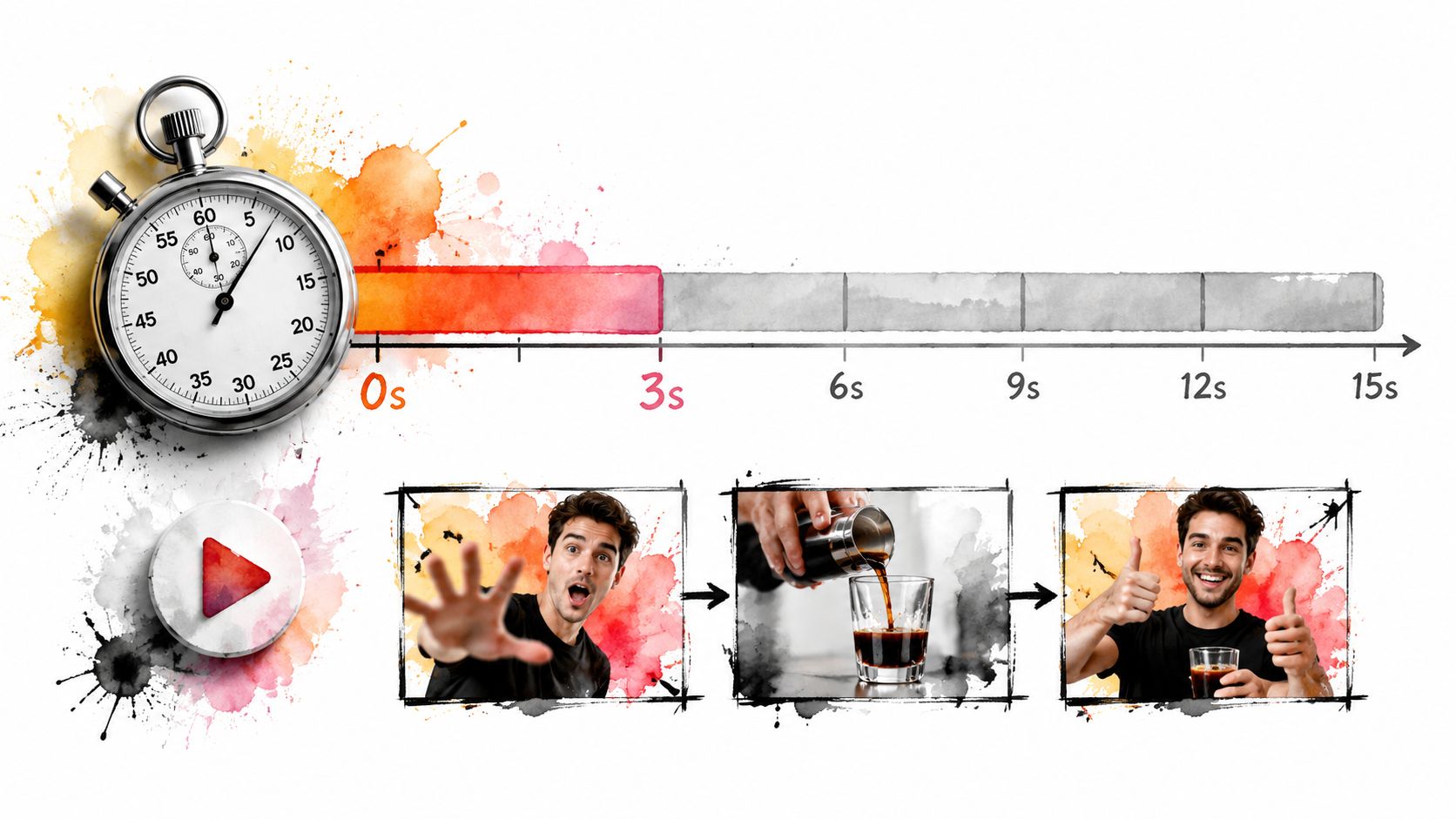
Start with what the buyer already cares about. A local roofer should open on storm damage and the insurance headache. A software company should show the broken workflow or reporting mess that costs the prospect time and money. A consumer brand should show the product solving the problem before the explanation starts. Strong hooks clarify the value immediately.
Match length to buying intent
Video length should follow sales intent, not creative ego. Short ads work when the audience already knows the category or the brand and just needs a reminder, offer, or next step. Longer ads earn budget when they remove friction, answer objections, or prove the product works.
Use videos for advertising built for the stage of the sale, not leftover brand footage that looks polished but does nothing for CPA or ROAS. A six-second ad can keep warm prospects moving. A thirty-second ad can explain a service clearly. A longer testimonial or demo can close trust gaps if your CRM shows that hesitation, not awareness, is what slows revenue.
A few rules hold up across industries:
- Open with the pain point or result: Skip logo-first intros and get to the reason the viewer should care.
- Show the brand early: Brand recall matters more when the message lands before the skip.
- Put the CTA in before the final seconds: Late calls to action get missed, especially when attention drops.
- Edit for retention and action: If a scene does not increase trust, clarity, or urgency, cut it.
Views are not the scoreboard.
Watch where viewers drop off, then tie that behavior to downstream outcomes. If people leave early, the hook failed. If they watch but do not convert, the offer, CTA, landing page, or follow-up process is the problem. That is why timing decisions should connect back to your full stack, including conversion tracking, CRM attribution, and review proof. Creative length is not an artistic choice. It is a margin decision.
4. Implement Multi-Stage Funnel Campaigns With Sequential Messaging
One ad rarely closes a meaningful sale. Stop asking it to do a full sales team's job.
People need different messages at different stages. Cold audiences need problem recognition. Warm audiences need proof. Near-buyers need clarity, urgency, and reduced friction. Sequential messaging solves this by moving viewers through a planned journey instead of hammering the same ad over and over.
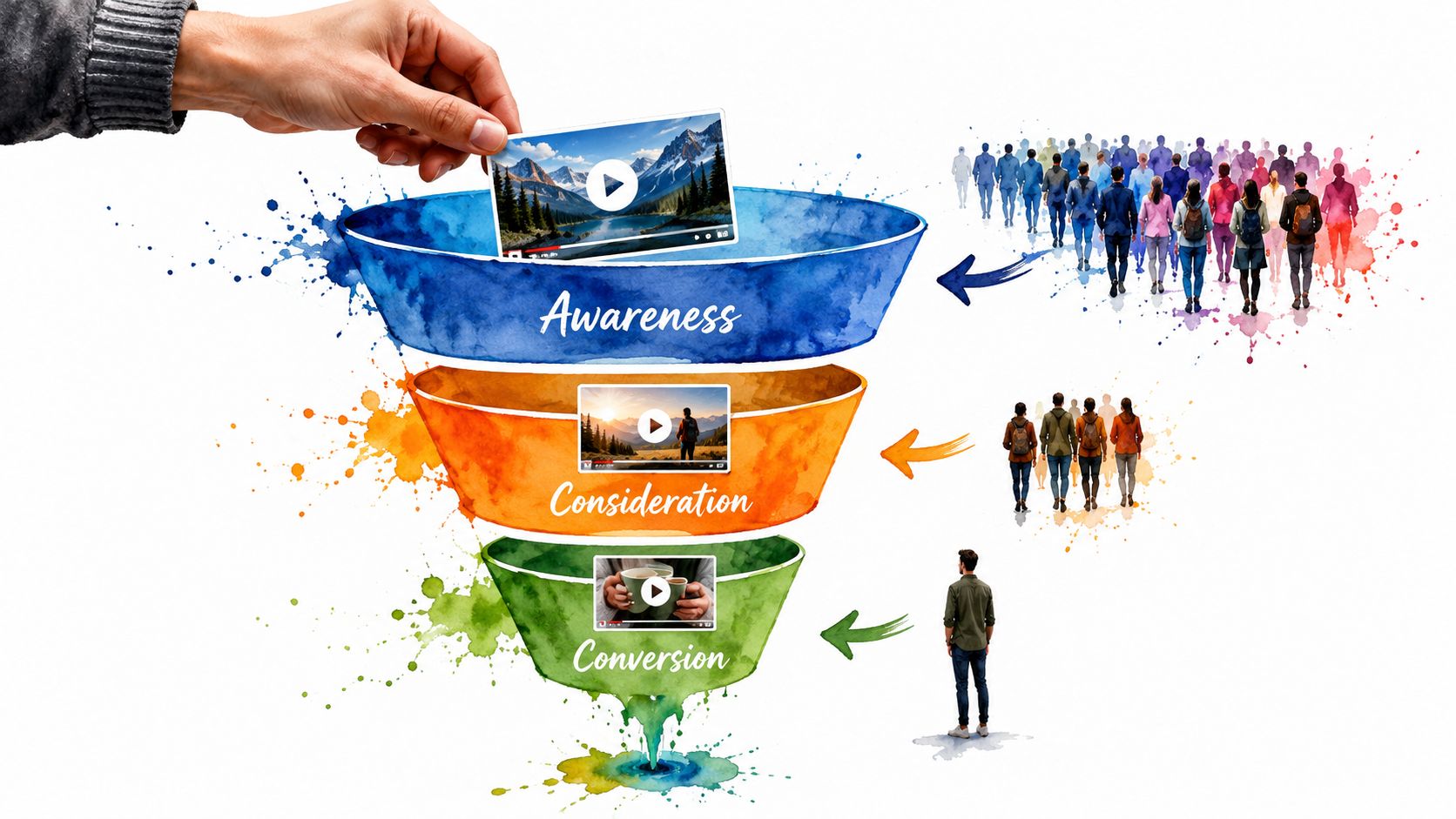
A home services franchise can start with neighborhood-level problem awareness, then serve comparison-style messaging to site visitors, then push offer and review-focused conversion ads to people who engaged significantly. An ecommerce brand can lead with category pain, follow with product education, then close with urgency and customer proof. A SaaS company can move from challenge-based thought leadership into demos and onboarding risk reduction.
Push viewers forward, not sideways
Each campaign stage should answer a different question:
- Awareness: Why should I care?
- Consideration: Why should I trust you?
- Conversion: Why should I act now?
Keep your branding consistent across stages so the journey feels connected. Change the message, not the identity. If every ad looks unrelated, you're forcing the buyer to start over.
Many advertisers waste budget by retargeting everyone with the same generic sales pitch. Better sequencing respects buying temperature. It also gives your team cleaner diagnostics. If awareness works but consideration stalls, you know exactly where the funnel needs repair.
5. Use Audience Exclusions and Negative Targeting to Cut Waste
You don't scale profit by paying for bad traffic more efficiently.
A clean YouTube account excludes people who shouldn't see a campaign. Existing customers don't belong in acquisition ad sets. Shoppers looking for free solutions usually don't belong in premium-service campaigns. People outside your service area definitely don't belong in your budget.
This sounds obvious. It's not common enough.
A local law firm should exclude regions it doesn't serve. A plumbing company should suppress DIY-style intent if it wants urgent service calls, not tutorial seekers. A subscription brand should split current customers into their own retention or upsell campaigns instead of mixing them with cold acquisition traffic. That one move alone creates cleaner reporting and better budget discipline.
Build one strong exclusion framework
Don't create a mess of tiny, overlapping exclusions no one can manage. Build a controlled framework tied to real conversion behavior.
- Exclude existing customers: Run separate retention and upsell campaigns for them.
- Exclude weak-fit intent: Remove search themes and audiences that signal low buying probability.
- Exclude low-value geographies: If an area repeatedly produces poor lead quality, stop funding it.
- Exclude brand-risk placements when needed: Protect trust, especially in regulated or reputation-sensitive industries.
Bad traffic doesn't become good traffic because the creative team worked harder.
Review exclusions regularly. Markets shift, offers change, and some segments deserve a second look. But don't romanticize “top-of-funnel reach” when your business needs profitable demand. Tight exclusions are one of the least glamorous and most effective YouTube ads best practices.
6. Leverage Responsive In-Stream Ads With Controlled Automation
Automation isn't the strategy. It's a force multiplier for a strategy that already makes sense.
Responsive in-stream formats can help you test combinations of headlines, descriptions, images, and video assets without manually building every variation. That's useful, especially when managing multiple offers, locations, or audience segments. It is not permission to upload weak assets and hope the algorithm develops standards.
The best use of automation is operational, not philosophical. Feed the system strong ingredients. Then let it discover combinations that align with actual user behavior.
A retail brand might upload multiple value propositions around convenience, quality, and price positioning. A franchise organization might provide location-specific messaging variations. A software company might mix benefit-led and role-specific headlines to see which direction resonates with each audience cluster.
Give the machine something worth optimizing
Responsive formats work when the inputs are distinct enough to teach the system something. Five slightly different versions of the same boring line won't help.
Build asset sets with contrast:
- Emotion-led messaging: Relief, confidence, speed, convenience.
- Logic-led messaging: Process, proof, offer structure, service scope.
- Trust-led messaging: Reviews, guarantees, credentials, experience.
Google Ads says its optimization recommendations are based on Google's internal data. Treat that as a technical reason to test and optimize systematically, not as a reason to hand over judgment. Your team still needs to review what combinations are drawing attention and which ones are attracting weak-fit traffic.
Automation helps scale learning. It doesn't replace positioning, offer quality, or funnel discipline.
7. Implement Smart Bidding That Maps to Business Outcomes
If you're still optimizing YouTube around cheap views, you're buying activity, not outcomes.
Bidding strategy should reflect the economics of the business. If your company needs a certain acquisition cost to stay profitable, bid toward that. If your ecommerce model depends on revenue efficiency, align campaigns around return. Don't let the platform optimize for what's easy to count when your finance team cares about what's hard to fake.
That's why smart bidding matters when the account has proper tracking behind it. Bidding toward acquisition or return forces the platform to pursue users more likely to create business value, not just cheap engagement.
Bid against what finance cares about
The metric names aren't the point. The point is alignment.
Use return on ad spend and acquisition economics as operating constraints, then let bidding support them. A direct-to-consumer brand may care about order value and margin. A legal firm may care about signed cases, not form fills. A dental group may care about booked procedures, not leads that vanish after one voicemail.
- Feed accurate conversions back to the platform: Bad data creates bad bidding.
- Separate campaign goals: Don't mix awareness and conversion expectations in one setup.
- Adjust targets deliberately: Sharp changes create chaos and muddy your read on performance.
This is one of the clearest dividing lines between hobbyist media buying and real performance management. The campaign should adapt to the business model, not the other way around.
8. Create Localized Campaigns for Multi-Location and Service-Area Brands
National creative with generic copy usually underperforms for local businesses. People want to know you serve their area, understand their problem, and can help.
If you run multiple locations, break campaigns out by territory or service region. Let each market earn budget based on quality, not internal politics. A plumbing company in a cold-weather market should speak differently than one in a year-round warm region. A dental group should tailor messaging around local trust signals, availability, and location-specific reputation. A franchise network should stop pretending one-size-fits-all creative creates accountability.
Make local relevance obvious
Use campaigns that reflect real market conditions and real operating capacity. Then tie them to local conversion tracking, not blended reporting that hides underperforming locations.
A better approach includes:
- Location-specific messaging: Mention the service area, local pain points, and relevant urgency.
- Location-level budgets: Fund markets based on opportunity and conversion quality.
- Location-level follow-up: Route leads correctly and measure what each branch closes.
For service businesses, lead generation for local businesses only works when ad targeting, landing pages, and sales handling are built for local intent. Otherwise, you're paying to create confusion at scale.
Local advertising fails when the creative says “we know your market,” but the follow-up process acts like a call center lottery.
9. Build Strategic Remarketing With Tiered Messaging
Remarketing isn't just “show them the ad again.” That's lazy, and buyers can feel it.
Warm audiences need customized follow-up based on what they already did. Someone who visited a pricing page should see different messaging than someone who watched part of a product video. Someone who abandoned a cart needs a different prompt than a previous customer ready for a repeat purchase. If you treat all warm traffic the same, you flatten intent and lose efficiency.
A service business can retarget recent site visitors with trust-heavy creative focused on reviews, response speed, and next-step simplicity. A SaaS brand can retarget demo-page visitors with onboarding clarity and proof of fit. An ecommerce brand can retarget product viewers with creative centered on use case, product detail, and urgency.
Build remarketing by behavioral depth
Segment audiences by the action they took, then write ads that answer the hesitation behind that action.
- Video viewers: Reinforce the core promise and invite a next step.
- Website visitors: Focus on credibility and differentiation.
- High-intent page visitors: Handle objections and reduce friction.
- Existing customers: Push cross-sell, upsell, or repeat use cases.
Use sequential messaging inside remarketing too. The first reminder can be soft. The next can introduce proof. The next can sharpen urgency. What matters is progression.
Done well, remarketing turns wasted interest into recovered revenue. Done poorly, it just turns your brand into background noise.
10. Align YouTube Ads With Review Management and Social Proof
Most ads ask for trust before they've earned it. Reviews fix that, if you use them.
For many businesses, especially local service brands and high-consideration offers, trust is the primary conversion bottleneck. Not awareness. Not reach. Trust. People want evidence that someone else chose you and was glad they did. That evidence should show up in the ad, on the landing page, and in the follow-up flow.
A restoration company can feature a real customer describing response speed and professionalism. A med spa can use testimonial-style creative that addresses hesitation directly. A software company can send traffic to pages where customer proof is visible immediately, not buried under polished brand copy.
Put proof where the buyer needs it
Social proof should support the buyer at the moment doubt shows up.
- Use testimonial video in rotation: Real customer language often outperforms polished brand scripting.
- Match reviews to the offer: Show proof relevant to the service line or product category being advertised.
- Send traffic to trust-built pages: Don't pay for a qualified click, then dump it on a generic homepage.
If your review pipeline is weak, fix it. How to get more Google reviews isn't a side project. It's part of conversion infrastructure.
Trust doesn't live in your brand guidelines. It lives in what customers say after doing business with you.
For The Advertising Suite, the hybrid model holds particular importance. Review management isn't an add-on after the ad campaign. It's part of the same system that turns cold traffic into confidence and confidence into revenue.
YouTube Ads Best Practices: 10-Point Comparison
| Strategy | Implementation complexity | Resource requirements | Expected outcomes | Ideal use cases | Key advantages |
|---|---|---|---|---|---|
| Implement Data-Driven Creative Testing with Conversion Tracking | High, complex setup and attribution | Analytics/CRM integration, tracking pixels, multiple creative variants, sufficient traffic | Identify revenue-driving creatives; improved ROAS and scalable winners | E‑commerce, SaaS, data-driven brands with mid+ budgets | Ties creative to revenue; automated winner identification; reduces wasted spend |
| Leverage Audience Segmentation with Custom Intent-Based Targeting | Medium–High, requires customer-journey mapping | Keyword research, audience lists, ongoing refinement | Higher ROAS and more qualified traffic; fewer wasted impressions | Limited-budget advertisers, local services, B2B/account-based efforts | Precise intent targeting; personalized messaging; privacy-friendly approach |
| Optimize Video Length and Hook Timing for Platform Algorithm and Viewer Behavior | Medium, iterative creative testing | Multiple edit versions (6/15/30s), professional editing, A/B tests | Better view-through and completion rates; improved CTR and conversions | Direct response, product showcases, short-form campaigns | Increases engagement and algorithm favorability; lowers CPV |
| Implement Multi-Stage Funnel Campaigns with Sequential Messaging | High, multi-campaign orchestration | Multiple stage-specific creatives, remarketing pixels, audience automation | Improved conversion rates across funnel; efficient budget allocation | End-to-end e‑commerce, SaaS funnels, franchises | Progressive messaging; audience progression; stage-level accountability |
| Utilize Advanced Audience Exclusion and Negative Targeting | Medium, data-driven exclusions | Historical performance data, exclusion lists, regular audits | Reduced wasted impressions; improved CPA and campaign efficiency | SMBs, service-based businesses, limited budgets | Eliminates low-quality traffic; stretches budget; improves metrics |
| Leverage Responsive YouTube In-Stream Ads with Automated Optimization | Low–Medium, asset preparation and monitoring | Multiple headlines/descriptions/images/videos, asset management | Faster identification of winning combinations; scalable testing | Agencies, multi-client accounts, brands with many assets | Automation reduces manual testing; ML finds effective combinations |
| Implement Smart Bidding Strategies (Target CPA, Target ROAS) | Medium, needs setup and monitoring | Sufficient conversion history (30–50+/week), goals, monitoring | Bids optimized to business metrics; predictable CPA/ROAS | Established accounts with conversion history, scaled campaigns | Machine-learning bid optimization; ties spend to profitability |
| Create Localized and Location-Based Campaigns for Multi-Location Brands | Medium–High, many localized campaigns | Location-specific creatives, local extensions, tracking per location | Increased foot traffic and location-level measurable leads | Franchises, multi-location services, regional retailers | Higher local relevance and accountability; tailored messaging by region |
| Build Strategic Remarketing Campaigns to Re-engage Warm Audiences | Medium, segmentation and sequential creative | Pixel implementation, dynamic creative, audience lists | Higher conversion rates and lower CPA; recovers abandoned sales | E‑commerce cart abandoners, free-trial users, previous customers | Targets warm audiences with tiered messaging; high ROI potential |
| Align YouTube Advertising with Customer Review Management and Social Proof | Medium, review collection and creative integration | Review management system, testimonial videos, review-enabled landing pages | Increased trust, higher CTRs and conversion rates | Local services, trust-sensitive categories, e‑commerce | Social proof boosts conversions; differentiates brand and builds credibility |
Your Growth Partner, Not Just Your Ad Vendor
Implementing strong YouTube ads best practices isn't about chasing platform tricks. It's about building a system that makes ad spend accountable. That means better creative, tighter audience segmentation, disciplined exclusions, smarter bidding, stronger remarketing, and a backend that tells you what happened after the lead came in. Without that system, YouTube stays a media channel. With it, YouTube becomes an acquisition engine.
That's the difference most businesses feel immediately. Agency-burned founders are tired of hearing that visibility is a win by itself. Scale-ready companies don't need prettier reports. They need a reliable path from impression to lead, from lead to sale, and from sale to repeat business. Service-based franchises need local accountability, not blended dashboards that hide weak markets. You don't solve those problems with more “content.” You solve them with operating discipline.
The best YouTube strategies also don't stop at the ad account. They connect media to sales follow-up, CRM visibility, landing-page performance, and review management. If your campaigns drive leads but your pipeline can't track or convert them, the media isn't the only issue. If your ads generate interest but your reputation signals are weak, trust becomes the bottleneck. That's why a revenue-first model matters. It forces every moving part to answer the same question. Did this drive profitable growth?
The Advertising Suite was built for that standard. We're a growth-focused partner, not a vendor waiting to send you a monthly screenshot of impressions. Our hybrid model combines strategy, execution, CRM visibility, and reputation management so your marketing doesn't break apart between acquisition and conversion. That's how businesses move from random wins to repeatable performance.
It's also why our Membership matters. Members receive a 25% discount on services and gain access to the proprietary CRM and review management software that support the entire funnel. That stack isn't a side benefit. It's part of the strategy. Better tracking creates better decisions. Better follow-up improves lead value. Better reviews improve trust and conversion. That's how growth compounds.
And yes, scale matters. More than 10,000 satisfied customers have trusted The Advertising Suite because this methodology isn't built around vanity metrics. It's built around what business owners care about. Revenue. Efficiency. Accountability. Predictability.
If your YouTube campaigns have been producing activity without enough profit, don't throw more budget at the problem. Fix the system behind the spend.
Request a demo if you want to see what a revenue-first YouTube strategy looks like with the right tech stack behind it. Or explore the Membership if you want the software access and service discount that turn execution into a real growth advantage. Either way, the goal is the same. Build a marketing engine that works like an extension of your team, not another disconnected expense.
If you're ready to turn YouTube from a visibility play into a measurable profit center, The Advertising Suite can help. Request a demo to see how our growth-tech hybrid model connects creative, media buying, CRM visibility, CRO, and review management into one results-first system. If you want deeper support and better economics, explore the Membership to access the proprietary tech stack and a 25% discount on services.