Most advice on lead generation for local businesses is wrong at the starting line.
It tells owners to chase more leads. More clicks. More form fills. More traffic. That sounds productive, but it's how businesses end up with bloated ad spend, a tired front desk, and no meaningful lift in revenue. Activity isn't the goal. High-intent revenue is.
That distinction matters more than ever. By 2025, 91% of marketers ranked lead generation as their top priority, yet 58% said generating high-quality leads was their biggest challenge. The issue isn't a lack of effort. It's that many organizations still treat lead gen like a traffic problem when it's a conversion system problem.
If you're the founder who's been burned by campaigns that delivered “great engagement” but didn't produce booked jobs, consults, or signed contracts, your frustration is justified. Plenty of local businesses already have enough demand signals to grow. They just leak those opportunities through weak qualification, generic follow-up, poor reputation management, and no reliable system to move leads from inquiry to sale.
That's why the smart play isn't adding random tactics every quarter. It's building a tighter operating system. The businesses that win locally don't just advertise better. They capture better, respond better, nurture better, and close better.
Bottom-line rule: If your lead process isn't tied to revenue, you don't have a growth strategy. You have a list of marketing activities.
Lead generation for local businesses works when every channel feeds a central engine, and that engine is built to convert trust into revenue. That means your website, outreach, reviews, CRM, follow-up, and reporting all need to work together. Otherwise, you're pouring money into a leaky bucket and calling it growth.
Introduction
More lead tactics will not fix a broken sales process.
Local businesses waste money when they treat lead generation like a traffic contest. More clicks, more form fills, more “awareness.” Then revenue stays flat because the underlying problem sits underneath the campaigns. The website hesitates. The inbox gets ignored. Reviews are unmanaged. Follow-up is manual. Good leads slip through basic operational gaps.
That is the local growth trap. You do not need a bigger bucket. You need one that stops leaking.
What local owners get wrong
The first mistake is chasing volume before fixing conversion. A lead is only valuable if your business can capture it, route it, respond fast, and turn the interaction into trust. That requires a connected system, not a pile of disconnected tactics.
Ask better questions:
- Wrong question: How do we get more leads?
- Better question: Where does demand break down between first contact and closed revenue?
That shift forces better decisions. You stop buying activity and start building a process that produces booked jobs, consults, and signed contracts.
The foundation is simple.
High-intent demand
Prioritize the channels and offers that bring in buyers who are ready to act, not casual browsers.Fast, consistent follow-up
Speed matters, but consistency matters just as much. A missed call, stale inbox, or delayed text response costs real revenue.A core tech stack that closes the loop
Your CRM and reputation system should sit at the center of local lead gen. The CRM tracks, assigns, automates, and measures. Reputation tools turn completed work into reviews, trust, and referrals. Without both, marketing stays noisy and sales stay unpredictable.
What actually produces revenue
Effective lead generation for local businesses is not about adding channel after channel. It is about integration.
Your ads, website, forms, calls, reviews, CRM, automations, and reporting need to work as one operating system. If they do not, every new campaign pours more budget into the same leaks.
A revenue-focused system should do five things well:
- attract demand from the right service area
- capture inquiries without friction
- route and qualify leads fast
- follow up automatically until a human conversation happens
- turn completed customers into reviews and referral sources
That is how local marketing becomes predictable. Not by doing more. By connecting the pieces that already should have been working together.
Why Your Current Lead Generation Is Leaking Revenue
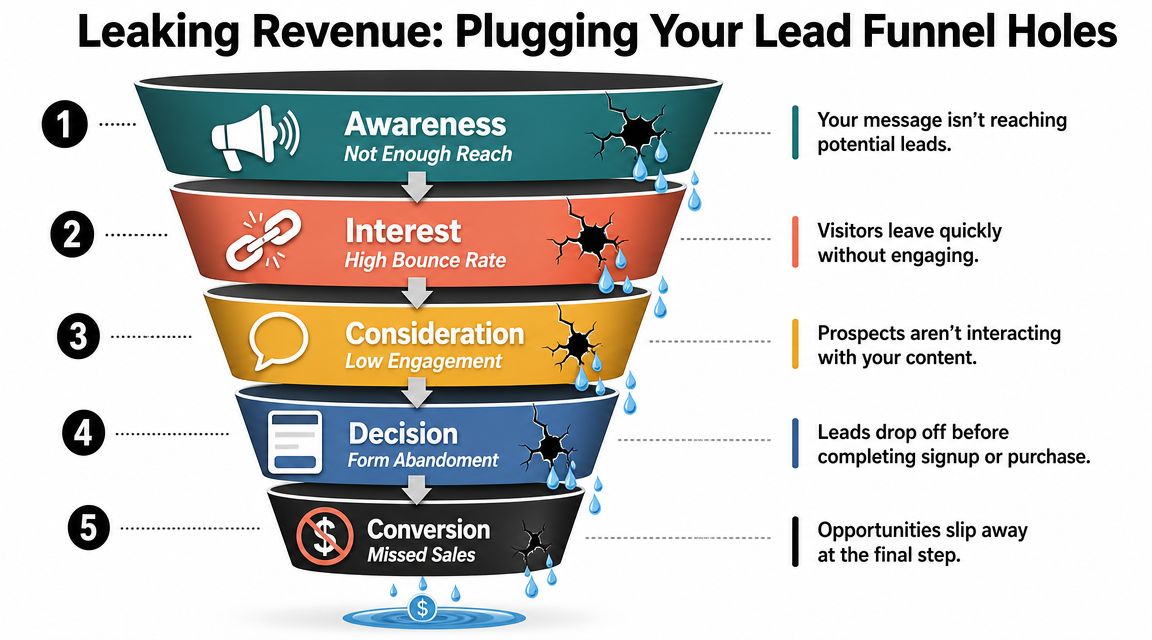
If your pipeline feels inconsistent, don't assume you need more traffic. Start by assuming you have leaks.
Most local businesses do. They buy ads, post on social, ask for referrals, maybe invest in search visibility, then wonder why revenue still feels unstable. The answer is usually simple. Their funnel is held together by inboxes, sticky notes, voicemail, and hope.
A strong local workflow isn't random. Practitioner guidance describes it in five technical stages: define a geographic ICP, source decision-makers, segment by objective signals like online ratings, personalize outreach, and measure conversion at each stage for refinement. If you aren't managing those stages deliberately, you're guessing.
Audit the funnel before you add budget
Run this checklist against your current process.
Audience fit is fuzzy
If your team can't clearly define the neighborhoods, service areas, job types, or customer profiles that produce the best revenue, your campaigns are too broad.Your intake path has friction
Long forms, confusing calls to action, weak offers, or pages that bury the next step kill intent fast.Follow-up depends on memory
If someone has to “remember to call them back,” your process is broken.Leads aren't segmented
A tire-kicker and a ready-to-buy prospect shouldn't go into the same bucket.No stage-level tracking exists
If you only know total leads and total sales, you can't see where the drop-off happens.
The leaky bucket usually breaks in the middle
Top-of-funnel gets all the attention because it's visible. You can see clicks. You can see impressions. You can see traffic. The critical damage often happens after interest shows up.
A common pattern looks like this:
| Funnel Stage | What goes wrong | Revenue impact |
|---|---|---|
| Inquiry | Lead form is weak or call routing fails | Good prospects disappear immediately |
| Response | Team replies late or inconsistently | Buyer chooses a faster competitor |
| Qualification | No scoring or filtering | Sales time gets wasted on poor-fit leads |
| Nurture | No reminders or follow-up cadence | Warm leads go cold |
| Close | No handoff discipline | Opportunities stall and die |
A lead that isn't contacted, qualified, and moved forward quickly isn't an asset. It's wasted acquisition cost.
What to fix first
Don't rebuild everything at once. Fix the choke points with the biggest financial consequence.
Start here:
Tighten your ideal customer profile by geography and service type.
Be specific about who you want and where.Reduce intake friction.
Short forms. Clear calls to action. Obvious contact options.Create a real response process.
Every inbound lead needs an immediate path into follow-up.Track conversion by stage.
Not just leads generated. Track where they stall.
Do that before you increase spend. Scaling a leaky funnel just means you lose money faster.
Choosing Priority Channels for High-Intent Leads
Local businesses waste a lot of money by spreading budget across too many channels too early. That's usually a reaction to underperformance, not strategy. One campaign disappoints, so another tactic gets bolted on. Then another. Soon the business has fragmented marketing, muddy attribution, and no clue what's producing revenue.
The better approach is simpler. Pick channels based on buyer intent, sales cycle, and your ability to track outcomes.
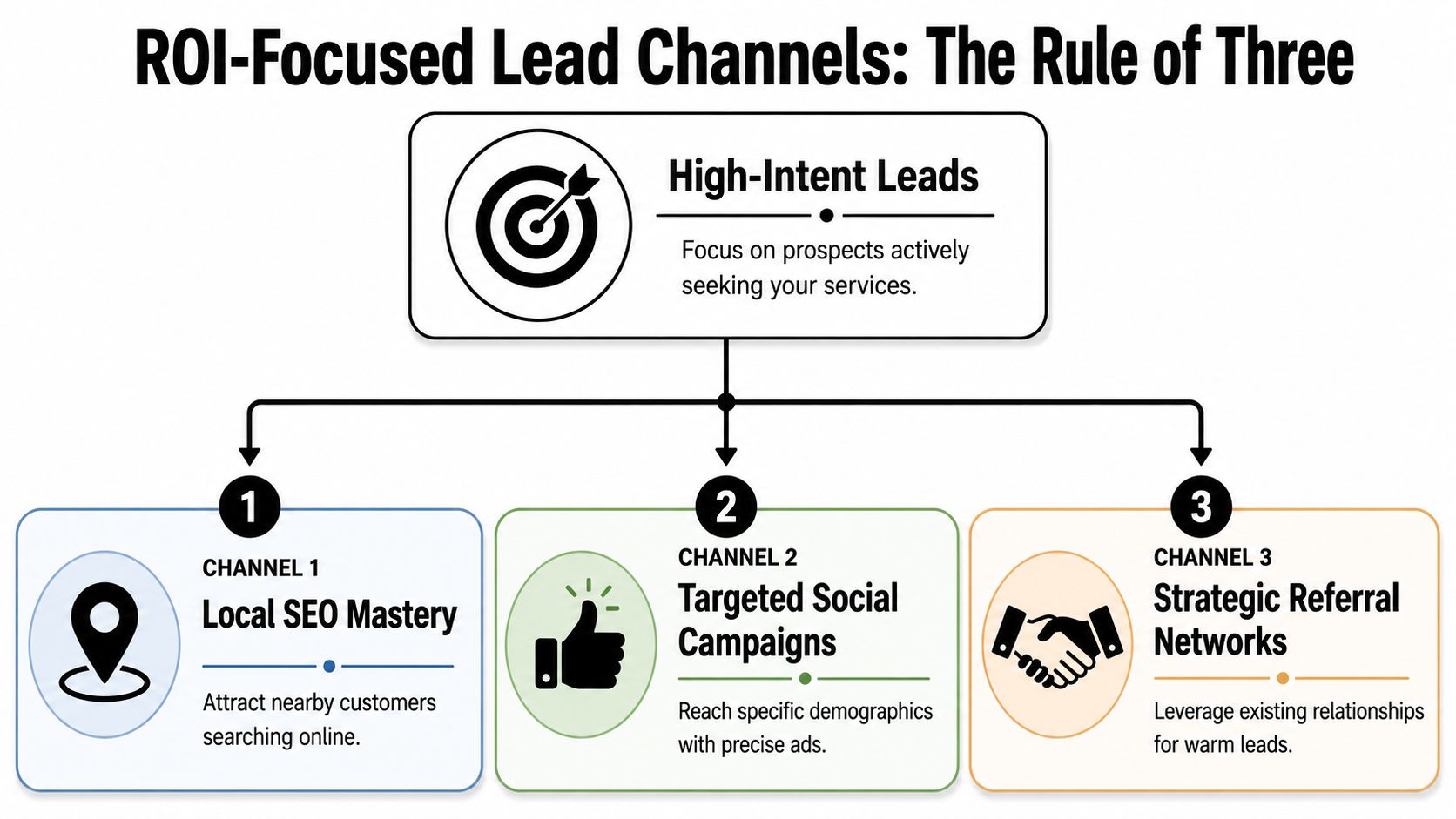
Independent guidance on local business lead generation points to a coordinated multichannel stack because traditional attribution is getting less reliable as cookies, tracking, and local search visibility become less dependable. That means channel choice isn't about chasing trends. It's about building a mix you can operate.
The Rule of Three for local lead generation
For most local businesses, three channels deserve priority.
Local search presence
This is your foundation. When buyers already know they need help, local search is where intent shows up. Your job is to make sure they find a clean, trustworthy presence that matches the area you serve.
This includes your local search visibility, location pages, service pages, and profile accuracy. If your local footprint is weak, fix that first. If you want a deeper breakdown of what strong local visibility looks like, review this guide on local search marketing.
Track metrics tied to revenue, not vanity:
- Qualified calls
- Booked appointments
- Lead-to-customer rate from local search traffic
Geo-targeted paid campaigns
Paid ads help when you need immediate traction or want tighter control over geography, service line, and offer. They work best when you already know what a qualified lead looks like and your landing pages can convert.
Most businesses sabotage paid campaigns by aiming too broad and judging success by cheap clicks. Cheap clicks don't pay payroll. Qualified appointments do.
Use paid campaigns when:
- you need demand now, not six months from now
- your service has urgent intent
- you can route leads into fast follow-up
- you have an offer worth acting on
Review and reputation management
This is the conversion multiplier most owners underfund. A prospect doesn't just compare prices. They compare confidence. Reviews, response quality, and overall reputation shape that decision.
If your reputation is weak, your other channels get more expensive because buyers need more persuasion before they trust you.
Practical rule: Don't separate lead generation from reputation. For local buyers, trust is part of acquisition.
How to choose the right mix
Channel selection should match the shape of your business, not generic marketing advice.
| Business situation | Priority channel | Why it matters |
|---|---|---|
| High urgency service | Paid plus reputation | Buyers need fast action and immediate trust |
| Longer consideration cycle | Search plus nurture | Prospects compare options before committing |
| Tight service area | Search plus direct outreach | Precision beats broad reach |
| Referral-heavy market | Reputation plus partnerships | Trust compounds faster than traffic |
The right answer usually isn't one channel. It's a small, coordinated stack that can be measured. Start narrow. Prove conversion. Then expand.
Building a Referral Engine with Local Partnerships
A lot of local businesses ignore the most obvious growth channel sitting in front of them. Other businesses already serve the same customer you want.
If you're a service provider with a tight geography, broad inbound alone isn't always the smartest play. Some independent guidance makes the contrarian point clearly: direct outreach methods such as referrals, local partnerships, and even direct mail can be more cost-effective than broad inbound demand capture for many service businesses. That's not old-school. That's efficient.
Why partnerships close better
Referral leads often arrive with preloaded trust. That changes the sales conversation.
You spend less time proving you're legitimate and more time solving the problem. That's why partnerships work especially well for businesses where timing, credibility, and local familiarity matter.
Strong partners are usually:
Complementary, not competitive
They solve adjacent problems for the same customer.Locally trusted
Their recommendation carries weight.Operationally reliable
If they're sloppy, they'll send sloppy referrals.
Examples are straightforward. A roofer can partner with an HVAC company. A family law firm can build relationships with financial advisors. A med spa can align with a fitness or wellness business that serves the same local audience.
How to structure the relationship
Keep it simple and concrete. Vague “let's support each other” conversations go nowhere.
Use a structure like this:
Define the overlap
Who exactly should be referred, and in what situation?Make the handoff easy
Shared intro email, direct text, short web form, or dedicated contact person.Set expectations
How fast will each side respond? What counts as a qualified referral?Close the loop
Let the partner know the outcome. People keep referring when they know it matters.
The fastest way to kill a referral relationship is to ignore the lead and never report back.
A simple outreach script
You don't need polished corporate language. You need clarity.
We both serve the same local customer from different angles. I think there's a clean referral fit here. If one of your clients needs [your service], we'll take great care of them and keep you updated. If one of ours needs [their service], we'll send them your way. Worth a quick conversation this week?
That works because it's specific, low-friction, and mutually beneficial. Local partnerships don't need to be flashy. They need to be useful and repeatable.
Optimizing Your Website to Convert Visitors into Sales
Your website doesn't need to win design awards. It needs to make the next step obvious.
A lot of local businesses lose sales because their site behaves like a brochure when it should behave like a salesperson. It talks about the company, lists services, and looks “professional,” but it doesn't reduce doubt or move the visitor toward action. That's why traffic alone disappoints.
If your site gets visits but not enough calls, form fills, or booked appointments, don't jump straight to a redesign. Start with conversion fundamentals. This breakdown of how to improve conversion rate is a useful benchmark for what to tighten first.
Fix the homepage message
Most local sites open with vague claims like “quality service you can trust.” That says nothing. Buyers need relevance fast.
Your main headline should answer three things:
- What you do
- Who you help
- Where you do it
A stronger message sounds like a real offer, not a slogan. It should also support the visitor's immediate question: “Am I in the right place?”
Reduce friction on the path to contact
Forms are often where intent dies. Local buyers don't want homework before first contact.
Tighten the conversion path:
Ask for only what matters first
Name, contact info, and the key service need are usually enough.Give more than one contact option
Some people call. Others prefer forms or text-based contact.Put calls to action where buyers can see them
Don't make people hunt.Match the page to the offer
If the ad promised one thing and the page talks about something else, conversion drops.
Use proof where decisions get made
Trust doesn't belong on a lonely testimonial page nobody visits. Put it near the action.
Add proof elements beside forms, calls to action, and service claims:
| Website element | What it should do |
|---|---|
| Reviews | Lower buyer hesitation |
| Service-area references | Confirm local relevance |
| Outcome-focused copy | Show practical value |
| Clear next-step language | Remove uncertainty |
Buyers don't convert because your site has more words. They convert because the site answers doubt at the moment they feel it.
What to change this week
If you want immediate improvements, start with the smallest high-impact edits:
- Rewrite the hero headline to be specific.
- Shorten every lead form.
- Add trust signals next to primary calls to action.
- Make one page for each major service and service area combination that matters.
- Remove fluff copy that doesn't help a visitor decide.
That's not glamorous work. It's profitable work.
How to Integrate a CRM and Automation Ecosystem
Most local growth efforts either become scalable or stay chaotic at this point.
A business can survive for a while on hustle, memory, and manual follow-up. It can't scale that way. Once multiple channels produce leads, and multiple team members touch those leads, you need a central system that controls handoff, follow-up, pipeline visibility, and customer communication.
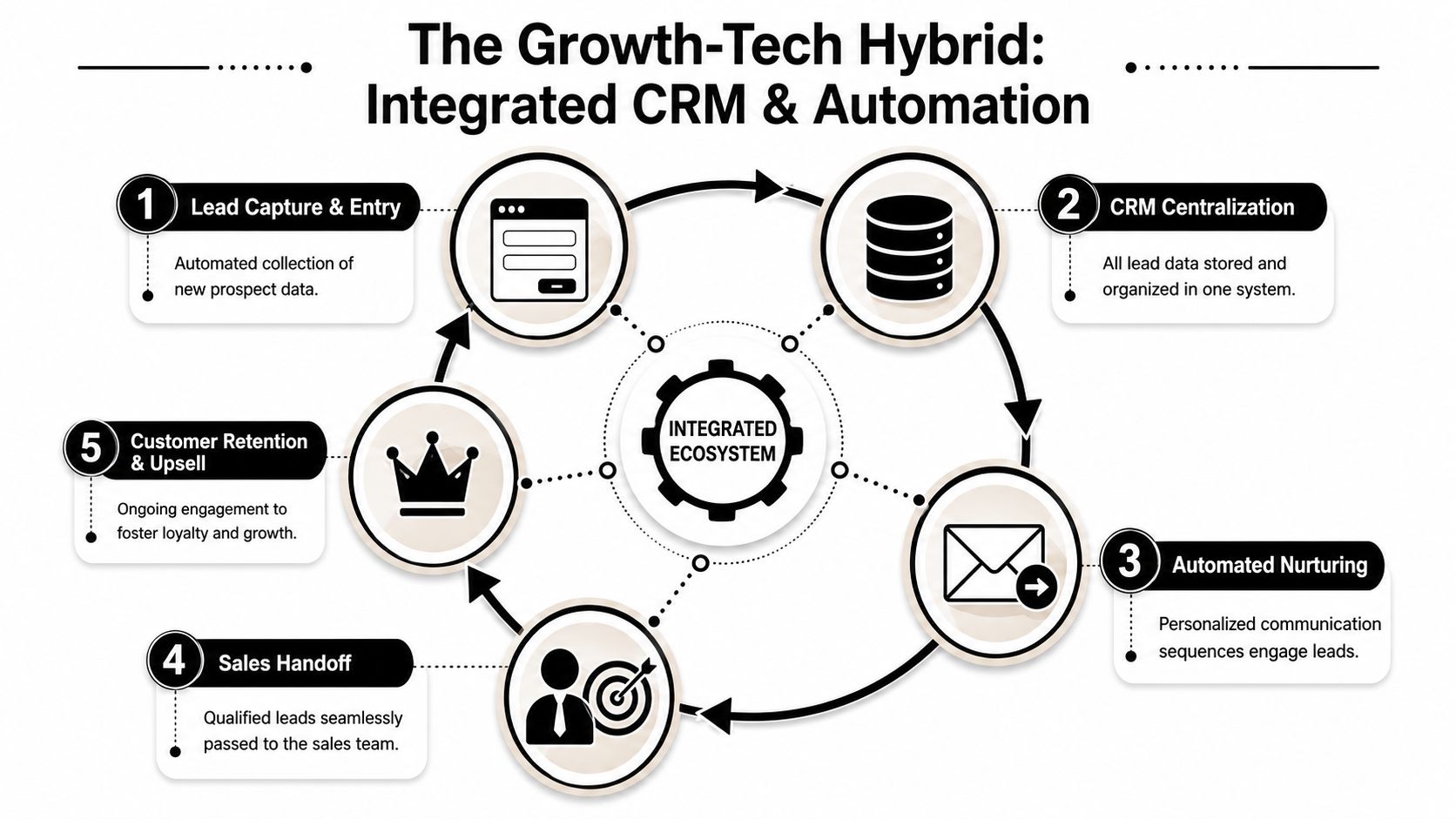
Process guidance on lead generation warns that weak audience definition and poor stage-by-stage conversion analysis are common pitfalls, and recommends using an integrated system to track where leads drop off while applying automated scoring to separate marketing-qualified from sales-qualified leads. That's the key value of a CRM. Not storage. Control.
What the ecosystem should do
A proper CRM and automation setup for local lead generation should connect marketing, sales, and reputation into one operating loop.
At minimum, it should handle:
Lead capture
Every form submission, call inquiry, or message enters one system.Routing and alerts
The right team member gets notified fast.Qualification
Leads are tagged by service need, location, urgency, and fit.Follow-up sequences
No lead sits untouched because someone got busy.Pipeline visibility
You can see what's new, what's stalled, and what's closing.Post-sale communication
Review requests, reactivation, and upsell opportunities don't rely on memory.
What this looks like in practice
A prospect clicks a local ad and fills out a form. That lead enters the CRM immediately. The system tags the source, location, and requested service. A team member gets alerted. The lead receives a confirmation message. If nobody responds within the defined window, an internal reminder fires.
If the lead books, the opportunity moves stages. If they don't, the nurture sequence continues. Once the job is complete, the system requests a review and records the customer for future follow-up.
That's how you stop losing leads in the gaps between teams, inboxes, and handoffs.
Build the system around decisions
Too many businesses treat a CRM like a filing cabinet. That misses the point.
Your setup should help the team make better decisions:
| CRM function | Business decision it supports |
|---|---|
| Lead source tracking | Which channels deserve more budget |
| Qualification tags | Which leads sales should contact first |
| Pipeline stages | Where deals are stalling |
| Follow-up automation | Which opportunities need nudging |
| Review workflows | Which customers can strengthen trust and referrals |
A CRM becomes valuable when it tells your team what to do next, not when it simply stores contact records.
The non-negotiables
If you're building lead generation for local businesses, these are not optional:
- Every lead enters one system
- Every lead gets a defined next action
- Every stage is measurable
- Every closed customer can feed reviews, retention, or referrals
Without that infrastructure, marketing stays fragile. With it, growth starts to compound.
Measuring and Scaling Your Lead Generation for Profit
If you can't tie lead generation to profit, you're still guessing.
Local businesses get trapped when they report on impressions, clicks, traffic spikes, and social engagement while revenue stays flat. Those metrics aren't useless, but they're supporting indicators. They are not the scoreboard.
The numbers that actually matter
Focus on metrics that connect spend to sales outcomes.
Lead-to-customer rate
How many leads become paying customers.Cost per qualified appointment
Not every lead deserves equal value.Customer acquisition cost
What it takes to win a paying customer.Average revenue per sale
Helps you judge whether acquisition costs make sense.Pipeline stage conversion
Shows where opportunities stall.
For context on how to evaluate channel efficiency beyond surface metrics, this guide on what return on ad spend means is worth reviewing.
A practical monthly budget template
Don't spread budget evenly. Allocate it according to role in the revenue system.
| Expense Category | Recommended Allocation | Focus / Key Metric |
|---|---|---|
| Demand capture channels | Highest priority share | Qualified inquiries and booked appointments |
| Website and landing page improvements | Protected ongoing allocation | Lead conversion rate |
| CRM and follow-up systems | Fixed operational allocation | Speed to contact and stage progression |
| Reputation and review generation | Consistent support allocation | Review volume, quality, and assisted conversion impact |
| Partnership and referral development | Smaller but intentional allocation | Referred leads and close quality |
| Testing and optimization | Reserved flex allocation | Improvements in weak funnel stages |
This kind of planning forces discipline. It prevents a business from dumping money into top-of-funnel traffic while underfunding the systems that convert it.
How to scale without breaking the machine
Scaling should happen in this order:
- Prove one working channel-to-close path
- Tighten handoff and follow-up
- Improve conversion on the existing traffic
- Increase spend only after the process holds
- Expand channel mix with clear attribution rules
That's how you grow profitably. Not by adding noise, but by strengthening the machine.
The point of lead generation for local businesses isn't to stay busy. It's to build predictable revenue from a repeatable system your team can run.
If you want that system built the right way, The Advertising Suite is the partner to call. We combine strategy, execution, CRM infrastructure, and reputation management into one revenue-first framework, so your marketing doesn't stop at lead volume. It turns into booked business, stronger customer experience, and sustainable growth. If you want an extension of your team, not another vendor chasing vanity metrics, book a growth consult or request a demo.