Most advice about leads for contractors is upside down.
You don't have a lead problem first. You have a conversion system problem. Contractors burn cash chasing more form fills, more calls, and more "visibility" while the primary leak sits in plain sight: slow response, weak qualification, scattered follow-up, and zero operational control after the lead comes in.
That's why vanity metrics are such a trap. More clicks won't save a broken pipeline. More traffic won't fix a team that replies late, forgets follow-up, or tracks prospects in a spreadsheet. If you're agency-burned, that's probably the part nobody told you. The ad campaign isn't the whole machine. Revenue comes from the handoff between marketing, sales, and customer experience.
If you want better leads for contractors, stop asking one question: "How do I get more?" Start asking three better ones: Are these leads qualified? Are we responding fast enough? Are we converting them into booked jobs?
Why Your Business Does Not Need More Leads
Most contractors asking for more leads are pouring water into a bucket with holes.
The benchmark that matters isn't raw lead count. It's whether your team can turn inquiries into booked work at a healthy rate. The industry benchmark for a healthy lead-to-booked-job rate is 30%, and when contractors fall below that mark, the issue is usually pipeline failure, not traffic volume. One of the biggest leaks is response time drifting past 15 minutes, which makes extra ad spend inefficient because you're feeding a system that isn't built to convert (healthy lead-to-booked-job benchmark).
That's the part most local businesses miss. They buy volume before they fix operations.
Lead volume is a vanity metric when your process is weak
If your team responds late, qualifies poorly, and follows up once, more leads only create more waste. You don't need a bigger top of funnel. You need tighter control between inquiry and appointment.
A revenue-first contractor looks at three things before increasing budget:
- Response discipline: Are new inquiries getting attention fast, or sitting untouched while your crew is in the field?
- Sales capacity: Are reps working leads, or just skimming the newest one and ignoring the rest?
- Pipeline visibility: Can you see where each opportunity came from, where it stalled, and what needs to happen next?
More leads don't fix a broken sales process. They hide it for a month, then expose it at a higher cost.
Fix the system before you buy more traffic
This is why smart growth starts with the funnel, not the ad platform. If your current pipeline leaks, every extra dollar compounds the problem. A tighter process turns the leads you already get into more booked work, and then your acquisition channels become easier to scale.
If you're trying to diagnose where local lead generation breaks down, this guide on lead generation for local businesses is a useful companion. The pattern is the same across service categories. Revenue follows speed, qualification, and follow-through, not lead count alone.
Building Your High-Conversion Digital Job Site
Your website shouldn't act like a brochure. It should work like a job site foreman. Direct traffic, capture details, and move the next step forward without confusion.
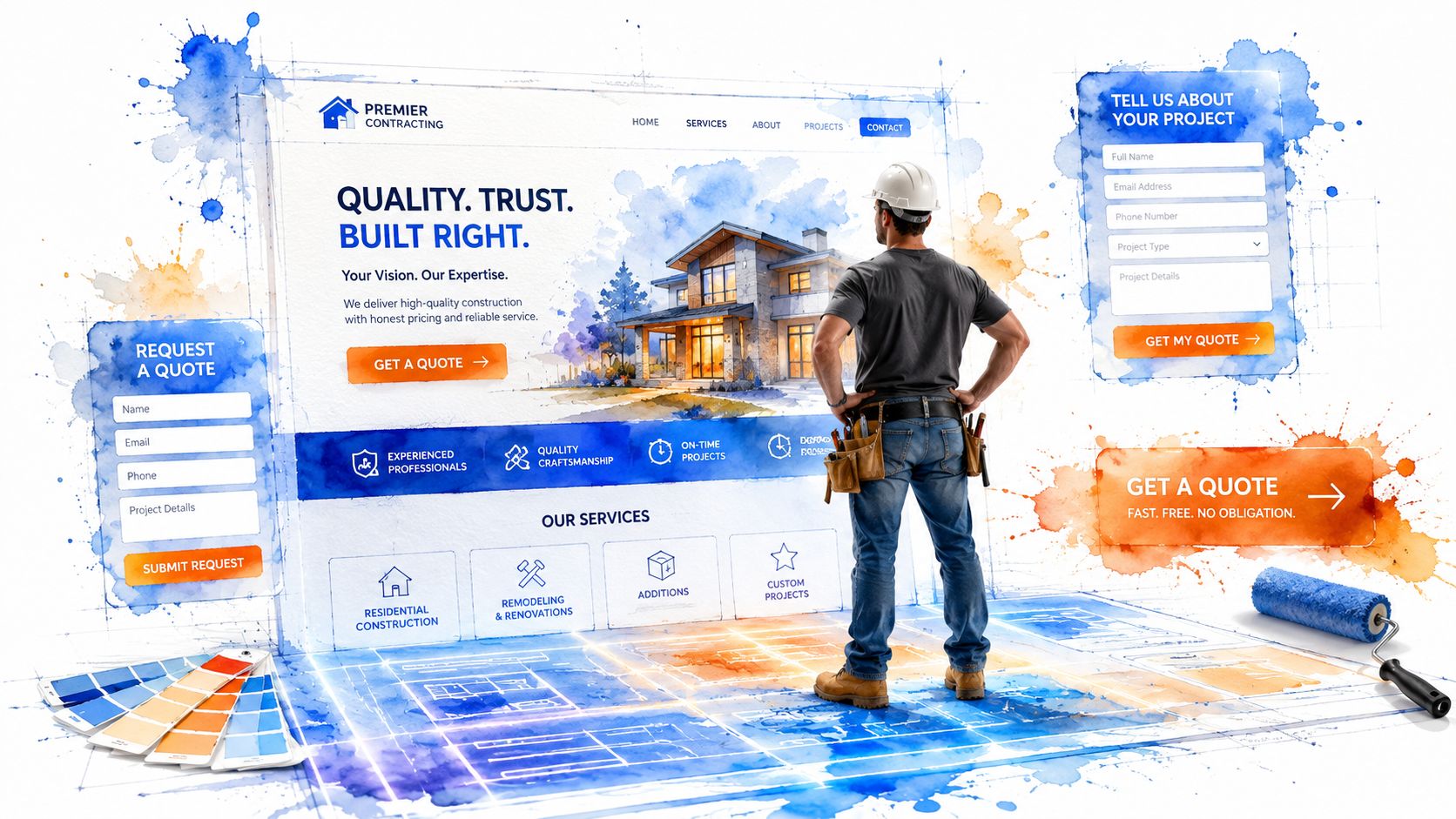
Most contractor sites fail for a simple reason. They ask a ready-to-buy homeowner to hunt for the next step. Hidden phone numbers, vague service pages, long forms, and disconnected inboxes kill momentum. That's expensive, because your website form conversion rate is already narrow. You can't afford friction when the window is that tight.
Build for action, not admiration
A high-conversion contractor page needs to do three jobs well:
- Show the service clearly
- Prove you're credible
- Make contact effortless
If one of those breaks, the page underperforms.
Use this checklist:
- Clear service promise: Put the actual service and service area near the top. A visitor should know within seconds whether they're in the right place.
- Primary call to action: Make "Call now" and "Request an estimate" obvious. Don't make people scroll to figure out how to contact you.
- Short qualification form: Ask only what helps route the lead. Service type, zip code, and project timeframe are useful. A giant intake form is not.
- Proof from real work: Show project photos, review snippets, and trust signals that reduce hesitation.
- Fast capture into one system: Every form submission should land instantly in your CRM, not in a forgotten inbox.
The spreadsheet habit is costing contractors money
Here's the blunt truth. Manual tracking is one of the most common reasons contractors waste good leads.
Spreadsheet-based lead tracking remains a critical gap for contractors, with 78% of small service businesses still using manual spreadsheets instead of dedicated CRM systems, leading to an average 34% loss in follow-up conversion rates due to delayed responses (contractor lead tracking gap).
That number should bother you.
A spreadsheet doesn't route leads. It doesn't notify your team. It doesn't trigger a response. It doesn't remind anyone to follow up. It just records the fact that a lead existed after the moment to win it has already passed.
Practical rule: If a lead can enter your business without triggering an immediate action, your system is too loose.
What your digital job site should actually do
Think less about web design, more about operational flow. A contractor site that converts should connect directly to your sales process.
A strong setup includes:
| Page Element | What It Should Do | Why It Matters |
|---|---|---|
| Service-specific headline | Match the visitor's intent | Reduces bounce and confusion |
| Click-to-call option | Capture urgent buyers fast | Some prospects want speed, not forms |
| Short form with light qualification | Filter low-fit inquiries early | Saves your team time |
| Review and project proof | Build confidence | Helps serious buyers move |
| CRM-connected submission flow | Push leads into action instantly | Prevents delay and handoff loss |
Pretty sites win compliments. Integrated sites win jobs.
If your site doesn't connect traffic, qualification, and follow-up into one flow, it's not a growth asset. It's decor.
Choosing Your Lead Channels for Profit Not Clicks
Contractors love asking which channel gets the most leads. Wrong question.
The right question is which channel gives you the best shot at profitable, high-intent work after cost, fit, and close rate. Clicks don't pay payroll. Booked jobs do.

Start with channel economics
The cost spread across channels is too wide to ignore. The average cost per lead for contractors in 2026 varies sharply by channel: SEO at about $35, Meta Ads at $28, Local Services Ads at $45, and direct Google Ads at $90 per lead (contractor CPL by channel).
That doesn't mean the cheapest lead is always the best one. It does mean you need to stop treating every source like it's interchangeable.
A practical way to evaluate channels:
| Channel | Typical Buying Intent | Cost Profile | Best Use |
|---|---|---|---|
| SEO | Often strong intent from local search | Lower relative CPL | Long-term, compounding demand capture |
| Meta Ads | Can be efficient on cost | Lower relative CPL | Demand generation and retargeting |
| Local Services Ads | Strong local service intent | Mid-range CPL | High-intent local inquiries |
| Direct Google Ads | Often expensive | Higher CPL | Urgent demand when managed tightly |
Cheap leads can still be expensive
A low CPL can fool you if the leads are weak. That's why channel selection has to include qualification, not just cost.
Paid directories are a classic budget sink. 65% of contractor leads from paid directories are low-intent, including job seekers, suppliers, and out-of-area inquiries, even though they still cost $45 to $75 per lead. Contractors who use negative keywords and light qualification fields like service type, zip code, and timeframe reduce wasted spend by 42% and increase booked project conversion by 28%. The same analysis found that contractors who shifted Local Services Ads to a conversion-focused setting saw 31% fewer total leads but 47% higher close rates, producing 35% higher revenue per lead (lead quality filtering for contractors).
That's the whole argument in one set of numbers. Fewer leads can produce better revenue.
If a channel gives you more junk inquiries, it isn't scaling your business. It's scaling your admin work.
What to prioritize first
For most contractors, channel selection should follow this order:
- Own your intent capture: Local organic visibility and service-page structure matter because they catch buyers already looking.
- Use paid search carefully: High-intent search can work, but loose keyword targeting turns it into a cash bonfire.
- Harness social's potential, not hope: Social channels can create demand and support retargeting, but they need a clear offer and tight landing flow.
- Filter at the front door: Ask enough on the form to block bad fits before your team wastes time on them.
If you're spending on search, keyword strategy matters more than most contractors realize. This breakdown of buying keywords on Google is worth reading before you throw budget into broad, expensive terms that attract the wrong clicks.
The channel mix that usually wins
The strongest contractor pipelines don't rely on one source. They combine:
- Intent capture from organic visibility
- Immediate demand from paid search or local service placements
- Re-engagement through retargeting and follow-up
- Qualification controls that protect sales capacity
This is what revenue-first marketing looks like. Not "more traffic." Better economics, better fit, and fewer bad leads entering the pipeline.
The 5-Minute Mandate That Wins 78% of Jobs
If you ignore everything else, don't ignore this.
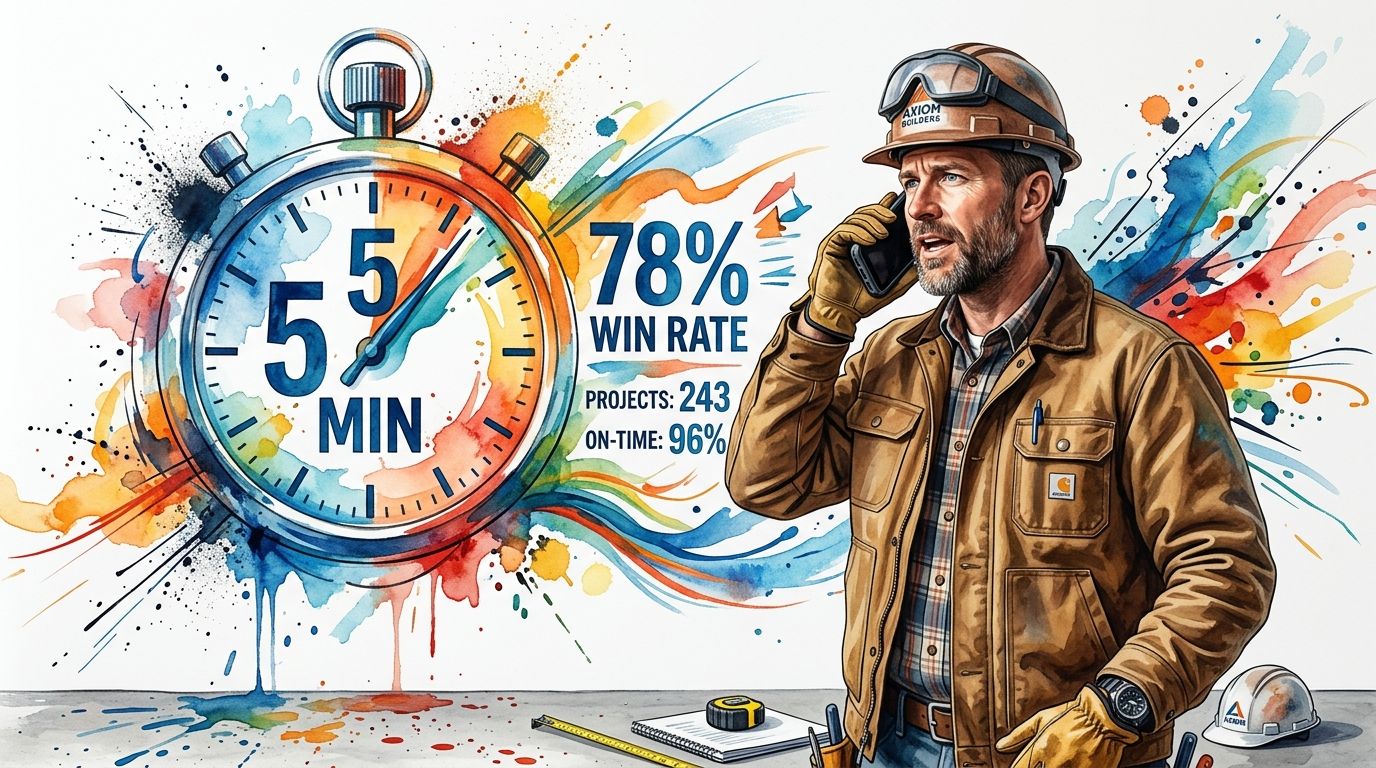
Speed to lead is the single most critical metric in contractor conversion. 78% of consumers hire the first contractor who responds, and responding within five minutes creates a 21x lift in lead qualification compared with slower responses (speed to lead for contractors).
That's not a soft preference. It's a competitive rule.
Manual follow-up is too slow
Contractors lose good jobs because they treat new inquiries like admin work instead of active revenue. The homeowner fills out a form, gets silence, and moves to the next business. The contractor calls back later and wonders why the lead "wasn't serious."
The lead was serious enough to reach out. You were just late.
For concrete contractors, the pattern is just as sharp. Responding within 1 hour produces a 5x higher conversion rate than responding within 24 hours, and fast response also supports better local service ad visibility because the platform rewards it (response speed for concrete contractor leads).
The right first response isn't complicated
You don't need a call center. You need an automatic first touch and a clean handoff.
The first few minutes should look like this:
- Instant acknowledgement: Send a text and email immediately confirming the inquiry was received.
- Internal alerting: Notify the right person with the lead details, not a generic inbox blast.
- Fast human contact: Call as soon as possible while the prospect is still evaluating options.
- Simple next step: Offer one action, usually a quick call or estimate scheduling.
A lead should never wonder whether their message went through.
The first response doesn't need to close the job. It needs to keep the job in play.
Why integrated tech matters here
Disconnected systems directly impede revenue. If your form system, call handling, and follow-up process live in different places, speed dies in the handoff. An integrated CRM and reputation ecosystem isn't a nice extra. It's how a contractor turns response speed into a repeatable advantage instead of a daily scramble.
If you're building that flow, this guide on a marketing automation workflow is a practical next read. The point isn't to replace your team. It's to remove the lag between inquiry and action.
Non-negotiables for the first five minutes
| Moment | Required Action | Outcome |
|---|---|---|
| Immediately after inquiry | Auto text and email acknowledgement | Confirms responsiveness |
| As soon as alert fires | Lead routed to the right person | Prevents internal delay |
| First live outreach | Call or direct response | Captures buyer while intent is high |
| If no answer | Move into follow-up cadence | Keeps momentum alive |
Contractors still trying to manage this from memory are giving jobs away.
A Follow-Up Cadence That Actually Books Appointments
Most contractors quit too early.
They call once, maybe twice, hear nothing, and label the lead cold. That's lazy pipeline management. Good leads often need multiple touches, especially when homeowners are comparing bids, checking with a spouse, or are busy.
Contractors reach a 90% lead contact rate only after at least six follow-up attempts, and the odds of contact rise significantly on the sixth call, while most businesses stop after one attempt (contractor follow-up contact rate).
Follow-up is a system, not a mood
If your team follows up only when they "have time," your process is broken. Good follow-up needs sequence, timing, and channel variation. Call, text, email, then repeat with purpose. The goal isn't to pester people. It's to make it easy for a serious prospect to re-engage.
The source above also notes that high-performing contractors use an automated response within 30 seconds of form submission, then move into a phased sequence using calls and texts, with call attempts prioritized between 4 to 6 PM and around 8 AM. It also notes that 80% of sales require at least five follow-up touchpoints.
Sample 7-Day Follow-Up Cadence for High-Intent Leads
| Day | Time | Action | Notes / Script Snippet |
|---|---|---|---|
| Day 0 | Immediately | Text and email confirmation | "Thanks for reaching out. We received your request and will contact you shortly." |
| Day 0 | As soon as possible | First call attempt | Reference the service requested and offer the next scheduling step |
| Day 0 | If missed | Follow-up text | "Tried to reach you about your project. Reply here and we'll find a time that works." |
| Day 1 | Around 8 AM | Second call attempt | Short call, direct purpose, no rambling voicemail |
| Day 2 | Late afternoon | Third touch by text or email | Re-state value and invite a simple reply |
| Day 4 | Between 4 and 6 PM | Fourth call attempt | Focus on booking the conversation, not overselling |
| Day 5 | Midday | Fifth touch by text | Mention availability or estimate window |
| Day 7 | Morning or late afternoon | Sixth call attempt | Final direct attempt before recycle or nurture track |
The scripts should stay simple
Most contractors overtalk. Don't.
Use direct language:
- After a form fill: "Got your request for [service]. We can help. What's the best time for a quick call?"
- After a missed call: "Tried you about your project. Reply here if text is easier."
- Later-stage follow-up: "Still interested in moving forward with an estimate?"
Silence after one attempt doesn't mean no. It usually means your prospect is busy, distracted, or comparing options.
Why CRM execution matters
This cadence falls apart when it's run from memory, inboxes, and sticky notes. A contractor-specific CRM keeps every touchpoint visible, triggered, and assigned. That's the only realistic way to maintain six or more touches without dropping leads or annoying prospects with duplicate outreach.
If you're still patching this together manually, start with a proper CRM for service businesses. The right system doesn't just store contact records. It enforces follow-through.
One more warning on lead volume
The same source set points to another issue most owners miss. Overloading sales reps with more than two to three leads per day can trigger a 30% to 50% drop in conversion because reps chase the newest inquiry instead of fully working the current ones. That's why "just send us more leads" often backfires. Capacity matters. Good follow-up needs room to breathe.
Measuring for Revenue From Lead to Closed Job
If you're still judging marketing by clicks, impressions, or raw lead count, you're measuring activity, not business performance.
The scorecard for leads for contractors should be brutally simple. Did the lead become a booked job? At what cost? From which source? How fast did your team respond? Where did deals stall? Those answers tell you what to scale, what to fix, and what to stop funding.
The metrics that deserve your attention
A revenue-first contractor watches operational metrics, not vanity metrics.
Track these consistently:
- Lead-to-booked-job rate: This tells you whether the pipeline converts, not whether ads are noisy.
- Response time: If speed slips, booked jobs usually slip with it.
- Qualified lead source: Not every channel deserves equal trust.
- Sales capacity by rep: Too many leads assigned to the wrong person can crush close rate.
- Cost per acquired customer: CPL matters, but only after you know what it costs to win the job.
Use the 30% benchmark as a diagnostic line
The industry benchmark for a healthy lead-to-booked-job rate is 30%, and when contractors sit below that line, they usually have pipeline problems, not a traffic shortage. One common leak is response time stretching beyond 15 minutes, which turns winnable jobs into missed opportunities (offline conversion tracking for real revenue visibility).
That benchmark gives you a hard question to ask. If you're under 30%, why would you buy more leads before fixing what happens after inquiry?
A simple revenue view of your funnel
| Funnel Stage | What to Measure | What It Tells You |
|---|---|---|
| New inquiry | Source and qualification | Whether acquisition is attracting the right buyers |
| First contact | Response speed | Whether your team is competitive |
| Follow-up | Touchpoint completion | Whether leads are being worked properly |
| Appointment booked | Conversion to next step | Whether interest is turning into pipeline |
| Closed job | Revenue by source | Whether marketing is profitable |
The best contractors don't just generate demand. They can explain, with confidence, which leads turn into revenue and why.
When you measure this way, the pattern gets obvious. Better channels help. Faster response helps more. Consistent follow-up closes the gap. Integrated tech holds the whole system together.
If you're done paying for vanity metrics and ready to build a revenue-first pipeline, The Advertising Suite is built for that job. We're a growth-focused partner, not a vendor you hand ad spend to and hope for the best. Our Growth-Tech Hybrid model combines strategy, conversion-focused execution, and an integrated CRM plus reputation ecosystem so your marketing connects to booked jobs and long-term growth. If you want an extension of your team that optimizes for bottom-line revenue, not noise, Book a Growth Consult or Request a Demo. If you want the full system advantage, Explore the Membership for a 25% discount on all services and access to the proprietary software that keeps leads moving.