Most advice on reputation management is too small to be useful.
If you treat reputation as “responding to bad reviews,” you're already behind. That's not strategy. That's cleanup. A real reputation management strategy shapes what prospects see before they call, what customers say after they buy, and how efficiently your marketing turns attention into revenue.
That shift matters because reputation has already become a serious commercial category. The global online reputation management market was valued at USD 6.88 billion in 2025 and is projected to reach USD 14.01 billion by 2031, with a projected 12.59% CAGR from 2026 to 2031, according to Mordor Intelligence's online reputation management market analysis. Markets don't grow like that because businesses enjoy replying to comments. They grow because reputation now affects discovery, trust, conversion, retention, and expansion.
A weak reputation drags down paid traffic. It lowers close rates. It forces your sales team to overcome doubts that should never have existed in the first place. If you're spending on acquisition but ignoring what buyers find when they search your brand, you're creating your own friction. That's the same mistake businesses make when they obsess over surface metrics and ignore what drives profit, which is why return on ad spend only tells part of the story.
The smart approach is simple. Stop treating reputation as a side task owned by whoever has spare time. Treat it like revenue infrastructure. Build the system. Assign owners. Monitor continuously. Respond fast. Generate positive proof on purpose. Then connect the whole thing to conversion and customer lifetime value.
Introduction
Most businesses still misunderstand reputation.
They think it's defensive. They think it belongs to support, or PR, or the unlucky person who checks review sites once a week. That mindset costs money because buyers don't separate “marketing” from “reputation” when they make decisions. They see one blended picture of your business, and they decide whether to trust it.
Practical rule: If your brand search results, reviews, and public feedback aren't actively managed, your pipeline is doing extra work for no good reason.
A real reputation management strategy is offensive. It helps you win before a sales conversation starts. It strengthens branded search. It gives prospects proof. It gives your team language customers already use when they describe what you do well. It also exposes where the customer experience is breaking, which makes it useful far beyond marketing.
That's why the category itself keeps expanding. Businesses are moving away from occasional cleanup and toward always-on monitoring, response workflows, and integrated systems. The companies that get this right don't just “look better online.” They build a stronger full-funnel machine.
Three things separate serious operators from the rest:
- They audit what the market sees. Not what the brand deck says.
- They centralize monitoring and response. No scattered logins or guesswork.
- They connect reputation to revenue outcomes. Not vanity reporting.
If that sounds strict, good. Reputation is too important for loose process.
The Foundation An Audit of Your Digital Reputation
You can't fix what you haven't inspected.
A reputation audit is where you find the leaks. Not hypothetical leaks. Real ones. The outdated listing. The unanswered complaint. The weak branded search result. The employee or founder search result that tells a different story than the company website. Every one of those creates hesitation, and hesitation kills conversion.
Only 17% of businesses maintain an active reputation management plan, which means 83% are handling brand perception passively or inconsistently, according to this 2025 reputation management statistics roundup. That's good news if you're willing to be disciplined, because most competitors are still improvising.
Start with branded search
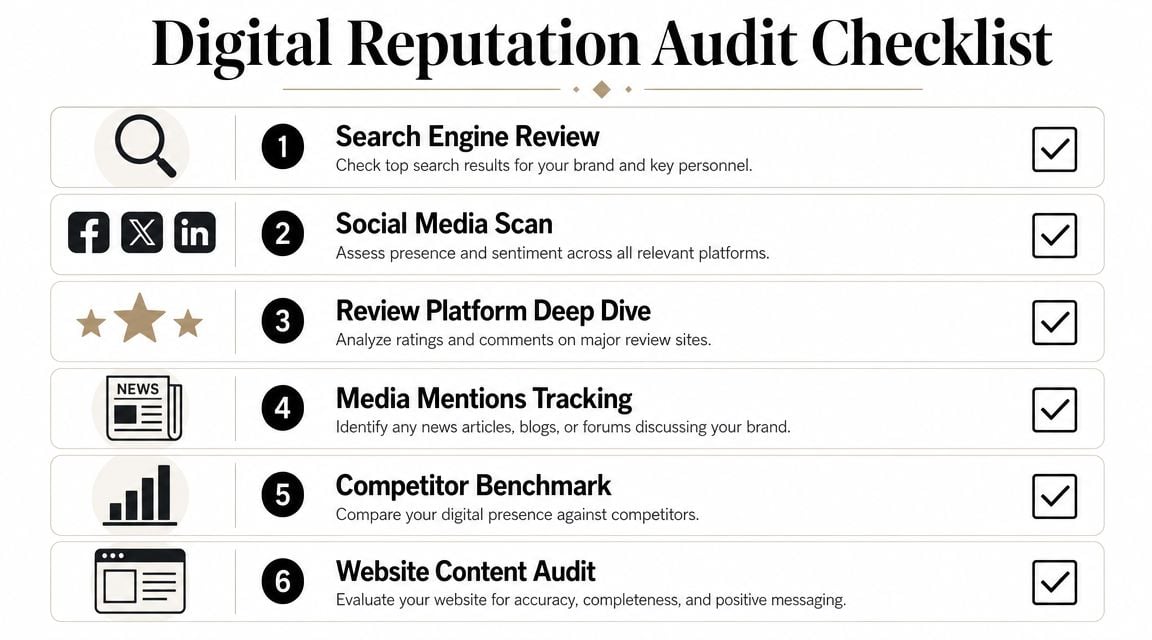
Open an incognito browser and search your business name, key people, and brand variations.
Don't skim. Review the results like a skeptical buyer. What appears first? Is it your website, your local profile, your social pages, and positive content? Or is the first page mixed with confusion, stale listings, off-brand profiles, forum chatter, or old complaints?
Use this basic audit lens:
- Check brand terms: Search your business name exactly as customers use it.
- Check people terms: Search owners, executives, and public-facing staff if they influence trust.
- Check service combinations: Search your brand with your core services and locations.
If the first page looks fragmented, your reputation problem isn't just “reviews.” It's visibility control.
Review every customer-facing proof point
Next, go platform by platform and look for patterns.
Don't just record the overall rating. Read the comments. Buyers do. You want recurring themes, not emotional reactions. If customers keep praising speed, professionalism, or communication, those themes belong in your ads, landing pages, and sales scripts. If they keep flagging delays, billing confusion, or poor follow-up, those issues belong in operations.
Focus on these areas:
- Review platforms: Look for volume, recency, response quality, and repeated complaints.
- Social channels: Scan comments, tags, direct feedback, and community sentiment.
- Listings and directories: Verify hours, contact details, category accuracy, and brand consistency.
- Owned assets: Check whether your website reinforces trust or leaves basic questions unanswered.
- Media and forum mentions: Identify any third-party discussions that shape perception.
A messy digital footprint tells prospects that the business may also be messy offline.
Build a simple scorecard
You don't need a complex dashboard yet. You need clarity.
Create a working document with four columns:
| Area | What you found | Revenue risk | Priority |
|---|---|---|---|
| Search results | Weak or off-brand results | Trust loss before contact | High |
| Reviews | Unanswered feedback or recurring issues | Lower conversion | High |
| Listings | Inconsistent business details | Lost leads and confusion | Medium |
| Website trust signals | Thin proof or unclear positioning | Lower close rate | High |
That scorecard gives you an order of operations.
Audit with a buyer's eye, not an owner's ego
Owners often defend what prospects reject.
If your review replies sound canned, fix them. If your latest feedback is old, build review generation. If your website says “quality service” but your public comments mention poor communication, stop polishing copy and address the actual gap.
A reputation audit isn't branding theater. It's a revenue diagnostic.
Building Your Tech-Enabled Monitoring System
Manual reputation management breaks the moment the business gets busy.
That's why so many teams think they're “watching things” when they're really just reacting late. One person checks reviews. Another sees social comments. A location manager handles local feedback differently than the corporate team. Nothing is centralized, so no one has the full picture and no one owns response speed.
That setup is sloppy, and sloppy systems lose business.
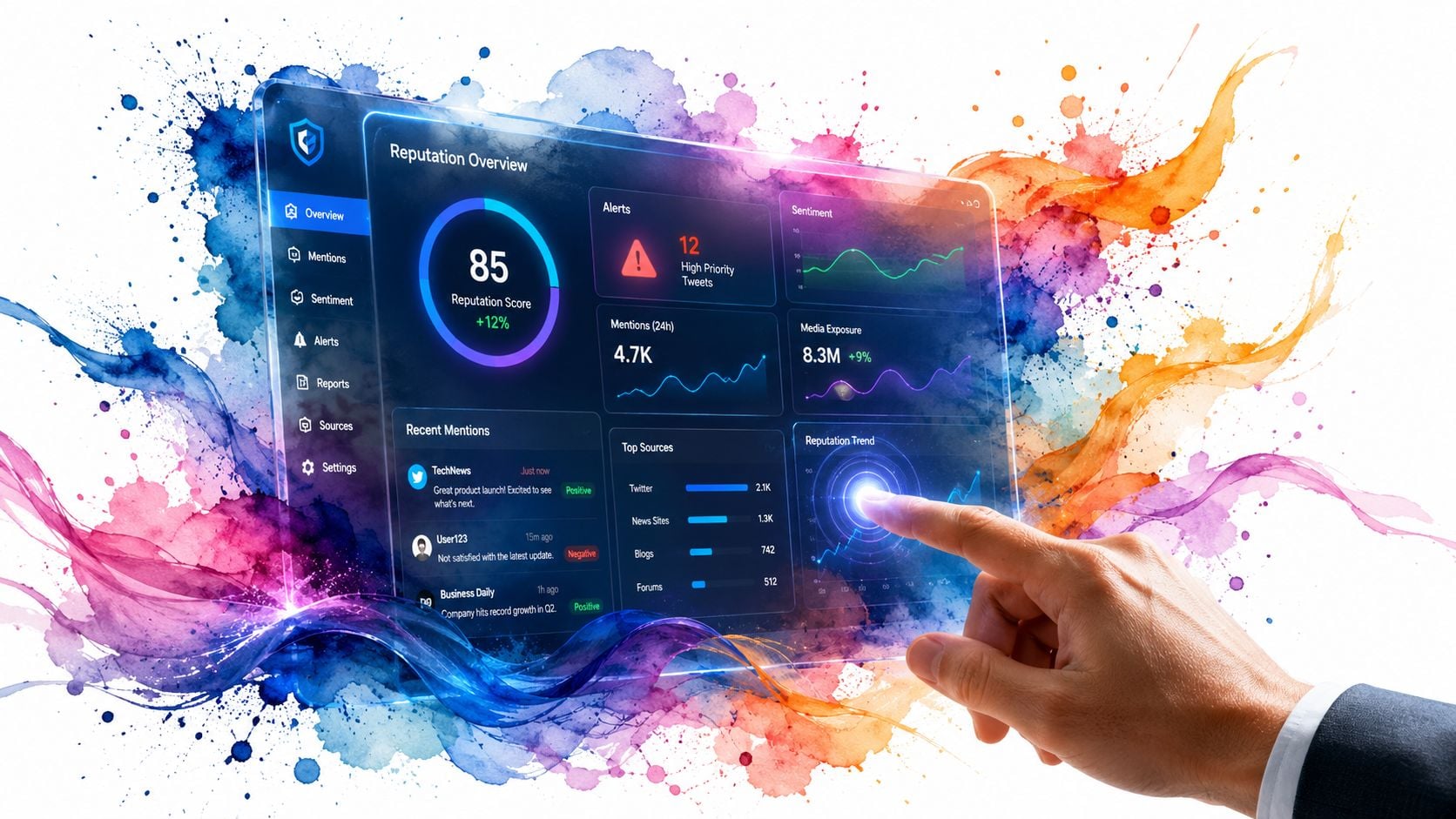
A stronger workflow consolidates review sources and feedback into a single dashboard and uses AI-driven detection to spot sentiment shifts and emerging issues before they escalate, according to Reputation.com's guidance on aligning reputation management with marketing. That's the difference between “we saw the problem” and “we saw it in time.”
What your monitoring system must cover
A useful monitoring system does three jobs. It captures signals, routes them to the right people, and makes action visible.
At minimum, track:
- New reviews: Every location, every major platform, one view.
- Brand mentions: Social comments, tags, and public discussions.
- Listing changes: Inconsistent or unauthorized edits create friction fast.
- Sentiment shifts: Not just single comments, but patterns that suggest a service problem.
- Internal ownership: Every alert needs a person attached to it.
If alerts go to a shared inbox and “someone usually handles it,” no one owns the result. That's not process. That's hope.
Centralization beats heroics
Some teams rely on a few highly attentive people to hold the whole system together. That works until someone gets sick, goes on vacation, or changes roles.
A centralized setup is better for three reasons:
- It standardizes visibility. Marketing, operations, and leadership can work from the same facts.
- It shortens response time. Issues don't sit in random inboxes.
- It creates accountability. You can see what was received, who responded, and what happened next.
Here's a simple operating model:
| Signal | Owner | Required action | Escalation trigger |
|---|---|---|---|
| Negative review | Customer experience lead | Respond and investigate | Pattern across locations |
| Positive review | Reputation owner | Respond and tag themes | Repeated praise worth amplifying |
| Brand complaint on social | Community manager | Acknowledge and route | Legal, safety, or media risk |
| Listing inconsistency | Marketing ops | Correct and verify | Multiple assets affected |
Use a weekly cadence, not random checking
Daily visibility matters, but discipline matters more.
Set a weekly review rhythm across teams. The point isn't a meeting for the sake of a meeting. The point is to force alignment around the same source of truth. Which comments signal a service issue? Which review themes should shape messaging? Which locations need intervention? Which complaints are isolated, and which show a pattern?
Operational standard: If reputation data lives in separate tools and separate teams, decisions slow down and quality drops.
You also need clear ORM KPIs. Keep them practical. Track review volume, average star rating, customer satisfaction signals, response quality, and emerging sentiment themes. Don't build a dashboard full of decorative metrics nobody acts on.
The right system feels less like a marketing add-on and more like a control center. That's what it should be.
Mastering Review Responses and Crisis Playbooks
Most review responses are bad for one of two reasons.
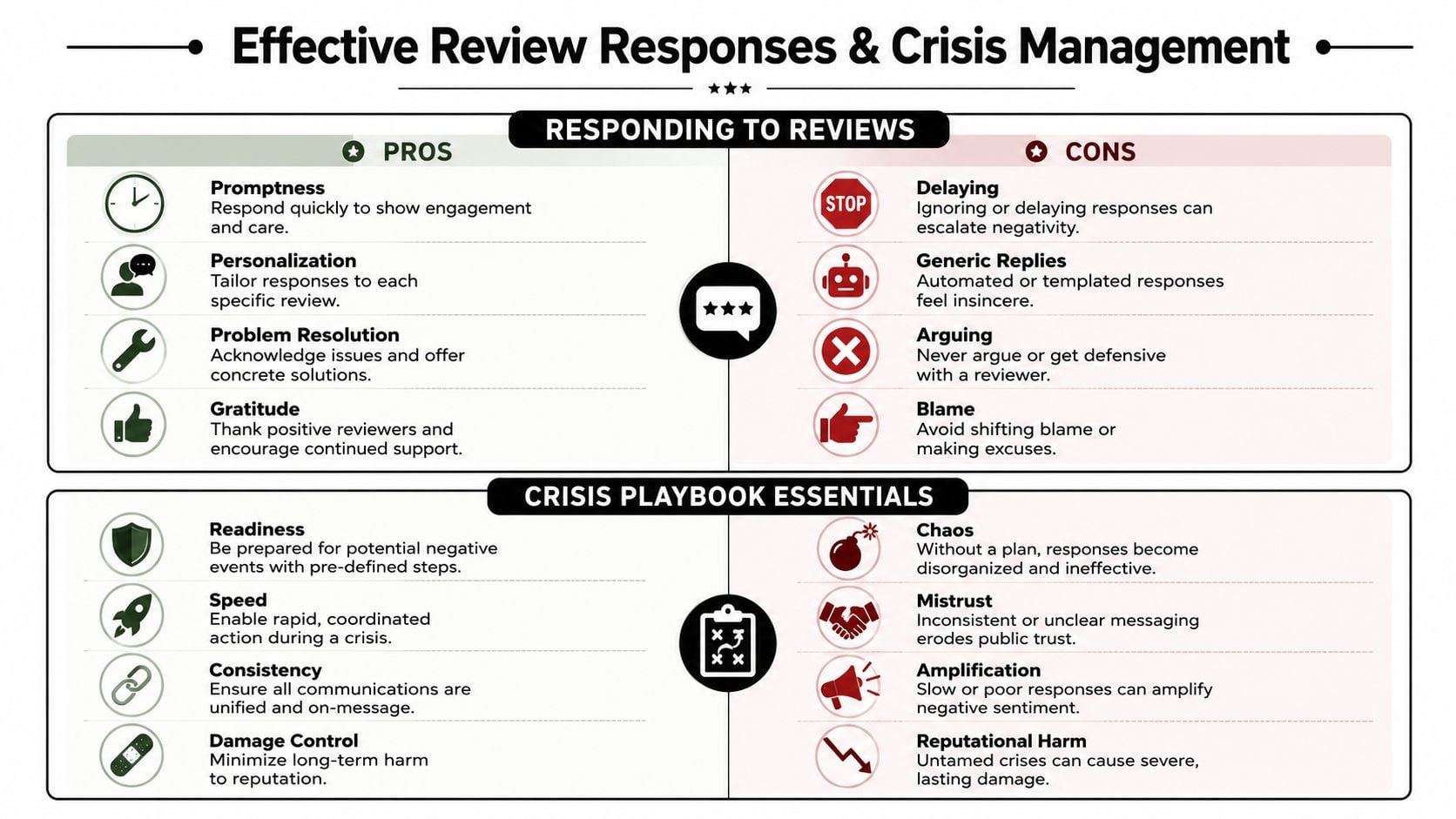
They're either robotic, or they're defensive. Both fail. A robotic reply makes the business look indifferent. A defensive reply makes the business look insecure. Neither earns trust from the person who left the review, and neither helps the many prospects reading without commenting before they decide whether to contact you.
Responding well isn't customer service theater. It's public proof that your business listens, owns problems, and handles friction like an adult.
What a good response actually does
A strong reply has a job. It acknowledges the experience, reflects the customer's concern in plain language, and points toward resolution without turning the comment thread into an argument.
Use this decision framework:
- Positive review: Thank them, reference something specific, reinforce what matters.
- Neutral review: Clarify, appreciate the input, and invite the next step.
- Negative review: Acknowledge the issue, apologize for the experience, move resolution offline fast.
Do not do these things:
- Don't argue: Prospects won't admire your takedown of an unhappy customer.
- Don't copy-paste: Template structure is fine. Template tone is not.
- Don't over-explain: Long excuses sound like blame with extra words.
- Don't ghost criticism: Silence reads as indifference.
Fast, calm, specific replies build more trust than polished corporate language ever will.
Say this, not that
Here's where teams usually get stuck. They know they should respond, but they sound like policy manuals.
| Situation | Weak response | Better response |
|---|---|---|
| Positive feedback | “Thank you for your review.” | “Thanks for calling out our team's communication. We work hard to keep the process clear, and we're glad it showed.” |
| Service complaint | “We apologize for any inconvenience.” | “I'm sorry the follow-up fell short. That's frustrating, and it's not the experience we want you to have.” |
| Mixed review | “We appreciate your feedback and will use it to improve.” | “Thanks for the honest feedback. I'm glad the service helped, and I understand why the delay was frustrating.” |
The difference is simple. Better responses sound like a person who read the review.
Build a one-page crisis playbook
If you run multiple locations, franchises, or public-facing teams, you need a crisis playbook before something goes wrong.
Not a giant binder. One page.
Include these elements:
- Trigger definition: What counts as a crisis versus routine criticism.
- Decision owner: Who decides whether the issue escalates.
- Response owner: Who writes and approves public messaging.
- Internal routing: Who informs leadership, operations, and customer support.
- Approved message principles: Acknowledge facts, avoid speculation, state next steps.
For local brands, keep one playbook at the brand level and allow local facts to be added without changing the response standard. That prevents chaos and keeps the tone consistent.
Personalization is not optional
Templates help with speed. They should never replace judgment.
If five locations reply with the exact same phrasing, buyers notice. It reads like a script because it is one. Use a consistent structure, yes. But write like someone inside the business understood the issue.
That's what de-escalates tension. That's what protects trust. And that's what keeps one bad experience from becoming a public story about how your company handles problems.
Your Automated Review Acquisition Engine
The easiest way to lose the reputation game is to “hope” happy customers leave reviews.
They usually won't, at least not consistently. Busy people move on. Even satisfied customers need a prompt, a direct link, and a reason to act now instead of later. If your business relies on staff remembering to ask, your review flow will stall the first time the team gets slammed.
That's why review acquisition needs automation.
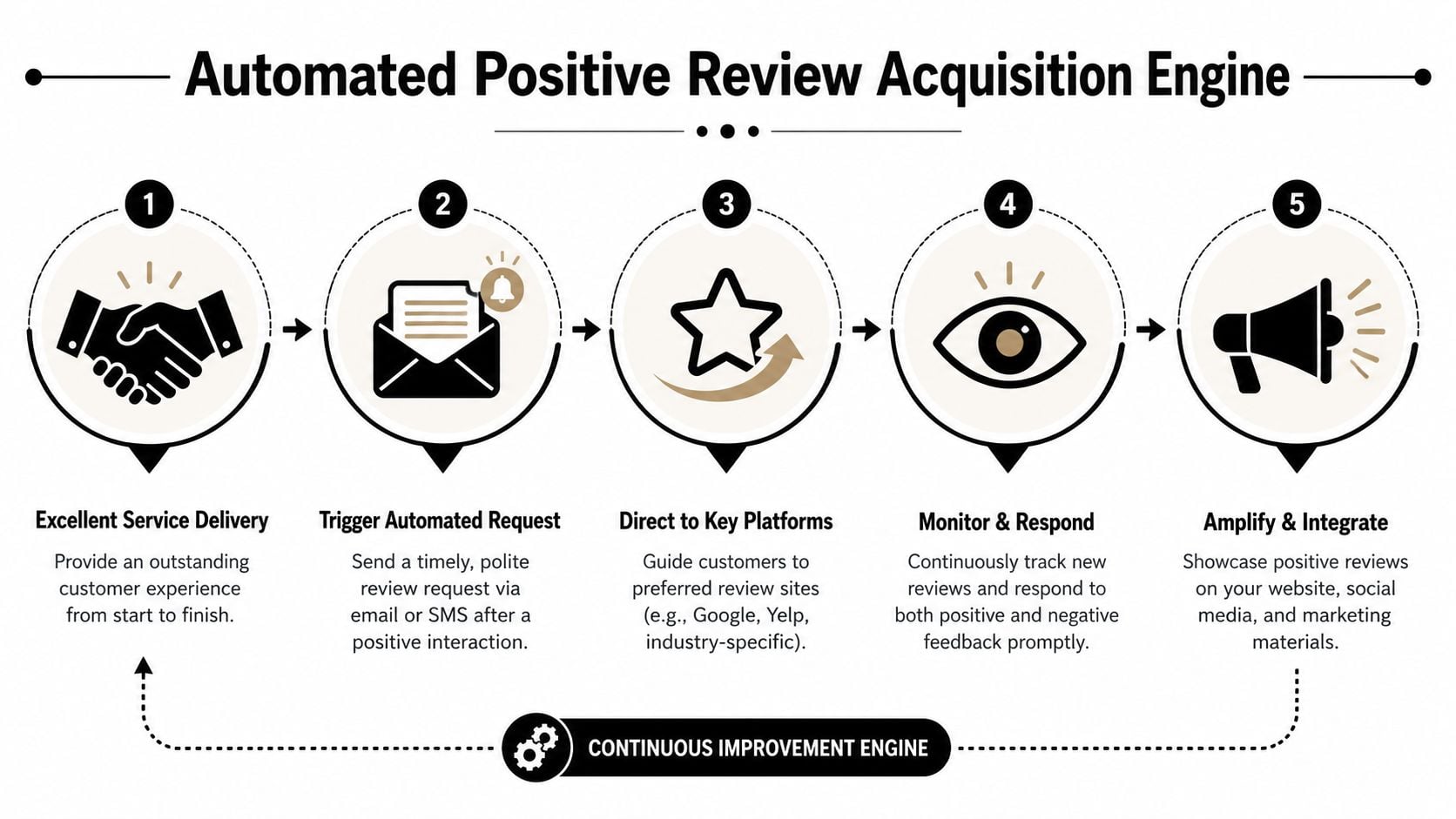
Expert guidance identifies response speed and structured review generation as the most effective tactics, and businesses that fail to assign who monitors, responds, and creates corrective content miss the feedback loop needed to improve search visibility, customer trust, and conversion performance, according to AppFollow's reputation management strategy guidance. That's why a review engine should be designed, not improvised.
How the engine works in a real service business
Take a home service company.
A technician finishes a job. The customer is happy. That moment is your highest-probability review window, not three weeks later when the experience is already fading. The CRM should mark the job complete, trigger a follow-up message, and send the customer directly to the review path with as little friction as possible.
The sequence is straightforward:
- Job closes in the CRM.
- Customer receives a polite review request by email or text.
- The message includes a direct path to the priority review destination.
- New feedback routes back into the monitoring system.
- The team responds and tags useful themes for future marketing.
If you want more visibility in local markets, this process belongs next to your broader local search marketing strategy, not outside it.
What makes review requests actually work
The mechanics matter.
A good request is short, timely, and easy to complete. A bad request is generic, delayed, or forces the customer to hunt for your profile. Don't make supportive customers do admin work.
Use these rules:
- Send close to service delivery: Ask while the experience is fresh.
- Keep the ask simple: One message, one action, clear wording.
- Remove friction: Link directly to the intended destination.
- Assign ownership: Someone must track sends, responses, and gaps.
- Close the loop: Negative feedback should trigger follow-up, not avoidance.
Customers are most willing to leave a review right after a positive outcome. If you miss that moment, you're choosing inconsistency.
Turn reviews into marketing inputs
At this point, average businesses stop too early.
They collect reviews and admire them. Better businesses mine them for messaging. If customers keep mentioning responsiveness, professionalism, clarity, or speed, those aren't just compliments. They're market language. Use them in landing page copy, ad creative, sales scripts, and onboarding materials.
Here's a simple translation table:
| Review theme | Operational meaning | Marketing use |
|---|---|---|
| “They kept me informed” | Strong communication | Use messaging around transparency and follow-through |
| “The process was easy” | Low-friction experience | Emphasize simplicity and convenience |
| “They fixed it fast” | Strong fulfillment speed | Highlight response and completion efficiency |
That's how reviews start feeding revenue, not just reputation.
Build the system once, then maintain it
An automated review engine doesn't remove the human element. It removes inconsistency.
Your team still needs to monitor incoming feedback, respond with judgment, and fix recurring service issues. But the request flow itself should run every day without relying on memory, mood, or spare time.
That's what turns review generation from a nice idea into a repeatable growth channel.
Tying Reputation to Revenue and Taking Action
The industry still has a measurement problem.
A lot of guidance explains how to monitor, respond, and plan for issues. Far less explains how to connect reputation work to revenue with confidence. That gap is real. Curogram's overview of online reputation management strategy notes that measurement and ROI remain an underserved part of the field, especially for businesses trying to justify the investment.
So fix that in your own operation.
Track business impact, not just surface metrics
Star ratings matter, but they are not the finish line. They're an operating signal.
What you want to know is whether reputation improvements change buyer behavior. Use your dashboard and CRM to compare reputation signals against business outcomes like lead quality, close rate, repeat purchase behavior, and retention patterns. If you want a practical framework for that connection, focus on the trust factors that improve conversion rate, because reputation lives there.
Track three layers:
- Visibility signals: Are branded search results and public feedback improving?
- Conversion signals: Are more leads turning into customers with less resistance?
- Retention signals: Are satisfied customers coming back, referring others, or staying longer?
Use reputation data across the funnel
Reputation shouldn't sit in a silo.
If customers consistently praise one part of your service, your ad copy should reflect it. If they repeatedly complain about a handoff or delay, fix the process before spending harder on acquisition. If one location earns better sentiment than another, inspect the operational difference and standardize it.
That's how reputation becomes a growth system:
- It sharpens acquisition messaging
- It improves conversion efficiency
- It supports stronger customer lifetime value
This is the right order of operations. Audit first. Centralize monitoring. Respond like a human. Build automated review generation. Then measure what changes in the business, not just what changed on a review profile.
Treat reputation as revenue infrastructure and it will start behaving like it.
If you're done guessing and want a partner that treats reputation, CRM, conversion, and paid growth as one system, The Advertising Suite is built for that job. We help businesses turn scattered marketing into a results-first framework with integrated software, accountable strategy, and full-funnel execution. You can Request a Demo to see the platform in action, or Explore the Membership to access the proprietary CRM, automated review management tools, and the 25% discount on all services. If you've been burned by agencies chasing vanity metrics, this is the opposite. We operate like an extension of your team, focused on revenue.