Most advice on how to improve conversion rate is stuck in the shallow end. Change the button color. Shorten the headline. Move the form up the page. Fine. Sometimes that helps.
But most businesses don't have a button problem. They have a system problem.
They buy traffic before they fix measurement. They redesign pages before they know where users drop off. They ask landing pages to do all the work while ignoring the CRM, the review pipeline, the follow-up sequence, and the customer experience after the click. Then they wonder why revenue feels unpredictable.
That approach burns money.
A better approach treats CRO as a core revenue function. Not a design task. Not a one-off website project. Not a collection of random experiments run by whoever had a free afternoon. If you want to know how to improve conversion rate in a way that sticks, you need a system that connects diagnosis, testing, attribution, trust, and follow-up.
Stop Polishing Deck Chairs on the Titanic
The market is full of CRO advice that sounds smart and produces very little. Endless micro-tests on surface-level elements can keep a team busy for months without fixing the actual leak.
If your analytics are shaky, your offer is unclear, your forms are clunky, your mobile experience is messy, and your sales follow-up is slow, you don't need more creative opinions. You need discipline.
The problem isn't usually the page alone
Most underperforming sites fail in one of three places:
- Measurement breaks first. Teams can't trust what they're seeing, so they optimize the wrong step.
- Message breaks second. The page doesn't make the value obvious fast enough.
- Experience breaks third. Users hit friction at the form, checkout, or handoff stage and leave.
That's why the usual "just test more" advice falls short. Testing random elements on a broken funnel is organized guesswork.
Practical rule: If you can't explain exactly where people drop off and why, you are not optimizing. You are decorating.
CRO is revenue engineering
Across industries, average website conversion rates are often reported around the low single digits. One benchmark puts the average across industries at roughly 2.9%, and another example shows moving from 2.35% to 3.5% creates a relative lift of nearly 49% without increasing traffic, according to conversion rate benchmarks and examples.
That is why conversion work matters so much. You don't need magical scale. You need a tighter system.
The companies that improve conversion rate consistently do a few things well. They diagnose before changing anything. They fix friction before buying more traffic. They use testing to learn, not to gamble. And they connect pre-click trust, on-page experience, and post-conversion follow-up into one operating model.
That's what makes CRO sustainable. Not prettier pages. Better decisions.
Diagnose Before You Prescribe Finding Your Conversion Leaks
A high-confidence CRO workflow starts with instrumentation, not redesign. First verify analytics accuracy, then map the funnel and isolate drop-off points using session recordings, heatmaps, and form analytics, as outlined in this CRO workflow reference.
That order matters. If tracking is wrong, everything after it is noise.
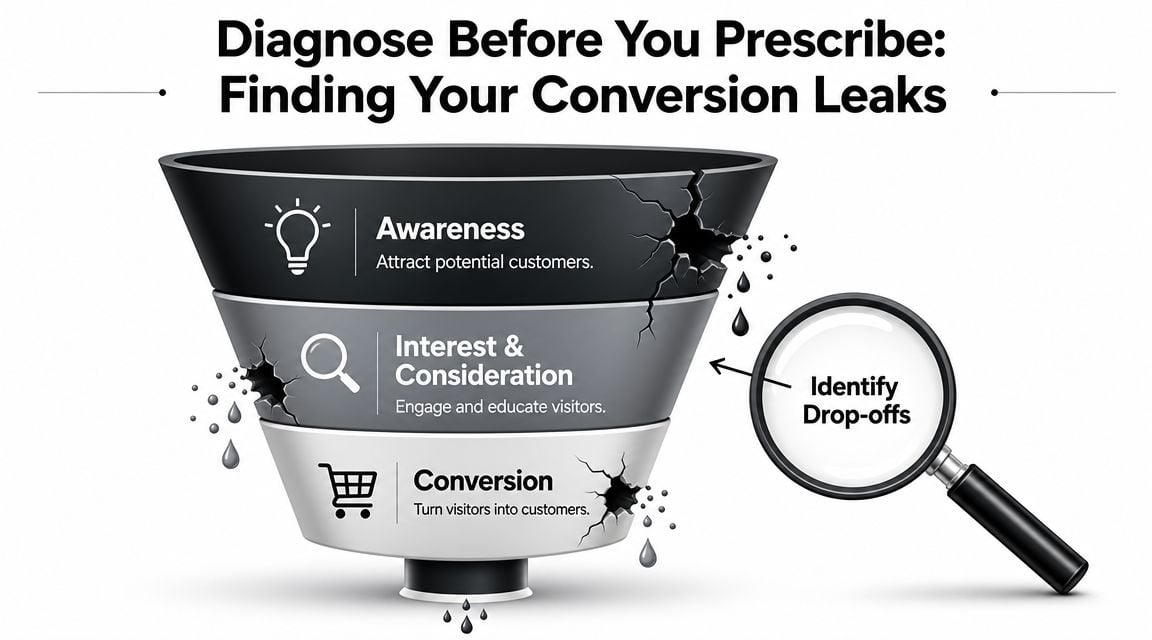
Start with the funnel, not the homepage
Many organizations obsess over the homepage because it's visible. That's lazy prioritization. The right move is to map the path from first click to completed action.
For a lead generation business, that usually means:
- Landing page
- Service or offer page
- Form submission
- Thank-you page
- Sales follow-up
For an e-commerce business, swap in product page, cart, checkout, and confirmation.
You're looking for the exact point where intent drops. Not where opinions gather.
What to inspect and what it means
Use a simple diagnostic stack and ask better questions:
- Analytics: Which pages get traffic but fail to move visitors to the next step?
- Heatmaps: Are people engaging with the primary CTA or wandering into distractions?
- Session recordings: Where do users hesitate, loop, rage-click, or abandon?
- Form analytics: Which fields create friction or trigger exits?
A few common leaks show up fast.
| Leak | What it usually means | What to check first |
|---|---|---|
| High drop-off after ad click | Message mismatch | Ad promise vs landing page headline |
| Heavy scrolling, low action | Important value buried too low | Hero section clarity and CTA placement |
| Form starts, low completions | Too much friction | Field count, required inputs, mobile usability |
| Mobile exits spike | Experience breaks on smaller screens | Layout, button size, page speed, form flow |
Don't diagnose in aggregates
A blended conversion rate hides problems. Look at behavior by source, page type, and device. A service page can convert well from high-intent search traffic and still fail badly for paid social traffic. Mobile visitors can hit friction desktop users never see.
Watch real sessions from the step with the biggest drop-off. You'll usually learn more in an hour of observation than in a week of arguing about page design.
The point of diagnosis isn't to create a giant backlog. It's to identify the smallest fix that removes the biggest revenue leak. That's how you improve conversion rate without turning the whole website into a six-month redesign project.
The Revenue-First Prioritization Framework
After you identify the leaks, the job is to rank them by revenue impact. That sounds obvious. Many teams still waste quarters on work that looks productive and does almost nothing for sales.
A typo on a low-traffic page can wait. Friction on a high-intent form cannot. A homepage refresh might satisfy leadership. Fixing the step where qualified visitors hesitate gets cash flow.
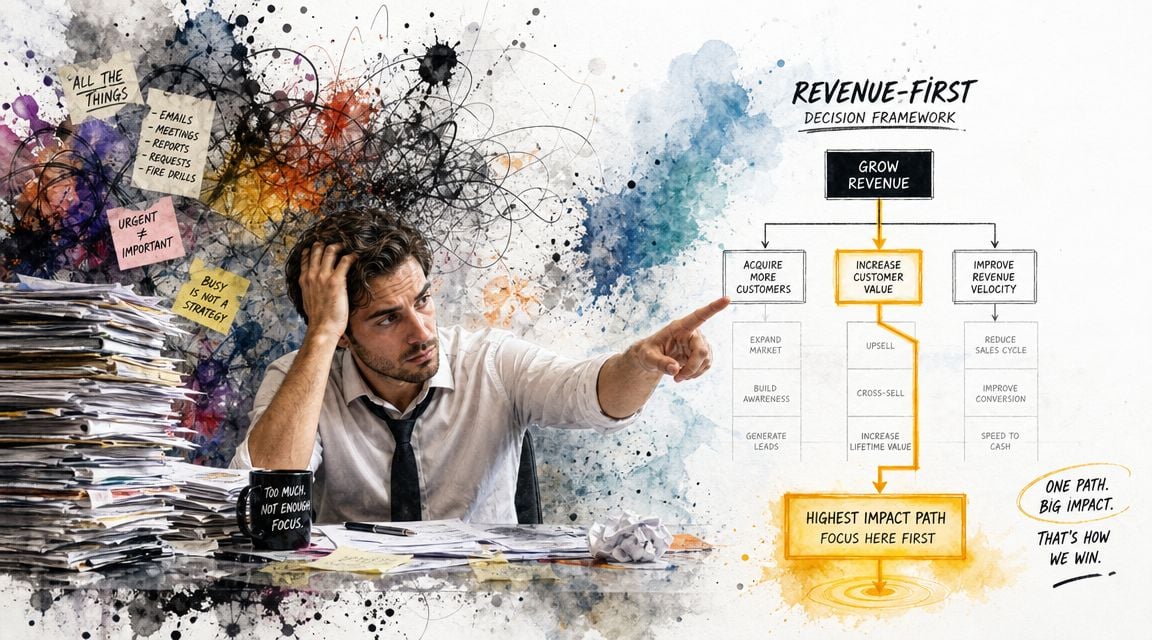
Define impact the right way
Impact means expected revenue gain from a specific change. Use that standard and a lot of bad ideas disappear fast.
Start with four questions:
- How close is this step to the sale? Changes near inquiry, checkout, booking, or demo request usually matter more than changes higher up the funnel.
- What kind of traffic hits it? High-intent traffic deserves attention first because small lifts there pay back faster.
- How serious is the friction? If users stall, abandon, or repeat actions at that step, fix it before you debate design polish.
- Can you measure the result cleanly? If your stack cannot connect the change to pipeline, purchases, or booked revenue, it is not ready for priority status.
That last point gets ignored. CRO breaks when measurement lives in one tool, experiments in another, and customer follow-up in a third with no clean handoff. If your CRM, analytics, testing, and review signals are disconnected, teams end up prioritizing visible changes instead of profitable ones.
A simple triage model
Use three buckets and be strict about them.
| Priority | What belongs here | Example |
|---|---|---|
| Fix now | Friction or failures on pages and steps tied directly to leads or sales | Broken forms, weak pricing visibility, checkout errors, call booking issues |
| Test next | Changes with a clear hypothesis and measurable commercial upside | Stronger offer framing, proof near the CTA, shorter forms, tighter page hierarchy |
| Ignore for now | Cosmetic work with weak commercial relevance | Broad visual refreshes, low-intent page tweaks, stakeholder preference projects |
This framework protects your team from vanity work. It also keeps acquisition and conversion connected. If paid traffic is expensive, every prioritization call should be filtered through return on ad spend and revenue efficiency, not page-level engagement metrics.
What this looks like in practice
A service business usually faces a choice like this. Leadership wants a homepage redesign because the brand feels dated. Meanwhile, the highest-intent service page has a clumsy appointment form, weak trust signals, and no clear follow-up flow into the CRM.
Only one of those projects improves revenue.
The right move is to fix the path that turns demand into customers, then make sure the lead data, attribution, follow-up, and review collection all connect after the conversion. That is how you improve conversion rate in a way that lasts. You are not optimizing a page. You are improving the system that carries a buyer from click to closed deal to repeat business.
If a task cannot plausibly increase revenue, shorten sales cycles, or improve lead quality, it goes to the bottom of the list.
Running Tests That Actually Teach You Something
A/B testing gets treated like a magic trick. It isn't. It's a way to answer a narrow question with less ego and better evidence.
Most businesses run bad tests for one reason. They don't have a real hypothesis. They have a hunch, some design preferences, and a vague hope that "Version B feels cleaner."
That's not testing. That's drifting.
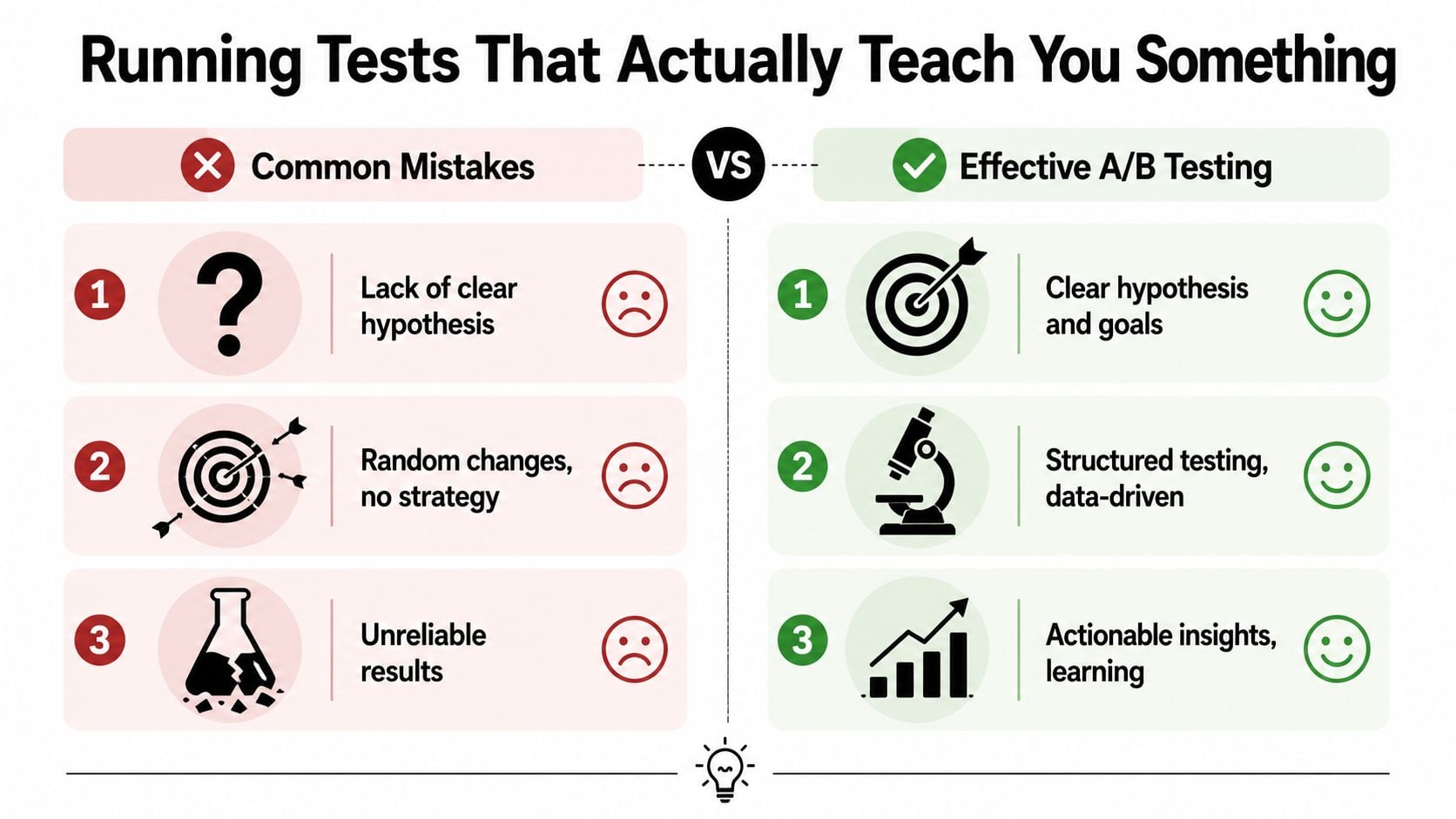
Build the test around a customer problem
A strong test starts with observed behavior. People hesitate at the CTA. They abandon at a form field. They scroll but don't act. Good. Now you have something to work with.
Turn that into a hypothesis:
- Observed issue: Users reach the form and drop.
- Likely reason: The ask feels too heavy.
- Hypothesis: Reducing the number of fields will increase completions because users will perceive less effort.
That is specific enough to test and useful enough to learn from.
Keep the experiment clean
For message-conversion improvements, a key practice is to A/B test one variable at a time, and one source warns that although a CTA may appear 5–6 times, it should remain the same CTA throughout the page to avoid confusion, according to this guidance on reducing CTA sprawl.
That one sentence eliminates a huge amount of wasted effort.
Here are the rules that keep tests useful:
- Change one thing: If you rewrite the headline, swap the hero image, shorten the form, and move the CTA, you won't know what caused the result.
- Use one primary goal: Pick the metric that matters for that page. Demo requests. Purchases. Qualified form submissions.
- Keep the CTA consistent: Repetition is fine. Mixed asks are not.
- Document the reason: If a test wins or loses, you should be able to explain what belief it challenged.
Learn from losses too
A losing test isn't useless. It's often more valuable than a lucky winner because it sharpens your understanding of buyer behavior.
If a more aggressive CTA underperforms, that tells you your audience needs more reassurance. If a shorter page loses, that may mean buyers require more proof before acting. If a feature-led headline loses to a benefit-led headline, your value proposition probably wasn't clear enough.
A good test doesn't just tell you what changed. It tells you what your buyer needed in order to say yes.
Teams that improve conversion rate over time build a knowledge base from these results. They don't just log winners. They record what users responded to, what created confusion, and which objections appeared near the moment of action. That's how testing becomes a revenue capability instead of a random tactic.
Optimizing Your Core Conversion Assets
Once diagnosis is solid and testing discipline is in place, the work shifts to the assets buyers experience; most conversion gains come from this. Not from novelty. From better execution of the basics.
The cleanest way to assess those assets is with three lenses: clarity, credibility, and friction.
Clarity beats cleverness
Most pages say too much and explain too little. Buyers shouldn't have to decode what you do, who it's for, or what happens next.
Fix that with direct messaging:
- Lead with the outcome: Put the result first, not the internal description of your service.
- Match the click: The page should continue the promise made in the ad, email, or listing.
- Choose one primary action: Every section can reinforce it, but don't split attention with competing asks.
If your page needs a guided tour to make sense, it won't convert well.
Credibility closes the gap between interest and action
Many businesses leave money on the table. They talk about trust as if it's decorative. It isn't. It is part of the conversion mechanism.
Displaying reviews or user ratings has been reported to increase conversion rates by up to 270% in controlled settings, products with reviews convert about 12.5% higher than those without, and positive star ratings make shoppers 85% more likely to purchase, according to these CRO statistics on reviews and social proof.
Those numbers explain why proof belongs near action points, not hidden on a testimonials page no one visits.
Use proof where decisions happen:
- Near the CTA: Reviews, ratings, or testimonials beside the action reduce hesitation.
- Near pricing or forms: Doubt usually peaks.
- Inside follow-up flows: Confirmation pages and CRM-driven nurture sequences should reinforce the same trust cues.
A local service business doesn't need more adjectives. It needs visible proof that real customers trust it.
Friction kills intent faster than weak copy
Even interested buyers leave when the process becomes annoying. Long forms, confusing layouts, too many steps, and dense mobile experiences all create unnecessary exits.
Audit friction with a harsh eye:
- Remove fields you don't need.
- Reduce checkout or booking steps.
- Keep layouts clean on mobile.
- Make pricing and next steps easy to understand.
- Place proof next to commitment points.
A page doesn't convert because it looks modern. It converts because it makes the next step feel obvious, safe, and easy.
How to Scale Wins with an Integrated Growth Ecosystem
A one-off CRO win is nice. It is not a growth system.
The problem starts after the test. One team updates a page. Another team keeps running old ad messaging. Sales follows up with a different story. Reviews live in a separate workflow. Customer data sits in disconnected places. The insight never spreads.
That is how businesses waste good learnings.
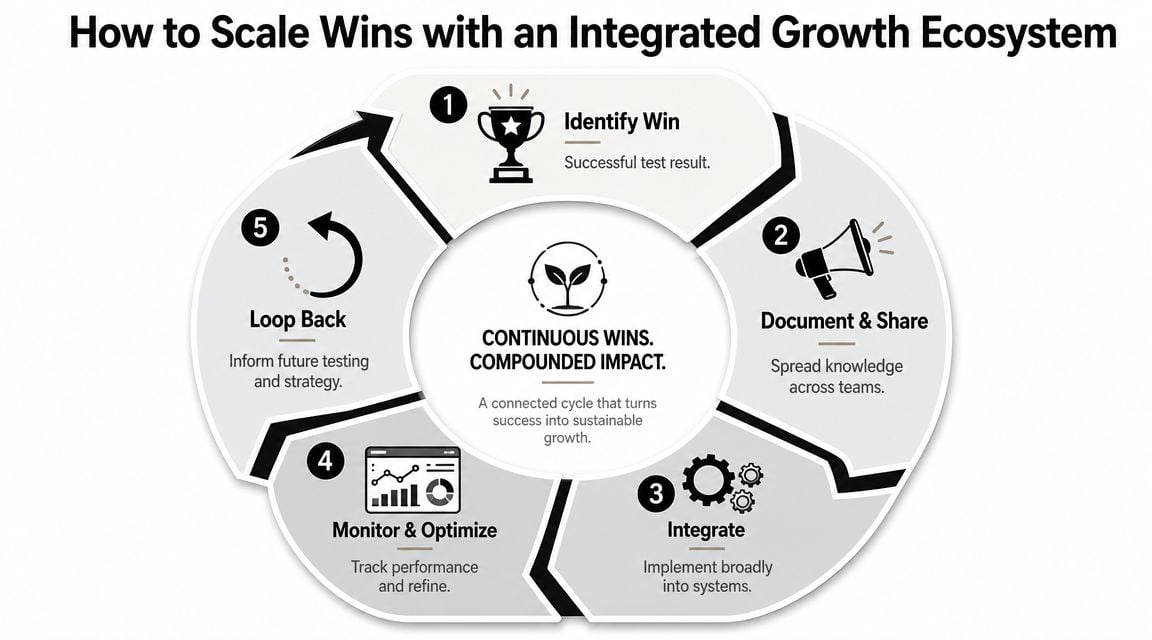
Conversion gains need a system around them
A test result should trigger operational changes across the funnel.
If buyers respond to a trust-led headline, that insight should shape:
- Ad creative: Use the same promise before the click.
- CRM workflows: Reinforce the same value in follow-up messages.
- Review requests: Generate more proof tied to the objections buyers care about.
- Sales scripts: Use the language that already proved persuasive.
That is what an integrated growth ecosystem does. It turns isolated learnings into repeatable performance.
Measurement is now part of CRO
In a post-cookie environment, marketers increasingly struggle to attribute conversions correctly, and many guides still focus on page-level tactics rather than the measurement architecture that reveals real winners and losers, as described in this analysis of optimization in partially blind environments.
That issue is not theoretical. If your attribution is weak, you can easily scale the wrong campaigns and kill the right ones.
So yes, page optimization matters. But sustainable conversion improvement now depends on first-party data discipline, cleaner tracking, tighter CRM usage, and a consistent reputation pipeline. When those systems connect, teams can see which traffic sources produce quality leads, which landing pages generate action, and which customer experiences create repeat business.
If your data, messaging, reviews, and follow-up live in separate silos, your conversion rate will always hit a ceiling.
The compounding effect comes after the click
Most articles about how to improve conversion rate stop at the form submission. Serious growth work doesn't.
A better system tracks what happens next. Which leads book. Which buyers close. Which customers leave reviews. Which cohorts become repeat purchasers. That feedback loop lets you improve not just the page, but the entire revenue path.
Integrated tech stacks stop being "nice to have" and become practical infrastructure. They help teams connect intent, action, trust, and retention in one loop. That's how wins compound instead of disappearing into disconnected channels.
Become a Revenue-First Organization
If you've been burned by agencies, dashboards, and "engagement" reports, here's the blunt truth. Conversion rate optimization isn't failing you. Shallow execution is.
The fix is straightforward. Measure before you change anything. Find the exact leak in the funnel. Prioritize based on revenue impact. Test with discipline. Strengthen the assets that drive action. Then connect those insights to your CRM, your reviews, your follow-up, and your broader customer experience.
That is how to improve conversion rate in a way that lasts.
What disciplined teams do differently
They don't chase vanity metrics. They don't redesign for sport. They don't confuse activity with progress.
They do three things repeatedly:
- They diagnose with evidence.
- They prioritize for revenue.
- They scale what works across the whole customer journey.
That operating model is what separates random improvement from predictable growth.
Stop treating conversion as a page problem
Your landing page matters. So does your offer. So does your trust stack. So does your measurement setup. So does your handoff after the lead comes in.
When those pieces work together, ad spend gets more efficient, customer acquisition gets cleaner, and growth stops feeling accidental.
If you're serious about turning marketing into a profit center, build a conversion system, not a pile of disconnected fixes.
If you want a growth-focused partner to help turn ad spend into measurable revenue, The Advertising Suite is built for exactly that. Their Growth-Tech Hybrid model pairs human-led strategy with an integrated CRM and reputation ecosystem, so conversion improvements don't stop at the landing page. If you're ready to stop guessing, Book a Growth Consult. If you want the software advantage and a 25% discount on services, Explore the Membership. Either way, you're not hiring another vendor. You're adding an extension of your team.