Most advice about social proof in advertising is too shallow to be useful. It tells you to add testimonials, sprinkle in star ratings, and hope trust magically appears.
That's not a strategy. That's decoration.
If your ads generate attention but your business still struggles to turn that attention into revenue, the problem usually isn't reach. It's trust. Buyers don't need more branded claims. They need evidence from other people that your offer is worth their money, time, and risk.
For founders who've already paid for pretty dashboards and empty reporting, this matters. Social proof in advertising works when it's tied to buyer hesitation, deployed where decisions happen, and measured against revenue. Everything else is vanity wearing a nicer outfit.
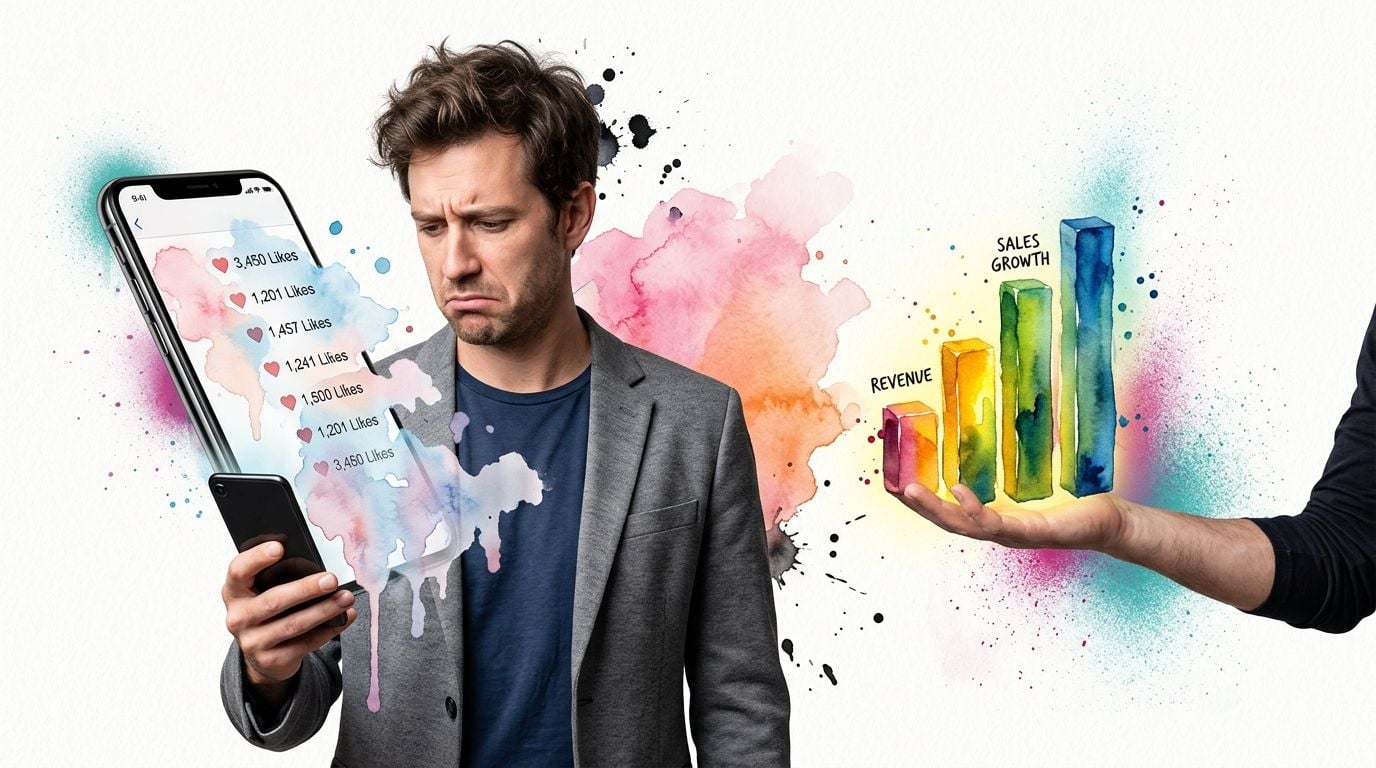
Why 'Likes' Don't Pay Bills but Social Proof Does
A post getting likes doesn't mean your pipeline is healthy. A campaign getting clicks doesn't mean your sales process is working. Those numbers can describe activity, but they don't prove commercial value.
The hard truth is simple. Attention without trust leaks money.
That's why social proof in advertising matters more than surface engagement. Buyers use other people's experiences to reduce perceived risk. If they're comparing options, your brand copy won't carry the argument by itself. The market has heard too many polished promises already.
Here's the number that should reset your priorities. According to Statista, 76% of US consumers always or regularly read online reviews to assess businesses before making decisions, and word-of-mouth recommendations remain the most trusted advertising form at 89% credibility, as summarized by Coursera's review of social proof statistics.
That tells you two things:
- Reviews are part of the buying process: Buyers aren't treating them as optional research.
- Peer validation beats brand messaging: Buyers trust people more than campaigns.
- Trust has to be visible: If your proof is buried, it can't do its job.
Practical rule: If a prospect has to dig for evidence that you deliver, your ads are asking them to take a blind leap.
Many businesses misunderstand social proof. They treat it like a website add-on instead of a conversion mechanism. A review widget in the footer won't rescue an expensive campaign. Trust has to sit near the decision point, where hesitation shows up.
For local businesses and service brands, that often means proof tied to reputation, response quality, and consistency. If you're serious about tightening that loop, a stronger reputation management strategy usually does more for revenue than another round of “awareness” creative.
What vanity metrics miss
Vanity metrics answer easy questions. How many impressions did we get? How many people watched part of the video? How many reactions did the post earn?
Revenue-focused operators ask better ones:
- Did trust increase at the point of action?
- Did more qualified buyers convert?
- Did the campaign reduce hesitation enough to lift sales?
That's the standard. Social proof earns its place because it helps buyers make a decision they already want to make, but haven't fully trusted yet.
What social proof actually does
At its best, social proof in advertising does three jobs at once:
| Job | What it changes | Why it matters |
|---|---|---|
| Reduces risk | Buyers feel less exposed | They stop delaying decisions |
| Adds credibility | Claims feel externally validated | Your message gets believed |
| Supports action | Confidence rises near the CTA | More traffic turns into revenue |
Likes can't do that by themselves. Reviews, testimonials, endorsements, and visible customer validation can.
The Psychology of Trust and Types of Social Proof That Convert
People don't buy based on information alone. They buy when uncertainty drops to an acceptable level. That's the essential role of social proof in advertising.
A skeptical buyer asks a quiet set of questions before converting. Has someone like me used this? Did it work? Can I trust the company behind it? Social proof answers those questions faster than polished copy ever will.
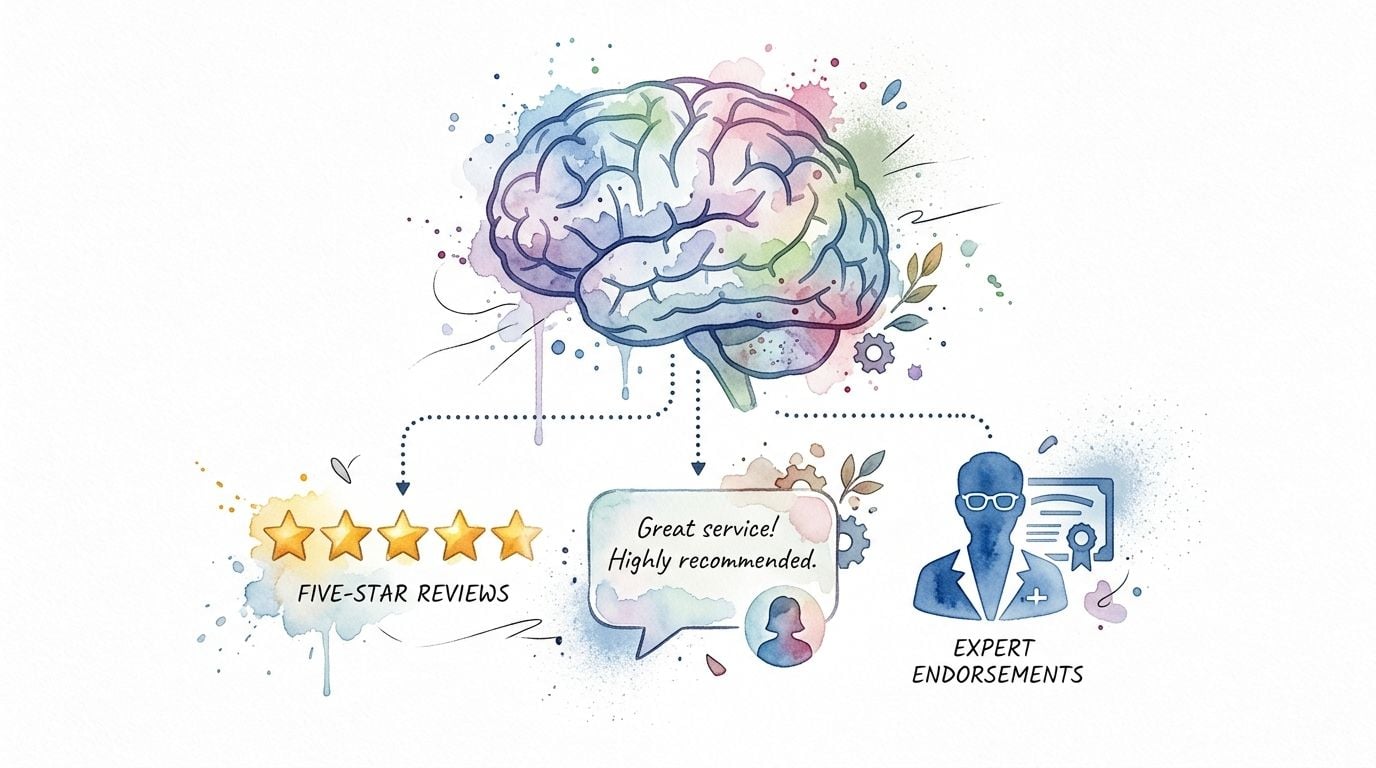
One reason it works so well is trust transfer. When buyers see a peer, a customer, or a recognized authority validate your offer, they borrow confidence from that source. That's especially important for founders who've been burned by agencies, vendors, or overpromising service providers before. User testimonials and endorsements from friends or peers sit in a 70% trust range, which is why they outperform generic advertising for skeptical buyers, according to Trustmary's overview of social proof examples.
The three categories that matter most
You don't need every type of social proof. You need the right type for the right buying moment.
Wisdom of the crowd
This is the broad signal that says, “A lot of people already trust this.”
Examples include customer counts, satisfaction claims that are properly supported, review volume, and visible demand indicators. This type works best when a buyer is still asking whether your business is credible at all.
Use it when:
- Your brand isn't widely known
- You need fast legitimacy on cold traffic
- You want to reduce first-impression friction
A crowd signal tells buyers they aren't stepping into something unproven.
Peer validation
This is usually the strongest proof for high-intent offers. Reviews, testimonials, customer quotes, before-and-after stories, and user-created content all fall into this category.
It works because specifics feel real. “Great service” is weak. A customer explaining the problem they had, why they hesitated, and what happened after buying does actual selling.
Generic praise doesn't convert skeptical buyers. Specific experiences do.
Use it when:
- The buyer is comparing options
- The offer involves risk, complexity, or commitment
- You need to answer objections inside the ad or on the landing page
Authority signals
These include certifications, awards, recognitions, media mentions, industry credentials, and expert endorsements. They don't replace customer proof, but they can strengthen it.
Authority is useful when buyers need reassurance that your business is established, compliant, or professionally credible.
Use it when:
- You sell expertise-heavy services
- Your market values credentials
- Buyers need one more reason to trust your process
Match the proof to the hesitation
A lot of businesses use social proof randomly. That's why it underperforms. You need to match the proof format to the buyer's actual concern.
| Buyer hesitation | Best proof type | Why it works |
|---|---|---|
| “Can I trust this company?” | Crowd signals and authority markers | They establish legitimacy fast |
| “Will this work for someone like me?” | Detailed testimonials and reviews | They create relevance |
| “Is this worth the risk?” | Specific outcome-focused customer stories | They lower perceived downside |
The best-performing social proof usually sounds less like marketing and more like a buyer talking to another buyer. That's the benchmark.
Building Your Social Proof Advertising Playbook
Most businesses don't need more ad ideas. They need a tighter operating system for trust.
If you want social proof in advertising to drive revenue, stop dropping testimonials into random creatives and start building around buyer hesitation. The sequence matters. Placement matters. Message accuracy matters.

A strong implementation starts with uncertainty mapping. To implement a high-conversion social proof strategy, first identify specific customer uncertainty points and integrate real-time data-driven social proof messaging. Rigorously deploy A/B testing to measure uplifts, as success rates indicate that when social proof effectively buffers uncertainty, conversion improvements can reach up to 400%, according to CXL's analysis of social proof and conversion behavior.
Step one, find the hesitation point
Don't ask, “Where can we add proof?”
Ask:
- Where does the buyer hesitate?
- What proof would reduce that hesitation?
- Can we place it next to the action we want them to take?
For an appointment-driven business, hesitation might happen before form submission. For a product page, it may happen near price. For a lead generation ad, it may happen before the click because the offer sounds too polished to trust.
That diagnosis should drive the creative.
Step two, build channel-specific proof
Different placements need different proof formats. Don't use one testimonial everywhere and call it optimization.
Search ads
Search traffic usually arrives with intent. That means your proof should confirm the buyer's decision, not entertain them.
Use:
- Review-focused extensions or landing page carryover: Lead with the rating signal or customer satisfaction proof on the destination page.
- Short trust statements: Keep the language factual and buyer-centered.
- Proof near the primary CTA: Don't bury it below a wall of copy.
Example approach:
- Headline promise in the ad
- Review signal or trust marker immediately on the landing page
- Specific customer quote close to the form or booking button
Social ads
Social traffic needs interruption and reassurance. People scroll fast, and they're suspicious of polished creative.
Use:
- Customer quote cards: Pull short lines from actual feedback
- Video or image-based user proof: Real customer experience usually lands better than studio-perfect assets
- Comment-aware creative: Build ads that answer the objections you repeatedly hear
If you're building campaigns around customer voices, this guide to user-generated content campaigns is the right next step.
Field note: The best social ad proof often looks slightly less polished than brand creative, because buyers read “real” before they read “perfect.”
Display and retargeting
Display should reinforce credibility, not try to say everything at once.
Use:
- Client logo bars
- Recognition or trust badges
- A single strong testimonial line
- Simple proof-backed headlines
Retargeting is where proof can clean up hesitation from earlier clicks. If someone visited but didn't convert, don't just repeat the offer. Show evidence.
Step three, write proof that actually works
Weak proof is vague, inflated, and self-congratulatory. Strong proof is concrete and buyer-oriented.
Use this simple structure:
| Component | Weak version | Stronger version |
|---|---|---|
| Customer quote | “Amazing service” | “We were hesitant to switch, but the process was clear and the team followed through” |
| Headline support | “Trusted by many” | “See why customers choose us when reliability matters” |
| CTA support line | “Don't miss out” | “Read what customers said before they booked” |
Step four, keep it factual
There's no faster way to kill trust than inflated claims, fake urgency, or made-up activity notifications. If your proof isn't current, accurate, and defensible, don't run it.
Stick to three rules:
- Use real customer language
- Keep counts and ratings current
- Place proof where decisions happen, not where designers had spare space
That's the playbook. Not glamorous. Very effective.
The Tech Advantage of an Integrated Proof Ecosystem
Most businesses treat social proof like a content asset. Collect a few reviews. Drop them on the site. Reuse one or two in ads. Then wonder why results plateau.
That approach breaks because it's manual, inconsistent, and disconnected from the customer journey.
The better model is an ecosystem. Social proof in advertising performs when your business continuously identifies happy customers, captures their feedback, routes it into marketing assets, and puts it in front of the next buyer at the right moment. That requires coordination, not improvisation.

The revenue case is hard to ignore. Consistent social proof implementation can increase revenue by 62% per individual customer, as reported in Datapins' roundup of social proof statistics. That's what a revenue-first operator should care about. Not whether the campaign looked busy. Whether the system increased customer value.
What an integrated proof loop looks like
A functional proof ecosystem usually follows this pattern:
Customer data identifies satisfaction signals
Your team sees who had a good experience, completed a successful engagement, or gave positive feedback.Review requests go out at the right moment
Not weeks later when the experience is cold. Right after the value was felt.Feedback gets organized by theme
Speed, trust, communication, quality, results, ease of use. Those themes become creative assets.Proof gets deployed across revenue touchpoints
Ads, landing pages, product detail pages, follow-up emails, and sales materials all use the right proof for the right objection.Performance data feeds the next round
You keep what reduces friction. You drop what doesn't.
Many teams need stronger customer data coordination. If your records are fragmented, your proof stays fragmented too. A more connected view of customers through unified customer profiles makes it much easier to know who to ask, what to feature, and when to deploy it.
Why isolated tactics stall out
You can't scale trust with screenshots floating in a shared folder.
An isolated tactic creates three problems:
- Collection becomes inconsistent: Teams ask for reviews when they remember, not when timing is best.
- Creative becomes repetitive: The same proof gets reused until buyers tune it out.
- Measurement becomes fuzzy: You can't tie proof assets to commercial outcomes cleanly.
Buyers don't experience your brand in silos. Your proof system shouldn't operate in silos either.
A connected proof engine turns customer experience into marketing input. That's the advantage. It removes guesswork, reduces dependence on brand claims, and gives your advertising a steady supply of real trust assets instead of stale filler.
Measuring What Matters From Vanity Metrics to Revenue Lift
If you can't isolate the effect of social proof, don't pretend you're optimizing. You're guessing with prettier language.
The point of social proof in advertising isn't to make your campaign feel more credible. The point is to improve commercial performance in a way you can measure. That means running disciplined comparisons and tracking metrics that connect to money.
The KPIs worth your attention
Start with the metrics closest to revenue:
- Conversion Rate Uplift (CRU): Compare a page or ad variation with proof against a comparable version without it.
- Revenue Per Visitor (RPV): Track whether trust elements improve the value of traffic, not just the volume.
- Add-to-basket or lead submission rate: Use the action that best reflects buyer commitment in your funnel.
- Bounce rate as a secondary signal: Useful, but not the headline metric.
This is the right lens for ROI-focused teams. If you need a cleaner financial framework around attribution, contribution, and reporting, use a structured approach to calculating marketing ROI.
What good testing looks like
Most bad tests fail because too many variables change at once. Keep the comparison tight.
Test one meaningful difference:
- Version A has no testimonial near the CTA
- Version B includes a specific testimonial near the CTA
Or:
- Version A uses a static trust badge
- Version B uses detailed review content plus a customer video
Then measure the commercial delta.
A strong benchmark comes from B2B SaaS. Companies implementing well-rounded social proof strategies, especially with multi-format elements like reviews and video testimonials, have seen conversion improvements ranging from 10% for basic implementations to a median lift of 37% and a maximum boost of 270% for optimized approaches, according to Genesys Growth's social proof conversion benchmarks.
A simple scorecard for operators
| Metric | What to compare | What you're looking for |
|---|---|---|
| CRU | Proof version vs non-proof version | Whether proof increased conversion efficiency |
| RPV | Revenue generated per visitor by variant | Whether better trust produced stronger monetization |
| Lead quality or basket intent | Submission quality or buying actions | Whether proof improved buyer confidence, not just clicks |
Don't stop at “engagement improved.” That's often how teams hide weak commercial outcomes.
If a trust element raises clicks but doesn't improve conversion or revenue, it's not a growth lever. It's decoration with a budget attached.
The goal is clarity. You want to know which proof type, placement, and format moves the bottom line so you can scale it with confidence.
The Future of Social Proof Privacy, Ethics, and Staying Ahead
The next phase of social proof in advertising belongs to brands that can prove trust without creeping people out.
Old tactics relied on heavy tracking, fuzzy attribution, and recycled customer content used without much thought. That approach is losing ground. Privacy restrictions are tightening. Buyers are paying closer attention. Regulators are doing the same.
There is real upside for disciplined operators. Existing content rarely explains how to use social proof ethically in privacy-restricted ad environments, with a reported drop in UGC-based conversion attribution and limited SMB adoption of community-curated proof, according to Salesforce's discussion of social proof for SMBs.
What community-curated proof looks like
Privacy-safe proof is practical. It uses signals buyers can verify and your team can manage without invasive tracking.
- Public engagement patterns: Visible conversation and interest around an offer
- Real-time purchase or booking signals: Factual activity indicators that don't expose personal identity
- Permission-based customer content: Proof you are allowed to reuse, not content your team pulled without clear consent
This works better because it holds up under tighter privacy rules and stronger buyer scrutiny. It also forces better operating discipline. You stop chasing every vanity signal and start building a proof library you can use across ads, landing pages, CRM follow-up, and reputation workflows.
The ethical rules are simple
Teams overcomplicate this. They should not.
Use these rules:
- Get permission before reusing customer content
- Don't fake activity, urgency, or customer counts
- Keep proof current enough to stay accurate
- Use first-party systems to manage consent and context
If your growth plan depends on cleaner targeting and more reliable customer data, your first-party data strategy needs to support how proof is collected, approved, deployed, and measured.
The brands that stay ahead will not win because they collected more screenshots, reviews, or likes. They will win because they built a system. Proof flows into the CRM. Reputation signals stay current. Sales and marketing use the same source of truth. That is how social proof stops being a tactic and starts acting like a predictable growth engine.
If you want that system in place, The Advertising Suite is built for it. Request a Demo to see the CRM and review management stack in action, or Explore the Membership if you want the software, the service discount, and a team that treats revenue as the scoreboard.