Most advice on local search marketing is stuck in checklist mode. Claim your profile. Add photos. Ask for reviews. Build citations. Then wait for rankings and call it strategy.
That's why so many business owners feel burned. They paid for activity, got a report full of impressions and position changes, and still couldn't answer the only question that matters. Did local search produce revenue?
If your current approach treats local search like a side quest, it's underperforming. Local visibility isn't a branding exercise for service businesses, clinics, legal offices, home service companies, or multi-location brands. It's a direct path from search intent to booked jobs, store visits, and closed revenue. The businesses that win aren't the ones with the prettiest dashboards. They're the ones that connect visibility, trust, and follow-up into one system.
Your Local Search Strategy Is Probably Broken
Most local search programs break in the same place. They stop at discovery.
A business shows up in the map results. The profile gets views. A few keywords move up. Someone calls that progress. It isn't. It's only progress if those searchers turn into real conversations, appointments, and customers.
The old mindset says local search marketing is mostly technical housekeeping. Keep listings tidy. Sprinkle city names on pages. Collect reviews when you remember. That's incomplete. Local search is a high-intent revenue channel, and treating it like admin work is how businesses waste opportunity.
What the broken version looks like
You've probably seen some version of this:
- Reports without accountability: You get ranking updates, but no link to booked work.
- Visibility without trust: Your listing appears, but the reviews are stale, thin, or unanswered.
- Leads without process: Calls come in, forms arrive, nobody tracks where they came from or what they became.
That last one is brutal. A business can improve visibility and still feel no growth because the follow-up is slow, inconsistent, or disconnected from the source.
Practical rule: If your local search reporting ends at impressions, it's not a growth strategy. It's a vanity report.
The real job of local search
Local search marketing should do three things at once:
- Get you found when someone has immediate local intent.
- Get you chosen by proving you're credible and convenient.
- Get you measured so you know which locations, pages, and actions create revenue.
That means the best local strategy isn't just about rankings. It's about operational fit. Your profile, your website, your reviews, your hours, your location pages, and your lead handling all have to agree with each other.
If they don't, you're sending mixed signals to both search engines and buyers. Mixed signals don't scale.
Why Your Business Lives or Dies by Local Search
A lot of channels create interest. Local search captures demand that already exists.
That's the difference. People searching locally usually aren't browsing for amusement. They're looking for a nearby provider, a solution, or a business they can visit or contact now. One widely cited benchmark says 46% of all Google searches have local intent, and that same benchmark notes 76% of people who search for something nearby visit a business within 24 hours, while 78% of mobile local searches result in an offline purchase (local search benchmark data).
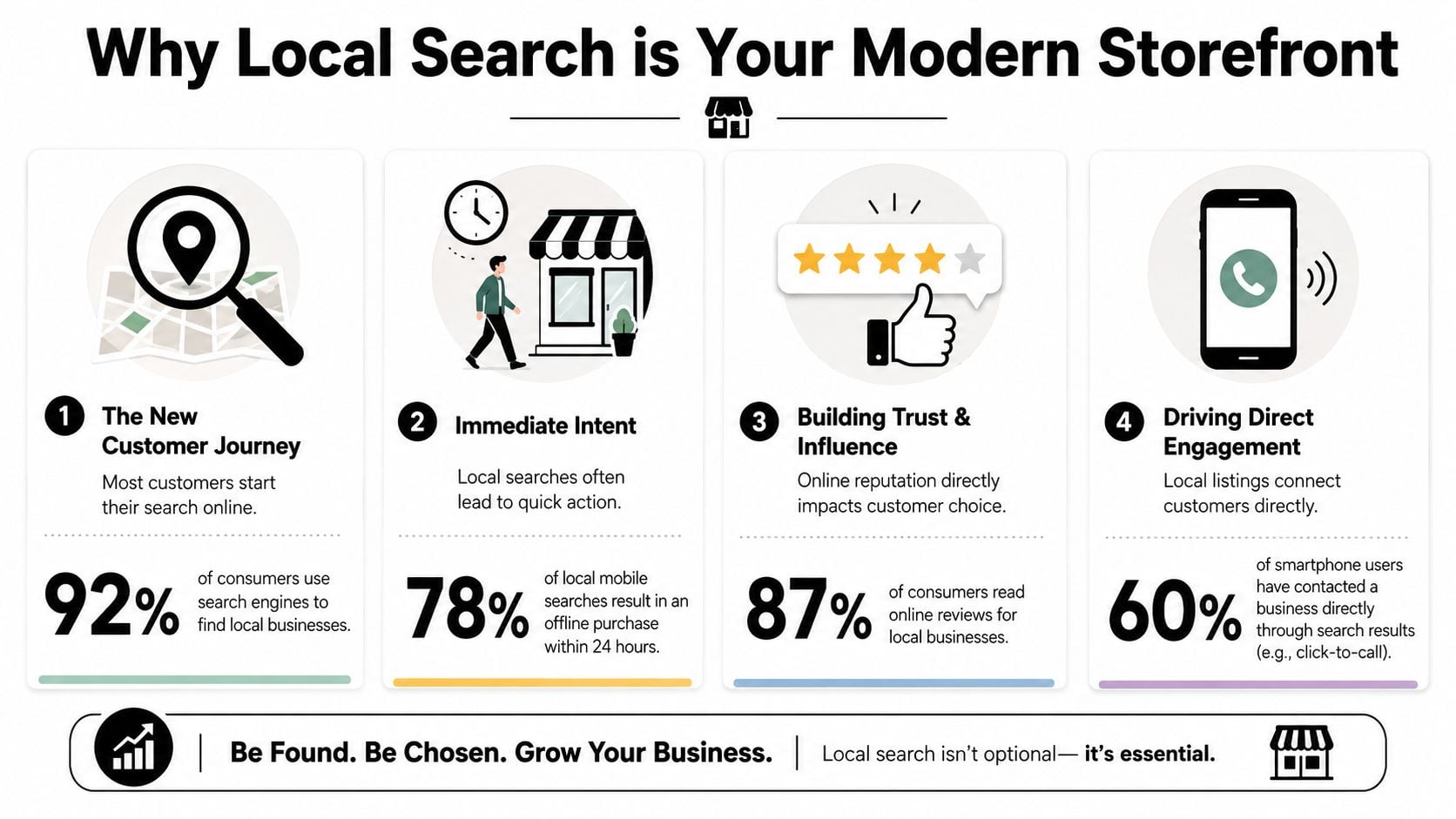
Those numbers should change how you think about local search marketing. This isn't top-of-funnel fluff. This is buyers signaling urgency.
Search is now the storefront
For many businesses, the local results page does the work your storefront, receptionist, and sales sheet used to do.
A prospect checks your hours. Reads your reviews. Looks at your category. Compares you with nearby alternatives. Requests directions. Calls. Sometimes they never visit your website at all. That means your local presence has to function like a complete buying environment, not just a traffic source.
If your listing is incomplete, your details are inconsistent, or your reputation looks neglected, you're giving away customers with intent that's already formed.
What high-intent local behavior actually means
Here's the practical takeaway from that search behavior:
| Buyer behavior | What it means for your business |
|---|---|
| Searching nearby | The buyer wants a local solution, not a broad list of options |
| Acting within hours | Slow response and outdated information cost you immediately |
| Buying offline | Revenue often happens off-site, so website traffic alone misses the story |
That last point matters more than most businesses realize. Local search often creates calls, walk-ins, and bookings that never show up as a clean website conversion path. If you only judge performance by clicks, you'll undervalue one of your strongest channels.
A weak local presence doesn't just reduce exposure. It redirects ready-to-buy customers to the business down the street.
Why this is urgent for SMBs and multi-location brands
Single-location businesses lose because they aren't visible enough. Multi-location brands lose because their execution gets sloppy at scale.
Common failure points include:
- Inconsistent hours: One location says open, another listing says closed.
- Generic location pages: Every page reads the same, so none of them feel local.
- Fragmented reputation: Reviews pile up with no response pattern or service recovery process.
Local search rewards relevance, trust, and clarity. If your business serves a defined geography, local visibility is not optional. It's part of basic market access now.
The Core Components of Winning Local Search
Local search breaks down when teams treat it like a checklist instead of a revenue system.
You do not win by tweaking one ranking factor at a time. You win by making it easy for a buyer to find the right location, trust what they see, and take the next step without friction. That means your profile data, website structure, listings, and review process need to work together like one sales motion.
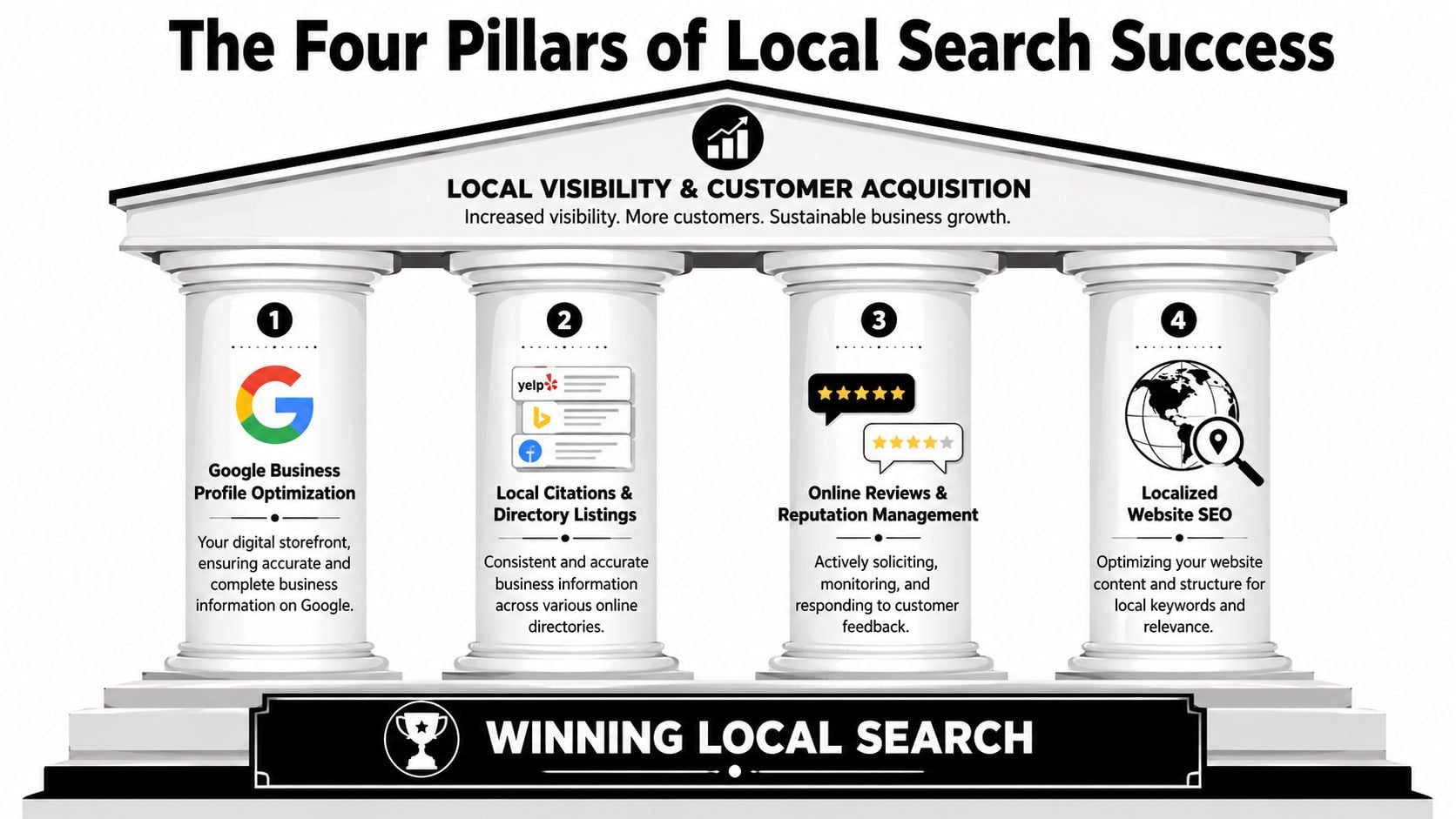
Google Business Profile is your control center
Your Google Business Profile shapes first impressions before a buyer ever reaches your site. If it is incomplete, outdated, or sloppy, you lose calls and visits from people who were ready to act.
Get the basics right. Use the correct primary and secondary categories. Keep hours current, including holiday changes. List real services. Upload strong photos that reflect the location the buyer will visit. Make sure the phone number, address, and business description match the rest of your local presence.
Then treat the profile like an active conversion asset, not a set-it-and-forget-it listing. Update it when services change. Review questions regularly. Watch for incorrect edits. The businesses that stay accurate usually outperform the ones that only optimize once.
Your website needs location architecture that matches how people buy
A generic services page does not carry local intent well, especially for businesses serving multiple cities, neighborhoods, or storefronts. Buyers want confirmation that you serve their area and understand their local context. Search engines want the same clarity.
Build one strong page per location or service area. Give each page useful local detail instead of swapping city names into the same template. Show the services available there, the markets you cover, proof from nearby customers, and a clear next action.
Use a structure like this:
- One page per location or service area: Give each market a page with specific business details and service coverage.
- Local proof: Add testimonials, photos, FAQs, and examples tied to that area.
- Clear conversion paths: Put calls, forms, booking actions, and trust signals on every location page.
The link between local SEO and revenue becomes clear. A location page should not just rank. It should answer buying questions fast enough to turn search demand into calls, appointments, and store visits.
Citation consistency supports trust at scale
Your business data needs to match everywhere it appears. If your name, address, phone number, or hours conflict across directories, maps, and your own site, you create doubt for both search engines and buyers.
That confusion shows up in real ways. A customer calls the wrong number. A listing sends them to an old address. A duplicate profile splits your review history. Each of those failures cuts into lead volume and conversion rate.
A simple way to look at it is:
| If your data is inconsistent | If your data is aligned |
|---|---|
| Search engines see conflicting entity signals | Search engines can validate the location with more confidence |
| Customers hesitate or get frustrated | Customers trust that your business is real and reachable |
| Duplicate listings compete with each other | One clean entity supports stronger visibility |
For multi-location brands, this gets harder fast. You need one source of truth for every location and a process for updating listings whenever hours, phone numbers, or service details change.
Reviews are part ranking signal, part sales asset
Reviews influence visibility, but their bigger job is conversion. Buyers read them to judge risk. They want proof that you deliver the experience your profile and website promise.
Treat review generation like part of your customer journey. Ask at the right moment, usually right after the service is delivered or the purchase is completed. Respond like a business that cares about retention, not just public appearance. Use review themes to spot service issues that are blocking repeat business and referrals.
A mature review process includes:
- Consistent requests: Build them into your follow-up workflow.
- Useful responses: Answer both praise and complaints with specifics.
- Operational feedback: Fix the service problems reviews keep exposing.
Local search works best when marketing, service, and sales are aligned. Rankings get you seen. Trust and follow-through get you paid.
Beyond Rankings The Real Goal Is Reputation and Revenue
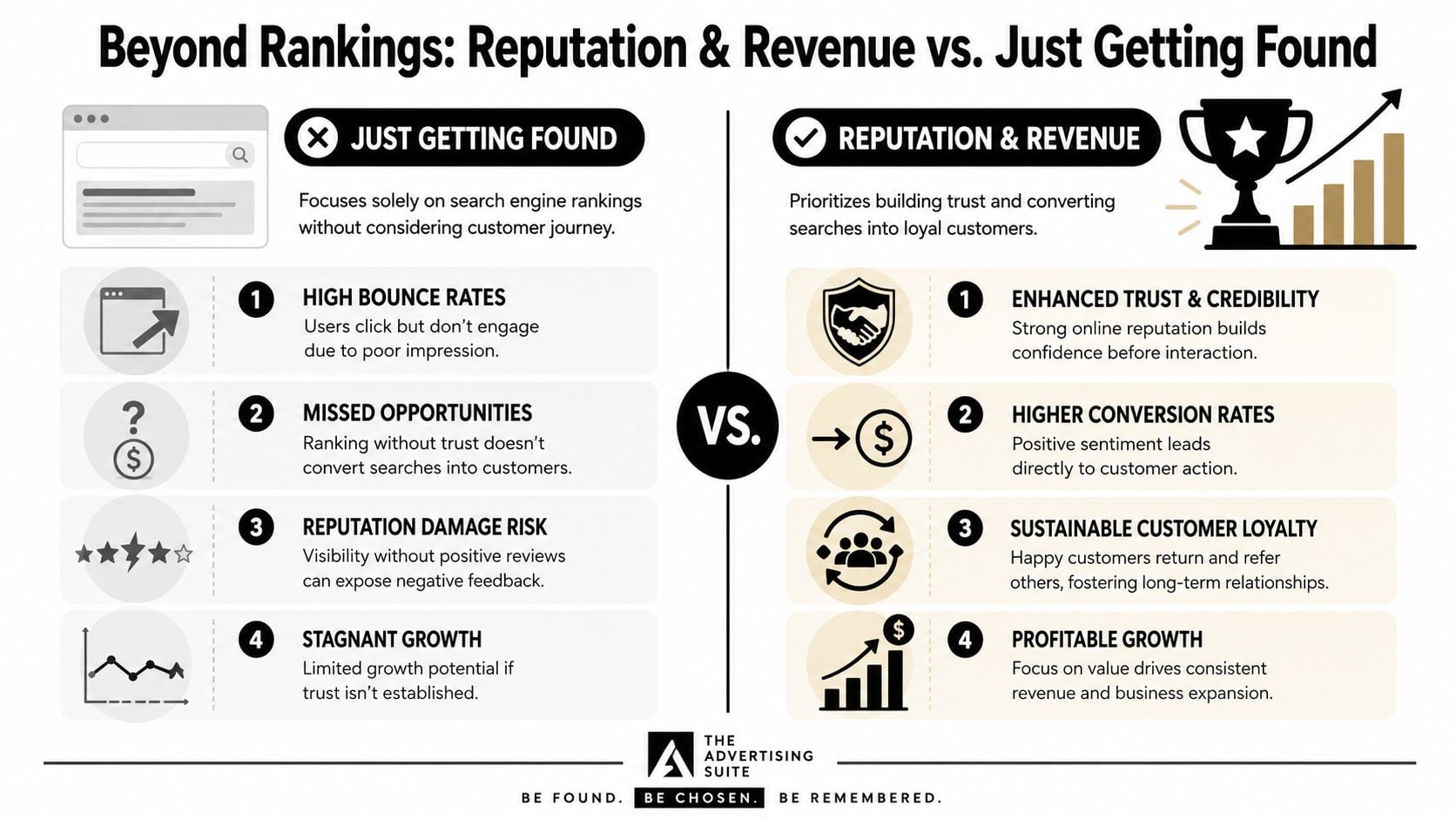
A top map position with weak trust signals is a trap. You might get found more often, but you won't get chosen often enough.
That's why ranking obsession is outdated. Local search marketing only works when visibility and reputation reinforce each other. If one rises while the other lags, performance stalls.
Reviews are no longer a simple volume game
Recent local search trend reporting found that high Google ratings ranked sixth for local pack visibility but first for conversion impact. The same reporting says review recency, sentiment, and volume all influence performance, which is one reason local search has shifted toward a broader trust-based ecosystem rather than a simple directory game (local search trends and review impact).
That should change the way businesses manage reviews.
The lazy strategy says, “Get more reviews.” The better strategy asks harder questions:
- Are your newest reviews positive?
- Do they mention the services you want to be known for?
- Are you responding in a way that builds confidence?
- Are reviews exposing recurring service failures you need to fix?
A business with active, recent, credible feedback often outperforms a business with an older review profile that looks abandoned.
Reputation is a conversion asset
Reviews do more than help rankings. They reduce uncertainty.
A local buyer compares providers fast. They scan star ratings, recent comments, owner responses, and signs of professionalism. If they see fresh praise, clear communication, and responsiveness, they move closer to action. If they see silence, defensiveness, or stale feedback, they hesitate.
That hesitation kills conversion before your team ever gets a chance to sell.
Field note: Review response quality matters because buyers read replies as a preview of how you handle problems.
What smart businesses do differently
The strongest operators treat review management as part of customer experience, not just marketing.
They build systems around three priorities:
Freshness
Keep new feedback coming in steadily so your profile reflects current service quality.Sentiment
Pay attention to the language customers use. It reveals what the market values and where your service is leaking trust.Operational follow-through
If reviews repeatedly call out missed callbacks, unclear pricing, or poor front-desk communication, fix the process. Don't just write a polished response.
Local search stops being a ranking project and becomes a business quality signal. Your profile doesn't just show how visible you are. It shows how well your business runs.
Building Your Local Search Marketing Playbook
Most local search reporting is built to impress, not to inform. It gives you movement, not meaning.
Impressions, profile views, and average rank can be useful diagnostics. They are not business outcomes. A business owner can't pay payroll with a prettier visibility graph. Ultimately, the question is whether local search created qualified conversations and measurable revenue.
Stop treating clicks as the final proof
A key issue in modern local search is measurement. Feature-rich search results can reduce clicks even when visibility increases, so rank tracking and traffic alone are weak proxies for impact. A stronger approach is tying calls, direction requests, and bookings back to local search touchpoints instead of treating profile impressions or keyword positions as the end metric (incremental revenue and local attribution guidance).
That changes the scoreboard.
Track outcomes that reflect buying intent:
- Phone calls from local listings
- Direction requests
- Appointment bookings
- Form submissions from location pages
- Closed revenue tied to source and location
If you also want to tighten performance after the click or call, study your conversion rate process with the same discipline. Local search doesn't stop at lead generation. It only works when the conversion path is built to close.
A practical KPI model for local businesses
Use this simple model to separate signal from noise:
| Layer | What to track | Why it matters |
|---|---|---|
| Visibility | Search presence, map exposure, branded discovery | Shows whether you're appearing in the market |
| Action | Calls, bookings, direction requests, form fills | Shows whether visibility is creating intent-driven engagement |
| Revenue | Qualified leads, won jobs, location-level sales impact | Shows whether local search is profitable |
Most agencies stop at layer one. Better operators track layer two. Serious growth teams insist on layer three.
Single-location and multi-location priorities are different
A single-location business should focus on depth. Tighten the profile, build a strong local page, generate recent reviews, and make response times fast.
A multi-location brand needs governance. The challenge is consistency without turning every market into copy-paste sludge.
Use this decision framework:
Single location
- Prioritize profile completeness
- Build one strong local landing page
- Create a disciplined review request process
- Track every call and booking source
Multiple locations
- Standardize core data across every listing
- Give each location a unique page with localized relevance
- Monitor review trends by location, not just brand-wide
- Compare conversion quality across markets, not just visibility
Good local search management looks boring from the outside. Clean data, clear pages, recent reviews, tight attribution. That's usually what wins.
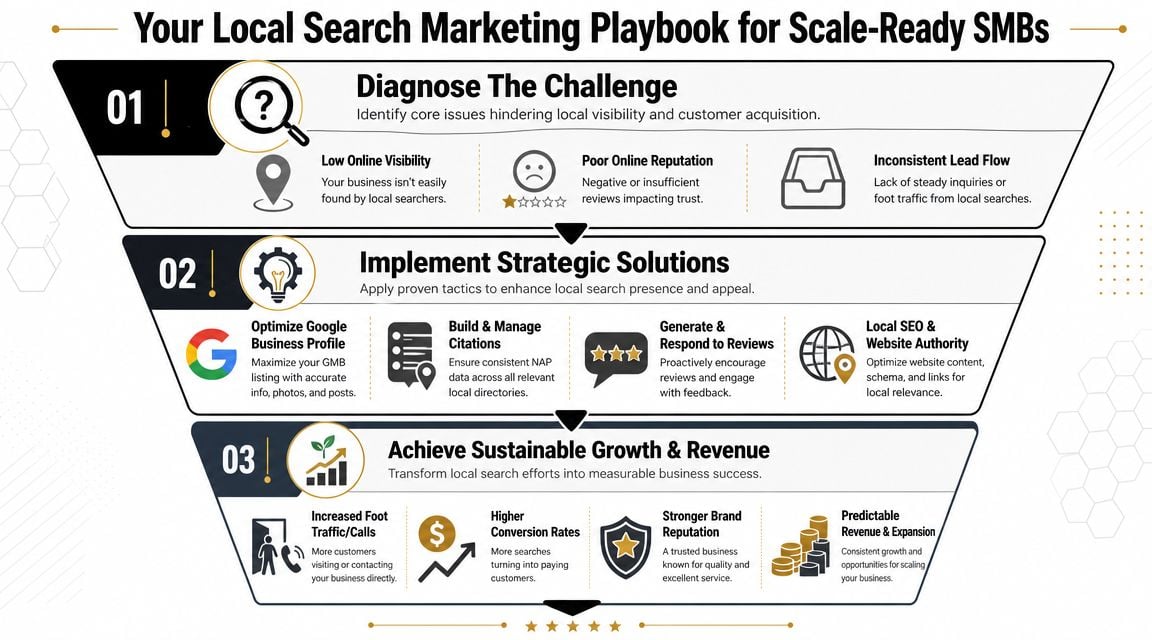
The playbook that actually scales
A local search playbook should be operational, not aspirational.
Run it like this:
Audit your entity signals
Fix mismatched business details, duplicate listings, and weak location pages.Improve your trust signals
Build a repeatable system for review generation, responses, and service recovery.Measure business actions
Connect calls, forms, and bookings to specific profiles, pages, and locations.Refine based on close rates
Don't just ask which location got the most leads. Ask which one produced the best customers.
That's how local search becomes a profit center instead of a recurring marketing expense.
How to Integrate Local Search into Your Growth Engine
Ranking in the map pack is not the win. Revenue is.
A business can show up everywhere locally and still waste the opportunity if calls go unanswered, forms sit in an inbox, and walk-in demand never gets tied back to the source. That is the primary failure point. Local search should feed your sales process, your customer experience, and your reporting. If it does not, you have visibility without a system.
The fix is operational. Every local search action needs a clear path from first click to closed revenue. A phone call from your business profile should route, log, and trigger follow-up. A form from a location page should enter the same pipeline your team uses. A direction request should not disappear into guesswork if that visit turns into a sale later.
Use this standard:
- Capture every lead source in one place: Calls, forms, bookings, chats, and location-driven inquiries need one record of truth.
- Respond while intent is still high: Local prospects choose fast. Slow follow-up sends them to the next option.
- Report on revenue, not just lead volume: Track which profiles, pages, and locations produce customers, not just activity.
Many local programs fail at this stage. Marketing generates demand. Front desk staff answer inconsistently. Sales teams forget source tags. Leadership gets a report full of clicks and calls, then has to guess which location generated profit.
Fix the handoff. Set ownership for every step, from inquiry to booking to close. Build response rules. Audit call handling. Review missed leads weekly. Train each location to treat local search leads like high-intent buyers, because that is exactly what they are.
Clean measurement matters too. If your reporting is split across spreadsheets, inboxes, and call logs, you cannot judge performance accurately. Better return on ad spend reporting starts with clean lead capture and disciplined source tracking.
Local search scales when every buyer action has an owner, a response standard, and a revenue trail.
That is the difference between local SEO as a marketing task and local search as a growth engine. The businesses that win do not stop at rankings. They connect visibility to service, service to conversion, and conversion to revenue they can measure and improve.
Local search marketing works when it's connected to the rest of the business. That's where The Advertising Suite stands apart. We're a growth-focused partner built for companies that are done chasing vanity metrics and ready to tie visibility, reputation, and lead handling to real revenue. Our Growth-Tech Hybrid model combines strategy with an integrated CRM and review management ecosystem, so leads don't disappear after the click, call, or map view. If you want a team that acts like an extension of your business, not another vendor with pretty reports, Book a Growth Consult or Request a Demo. If you want smarter economics while you scale, Explore the Membership to gain access to the proprietary software and the 25% discount on all services.