Stop buying leads that never become revenue. Lead volume is an input, not a growth strategy. If traffic, forms, and campaign reports look healthy while sales receives poor-fit contacts, slow follow-up, or incomplete records, the business hasn't built a pipeline. It has built a very expensive waiting room.
The strongest lead generation best practices connect the full revenue path, from identifying high-intent audiences and creating persuasive assets to capturing demand, nurturing prospects, measuring pipeline, and scaling responsibly. That requires more than a clever ad. It requires clear qualification, useful content, low-friction conversion paths, privacy-conscious data collection, and a CRM that shows what happens after handoff.
The problem is measurable. A 2026 industry summary reports that 91% of marketers rank lead generation as a top priority, yet organizations average 1,877 leads per month and still see 80% fail to convert into customers (lead generation industry statistics). The commercial lesson is straightforward: qualified pipeline and closed revenue matter more than raw submissions.
The Advertising Suite approaches acquisition as a growth-tech hybrid, combining human-led strategy with CRM and reputation-management infrastructure. The aim isn't to chase likes or impressions. It's to align advertising execution with the customer experience so SMBs, e-commerce teams, local service providers, franchises, and agency-burned founders can see where demand becomes revenue.
1. Account-Based Marketing for Revenue-Focused Targeting
Broad targeting makes sense when a business is still learning who buys. Once the ideal customer is clear, continuing to spend equally across every possible prospect creates waste. Account-Based Marketing, or ABM, treats each priority account as its own market, bringing marketing and sales around the same target, message, and commercial outcome.
A mid-market software provider might build custom educational assets for selected companies, while a multi-location service brand could identify commercial property groups or franchise territories with the strongest fit. The creative changes by account and by stakeholder. A financial buyer needs a business case, an operations leader needs implementation clarity, and an end user needs proof that the solution works in practice.
Start with a small, deliberate target list rather than trying to personalize everything at once. Use the CRM to record contacts, interactions, content engagement, objections, and account status across the buying committee.

Build an account playbook
Use buyer persona development to define the account characteristics and stakeholder roles that deserve attention. Then:
- Prioritize fit: Rank accounts by commercial value, service area, buying need, and ability to become a strong customer.
- Track the committee: Record every meaningful touchpoint, not just the person who filled out the form.
- Layer intent signals: Combine website behavior, content consumption, and relevant business changes with account fit.
- Personalize by role: Give each decision-maker a reason to engage that reflects their responsibility.
- Measure progression: Judge ABM by qualified opportunities, account movement, deal quality, and revenue influence, not lead counts.
ABM won't suit every low-value, fast-purchase offer. For those businesses, focused audience segments and strong local intent may be more efficient. For complex B2B sales or high-value services, however, precision usually beats volume.
2. Content-Led Lead Generation for High-Intent Buyers
Content shouldn't exist to fill a publishing calendar. It should answer the questions buyers ask before they trust a company with money. A useful guide, comparison, calculator, checklist, product demonstration, or customer story can attract prospects who are already trying to solve a problem.
For an e-commerce brand, that might mean product education, buying guidance, or care instructions that reduce uncertainty. For an HVAC, legal, or medical business, it could be a location-specific explanation of the service, the process, and the questions a customer should ask before booking. The content earns attention by being useful, not by hiding a sales pitch behind a thin article.
A strong content system usually has one substantial asset supported by smaller pieces. A detailed guide can become a short video, a series of social posts, an email lesson, and a sales enablement resource. That approach extends the value of the original work without forcing the team to invent a new idea for every channel.

Match content to buying intent
Use storytelling in advertising to turn features into consequences buyers can understand. A practical content plan should include:
- Problem content: Explain symptoms, risks, and possible approaches for early researchers.
- Evaluation content: Compare options, clarify trade-offs, and show how implementation works.
- Decision content: Provide proof, demonstrations, service details, and a clear next step.
Gating every article can damage trust and reduce discoverability. Keep educational content accessible, then reserve forms for resources with enough immediate value to justify the exchange. Connect every download to the CRM so the team can see which topics lead to meaningful conversations and which only create activity.
3. Lead Magnet Optimization for Better Capture
A lead magnet works when it solves a specific problem faster than the prospect could solve it alone. “Sign up for updates” is rarely compelling because it asks for attention without defining the return. A useful template, assessment, buying guide, audit, inspection request, or implementation worksheet gives the visitor a concrete reason to identify themselves.
The offer also qualifies the lead. Someone who downloads an e-commerce merchandising worksheet has revealed a different need from someone requesting a consultation. Someone who asks for a local service inspection has shown stronger immediate intent than someone reading a general advice article. Use the offer to create useful context, not to build an unnecessarily intrusive profile.
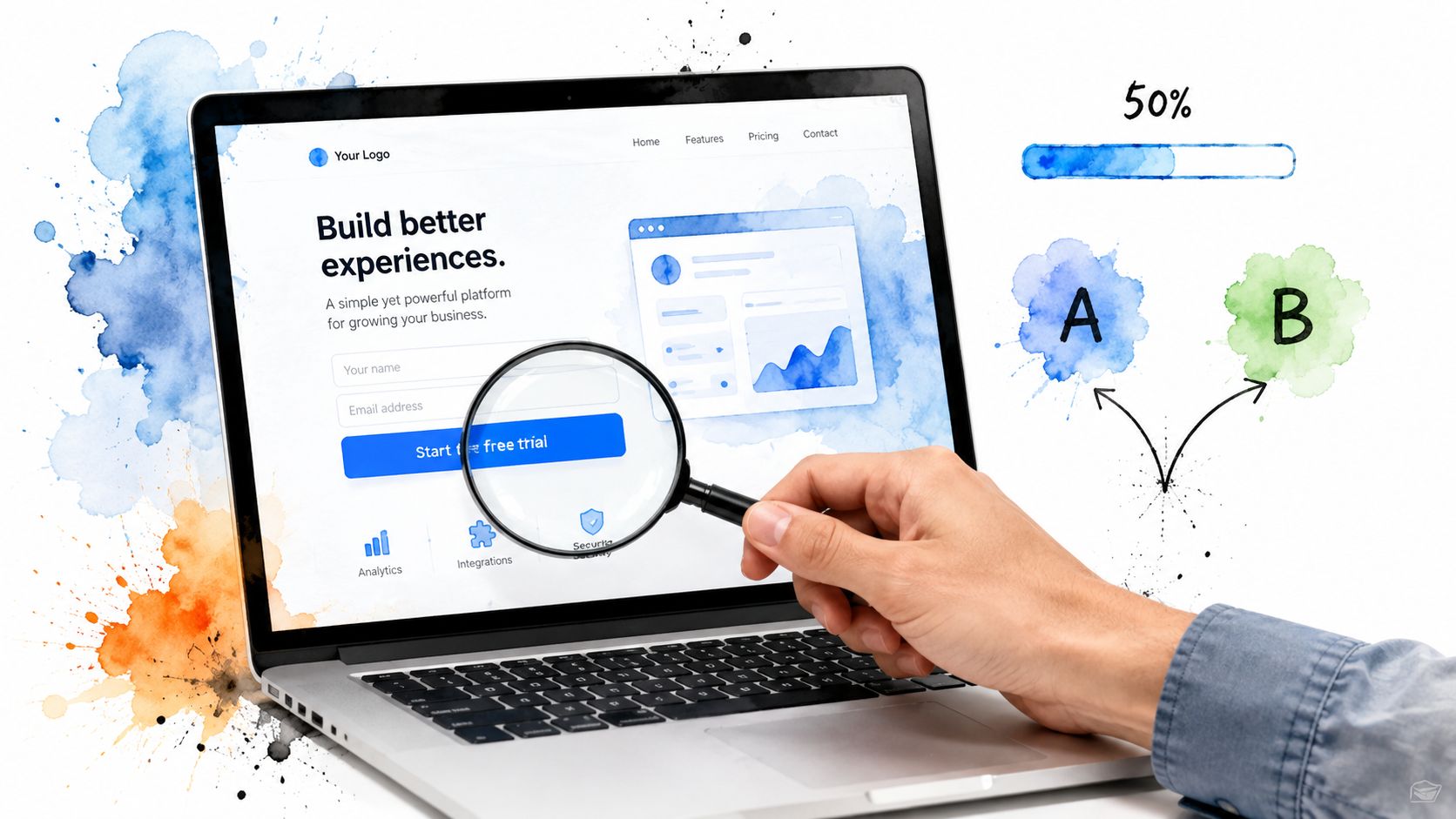
Form design matters because every additional question introduces friction. A benchmark reports conversion rates of 18.2% for one-field forms, 13.0% for two fields, 11.5% for three fields, and 9.9% for four fields. Forms with nine or more fields converted at 4.2% (form field conversion benchmarks).
Remove friction without losing context
Use web conversion optimization to test the offer, page, and follow-up as one system.
- Ask only for essentials: Start with information needed to deliver value and route the inquiry.
- Deliver immediately: Show the asset or confirmation on the next screen instead of creating avoidable email friction.
- Test the offer itself: Compare a template, checklist, assessment, and consultation rather than testing button color in isolation.
- Segment by intent: Store the magnet type in the CRM and tailor the nurture path accordingly.
Short forms don't mean weak qualification. They mean qualification happens progressively, through behavior, follow-up questions, and sales conversations.
4. Intent Data and Buyer Signal Tracking
A form fill is one signal, not the entire buying story. Prospects may visit pricing pages, return to product pages, read implementation content, watch a demonstration, or engage with several assets before they ever submit their details. Teams that treat those behaviors as context can prioritize outreach more intelligently than teams that rely on a single score.
First-party signals deserve particular attention because they come directly from interactions with the business. Website visits, content engagement, CRM history, email clicks, customer status, and service location can create a more relevant picture than a generic database record. Third-party signals may add context, but they also require careful review for accuracy, consent, and commercial relevance.
An e-commerce team might prioritize a known customer who repeatedly views a product category and returns to shipping information. A B2B team might alert sales when several people from the same account engage with solution pages. Neither signal proves a purchase is imminent. Both can justify a more timely and useful next step.
Practical rule: Treat intent as a reason to investigate, not permission to make an aggressive assumption.
Create response tiers
Use customer behavior analytics to build simple response rules:
- Early research: Send educational content and let the prospect continue learning.
- Active evaluation: Present comparisons, proof, implementation details, or a relevant consultation.
- High-intent action: Trigger a prompt human follow-up, sales task, or personalized offer.
Privacy changes the operating model. In a cookieless environment, teams should prioritize permission-based first-party data, transparent consent, company identification where appropriate, and signal-based selling over silent tracking or static lists. Good intent programs respect the buyer while improving timing.
5. Landing Page Optimization and Conversion Rate Testing
Paid traffic doesn't create value when the landing page fails to continue the conversation. A visitor who clicks an ad about emergency plumbing, a product bundle, or CRM implementation should see a page that reflects that exact promise. Sending every visitor to a generic homepage forces them to restart the decision process, and many won't bother.
Start with a baseline. Record the page's conversion event, traffic source, offer, form behavior, and quality of the resulting leads. Then test the highest-impact elements, such as the headline, offer framing, proof, call to action, page structure, and form length.
A B2B technology benchmark reports an average 2.6% visitor-to-lead conversion rate, 13% MQL-to-SQL conversion rate, and 21% win rate on sales-accepted opportunities (B2B lead generation benchmarks). These figures demonstrate why CRO can't stop at form submissions. The page should help create opportunities that sales can accept and advance.
Test for commercial impact
Use multivariate testing guidance when the traffic and testing maturity justify more complex experimentation. For most SMBs, a disciplined sequence is enough:
- Fix message match: Align ad language, landing-page promise, and follow-up.
- Reduce distractions: Give the visitor one primary action and supporting proof.
- Study behavior: Use recordings, heatmaps, and form analytics to identify hesitation.
- Change one meaningful variable: Make the result easier to interpret.
- Track downstream quality: Compare qualified opportunities and revenue, not just conversion rate.
A higher conversion rate can be a negative result if it attracts poor-fit contacts. The best landing page is the one that produces profitable customers, not the one that wins a dashboard contest.
6. Omni-Channel Lead Nurture Across Owned Channels
Most prospects aren't ready to buy at the first interaction. A useful nurture program keeps the conversation relevant without treating every contact as an immediate sales opportunity. Email can deliver education, SMS can support time-sensitive reminders where consent exists, retargeting can reinforce a known offer, and the CRM can coordinate the next human action.
The sequence should reflect the buyer's stage. Early messages can explain the problem and offer practical guidance. Consideration messages can answer objections, clarify differences, and show implementation. Decision-stage messages should make the next step easy, whether that's a consultation, product purchase, demo, or appointment.
Email performance is uneven, so opens alone aren't a reliable success metric. A 2026 benchmark reports a 21.5% median open rate, 2.3% median CTR, 10.7% click-to-open rate, and 1.8% conversion rate (email lead generation benchmarks). The same source identifies elite bands of 40% or higher open rate, 6% or higher CTR, and 5% or higher conversion, but teams should treat those as directional benchmarks, not promises.
Build sequences that earn the next message
A practical nurture workflow includes:
- A useful first delivery: Give the promised asset and confirm the next relevant resource.
- Behavioral branching: Change the path when a contact clicks, revisits, purchases, or disengages.
- Channel discipline: Add SMS or retargeting only when the permission and customer context support it.
- Sales thresholds: Alert sales when fit and behavior justify a personal conversation.
- Exit logic: Stop promotional messages after conversion, opt-out, or a clear negative signal.
For e-commerce, abandoned-cart and post-purchase sequences should support the customer experience. For services, nurture should reduce anxiety and make scheduling simple. Automation should make follow-up more consistent, not more robotic.
7. Reputation Management and Review Generation
A prospect often checks public feedback before completing a form or making a call. That makes reputation management part of lead generation, especially for local services, franchises, healthcare practices, legal firms, and businesses where trust determines who gets contacted first.
Consumer research reports that 86% of consumers consider reviews either the most important or somewhat important trust factor, while only 11% trust brand messaging over public sentiment. The same research says 50% lose trust when owners or employees appear to review their own business (consumer trust and online reviews). Authenticity matters more than polished self-praise.
Review volume also influences evaluation. Recent reporting says 97% of consumers read online reviews when assessing a local business, and 41% always read them, compared with 29% the year before. That source identifies a trust sweet spot between 4.2 and 4.5 stars (local review conversion benchmarks).
Make customer feedback operational
Ask for reviews after a successful service interaction, completed appointment, or delivered order. Make the request easy, but don't script praise or pressure customers to conceal negative experiences.
- Respond publicly: Thank customers and address concerns without arguing.
- Close the service loop: Route serious complaints to a person who can resolve them.
- Monitor locations separately: Centralize reporting while allowing local teams to respond with relevant context.
- Reuse authentic proof: Bring useful review themes into ads, landing pages, product pages, and sales conversations.
- Watch rating drift: A sudden change may reveal a delivery, staffing, or product problem.
Reviews don't replace a strong offer. They reduce the trust barrier that prevents a qualified prospect from taking action.
8. Paid Social Lead Generation on Meta and Google
Paid social works best when the audience, message, offer, and follow-up are connected. Meta can help local businesses reach defined geographic audiences, e-commerce brands build permission-based remarketing paths, and service companies promote a clear consultation or booking offer. Google can capture active searches when a buyer is already looking for a solution.
The common mistake is scaling cold audiences before proving that warm demand converts. Start with existing customers where appropriate, engaged website visitors, and people who have interacted with relevant content. Then expand using audiences built from qualified customers, not every contact in the database.
Creative needs variety because different prospects respond to different forms of proof. Test demonstrations, customer stories, practical education, product detail, and direct offers. Keep the promise consistent with the landing page, and make the first action proportionate to the buyer's readiness.
Protect the economics
Use native lead forms when reducing friction is the priority, but don't assume fewer clicks mean better leads. A custom landing page may provide more context and stronger qualification, particularly for expensive services or complex B2B products.
- Track the full path: Send source, campaign, creative, and form data into the CRM.
- Build customer-based audiences: Use qualified buyers or profitable customer segments as the model.
- Retarget responsibly: Apply consent controls and frequency discipline.
- Review search terms and placements: Remove irrelevant traffic and weak inventory.
- Shift budget by revenue: Pause campaigns that create volume without accepted opportunities or sales.
The Advertising Suite's approach combines strategic creative, precision targeting, and conversion-rate optimization. That combination matters because media buying can amplify a strong offer, but it can also amplify a broken funnel.
9. Referral and Affiliate Programs
A satisfied customer can shorten the trust-building process for the next buyer. Referral programs formalize that advantage by making introductions easy, explaining who the business serves, and rewarding appropriate advocacy. They work particularly well when the purchase involves trust, expertise, or a relationship that advertising can't fully establish.
For a local service company, a customer might refer a neighbor or property manager. An e-commerce brand might encourage customers to share a product with a relevant community. A B2B company can build partnerships with complementary providers that already serve the same audience. The strongest programs don't reward every name in a spreadsheet. They reward qualified outcomes.
Design the experience around clarity. Give advocates a simple link or message, explain the reward, and tell the referred prospect what happens next. If the program is difficult to understand, customers won't promote it no matter how attractive the incentive appears.
Keep referrals profitable
- Choose the right advocate: Start with customers who had a successful experience and understand the value.
- Define qualification: Decide whether a referral counts at inquiry, accepted opportunity, purchase, or another meaningful event.
- Track source ownership: Record the referring customer or partner in the CRM.
- Support partners: Provide approved messaging, useful content, and a clear contact path.
- Review quality: Watch for duplicate, fraudulent, or poor-fit referrals.
Ask for referrals at a moment of demonstrated satisfaction, not after a difficult interaction or unresolved complaint. A referral program should strengthen the customer relationship, not turn it into a transaction.
10. Conversion-Focused Video Marketing
Video earns attention, but attention alone doesn't create pipeline. The useful question is whether a viewer understands the problem, sees credible proof, and knows what to do next. A short product demonstration, customer explanation, service walkthrough, or objection-handling video can perform that work more efficiently than a polished brand montage.
E-commerce teams can use video to show product scale, use, texture, installation, or results. Local businesses can show the people behind the service, explain what happens during an appointment, and demonstrate standards of care. B2B teams can use longer demonstrations, educational sessions, and customer stories to reduce uncertainty before a sales call.
Start with proof rather than production complexity. A credible customer story recorded clearly can be more persuasive than expensive footage that never addresses the buyer's concern. Captions matter because many social viewers watch without sound, and every video should include a specific next action.
Connect video to conversion
Use a simple distribution system:
- Create one core asset: Record a detailed explanation, demonstration, or customer conversation.
- Repurpose deliberately: Cut short clips for social, embed the full version on a landing page, and use excerpts in nurture.
- Match the CTA to intent: Invite an immediate purchase, consultation, download, or further education.
- Track meaningful behavior: Measure landing-page visits, form completion, booked conversations, and revenue influence.
- Refresh winners: Update demonstrations and proof when products, offers, or customer objections change.
Don't promise that adding video automatically lifts conversion. Its value depends on relevance, placement, speed, accessibility, and the strength of the offer around it. Video is a sales asset when it removes friction, not when it decorates a page.
Top 10 Lead-Gen Practices Compared
| Strategy | Implementation complexity | Resource requirements | Expected outcomes | Ideal use cases | Key advantages |
|---|---|---|---|---|---|
| Account-Based Marketing (ABM) | High, deep account research, sales alignment | High, intent data, CRM, bespoke creative, sales time | Revenue-focused deals, higher ACV, faster closes for targeted accounts | Enterprise & mid-market B2B targeting named accounts | Highly personalized, strong pipeline-to-revenue correlation |
| Content-Led Lead Generation | Medium, content strategy and editorial cadence | Medium, writers, SEO, distribution channels | Sustained inbound leads, organic traffic and authority over time | Brands building thought leadership, SaaS, educational markets | Compounding ROI, brand authority, reduced paid reliance |
| Lead Magnet Optimization | Low–Medium, create offers and test pages | Low, asset creation, landing page, CRM integration | Rapid email list growth and lead capture | Early-funnel list building, campaign-specific conversions | High conversion lift, low friction, easily measurable |
| Intent Data & Buyer Signal Tracking | High, integrations and real-time workflows | High, third-party providers, martech integration, analyst time | Prioritized hot leads, shorter sales cycles, better targeting | B2B sales teams, ABM at scale, enterprise demand gen | Identifies in-market buyers, reduces wasted outreach |
| Landing Page Optimization & CRO Testing | Medium, testing framework and analytics rigor | Medium, CRO tools, design/dev, analytics expertise | Improved conversion rates and higher ROI per visitor | Paid campaigns, high-traffic pages, signup flows | Direct revenue impact; small wins compound significantly |
| Omni-Channel Lead Nurture | Medium–High, coordinated multi-touch sequences | Medium, CRM, email/SMS provider, ads, content | Higher lead-to-customer conversion and increased LTV | Complex purchase journeys, SaaS, e-commerce retention | Consistent personalization across channels; better conversion velocity |
| Reputation Management & Review Generation | Low–Medium, workflows and monitoring | Low, review tools, automation, staff responses | Better local search, increased trust, higher conversion from organic | Local services, franchises, consumer-facing businesses | Generates organic leads via social proof; SEO uplift |
| Paid Social Lead Gen Campaigns | Medium, campaign setup, targeting, optimization | Medium–High, ad spend, creative production, platform tools | Fast, measurable lead volume; scalable with budget | Demand gen, consumer brands, B2B on LinkedIn | Precise targeting, rapid testing, predictable scaling |
| Referral & Affiliate Programs | Low–Medium, program design and tracking | Low–Medium, incentives, tracking, partner support | High-quality, lower-cost leads; improved retention | Companies with satisfied customers, SaaS, marketplaces | Lower CAC, higher LTV, scalable viral acquisition |
| Conversion-Focused Video Marketing | Medium, production plus distribution strategy | Medium–High, production resources, editing, paid placement | Increased engagement and conversion lift; stronger persuasion | Product demos, testimonials, social ad campaigns | Strong attention, social proof, durable content asset |
Build the Revenue Loop, Not Just the Lead List
Ten tactics can look like ten separate projects. That approach creates the same problem this article began with, disconnected activity that produces reports but not dependable revenue. The practical alternative is to build a revenue loop in which audience selection, creative, capture, nurture, sales follow-up, customer experience, and measurement improve one another.
Start by defining the customer and the conversion event. An e-commerce team may care about a completed purchase and profitable repeat behavior. A local service business may define success as a qualified call or booked appointment. A B2B company may need an accepted opportunity and later revenue. If the team can't agree on what counts as a valuable conversion, campaign optimization will default to the easiest metric to increase.
Put the operating system in place
Build the first version around one audience, one offer, and one focused landing page. Don't launch every channel at once. Make the path clear enough that a prospect can move from message to action without guessing.
- Define fit: Document industry, location, use case, purchase need, and disqualifying signals.
- Choose one offer: Select the asset or action that best matches the audience's current intent.
- Connect capture: Send form, source, consent, and engagement data into the CRM.
- Trigger follow-up: Deliver the promised value immediately and alert the right person when intent is strong.
- Create nurture: Use educational, proof-based, and decision-stage messages across appropriate channels.
- Close the feedback loop: Give sales a way to record quality, objections, status, and outcome.
Response speed deserves its own operating rule. A widely cited inbound-lead study reports that conversion rates drop by eight times after five minutes, only 0.1% of inbound leads are engaged in under five minutes, and 57.1% of first call attempts happen after more than a week (inbound lead response research). Route new inquiries immediately, automate alerts, and make a first response within five minutes the preferred standard whenever the business can support it.
Measure what happens after handoff
A CRM is not just a contact list. It should show where leads came from, which campaigns created qualified opportunities, how quickly sales responded, why prospects stalled, and what ultimately produced revenue. CRM adoption is already widespread among larger businesses. 91% of companies with ten or more employees use a CRM, compared with 50% of firms with fewer than ten employees.
That doesn't mean every company needs an elaborate implementation. SMBs can begin with consistent source fields, lifecycle stages, ownership rules, response-time tracking, and closed-revenue attribution. E-commerce teams should connect acquisition sources with orders, repeat purchases, refunds, and customer value where their systems allow it. Local brands should connect campaigns with calls, bookings, locations, reviews, and service outcomes.
Privacy belongs inside the design, not in a footnote. Collect only what the business can explain and use, obtain appropriate consent for email and SMS, honor opt-outs, and favor first-party engagement over indiscriminate tracking. In a fragmented, cookieless environment, coordinated permission-aware touchpoints are more durable than dependence on a single retargeting mechanism.
The Advertising Suite's growth-tech hybrid model is designed around that full path. Human-led strategy handles positioning, creative, channel decisions, and commercial judgment, while the integrated CRM and reputation-management ecosystem supports routing, follow-up, customer feedback, and accountability. The model also recognizes that advertising can't compensate for a poor customer experience. Reviews, response quality, fulfillment, and retention all influence whether acquisition becomes profitable growth.
Scale only after the first loop produces evidence. Review qualified pipeline, sales acceptance, conversion efficiency, response time, customer quality, and revenue attribution. Then increase investment in the channels and offers that bring the right customers, while cutting activity that produces vanity metrics without commercial value.
Businesses that want a more connected operating model can Request a Demo or Book a Growth Consult with The Advertising Suite. Teams can also Explore the Membership, which provides a 25% discount on all services and gives access to the proprietary CRM, giving the marketing and customer-experience workflow a shared foundation. The Advertising Suite serves more than 10,000 satisfied customers, and its role is straightforward: become the accountable extension of your team, from the first audit through scalable growth.
The Advertising Suite combines strategic creative, omni-channel execution across Google, Meta, and other channels, conversion-rate optimization, CRM infrastructure, and automated review management to help turn lead generation into measurable revenue. Visit The Advertising Suite to request a demo or book a growth consult, and explore the Membership for the 25% service discount and proprietary CRM access.