Sixty-six percent of consumers are somewhat likely to pay by text, rising to 88% among Gen Z and Millennials. Text to pay gives businesses a fast way to meet that demand, but the channel only creates durable growth when consent, security, payment data, and customer experience work together.
That distinction matters. A payment link can shorten the path from “I'll handle that later” to completed payment, but an improvised SMS campaign can create compliance exposure, customer confusion, and fraud risk. The practical opportunity is to treat text to pay as part of a revenue-first operating system, not as another disconnected billing feature.
Why Text-to-Pay Is the Missing Link in Revenue Growth
The strongest reason to adopt text to pay isn't novelty. It's alignment with how customers already manage urgent, everyday transactions. Research found that 66% of consumers were somewhat likely to pay by text, with that figure rising to 88% among Gen Z and Millennials. The same research reported that 45% of consumers preferred paying bills on mobile devices, compared with 29% the prior year. See the underlying findings in this research on fast, frictionless text payments.
A service business can spend heavily to generate a high-intent lead, respond quickly, complete the appointment, and still lose revenue when the final invoice sends the customer to a slow portal. Text to pay closes that gap by placing the next action in a channel the customer already checks. It doesn't replace a thoughtful sales process, but it can remove an unnecessary pause after the buying decision.

Revenue follows the shortest trustworthy path
The best use cases usually share three traits:
- High intent: The customer already owes money or has agreed to buy.
- Mobile context: The customer is likely to act from a phone rather than a desktop.
- Small decision burden: The customer shouldn't need to remember credentials, search for an invoice, or move through several pages.
That makes text to pay useful for deposits, completed-service invoices, appointment balances, recurring payment recovery, and one-time bills. It can also complement cart abandonment recovery when a customer has shown intent but hasn't completed the transaction.
The broader payment picture reinforces the opportunity. A major 2024 market snapshot found that 60% of all paid bills in the United States in 2023 were one-time payments, representing approximately 10 billion bills. The same report found that 40% of consumers had made a late payment in the prior 12 months, which helps explain why businesses are testing faster, lower-friction collection methods. These figures don't guarantee that every text will convert. They show why a mobile payment path deserves a place in a serious revenue strategy.
How Text-to-Pay Works from SMS to Secure Checkout
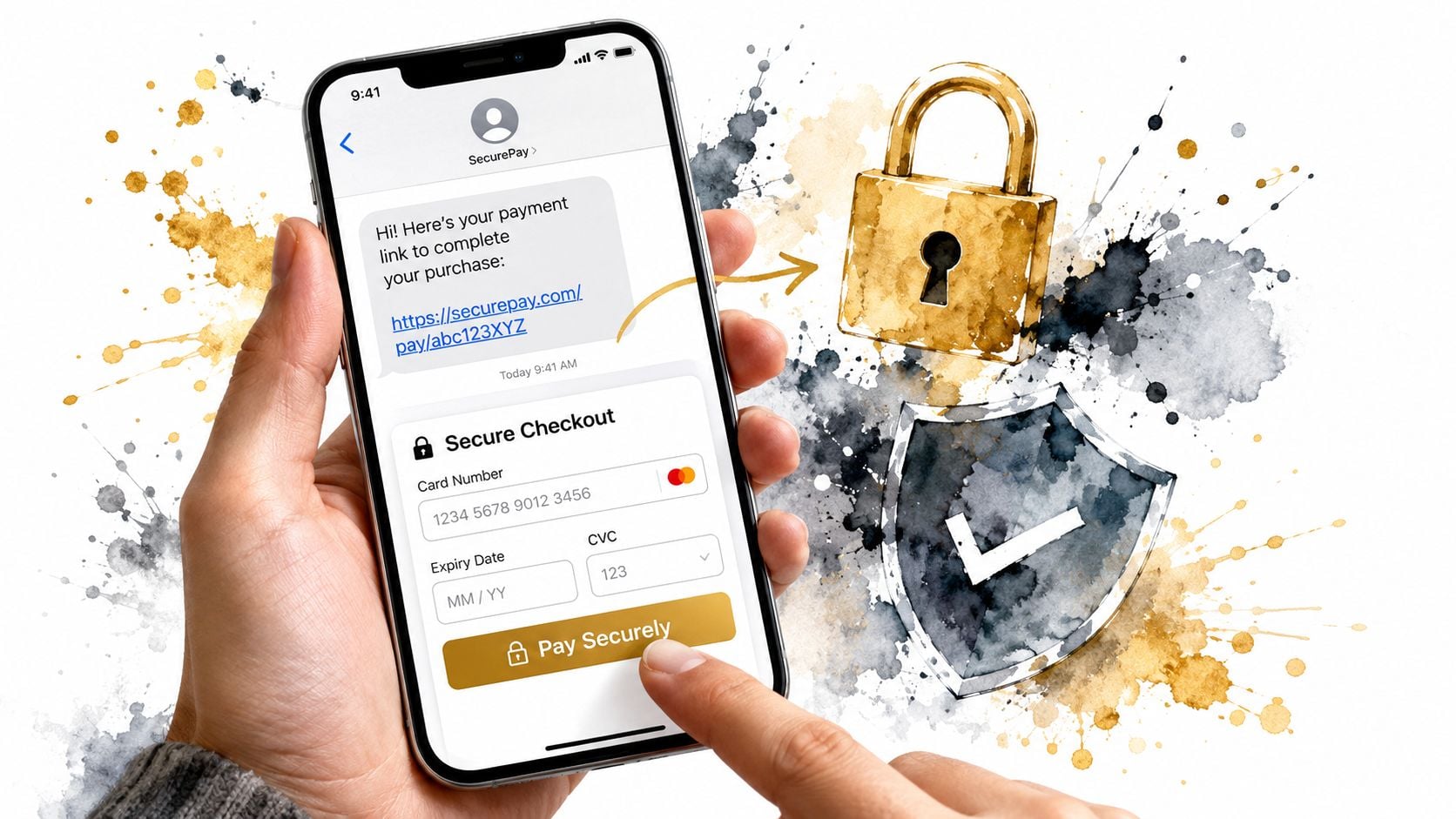
Text to pay is usually a secure payment link delivered by SMS, not a card transaction completed inside the message. That distinction affects security controls, compliance responsibilities, and how the payment provider handles sensitive data. It also connects billing with marketing strategy: the message, timing, and checkout experience work together to turn existing intent into collected revenue.
A practical flow looks like this:
- The business confirms permission and payment context. The customer should know who is sending the message, why payment is requested, and how to opt out or get help.
- The system creates a payment request. The message identifies the business and relevant invoice or account context without exposing unnecessary personal information.
- The customer opens the link. The link leads to an HTTPS-hosted, mobile-friendly checkout page with the amount and payment context clearly displayed.
- The processor handles payment data. The customer enters card or other accepted payment details on the hosted page. Sensitive data stays in the payment environment instead of passing through SMS or merchant systems.
- The system confirms the result. The customer receives an on-screen confirmation, a confirmation text, or both. Internal records should update only after the processor returns a verified payment status.
Why hosted checkout matters
Text-to-pay implementations typically use a secure link to a hosted checkout page, allowing the payment processor to handle card data without storing it in the merchant's systems. This design can reduce PCI scope and breach exposure because sensitive information remains within an environment built for payment controls. See this overview of secure text-to-pay processing for an example of the processing model.
A secure setup should use short-lived links, encryption, tokenization, and controls that match the processor's PCI obligations. Link expiration limits replay risk if a message is forwarded or intercepted. Phone and device relationship checks can add protection for higher-risk transactions.
Processing speed also shapes the customer experience and cash-flow forecast. Settlement timing varies by payment method and processor, so review how long payments take to process before setting internal collection expectations.
Do not judge a system by polished SMS copy alone. Ask what happens behind the link, where payment data is stored, how failed payments are reported, and how quickly a customer can reach a human. Customers value speed, but trust determines whether they click and complete checkout.
Measuring the Real ROI and Conversion Lift
The business case for text to pay belongs in the cash-flow dashboard, not the engagement dashboard. Clicks matter only because they can lead to completed payments, fewer collection touches, and a cleaner customer experience.
The major 2024 market snapshot cited earlier found that about 50% of consumers who received a payment reminder text clicked through to pay. It also reported that 66% said they were somewhat likely to pay by text, rising to 88% among Gen Z and Millennials. Those figures point to intent and movement through the funnel, not guaranteed revenue. Your own reporting must connect the message to the settled transaction.
Track the complete payment path
A useful measurement framework follows three stages:
| Stage | What to measure | Why it matters |
|---|---|---|
| Reach | Delivered messages and valid recipients | Shows whether your consent and contact data are reliable |
| Action | Link clicks and checkout starts | Reveals whether the message and payment context create enough confidence |
| Revenue | Successful, settled payments and recovery time | Connects the channel to cash flow rather than attention |
For one-time billing, compare text-assisted payment behavior with your existing collection path. Look at payment completion, time from invoice to settlement, failed attempts, support contacts, and opt-out rates. For service businesses, also track whether staff spend less time sending reminders or manually matching payments to customer records.
A 2024 survey-based market snapshot found that one-time payments represented approximately 10 billion bills in the United States in 2023, while 40% of consumers had made a late payment in the prior 12 months. Those conditions create a clear testing environment for text reminders, particularly where customers already recognize the business and the balance is legitimate. The right conclusion isn't that every late payer should receive an SMS. It's that businesses should test the channel against a defined recovery workflow.
Use incrementality testing to separate genuine recovery from payments that would've arrived through another channel. A customer who pays after receiving a text isn't automatically evidence of incremental lift. Compare properly defined groups, keep the message and timing consistent, and judge the program on settled revenue, operational cost, and customer trust.
Navigating Compliance and Building Consumer Trust
The common misconception is that text payments are too risky to use. The more accurate view is that uncontrolled outreach is risky, while a permission-based, secure, documented workflow can make text to pay a responsible channel.
Collection activity may involve the TCPA, FDCPA, and Regulation F at the same time. A compliance-oriented guide states that most collection agencies should treat prior express written consent as the operating standard for text-to-pay outreach, even when a narrower transactional-consent theory might apply in some circumstances. It also connects secure deployment with HTTPS-hosted checkout pages and PCI Level 1 controls. Review the relevant guidance in this collection-focused text-to-pay compliance resource.
Consent must be operational, not ceremonial
A compliant program needs more than a checkbox buried in a form. Build a record showing:
- Who consented: Tie permission to a specific customer and phone number.
- What they agreed to receive: Separate payment-related messages from unrelated promotional messaging where appropriate.
- When and how consent was captured: Preserve the source and wording of the opt-in.
- How opt-outs are handled: Suppress future messages promptly and consistently.
- How disputes are escalated: Provide a clear route to a person who can verify the account and investigate an unauthorized charge.
Security controls matter just as much. Use HTTPS checkout pages, short-lived links, tokenization, encryption, and a process for detecting suspicious or altered links. A payment request should identify the business clearly and avoid creating artificial urgency that resembles phishing.
Practical rule: If a customer can't independently verify why the message arrived, who sent it, and how to reach the business without clicking, the workflow isn't ready.
Trust also affects conversion. Independent research on mobile payment adoption identifies perceived security, risk perception, grievance resolution, and confidence as important influences on behavior. Compliance isn't merely a legal expense. It can become a conversion advantage when customers see a familiar brand, a clear amount, a secure destination, and an easy way to ask questions.
Integrating Payments with Your CRM Ecosystem
A standalone payment link can collect money. A connected CRM can explain what happened before and after the payment, which is where the operational value grows.
When a customer pays, the record should update with the transaction status, invoice context, communication history, and next appropriate action. That action might be a service follow-up, a receipt, a review request, or a suppression rule that prevents another reminder from arriving after settlement. Without that connection, staff can send duplicate requests, miss paid accounts, or treat a satisfied customer like an unresolved lead.
Design the data flow before choosing the message
Start with the customer record, not the SMS copy. Define:
- Trigger: What event creates the payment request?
- Status: How does the system distinguish sent, delivered, clicked, failed, pending, and paid?
- Ownership: Which employee handles a dispute or failed payment?
- Next action: What happens after payment, and what stops automatically?
- Experience signal: When is the customer invited to provide feedback or a review?
unified customer profiles become useful here. A customer who received an ad, booked a service, received an invoice, paid by text, and later submitted feedback should appear as one relationship, not five disconnected records.
The integration also improves marketing judgment. If a campaign generates inquiries but payment completion remains weak, the problem may sit in the checkout or follow-up process rather than in acquisition. If paid customers receive no post-purchase communication, the business is leaving retention and reputation work to chance.
The Ad Suite Membership grants a 25% discount on all services and provides proprietary CRM and automated review management software, aligning marketing efforts with the customer experience across the conversion funnel. That model reflects a broader principle: payment technology works best when it shares context with the systems responsible for acquisition, service, retention, and reputation.
Choosing Between Standalone Tools and Growth Partners
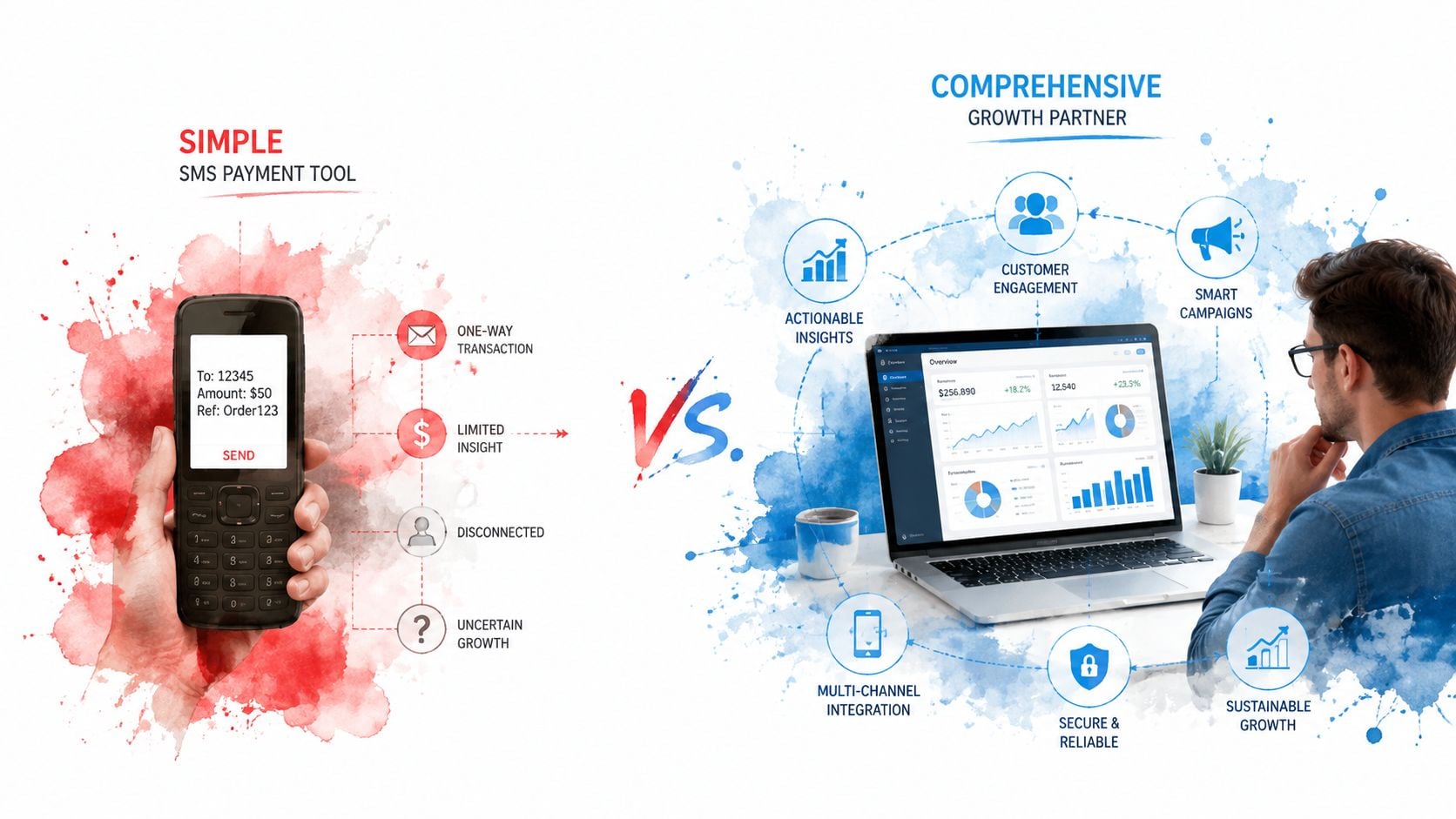
A standalone SMS payment tool can be the right choice when the need is narrow. If you already have compliant consent records, a reliable customer database, established support ownership, and a payment processor that fits your requirements, adding a payment-link workflow may solve the immediate problem without a broader transformation.
The limitations appear when payment recovery exposes weaknesses elsewhere. A disconnected tool won't fix poor lead qualification, weak offers, slow response times, inconsistent service, or missing customer records. It may also leave marketing and operations arguing over attribution because nobody owns the full journey.
Use the business problem to choose the operating model
| Choose a focused payment workflow when | Choose an integrated growth partner when |
|---|---|
| The payment use case is clearly defined | Payment friction is part of a broader funnel problem |
| Your CRM and support processes already work | Customer data is fragmented across teams |
| Internal owners can manage compliance | Consent, messaging, and escalation need governance |
| You need a specific transaction path | You need strategy, execution, CRO, and reporting together |
Businesses making between $500k and $10M often need a professional extension of their team, where integrated strategies can deliver higher returns than fragmented point solutions. That doesn't mean every company needs an expansive platform. It means the cost of coordination deserves a place in the decision.
Review your broader marketing technology stack before approving another isolated tool. Ask whether the proposed system shares customer identity, payment status, consent history, campaign context, and service outcomes. If the answer is no, calculate the manual work and customer confusion that the apparent “simple” solution may create.
The right partner won't promise that text alone solves revenue. It will help determine where text to pay belongs, which customers should receive it, how the workflow stays compliant, and how the resulting revenue feeds the next business decision.
Actionable Checklist for Business Rollout
A disciplined rollout starts with governance, then moves into technology and measurement. Use this sequence:
- Define eligible use cases. Start with recognized invoices, deposits, or payment reminders where the customer relationship is clear.
- Document consent. Store the phone number, permission source, wording, date, opt-out status, and suppression rules.
- Select the payment architecture. Require an HTTPS-hosted checkout, tokenization, encryption, short-lived links, and appropriate PCI controls.
- Map exception handling. Give staff a process for wrong numbers, disputed balances, failed payments, refunds, and suspicious messages.
- Connect the CRM. Sync payment status with customer records so paid accounts stop receiving reminders automatically.
- Train the team. Staff should recognize legitimate messages, explain the process, and escalate security or billing concerns.
- Measure settled outcomes. Track delivered messages, clicks, checkout starts, completed payments, recovery timing, opt-outs, disputes, and support effort.
- Review before expanding. Keep the workflow focused until compliance, reporting, and customer support operate reliably.
Don't launch with a large audience just because the message is easy to send. Start with a controlled segment, inspect the customer experience manually, and expand only after the payment and consent records reconcile cleanly.
Turning Payment Flows into Predictable Growth
Text to pay creates value at a precise moment, after the customer has shown intent and before friction can delay the transaction. Its role isn't to make a business look more digital. Its role is to help the business capture legitimate revenue while preserving trust, compliance, and useful customer data.
The strongest programs connect three operating decisions:
- Acquisition: Which campaigns and channels produce customers with real buying intent?
- Conversion: Where does the customer hesitate, abandon, or require unnecessary assistance?
- Retention: What should happen after payment to strengthen the relationship and reputation?
That framework keeps the organization focused on bottom-line performance rather than message volume. A high delivery rate means little if customers can't verify the request. A strong click rate means little if checkout fails. A completed payment still needs accurate reconciliation and a respectful follow-up.
The winning workflow is short for the customer and accountable for the business.
Mobile-first payment demand is real, but channel novelty won't overcome distrust, unclear consent, or a broken service experience. Businesses should evaluate text to pay by segment, payment context, balance type, customer confidence, and support requirements. Some customers will prefer a portal or another method, so a responsible program preserves choice rather than forcing one rail.
The strategic advantage comes from integration. When payment activity updates the CRM, informs follow-up, supports review management, and feeds revenue reporting, text to pay becomes part of a connected growth system. When it sits alone, it remains a useful link with limited visibility.
For scale-ready businesses, the question isn't whether customers want to pay by text. The better question is whether your organization can make that option secure, permission-based, measurable, and connected to the full customer journey.
The Advertising Suite helps businesses connect revenue-focused advertising, conversion optimization, CRM workflows, reputation management, and payment follow-up into one accountable growth system. Visit The Advertising Suite to request a demo or book a growth consult, and make the team an extension of your operation rather than another disconnected vendor.