

Most credit card payments authorize instantly, but funding usually lands in 1 to 3 business days. ACH transfers typically take 3 to 5 business days, and international wires can stretch to about a week when currency conversion is involved.
That's the part merchants feel in their cash flow, not at checkout. A customer sees a clean approval message, your dashboard lights up, and your bank balance still hasn't moved. If you've ever stared at a “paid” notification while payroll, inventory, or vendor bills are waiting, you already know the gap that causes the headache.
Why Approved Payments Do Not Mean Instant Cash
A paid invoice, a card approval, and cash in the bank are three different moments. Merchants often treat them like one event because the checkout screen makes the process look finished, but the money still has work to do behind the scenes.
A small business can collect a flood of approved orders on Friday afternoon and still see no usable cash until the middle of the next week. That's not a software glitch. It's the difference between authorization, which is the instant yes or no from the issuing bank, and settlement, which is the actual movement of funds through banking networks. The same pattern shows up in online commerce, service billing, and recurring payments.
Practical rule: if the customer saw “approved,” that only means the issuing bank said yes. It does not mean your account is funded yet.
The cleanest way to think about it is this. Authorization checks whether the card can be used. Settlement clears the transaction, moves it through the network, and releases the money to the merchant side. That's why the front end feels instant while the back end runs on banking schedules, batch windows, and interbank movement.
For merchants trying to map payment timing against working capital, that distinction matters as much as revenue does. A business can look healthy on paper and still be cash-tight if funding is lagging behind sales. If you're reviewing the operational impact of payment timing, it's worth pairing this with a basic revenue visibility framework, because timing problems become cash problems fast.
The short version is simple. Approval is a permission check. Funding is the money arriving. Confusing those two is how a lot of otherwise solid businesses end up with avoidable stress at month end.
The Payment Processing Pipeline Explained
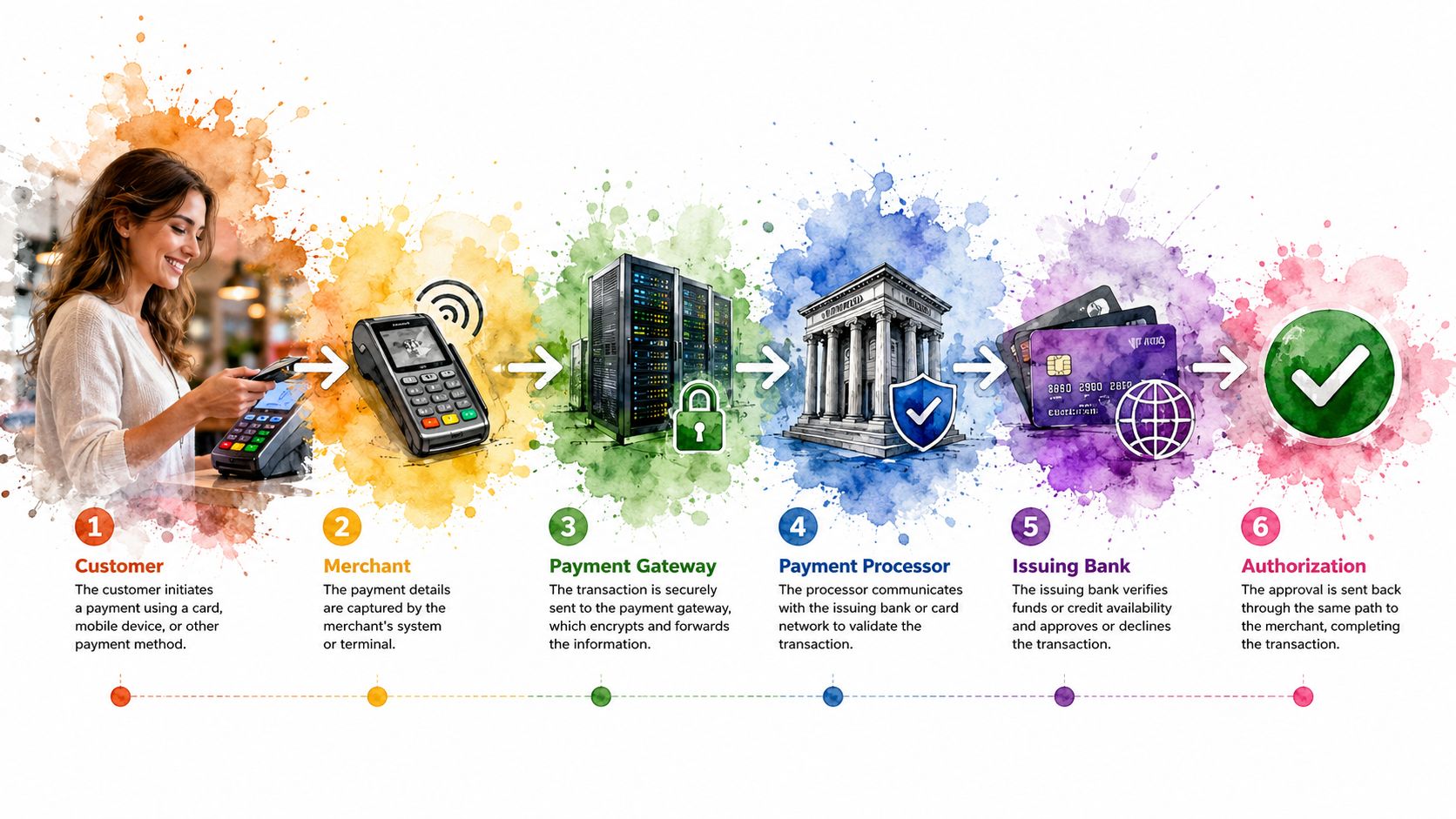
A payment moves like a relay race. The customer starts the run, but several institutions have to hand the baton cleanly before the merchant sees settled funds.
The first handoff is authorization
The issuing bank checks whether the customer has funds or available credit and returns a yes or no in seconds. That speed is real, and it's why checkout feels immediate. But the approval message only confirms that the transaction can proceed, not that money has been delivered.
After that, the processor groups transactions into batches. Merchants rarely send each payment as a separate transfer. They submit batches on a schedule, often tied to the end of the business day, which is one of the first places delay creeps in.
Then comes clearing and settlement
Clearing moves the transaction details through the card network or clearinghouse. Settlement is the interbank transfer step that moves the money between financial institutions. Once that happens, the acquirer or payment provider can fund the merchant account.
That final funding step is where bank schedules matter. If the receiving bank processes deposits at a later cut-off, the money can sit in limbo even after the transaction is technically settled. In plain English, the payment can be “done” before it is usable.
Operational takeaway: a fast approval screen does not override batch timing, bank routing, or funding schedules.
Why batching matters
Batching creates natural delays because it compresses many individual transactions into one processing event. That helps the back office run efficiently, but it also means a transaction submitted after the cut-off waits for the next batch. For merchants, that's the difference between same-day movement and tomorrow's money.
If you're trying to tighten the merchant side of the process, start with the flow itself before you blame customers or staff. A lot of “slow payments” are really just slow handoffs. If you also care about checkout recovery, the same operational discipline shows up in cart abandonment recovery, because timing and friction usually travel together.
The clean model is this. Authorization approves the transaction. Batching organizes it. Clearing moves it. Settlement finalizes it. Funding puts it in your account. Miss one step in that chain, and the payment looks stuck even though the front end already said yes.
Processing Timelines by Payment Method
Different rails move at different speeds, and the merchant experience changes with each one. Cards feel immediate to buyers, ACH moves on batch schedules, and cross-border transfers absorb extra time in local banking and FX steps.
| Payment Method | Typical Timeline | Best Case | Worst Case |
|---|---|---|---|
| Credit and debit cards | 1 to 3 business days for settlement and funding | Same-day settlement is possible on some rails | Longer than standard timing when routing or bank schedules slow funding |
| ACH / direct debit | 3 to 5 business days | Can clear faster when timing lines up early in the week | Weekend and holiday gaps can push it out further |
| International bank transfer | Roughly 1 day to nearly a week, depending on FX and local processing | About 27 hours 6 minutes on average in a large SWIFT sample | About 4.6 days when currency conversion is involved |
| Domestic card payment funding | Usually inside the same 2 to 3 business day window as settlement | Same-day settlement is possible | Delays appear when batches miss cut-off times |
| ACH from checking or savings | Up to 5 business days | Early-week initiation helps avoid weekend delay | Friday submissions can sit until the following business week |
Cards and card-linked wallets
Card payments are the closest thing to a fast lane for merchant cash flow. The authorization response happens in seconds, but actual merchant funding still follows the settlement clock. Standard processing commonly lands in 1 to 3 business days, even though customers think the payment is already complete.
That's why a business can process a strong sales day and still not see usable cash until later. For recurring operations, cards usually win on speed, predictability, and customer familiarity. The trade-off is that funding is still tied to network and bank timing.
ACH and direct debit
ACH behaves differently because it's batch-based and passes through a clearinghouse rather than a real-time card network. In the U.S., that usually means 3 to 5 business days before money is available. The calendar matters too, since weekends and bank holidays can stretch the wait.
For a direct-debit recurring bill, that slower pace can still be the right choice. It's usually easier to forecast than card chargebacks or manual invoicing, but the business has to plan around the lag.
International transfers
Cross-border transfers are the least forgiving when cash flow is tight. A large SWIFT sample found an average processing time of 27 hours 6 minutes, with 64.3% arriving within 24 hours. When currency conversion was involved, the average stretched to about 4.6 days. SWIFT's own 2025 analysis also shows that the last leg within the receiving country accounts for about 80% of the total journey time.
For business planning, that means international money can leave the sender's side quickly and still crawl on the way in. If your business depends on foreign clients or suppliers, that gap deserves as much attention as your sales forecast. For a deeper operational lens on payment flow and retention, the same discipline applies to offline conversion tracking, because delayed visibility creates bad decisions.
The practical summary is straightforward. Cards are fastest on the merchant side, ACH is slower but familiar, and international transfers can range from about one day to nearly a week depending on FX and local banking conditions.
What Causes Payment Processing Delays
The delay rarely comes from one big failure. It usually comes from a few predictable choke points, and the money gets stuck in a different place depending on whether you're dealing with cards, ACH, or cross-border transfers.
Cutoff times and batch windows
A payment can be approved and still miss the funding window. If a batch goes out after a bank's daily cutoff, it waits for the next cycle. That matters most in systems that rely on end-of-day processing, because a late submission does not move through just because the sale itself went through.
The calendar adds more friction. Weekend submissions and bank holidays can make a normal delay look worse, especially for ACH, which does not clear in real time. If the transaction lands near the end of the day, the processor may hold it until the next business cycle even though nothing is technically wrong with the payment.
Risk review and manual holds
Processors flag unusual patterns, and those flags can pause funding until a human or a risk system clears the transaction. That shows up when the amount is unusual, the customer profile looks unfamiliar, the location does not fit the normal pattern, or the behavior breaks from the merchant's standard flow. The payment may be approved at authorization, but the cash is still sitting inside the review queue.
When a processor asks for verification, the hold is usually about risk, not failure.
Currency conversion and cross-border checks
International payments slow down once foreign exchange enters the path, because extra steps get added between approval and settlement. The SWIFT data above shows the gap clearly. Timing that averages about 27 hours 6 minutes can stretch to roughly 4.6 days when currency conversion is involved. The receiving-country leg takes most of the journey, so the final mile is often where the transfer stalls.
Compliance checks add more drag. Local banking hours, holidays, and review procedures all lengthen the last leg, which is why a wire can look sent long before the money is available to use. If your business depends on tracking when payment signals turn into actual cash, offline conversion tracking helps separate real settlement delay from bad visibility.
The practical read is simple. For domestic card payments, look first at batching and funding schedules. For ACH, check the calendar and the submission time. For international transfers, expect FX and local banking to drive the wait.
How to Speed Up Payment Settlement
Faster funding starts with choosing the right rails and then removing avoidable friction. The merchants who get money sooner usually do fewer clever things and more disciplined things.
Pick the fastest available settlement option
If your processor offers same-day or next-day funding, use it when cash flow matters more than fee compression. Stripe notes that same-day settlement is possible, while standard two-day settlement remains common in the industry. That's a real lever when you're balancing payroll, inventory, or vendor terms.
For ACH, initiate payments early in the week if you can. That avoids weekend non-processing and reduces the chance that a Friday submission gets pinned behind two dead calendar days. Small timing changes matter more than many expect.
Keep data clean and patterns consistent
Clean transaction data lowers the chance of manual review. Consistent amounts, clear customer information, and predictable billing behavior make it easier for processors to trust the transaction flow. Weird inputs tend to create weird delays.
Best practice: funding speeds improve when your payment pattern looks boring to risk systems.
Use faster rails where they fit
Real-time rails like RTP and FedNow can compress access to funds where they're available, but they don't solve every problem. If your bank, processor, or workflow still introduces manual review, the rail alone won't save the day. Speed has to exist across the whole chain.
Make the funding schedule part of operations
Most merchants obsess over volume and ignore the release schedule. That's backwards. If you know exactly when batches close, when deposits hit, and what triggers a hold, you can forecast cash more accurately and make better decisions on purchases or hiring.
If your business also depends on clean internal workflows, the same principle applies to CRM for service businesses, because consistent inputs reduce downstream friction. The broader lesson is simple, tighten the process at the point where money changes hands, not after the cash is already late.
When Payments Get Stuck and What to Do
A payment that sits in pending longer than expected is usually one of three things, a normal delay, a hold for review, or a reversal after authorization. Those cases look similar from the outside, but the right response is different in each one.
The first mistake is assuming every pending payment is broken. Multiple parties often process transactions in batches, so authorization can happen fast while settlement lags behind. That's why a customer-facing status can look clean even when the merchant side is still waiting.
What to check first
Start with the transaction timestamp, the funding method, and the bank's business calendar. If the payment went out near a cutoff, on a Friday, or before a holiday, the delay may be normal rather than exceptional. If it's cross-border, expect a longer window before calling it stuck.
Then look for signs of review. Extra verification requests, repeated declines, or unusual transaction behavior often point to a hold rather than a failure. In those cases, the fastest path is usually to answer the processor's request cleanly and quickly.
When to escalate
If the payment is outside the stated window and there's no clear reason, contact the processor or bank with the transaction date, amount, payment method, and reference details. Ask whether the transaction is pending, held, reversed, or returned. Those are not the same problem, and vague support tickets waste time.
Don't ask, “Why is it slow?” Ask, “Is it pending, held, reversed, or released?”
That wording gets you to the right branch of the process faster. It also helps distinguish a genuine processing delay from a funding issue that needs manual intervention. For businesses that tie payment status to broader financial reporting, contribution margin analysis gives the right lens, because one delayed deposit can distort more than just the bank balance.
The point is simple. Faster branding doesn't always mean faster access. Bank policy, manual review, and cross-border compliance still get the final vote.
Choosing the Right Payment Mix for Your Cash Flow
The best payment mix isn't the one with the fewest options. It's the one that balances customer convenience with predictable access to cash.
Cards make sense when speed matters most and the business can tolerate standard funding lag. ACH works well for recurring billing and lower-friction direct debits, even though it settles more slowly. International payments need special handling because FX and local banking can turn a quick send into a slow arrival.
A useful way to think about it is by business model:
- High-volume e-commerce: prioritize cards for fast authorization and reliable customer checkout flow.
- Service businesses: mix cards for immediate payment with ACH for scheduled invoices and larger balances.
- B2B operations: build around ACH and wires, then plan inventory, payroll, and vendor terms around the funding window.
The point isn't to force every payment into the fastest rail. It's to match the rail to the cash need. A slower method can still be the right one if the business has enough working capital to absorb the delay.
If you're weighing payment timing against profitability, it helps to look at the full margin picture, not just the top line. A payment method that feels efficient can still create cash pressure if it delays funding or triggers extra manual work. The businesses that manage this well treat payment flow as part of revenue planning, not as an afterthought.
A CTA for The Advertising Suite.
