

You've paid for the clicks. The dashboard looks busy. The phone, however, stays suspiciously quiet.
That's the situation many agency-burned founders know too well. A campaign can generate traffic, impressions, and polished reports while failing to produce profitable customers. Small business PPC only earns its keep when it connects search intent to revenue, not when it makes a chart look energetic.
PPC still matters because it places a business in front of people who are already looking for a product or service. Adoption has become mainstream among smaller firms, with industry roundups citing around 65% of SMBs running PPC campaigns, while only 45% report having a paid search strategy and 55% use display ads according to HubSpot's PPC statistics roundup. That gap creates an opportunity, but only for businesses willing to manage the full journey from query to customer.
The Advertising Suite approaches that journey as a growth-tech hybrid, combining human-led advertising strategy with an integrated CRM and reputation management ecosystem. The point isn't to buy more activity. It's to connect campaign decisions, customer follow-up, reviews, and sales outcomes so ad spend supports sustainable growth.
This guide will translate the auction into plain English, show how to set a budget around break-even economics, and explain how landing pages, tracking, and customer experience determine whether a click becomes revenue. You can also use this advertising strategy for small businesses as a practical foundation for deciding where paid search fits.
Introduction Why Small Business PPC Must Drive Revenue Not Clicks
A local service company might receive a report showing thousands of impressions and a healthy stream of clicks. The report may call those results progress. The owner sees something else, unanswered enquiries, weak bookings, and an advertising bill that doesn't connect cleanly to sales.
That disconnect usually starts with the wrong scoreboard. Clicks are inputs, not outcomes. A click can represent genuine buying intent, casual research, a job seeker, an irrelevant search, or someone who misunderstood the offer. Treating every click as a win is how a campaign becomes expensive theatre.
PPC remains attractive for small businesses because it offers immediate visibility in high-intent search environments and lets advertisers test, measure, and adjust their investment. Benchmark summaries cite an average PPC conversion rate of 2.35% overall, while another benchmark places Google Ads search conversion rates around 4.2% for SMBs, as reported in Google Ads statistics from WebFX. Those figures aren't promises. They show why campaign quality and business context matter more than a generic industry average.
A revenue-first framework asks three practical questions:
- What action matters? A qualified call, booked appointment, purchase, or signed contract.
- What does that action produce? Revenue, gross profit, and customer value.
- What can the business afford to pay? A defensible acquisition cost based on break-even math.
Revenue rule: If the campaign can't tell you which leads became customers, it isn't measuring performance. It's measuring motion.
The Advertising Suite's model adds a CRM and reputation layer because conversion doesn't end at the form submission. A sales team still needs to respond, qualify, follow up, and create a customer experience that earns reviews. That loop is particularly important for local service businesses and franchises, where trust can influence the next searcher before the next ad click ever happens.
How Paid Search Actually Works for Small Businesses
Paid search is easier to manage once you stop thinking of it as buying a position and start thinking of it as entering a marketplace.
A person searches for “emergency HVAC repair,” “family solicitor,” or “same-day dental appointment.” The platform identifies advertisers whose targeting could match that query, then evaluates the eligible ads in an auction. Your ad competes through a combination of bid, ad quality, ad rank thresholds, competition, and search context, including location, device, time, and the other results shown on the page, as explained in Google's ad rank guidance.
The auction in plain English
Think of the auction as a shop window competition. Your bid is part of what you're willing to invest for the opportunity, but the platform also considers whether your advert is useful and whether the search context fits your business.
A large bid can't rescue an irrelevant message indefinitely. A smaller advertiser with a focused keyword, a clear advert, and a closely matched landing page can compete effectively because the platform has stronger evidence that the ad may help the searcher.
Many small businesses get tripped up by Quality Score. Google states that Quality Score isn't itself an input to the auction. It's a diagnostic based on expected click-through rate, ad relevance, and landing page experience, while the auction uses the broader factors described in Google's Quality Score explanation.
Why relevance can protect a modest budget
Expected click-through rate reflects the likelihood that an ad will be clicked for a keyword, regardless of its position, assets, or other formats. That signal encourages a useful optimization loop:
- Group searches by a clear intent.
- Write ad copy that directly answers that intent.
- Send the visitor to a page that fulfils the promise.
- Measure what happened after the click.
- Improve the weakest link.
The goal isn't to chase a diagnostic label. It's to make the entire experience more relevant. That can improve auction competitiveness and post-click performance without assuming that a small business can outbid every competitor.
When to Use PPC and How Much Budget You Really Need
PPC fits when customers search for a clearly defined need and your business can respond profitably. It's less suitable when the offer is unclear, the service area is too broad to serve properly, or the business can't follow up on leads.
Budget planning should start with economics, not an arbitrary monthly figure. Industry coverage cited in Google Ads statistics for 2026 reports an average search CPC of $5.42 and an average CPL of $66.69 across 13,474 U.S. campaigns. Legal campaigns in that coverage average $9.87 CPC and $131.63 CPL, showing why a budget that feels reasonable in one category may be badly underfunded in another.
The minimum viable budget formula
Use this sequence:
- Lead budget: Average CPL × desired leads.
- Click budget: Average CPC × expected clicks.
- Break-even check: Maximum acceptable CPL × expected leads.
- Business check: Expected gross profit from those customers minus ad spend and fulfilment costs.
The requested comparison below uses the available CPL benchmarks. For categories without verified vertical-specific figures, the table deliberately leaves the figures open rather than pretending a universal benchmark exists.
| Vertical | Avg CPC | Avg CPL | Budget for 20 Leads |
|---|---|---|---|
| Legal | $9.87 | $131.63 | $2,632.60 |
| Other categories | Not specified | Not specified | Calculate from your verified CPL |
The $2,632.60 legal estimate is a planning calculation based on the cited legal CPL, not a guarantee. A business should also check whether twenty leads represent enough volume to evaluate quality, whether its team can handle them, and whether the resulting customers produce enough margin to justify the investment.
For broader context, another benchmark summary reports a Google search CPC of $2.69 and notes that small-business PPC budgets commonly sit between $100 and $5,000 per month, as outlined in Google Ads statistics from WebFX. That range is a description of common spending, not proof that every business can win with the lower end.
A sensible test budget should buy enough qualified activity to reveal patterns while staying below the amount the business can safely lose during learning. If the budget only produces scattered clicks and no meaningful conversion evidence, the problem may not be the channel. It may be that the campaign is being asked to learn with too little fuel.
Use this marketing budget allocation framework to connect the test amount to sales capacity, customer value, and cash flow.
Choosing Channels and Structuring Campaigns That Scale
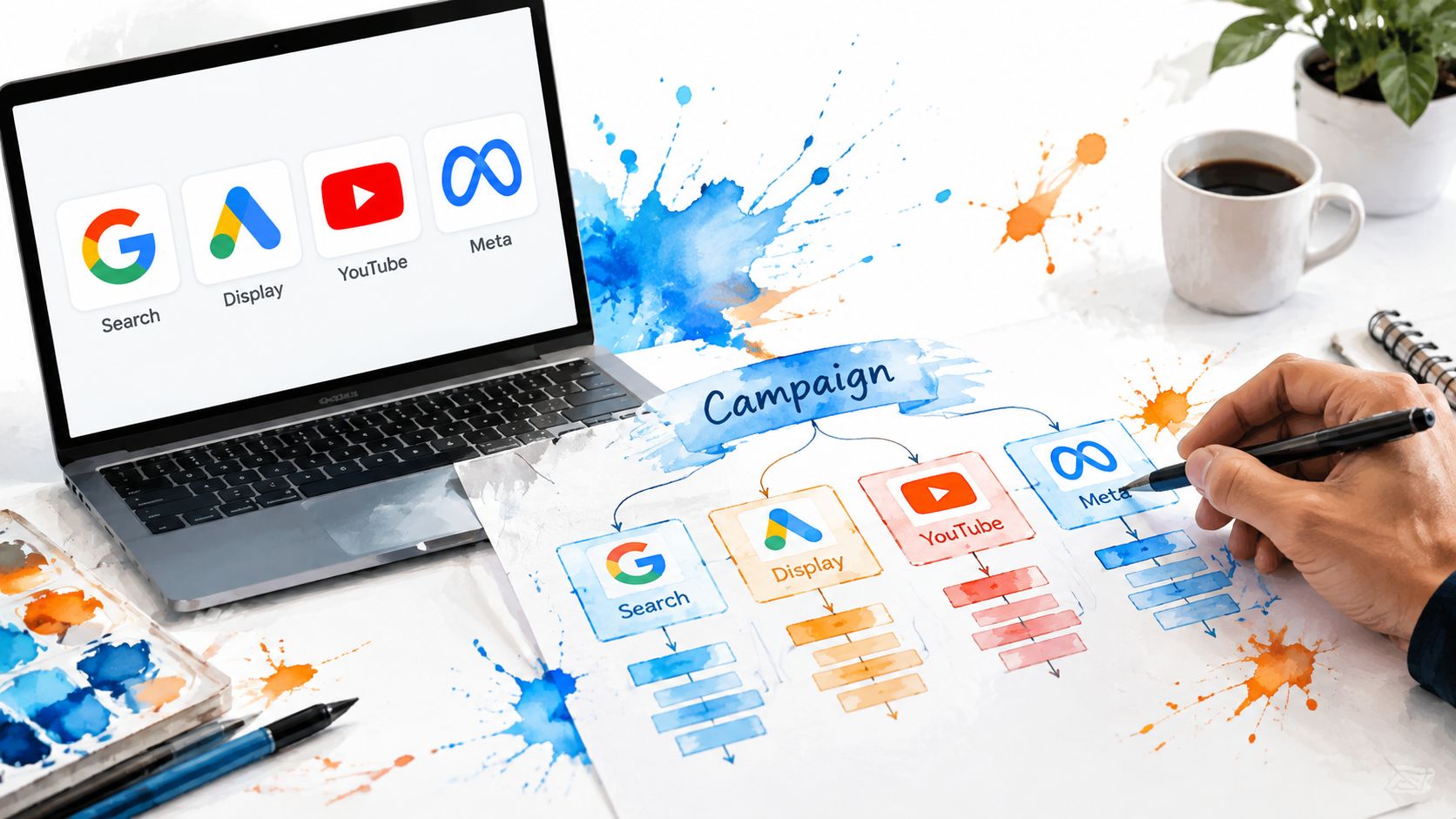
Different PPC channels solve different problems. Search captures existing demand, while display, video, and paid social generally help create awareness, shape consideration, or bring previous visitors back.
| Channel | Best role | Strong fit | Main caution |
|---|---|---|---|
| Search | Capture active demand | Urgent services and defined products | Competition can raise CPC |
| Display | Maintain visibility and support remarketing | Broad awareness and returning visitors | Lower intent requires careful measurement |
| YouTube | Explain and demonstrate | Products or services that benefit from visual proof | Creative quality matters |
| Meta | Reach audiences by profile and behaviour | Demand creation, lead generation, and retargeting | Users may not be actively searching |
A local emergency service will usually begin with tightly targeted Search because the customer's query expresses immediate intent. An e-commerce brand with a visual product may use paid social or video to introduce the offer before the shopper searches for it. Neither choice is automatically superior. The right starting point depends on whether the business needs to capture demand, create demand, or recover missed demand.
A structure that keeps spending visible
Start with one clear business objective per campaign. Separate brand protection, core services, locations, products, and remarketing when their budgets or messages need different controls.
A clean hierarchy looks like this:
- Campaign: Budget, location, network, and broad objective.
- Ad group: One tightly defined search theme.
- Keyword: A query concept with a specific intent.
- Ad: Message that mirrors the theme.
- Landing page: Destination that completes the promise.
Avoid placing every service into one campaign. A plumbing company shouldn't force emergency repair, boiler installation, and bathroom renovation into a single bucket and then wonder why reporting feels like soup.
Campaign structure also determines whether CRM data can answer useful questions. If every lead is labelled only “Google Ads,” the sales team can't easily identify which service, location, or message generated the opportunity. A revenue-first setup connects source, campaign, enquiry, follow-up, customer status, and review outcome.
The Advertising Suite can be used as one integrated option for combining advertising execution with CRM and reputation workflows. Its membership model includes a 25% discount on services and access to its proprietary CRM, according to the publisher's stated offering. Treat the technology as part of the customer journey, not as a decorative add-on attached after launch.
Keywords Match Types and Ad Relevance That Win Auctions
Keyword strategy works best as a relevance system. Don't begin with a giant list of phrases. Begin with the problems customers describe when they're close to taking action.
Suppose a company provides commercial air-conditioning repair. These searches carry different intent:
- “commercial AC repair”
- “emergency office air conditioning service”
- “air-conditioning maintenance”
- “DIY AC troubleshooting”
- “AC technician careers”
The first two may fit a lead campaign. The third may support a maintenance offer. The final two may require exclusions because they suggest research or employment intent rather than a service request.

Match types need supervision
Exact and phrase-style controls can help keep a new campaign close to its intended themes. Broad matching can uncover new demand, but it needs search-term review, exclusions, and enough conversion data to prevent the budget from wandering into irrelevant territory.
Group keywords by intent rather than by superficial wording. “Emergency commercial AC repair” and “office air conditioning technician” may belong together if the same ad and landing page answer both needs. “Commercial AC installation” should usually sit apart because the buyer, promise, and sales process differ.
Google's auction system uses expected click-through rate as a quality signal, and its expected CTR represents the likelihood of a click for a keyword regardless of position, assets, or other formats, as described in this explanation of Google Ads expected CTR. That's why an ad that mirrors the query can compete more effectively than generic copy, even when the budget is modest.
Build the message around the search
For the repair group, an advert might focus on:
- Emergency commercial repair
- Rapid scheduling
- Service coverage
- A clear call or booking action
The landing page should then discuss commercial repair, not send the visitor to a general homepage with six unrelated choices. Add relevant assets such as location, call, or service details where they help the searcher.
High Quality Score can coexist with low expected CTR, so don't treat a favourable diagnostic as permission to stop testing. Review the actual query, the advert's promise, the landing page, and the resulting lead quality together.
For a deeper look at intent-led keyword selection, explore buying keywords on Google.
Landing Pages Tracking and Local Proof That Convert Clicks
A paid click enters your business through the front door of the landing page. If the page doesn't quickly confirm that the visitor has found the right solution, the campaign pays for traffic that never gets a fair chance to convert.
The page should match the keyword and advert, state the offer clearly, support the claim with useful evidence, and present one primary next step. A local service page may need a visible service area, phone option, booking form, opening information, and authentic reviews. An e-commerce page may need product details, delivery information, returns guidance, and a clear purchase path.
Tracking must reflect business value
Google defines a conversion as a valuable action after an ad click or another interaction, including a purchase, newsletter sign-up, phone call, or download. For Analytics imports, Google says the account needs Admin access in Google Ads, Edit access in the linked Analytics property, and an event marked as a key event, according to Google's conversion measurement guidance.
Choose actions that represent genuine progress. A form submission may be useful, but a qualified appointment is more useful. A phone call may be a conversion, but the CRM should help identify whether the caller became a customer. Without that connection, automated bidding and budget decisions may optimise toward cheap activity rather than profitable demand.
Reputation closes the local loop
Local customers often evaluate trust before contacting a business. Reviews, accurate business information, consistent service-area messaging, and prompt follow-up all influence whether a lead moves forward.
Advertising claims must also remain truthful and non-deceptive. The FTC says online claims must meet the same legal standard as claims in TV, radio, print, and direct mail, with disclosures that are clear and conspicuous, as stated in its small-business advertising guidance. Don't promise guaranteed outcomes, imply unavailable credentials, or hide material conditions beneath a hard-to-find disclosure.
A CRM plus reputation workflow helps the team see the full chain:
- The search generated an enquiry.
- The team responded and qualified it.
- The customer purchased or booked.
- The business requested feedback appropriately.
- The review and revenue data informed the next campaign decision.
Fixing this chain often makes more sense than increasing spend. Use Google Ads landing page optimisation to inspect message match, friction, trust signals, and conversion paths before asking the auction for more traffic.
Your Quick Start Playbook to Launch and Measure ROI
A disciplined launch doesn't require a complicated account. It requires clear decisions and verification before money moves.
Set the commercial foundation
Write the target action in one sentence, then define what counts as a qualified lead. Record the maximum acceptable acquisition cost using gross profit and close rate, not optimism. A campaign selling high-value services can tolerate a different lead cost from a campaign selling low-margin products.
Next, confirm the operational basics:
- Service area: Target locations the business can serve.
- Offer: Give the visitor a specific reason to enquire now.
- Capacity: Make sure the team can answer calls and follow up.
- Tracking: Test forms, calls, purchases, and booking events.
- CRM status: Mark whether each lead is new, qualified, won, or lost.
Launch narrowly and inspect the evidence
Start with the highest-intent search themes and a landing page built for those themes. Keep the initial structure simple enough that you can identify which campaign, ad group, keyword, and location produced each conversion.
During the first two weeks, review search terms for irrelevant intent, compare CPC with conversion rate, and inspect landing-page behaviour. Don't make a dramatic change every time the dashboard wiggles. Look for repeated patterns, then adjust one meaningful variable at a time.
A median Google Ads benchmark reports approximately $1.53 CPC and 2.55% conversion rate, while the top quartile reaches approximately $3.76 CPC and 7.99% conversion rate, according to Google Ads benchmarks from Databox. The spread reinforces a useful point: a higher CPC can still be efficient when post-click relevance improves conversion rate faster than cost rises.
Decide whether to scale
Use ROAS versus ROI to avoid confusing revenue from ads with actual profitability. Scale only when qualified leads become customers at an acceptable acquisition cost, the team can handle additional demand, and the CRM confirms that performance survives beyond the first click.
The Advertising Suite positions its strategy, CRM, and reputation technology as an extension of a client's team, with more than 10,000 satisfied customers cited in its publisher information. The practical principle is simple: paid search shouldn't sit alone in an advertising account. It should connect to the people, systems, and customer experience that turn demand into durable growth.
The Advertising Suite combines human-led PPC strategy with campaign execution, CRM workflows, conversion optimisation, and reputation management, so you can judge advertising by revenue rather than vanity metrics. Request a demo or book a growth consult with The Advertising Suite and build a paid search system that works as an accountable extension of your team.
