

You've paid for the clicks, watched form fills arrive, and still had to explain to the sales team why the pipeline looks thin. The spreadsheet says marketing is busy. The revenue report says something else. For an agency-burned founder or a scale-ready SMB, that gap isn't a minor reporting problem. It's where acquisition costs become waste.
Marketing qualified leads give you a practical way to close that gap. Used correctly, an MQL isn't a trophy for collecting contact details. It's a revenue filter that separates casual interest from prospects whose profile and behavior justify continued attention.
This guide shows how to define, score, source, nurture, and measure MQLs without turning content downloads into a vanity contest. By the end, you'll have a framework for building a qualification process that marketing and sales can trust, supported by first-party data, CRM context, and clear commercial outcomes.
Why More Leads Does Not Mean More Revenue
A founder opens the campaign dashboard and sees a steady flow of new leads. Forms are being submitted, acquisition activity looks healthy, and the marketing team has evidence of demand. Sales then reviews the list and finds contacts outside the service area, prospects without the right need, and people who wanted only a free resource. Some do not remember submitting the form.
The business does not have a lead shortage. It has a qualification shortage.
A raw lead confirms only that someone exchanged information for something. The reason could be buying interest, early research, curiosity, or an accidental click. Giving every submission the same value makes sales inspect the entire list manually. Strong prospects can sit behind contacts who were never a realistic fit.
A revenue filter changes the job. It weighs first-party information, CRM context, and meaningful behavior instead of treating every content download as proof of intent. A prospect's company profile, service need, source, return visits, and response to relevant messages can support a better decision than one isolated form fill.
The difference is practical:
Revenue rule: A lead count measures collection. An MQL count measures how effectively you filter demand.
That filter creates shared accountability. Marketing must examine which sources produce suitable prospects, not only which campaigns generate activity. Sales must return specific feedback about fit, intent, and rejected leads, so the scoring model can improve rather than turning every weak handoff into a channel dispute.
Qualification also belongs inside a clearly connected small-business lead-generation process. Source-aware thresholds help because a webinar registration, a referral inquiry, and a low-intent paid form do not carry the same commercial meaning. The threshold should reflect the source and the evidence available in the CRM, while privacy-first collection keeps the model grounded in information the prospect has chosen to share.
Traffic can rise while revenue stays flat if the filter passes too many poor-fit contacts. A tighter MQL definition may reduce the visible lead total, yet give sales a queue with more usable conversations and clearer reasons for follow-up.
By the end of this framework, you should be able to define an MQL, score it without overvaluing shallow actions, route it with context, and find where revenue leaks from the funnel.
What Marketing Qualified Leads Really Are
A marketing qualified lead is not a prize for collecting a contact. It is a prospect whose fit and engagement provide enough evidence for the next revenue-focused action, whether that means continued nurturing or a sales review. A form fill alone cannot show whether the person can buy, needs your offer, or wants a conversation. LinkedIn's explanation of marketing qualified leads describes an MQL as a prospect who meets agreed qualification criteria, often after reaching a scoring threshold.

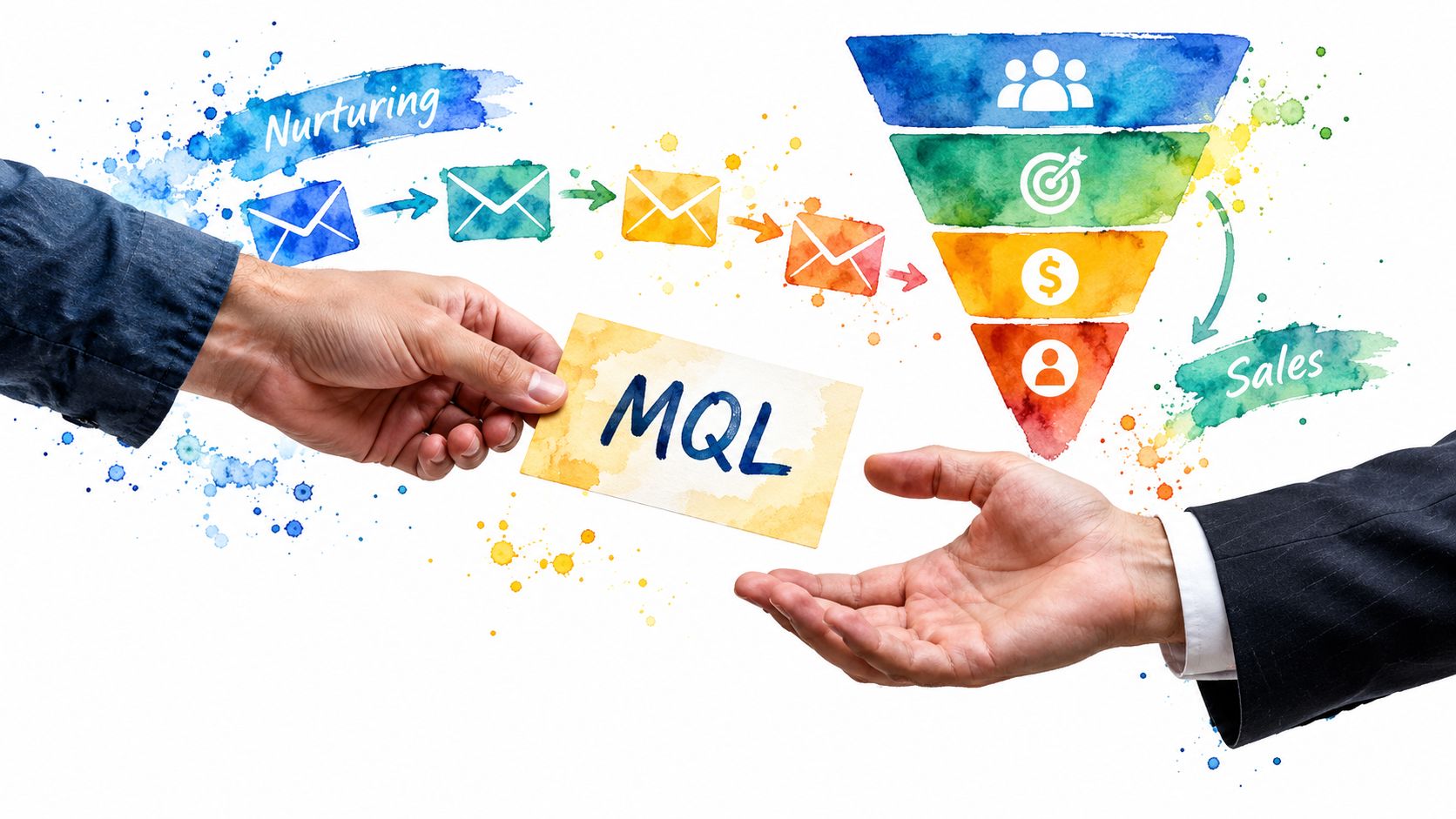
A busy venue offers a useful comparison. A lead approaches the entrance and leaves contact information. An MQL has the right invitation and enough demonstrated interest to enter the qualified queue. An SQL has shown stronger purchase intent and is ready for direct sales contact. The person checking the invitation is not predicting who will buy. The job is to decide who deserves a closer look.
Follow the funnel in order
The stages commonly look like this:
- Visitor: Someone arrives through search, advertising, referral, social content, or another channel.
- Lead: The visitor shares identifiable information through a form, consultation request, inquiry, or similar action.
- MQL: Marketing and sales agree that the person matches the target profile and has shown meaningful engagement.
- SQL: Sales determines that the prospect is ready for a direct commercial conversation.
- Customer: The prospect purchases and enters the customer experience.
These boundaries depend on the business. A local service company may treat a detailed service inquiry as ready for sales review. An enterprise provider may continue nurturing because several stakeholders influence the decision. The definition should match your sales motion, buying cycle, offer, and team capacity.
Separate fit from interest
Fit describes who the prospect is. It may include business type, location, role, company needs, service eligibility, and the size or complexity of the problem. Engagement describes what the prospect does, such as returning to important pages, replying to a message, requesting information, or responding to a high-intent offer.
A strong fit with little interest may need more education. A highly engaged visitor outside your service area should not become a priority because they clicked repeatedly.
A scoring model combines these signals into a practical decision. Adobe's MQL and SQL overview describes the common approach of assigning points to attributes and behaviors, then routing a contact after it crosses a defined threshold with its engagement history attached. In a privacy-first funnel, those inputs should come from first-party information the prospect chose to share and activity recorded in the CRM. Source-aware thresholds also matter. A referral inquiry, detailed request, and general content download do not carry the same commercial meaning.
Practical distinction: An MQL deserves nurturing or review. An SQL deserves active sales engagement.
Marketing and sales should write the definition together. If marketing sets the threshold alone, sales may reject the handoff. If sales defines it without understanding acquisition behavior, marketing may struggle to create enough qualified demand. The useful question is, “What evidence would make our sales team confident that this prospect deserves attention?”
How to Build Your MQL Definition and Scoring Model
Start with a short working session between marketing, sales, and whoever owns the CRM. The outcome shouldn't be a complicated spreadsheet. It should be a shared decision rule that a salesperson can understand without opening a detective novel.
Define the profile before the behavior
Write down the characteristics of your best-fit customers. Separate them into three groups:
- Firmographic fit: Business category, operating model, location, service area, and organizational characteristics.
- Role and need: Whether the contact can influence a decision and whether the business has the problem your offer solves.
- Disqualifiers: Out-of-area inquiries, unsupported use cases, student research, job seekers, competitors, or contacts seeking services you don't provide.
This profile becomes your foundation. A contact shouldn't receive a high score merely because they're active if they fail a requirement that makes the opportunity commercially unsuitable.
Then list the behaviors that suggest increasing intent. A pricing inquiry, consultation request, detailed reply, repeat visit to a service page, or interaction with comparison content may carry more weight than a general content download. Avoid assuming that every interaction has equal meaning.
Turn judgment into points
A simple model can have two dimensions:
- Fit score: How closely the contact matches your ideal customer profile.
- Engagement score: How strongly their actions suggest an active problem or buying process.
Add positive points for meaningful fit and intent. Subtract points for disqualifying attributes. You can also apply score decay, so an old interaction gradually matters less than recent activity. The exact values should come from your team's judgment and historical outcomes, not from a generic template copied from another business.
For example, an enterprise motion might prioritize role, business complexity, and repeated evaluation behavior. An e-commerce motion may emphasize account creation, product engagement, cart-related activity, and customer value signals. A service-based franchise may prioritize location eligibility, requested service, urgency, and whether the inquiry contains enough information for a local team to respond.
Use a model such as:
| Scoring area | Questions to answer |
|---|---|
| Fit | Does this contact match the customer profile and service boundaries? |
| Intent | Has the person shown a problem-specific or purchase-oriented action? |
| Recency | Is the engagement current enough to justify attention now? |
| Negative signals | What should reduce or eliminate the score? |
| Threshold | What combined evidence triggers MQL status? |
A content download can contribute context, but it shouldn't automatically dominate the score. A prospect who downloads several resources yet never engages with a relevant offer may still be researching. A prospect with fewer interactions but a specific request may deserve faster attention.

Set the handoff and recalibration rules
When a contact crosses the threshold, the CRM should route the record to the appropriate sales owner with the full engagement history, source, fit attributes, and reason for qualification. That prevents a salesperson from making the prospect repeat information they already provided.
Document what happens next:
- Marketing marks the contact as MQL.
- The CRM assigns ownership based on territory, service line, or account type.
- Sales accepts, rejects, or recycles the MQL using a defined reason.
- Marketing adjusts scoring, source strategy, or nurture based on the feedback.
Your scoring model should be reviewed when sales rejects too many MQLs, strong opportunities remain below the threshold, or one source produces activity without downstream progress. A unified view of customer information, described through unified customer profiles, makes those patterns easier to inspect.
Generating Higher Intent MQLs Across Paid Channels
A paid campaign can produce a full pipeline report and still leave sales with little to work. The better acquisition source is the one that creates qualified progression, not the lowest cost per lead. A cheaper contact who never reaches a useful conversation may cost more than a higher-cost contact with clear need and strong fit.
Paid search often captures people who can describe a problem, service, or desired consultation. That context gives your scoring model a useful signal, although search intent alone does not make a lead qualified. Paid social reaches people earlier, before they have fully named the problem, so the creative and landing page need to filter more deliberately. State who the offer serves, which problem it addresses, what the service includes, and what happens next.
Retargeting can bring previous visitors back, but repeated exposure is not purchase intent. Give more weight to the action after the return, such as visiting a relevant page, reviewing service details, or requesting a consultation. Impressions should support awareness, not masquerade as pipeline progress.
Make the offer do some qualifying
Match the offer to the decision stage you want to attract. Educational content can support early research. Assessments, quotes, consultations, product recommendations, and service-specific inquiries usually reveal more about need, timing, and fit.
A landing page should answer three questions quickly:
- Is this for me? Name the audience and service area.
- Does this solve my problem? Explain the expected outcome and relevant conditions.
- What happens after I respond? Set expectations for contact, timing, or the next step.
Forms should collect information that improves routing or sales preparation. Ask only for details with a clear use. A long interrogation reduces completion, while a form with no useful context leaves sales to reconstruct the conversation.
Treat source as part of the score
Source is part of intent. A referral or review-driven inquiry may arrive with more trust and context than a broad content response, while a paid campaign may attract a wider mix of research and active demand. Preserve that source in the CRM and compare channels by qualification, sales acceptance, opportunity creation, and revenue.
Do not reward referrals or any paid channel automatically. Use source-aware thresholds when the evidence supports them. A channel that produces many MQLs but few accepted opportunities needs a different standard from one that consistently produces fewer, stronger records.
Privacy changes and weaker addressability make first-party data more valuable. Capture consented information, connect interactions to the CRM, and enrich records carefully. CRM-linked scoring can then use known fit, declared need, return visits, and meaningful responses instead of counting content downloads as proof of intent. Closed-loop measurement shows which signals survive beyond the form.
For execution, paid search management should be judged by the quality of opportunities it helps create, not clicks alone. The same rule applies to paid social: optimize toward revenue-bearing progression, then adjust creative, audience, offer, and threshold together.
Nurturing MQLs and Nailing the Sales Handoff
An MQL can still lose momentum after qualification. The usual causes are familiar: the record goes to the wrong owner, sales can't see the original context, marketing keeps sending generic messages, or no one knows whether the contact was accepted or recycled.
A reliable workflow begins at the moment the threshold is crossed. The CRM should capture the source, page or offer that created the signal, relevant fit information, recent actions, and the recommended next step. Routing should reflect territory, service type, business model, or account ownership.
Match nurture to intent
Not every MQL needs the same follow-up. Create tracks based on what the contact appears to need:
- Early education: Provide practical guidance, problem clarification, and proof that helps the prospect understand their options.
- Active evaluation: Address objections, explain process, and make it easy to compare the offer against the prospect's requirements.
- Local or urgent need: Focus on availability, service coverage, trust signals, and a clear contact path.
Personalization doesn't require theatrical copy. It requires using the information already available. A local-service inquiry should receive relevant service and location context, while an e-commerce contact may need product or category guidance tied to the interaction that created the lead.
Reviews and reputation belong in this workflow because customer experience affects the credibility of future acquisition. A CRM and reputation ecosystem can connect the promise made in an ad with the evidence a prospect sees before contacting the business.
Handoff standard: Sales should know who the prospect is, what they asked for, where they came from, and why the system marked them as qualified.
Build a feedback loop
Sales needs clear outcomes for each MQL:
- Accepted: The contact meets the agreed criteria and deserves active follow-up.
- Rejected: The contact fails a documented fit requirement.
- Recycled: The contact is suitable but needs more education or timing support.
- Converted: The contact becomes an opportunity or customer.
Those reasons should return to marketing in a usable format. If rejected leads cluster around one location, audience, offer, or source, change the acquisition or scoring rules. If recycled leads later become strong opportunities, improve nurture rather than discarding the original source.
The sales-enablement strategy should support this shared operating rhythm. Review the accepted and rejected records, inspect missing context, and update routing when the business changes.
A membership-enabled technology checklist can include:
- CRM visibility: One record contains source, fit, activity, ownership, and status.
- Automated routing: Qualified contacts reach the right team without manual sorting.
- Reputation workflows: Review requests and customer feedback support trust after acquisition.
- Closed-loop reporting: Sales outcomes influence marketing decisions.
Measuring What Matters From MQL to Revenue
A revenue-first dashboard follows the path from first-party signal to closed business. Track how leads become MQLs, how MQLs become sales-accepted leads, how quickly opportunities progress, and which sources produce customers rather than downloads. Add customer acquisition cost and customer lifetime value to connect funnel activity with commercial outcomes.
The benchmark figures cited earlier are directional reference points, not targets to copy. A local service business, e-commerce journey, franchise network, and enterprise sales motion can show very different conversion patterns because their buying processes and sales capacity differ.
Use each stage as a diagnostic filter. A weak lead-to-MQL rate can point to poor targeting, incomplete enrichment, or an overly restrictive definition. A weak MQL-to-SQL rate can point to inflated scoring, weak intent signals, slow follow-up, or a qualification rule that sales does not trust. The right response is diagnosis before more traffic.
Diagnose the leak before buying more traffic
| Funnel Stage | Reference Point | What Low Rate Signals | Fix to Test |
|---|---|---|---|
| Visitor to lead | Directional benchmark, 2.3% average website visitor-to-lead conversion, as reported in the benchmark source | The offer, page, traffic fit, or form may be creating friction | Test a more specific offer, clearer qualification language, and a shorter relevant form |
| Lead to MQL | Directional benchmark from the same benchmark set, 31% average B2B lead-to-MQL conversion | Contacts may lack customer fit or meaningful buying intent | Review source quality, enrichment, negative scoring, and the signals required for qualification |
| MQL to SQL | Directional benchmark from the same benchmark set, 13% average B2B MQL-to-SQL conversion | The threshold may be too loose, sales may reject the criteria, or follow-up may lack context | Reweight intent, clarify acceptance rules, and inspect routing and response time |
| SQL to opportunity or customer | No universal benchmark applies | Sales execution, trust, pricing, timing, or the offer may be limiting progression | Review qualification notes, objections, sales conversations, and the customer experience |
The first three rows provide context, not a grading system. A clean dashboard can show every stage while keeping the source reference in one place. It should let you filter results by channel, campaign, audience, and customer segment. A download from a high-fit account may deserve more attention than several low-fit contacts from a broad campaign.
Attribution also needs care. Last-click reporting can hide the interaction that created awareness, while first-touch reporting can over-credit a source that did not influence the final decision. A practical cross-channel attribution approach connects source, qualification, sales acceptance, opportunity progression, and customer outcome. CRM-linked scoring then turns those signals into an operating rule, rather than a content-download count.
Review the model on a regular schedule, but change one major variable at a time. If scoring, forms, channel mix, and nurture all change together, the team cannot identify which adjustment improved revenue quality. Each test should have a defined stage, owner, success measure, and follow-up action.
Turn Your MQL Framework Into Predictable Growth
A dependable MQL system turns scattered activity into a revenue filter. It rests on three connected decisions.
First, marketing and sales define qualification together. The rule should combine customer fit, meaningful engagement, exclusions, and a threshold that matches available sales capacity. A form fill alone cannot carry that decision.
Second, the scoring model weighs source quality and intent. A high-fit account showing buying signals may deserve priority over several low-fit contacts from a broad campaign. First-party information, such as declared needs, account details, and CRM activity, keeps the model useful as addressability weakens.
Third, the CRM turns the model into daily execution. It routes qualified contacts, preserves context, supports segmented nurture, records sales feedback, and connects acquisition activity with the customer experience. Without that operating layer, scoring becomes another spreadsheet.
The Advertising Suite applies this revenue-first approach through a growth-tech hybrid model, combining human-led strategy with an integrated CRM and reputation ecosystem. The Ad Suite Membership includes a 25% discount on all services, plus access to proprietary CRM and review management software. Those capabilities support both campaign execution and the experience after conversion.
Judge the system by the relationship between advertising investment, qualified conversations, accepted opportunities, and profitable customers. A rising MQL count matters only when those downstream outcomes improve.
Request a Demo or Book a Growth Consult with your current lead stages, scoring rules, and source reports. The team can help identify where qualified demand is leaking and show how the Membership supports the CRM and review management work that follows.
