The most popular advice about Google Ads vs Meta Ads is to choose the platform with the higher reported return on ad spend. That's a tidy answer to the wrong question. If Meta introduces your business and Google collects the final branded search, cutting Meta can make your dashboard look better while leaving you with fewer customers.
Choose based on qualified revenue and incremental profit, not cheap clicks or competing attribution claims. Google is usually the better starting point when buyers already search for what you sell. Meta deserves the first test when customers need to see the product, understand the problem, or believe the story before they'll want it.
Google Ads vs Meta Ads at a Glance
Google Ads captures expressed demand; Meta Ads helps create demand and brings interested people back. Search and Shopping put Google close to an existing buying decision. Facebook, Instagram, Reels, Stories, and messaging let Meta introduce an offer during browsing.
Those roles aren't exclusive. YouTube can introduce a brand, and a Meta remarketing ad can close a sale. The useful distinction is the job you're hiring each campaign to do.
Google Ads vs Meta Ads decision criteria
| Criterion | Google Ads | Meta Ads |
|---|---|---|
| Demand role | Capture existing intent | Create demand and retarget |
| Core inventory | Search, Shopping, YouTube, Performance Max, Display | Feed, Reels, Stories, messaging |
| Strongest signal | Query, product, and landing-page quality | Pixel, Conversions API, and creative response |
| Creative requirement | Relevant text, assets, and product feed | Multiple visuals or short video variants |
| Bidding logic | Bid plus Ad Rank quality and context | Event optimization and delivery volume |
| Cost pattern | Higher CPC, stronger conversion rate on Search | Lower CPC, weaker last-click credit |
| Measurement default | Data-driven attribution inside Google | Modeled conversions, easy overlap with search |
| Best first job | High-intent leads and shopping capture | Prospecting, creative tests, and remarketing |
Read the rows as buying conditions
The cost pattern row isn't a price list. It describes the directional pattern in the campaign benchmarks, not what your account must achieve. A costly visit from someone seeking an urgent service can be worth more than inexpensive traffic from people who liked a video.
The creative requirement row is also easy to underestimate. Relevant copy and a well-maintained product feed can give Google a workable starting point. Meta generally needs a production process that can keep testing different demonstrations, objections, and reasons to buy.
A cheaper CPC is not a better channel.
Platform size doesn't settle the decision either. Alphabet reported $294.7 billion in Google advertising revenue for 2025 in its annual filing, while Meta reported $196.2 billion in its annual filing. Those are the companies' advertising revenues, not evidence of what either platform will return to your business.
Choose a job before choosing a platform
If your immediate need is qualified inbound inquiries, start by understanding how paid search works and checking whether relevant searches exist in your service area. If your challenge is that buyers don't yet recognize your offer, a search-only strategy can leave you waiting for demand you haven't helped create.
Use the table as an account-planning checklist. Targeting determines whom you can reach, creative determines whether they care, and measurement determines whether the apparent winner adds customers.
Targeting Creative and Bidding in Practice
A homeowner searching for emergency furnace repair has already supplied a useful targeting signal. Someone browsing short videos hasn't. Your campaign needs to account for that difference before you select an audience or bidding strategy.
On Google, match types help control which searches can trigger keyword-based ads, while Shopping connects product information with relevant queries. On Meta, interests, lookalikes, and broad audiences offer different starting points, but delivery increasingly relies on the conversion events and creative responses you provide.
Match the format to the buying task
Google's responsive search ads work when the buyer has named the problem. Shopping makes products comparable, while YouTube and Demand Gen give you room to demonstrate or explain.
Meta's single-image ads, carousels, Stories, and Reels need to earn attention before they can earn a purchase. If your advantage is visible, show it. If your offer needs a story, build a creative strategy for advertising around the buyer's objection rather than a collection of attractive graphics.
Say you sell a compact storage product. On Meta, demonstrate the cluttered space and the finished result. On Google, match the ad and landing page to the specific storage problem the buyer searched.
Understand what the auction actually buys
Google identifies six auction factors in its ad-position guidance: bid, ad and landing-page quality, Ad Rank thresholds, search context, competition, and the expected impact of assets or other formats. A lower bid can beat a higher one when the ad is more relevant and the experience is stronger.
Google's Quality Score documentation describes a 1–10 diagnostic based on expected click-through rate, ad relevance, and landing-page experience, and states that Quality Score itself isn't a live auction input. Treat it as a troubleshooting aid, not a visibility guarantee.
Bidding choices should follow the business outcome:
- Google conversion goals: Maximize conversions seeks conversion volume, Target CPA steers toward an acquisition-cost goal, and Target ROAS steers toward conversion value relative to spend. The account's conversion data must support the goal.
- Meta event goals: Traffic optimization seeks visits, lead optimization seeks lead actions, and purchase or value optimization needs sufficient conversion feedback to learn reliably.
- Broad-delivery safeguards: Advantage-style delivery won't distinguish an easy form submission from a valuable opportunity unless your measurement supplies that distinction.
Before scaling, check query or audience intent, confirm the landing page delivers the ad's promise, and test distinct messages. For Meta, start with three creative concepts, such as a demonstration, customer objection, and comparison. On Google, prioritize message-match before adding more assets.
Cost Metrics That Predict Revenue
Compare cost per qualified opportunity and contribution margin, not CPC. Your sales team can't pay wages with inexpensive visits, and an online store can't bank an attributed sale that disappears after refunds and fulfillment costs.
Published benchmarks help identify unusual account behavior. They don't tell you which platform deserves your next dollar without knowing campaign objective, customer mix, attribution settings, and sales quality.
Use benchmarks without turning them into promises
The Whatagraph PPC benchmark compilation reports the Google ecommerce figures below from a 2025 dataset of approximately 18,000 brands, alongside a separate Meta dataset of nearly 35,000 brands. The paid-ad benchmark compilation supplies the 2025/2026 lead and local-service figures, including 13,474 U.S. Google Search campaigns, and separate Meta traffic and lead campaign benchmarks.
2025 to 2026 directional cost benchmarks
| Dataset | CTR | CPC | Conversion rate | ROAS |
|---|---|---|---|---|
| Google ecommerce, about 18,000 brands, directional | 1.51% | Unknown | 3.22% | 3.31 |
| Google Search lead-gen, 13,474 U.S. campaigns, directional | 6.64% | $5.42 | 8.18% | Unknown |
| Meta ecommerce, about 35,000 brands, directional | Unknown | Unknown | Unknown | 1.86 median |
| Meta traffic campaigns, directional | 1.71% | $0.70 | Unknown | Unknown |
| Meta lead campaigns, directional | 2.59% | $1.92 | Unknown | Unknown |
Unknown means the cited compilation doesn't provide that figure for the dataset. These aren't matched experiments, so don't read the ecommerce ROAS difference as proof that moving spend between platforms will reproduce it.
Diagnose the cost that matters
Keep the definitions straight:
- CPM: Spend divided by impressions, multiplied by a thousand. It tells you what exposure costs during prospecting.
- CPC: Spend divided by clicks. It measures the cost of the visit, not the customer.
- CPA and ROAS: CPA is spend divided by tracked actions. ROAS is tracked revenue divided by advertising spend.
For an HVAC business, the Meta lead-campaign CPC above is not the price of a lead. A visitor who submits a form but never answers the phone creates follow-up work; a more expensive Search visitor who books a profitable job can be the better acquisition.
Segment prospecting from retargeting and new customers from returning customers. Then calculate cost per booked job or qualified purchase, including creative and sales effort where relevant.
For a hypothetical store with 40% gross margin, the Google ecommerce ROAS shown above wouldn't automatically establish profitability once returns, discounts, and sales time are included. Use your own break-even ROAS calculation.
The cited compilations don't establish reliable comparable public CPM or CPA figures for both platforms, so those columns are omitted. Calculate them from your accounts; treat a universal cross-platform comparison as unverified.
When Both Platforms Claim the Sale
A shopper sees your Meta demonstration, visits the store, and leaves. Later, they search your brand, click a Google ad, and buy. Last-click reporting awards the conversion to the final clicked ad, even though removing the earlier introduction might have prevented the purchase.
That doesn't prove Meta caused the sale. It proves that credit assignment and causation are different questions. A branded-search spike after a Meta campaign is a clue worth testing, not proof of incremental demand.
Attribution helps bidding, not causal certainty
Google's data-driven attribution documentation explains that its model distributes credit using an account's conversion data, comparing converting and non-converting paths across interactions on Search, Shopping, YouTube, Display, and Demand Gen. That differs from giving the final clicked ad and keyword all the credit, but it still isn't a complete independent account of Meta's contribution.
Meta relies on Pixel and Conversions API events, event matching, and modeled conversions when observable signals are missing. Improved event quality enhances delivery, but neither server-side events nor an advanced attribution model makes overlapping platform claims additive.
Your cross-channel attribution process needs a shared commercial definition underneath those dashboards. Otherwise, each platform can appear successful while the business misses its acquisition target.
Build a measurement chain you can use
Define the conversion once. Choose a qualified lead, booked call, or completed purchase. For services, record disqualification reasons so a form submission doesn't masquerade as sales progress.
Standardize tracking and deduplication. Use consistent UTMs and call-tracking labels for campaign identification. Deduplicate browser and server events with matching event identifiers, and reconcile duplicate contacts and transactions in the CRM.
Return offline outcomes. Send qualified opportunities, completed jobs, and sales revenue back to both platforms through appropriate conversion integrations. Don't train delivery only on the easiest action to generate.
Separate optimization from allocation. Use platform reporting to guide bidding and creative decisions. Use reconciled CRM revenue, customer acquisition cost, and contribution profit to decide budgets.
Test incrementality before removing an influential channel. Use an eligible conversion-lift experiment or comparable geographic holdouts to estimate what changes when advertising exposure changes.
Google says incrementality experiments can now cost about $5,000 rather than as much as $100,000, according to its incrementality testing guidance. That's a meaningful option for a serious SMB, not a guarantee that every account qualifies or that every test will be conclusive.
The budget question: Which channel creates more net-new customers after removing conversions that would have happened anyway?
For a geographic test, select comparable markets, establish baseline behavior, and keep offers, pricing, and sales coverage consistent. Allow for the buying cycle, and don't mistake a promotion or local disruption for advertising lift.
At The Advertising Suite, we test, measure, and optimize campaigns rather than guess. A growth partner should use that discipline to challenge dashboard conclusions, including the convenient ones.
Which Business Should Start Where
Choose the first platform based on the constraint holding back qualified revenue. A local franchise may have existing inquiries to capture, while a new product brand may need to create demand before shoppers search for it. The starting point should follow customer behavior, not platform popularity.
Where to put the first dollar by business type
| Business type | Start with | Add the other when | Do not scale until |
|---|---|---|---|
| Local service or franchise | Google Search | Meta remarketing after lead scoring | Cost per booked job is known |
| Established ecommerce | Both, Google for capture | Meta prospecting if creative can vary | Contribution margin clears blended CAC |
| New brand, little search demand | Meta creative tests | Google once branded queries appear | A message wins on qualified purchases |
| Multi-location rollout | Google in proven markets | Meta in new territories | Location-level revenue is tracked |
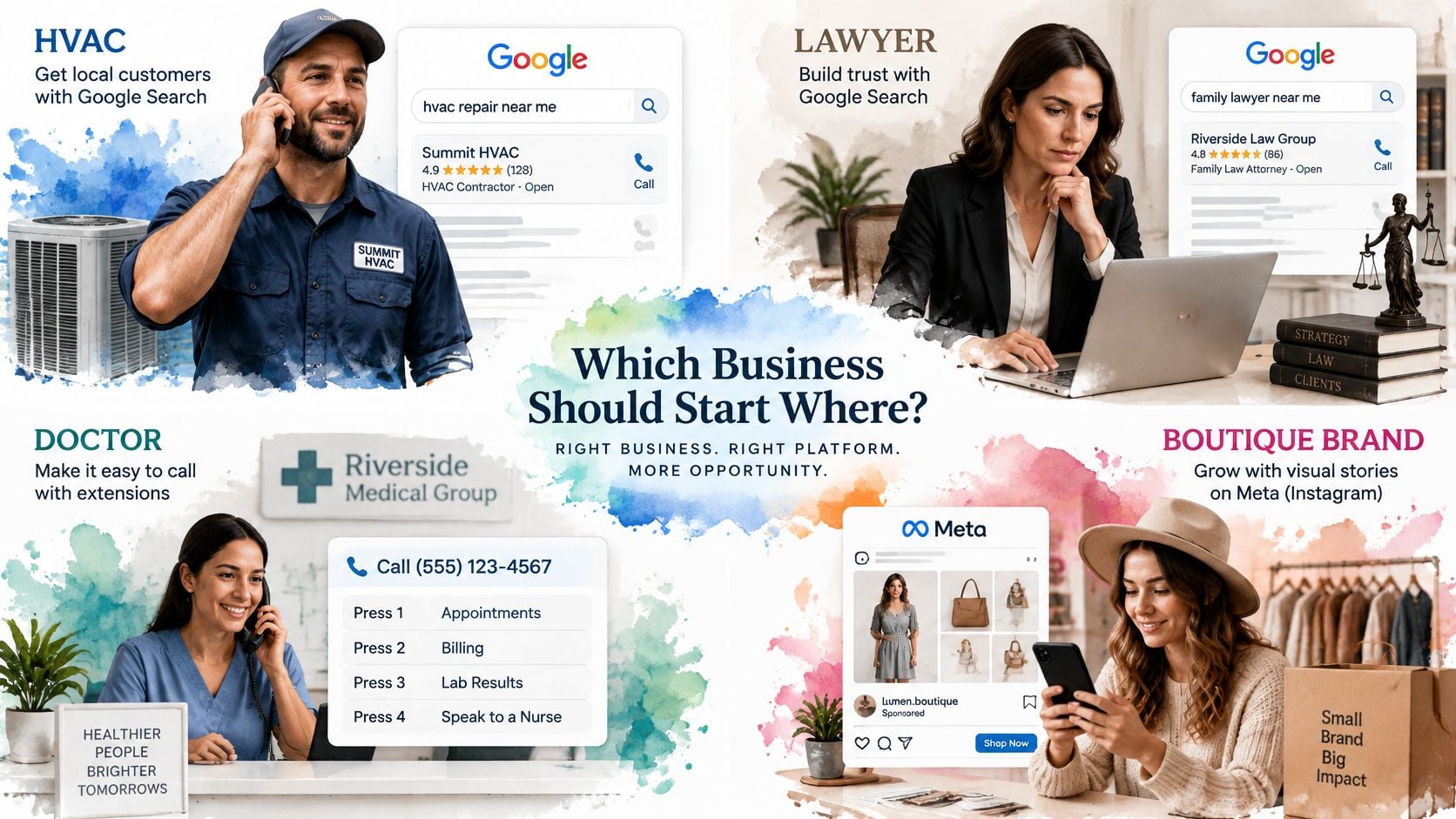
Apply the starting point to your business
For an HVAC, legal, or medical franchise, begin with relevant Google Search campaigns and call assets, often called call extensions. Build PPC campaigns for lead generation around service eligibility, territory, and booking quality. Add Meta remarketing with credible reviews and proof-led creative once you can score incoming inquiries.
For an established ecommerce brand, use Google to capture branded and relevant non-branded Shopping demand. Test Meta prospecting when your products have clear visual differences, and judge it by contribution per acquired customer against blended acquisition cost. If you cannot produce useful creative consistently, do not expand prospecting.
For a startup with little search demand, use Meta creative tests to learn which problem framing earns qualified purchases. Carry the language that works into search campaigns as relevant queries emerge. Attention alone is not a reason to scale.
For a multi-location rollout, make decisions by market. Maintain Google coverage where query demand is proven and test Meta introductions in new territories. A blended national report can make an unprofitable location look healthy by combining it with an established one.
Account for AI search without overreacting
Google's AI search advertising guidance says ads in AI Overviews and AI Mode use standard auctions and CPC or conversion-based bidding. Semrush's analysis of AI Overviews found they appeared on about 6.5% of queries in January 2025, nearly 25% in July, and below 16% by November, while ads alongside them rose from roughly 3% to 40% of cases between January and November.
Use those changes as a reason to inspect query-level performance, not to move the entire social budget. A local business may capture relevant searches beside an AI-generated answer, while a visual retailer may still need discovery campaigns to introduce products. Meta can create demand that Google later captures, so a lower last-click ROAS on Meta does not prove it added no value.
Move budget toward the surface that creates net-new demand, and keep the surface that harvests it.
Skip a universal equal split. Fund the buying behavior you can demonstrate, then adjust by market, margin, and the creative you can sustain.
Choose or Combine for the Next Dollar
Treat budget allocation as a decision you can revisit, not a permanent verdict on either platform. The goal is to put the next dollar where it can bring in profitable customers, measured through one shared scorecard for marketing, sales, and customer follow-up.
Run a revenue-first decision loop
Set the commercial target. Define what counts as a qualified conversion and the margin it must clear. Account for discounts, fulfillment, refunds, and sales effort when they affect acquisition economics. Assign ownership for qualification before launch.
Fund expressed demand when it exists. Start with a controlled Google budget for relevant searches. Before raising bids, fix a confusing landing page, weak offer, or broken booking process. More traffic will not solve a conversion obstacle.
Test the offer visually when discovery is the constraint. On Meta, compare three distinct concepts, not minor color changes. A product demonstration, an explanation that handles an objection, and a customer-use scenario address different buying questions.
Review qualified outcomes on a practical schedule. Use two to four weeks as an initial review window, then extend observation when the sales cycle or conversion volume calls for it. Check CRM outcomes, cost per qualified opportunity, and eventual revenue. Platform ROAS alone cannot show whether the spend produced valuable customers.
Assign the next dollar by incremental return. Increase investment where additional customers still meet the profit requirement. Use the measurement chain from the previous section to assess each platform's contribution, rather than treating reported conversions as interchangeable.
Set a trigger for retesting. Reassess when qualification weakens, creative fatigues, search placements change, or contribution profit falls. A campaign's past success does not guarantee its next dollar will perform.
Connect acquisition to customer experience
The Advertising Suite combines human-led strategy with digital advertising across search and social, streaming and video, and display. Its display network reaches across millions of partner websites. Keep follow-up and customer feedback connected to acquisition so the team can judge the customer path, not just the ad interaction.
The Ad Suite Membership costs $400 per year and includes access to the in-house CRM and Review Management Software. Members automatically receive a 25% discount on all products and services, with no caps or limits, and priority access to the team of experts.
Judge the full path from ad interaction to qualified inquiry, completed sale, and review. A form fill is a step in that path, not the outcome that proves the spend worked.
Book a Growth Consult with The Advertising Suite to plan Google and Meta around qualified revenue and CRM outcomes. Explore the Membership for CRM and Review Management access alongside campaign support.