The most popular advice about PPC for lead generation is to lower your cost per lead. That's an incomplete goal. A cheap form fill can waste more money than an expensive one if sales can't reach the prospect, the prospect isn't a fit, or the deal never closes. The useful question isn't how cheaply a campaign can collect contact details. It's whether the campaign brings in customers at an acquisition cost the business can support.
That shift changes what you track, how you structure campaigns, and what you ask a partner to report. Clicks and form submissions still help diagnose performance, but they're not the finish line. The finish line is revenue connected to the campaigns that generated it.
Why Your PPC Leads Are Not Turning Into Revenue
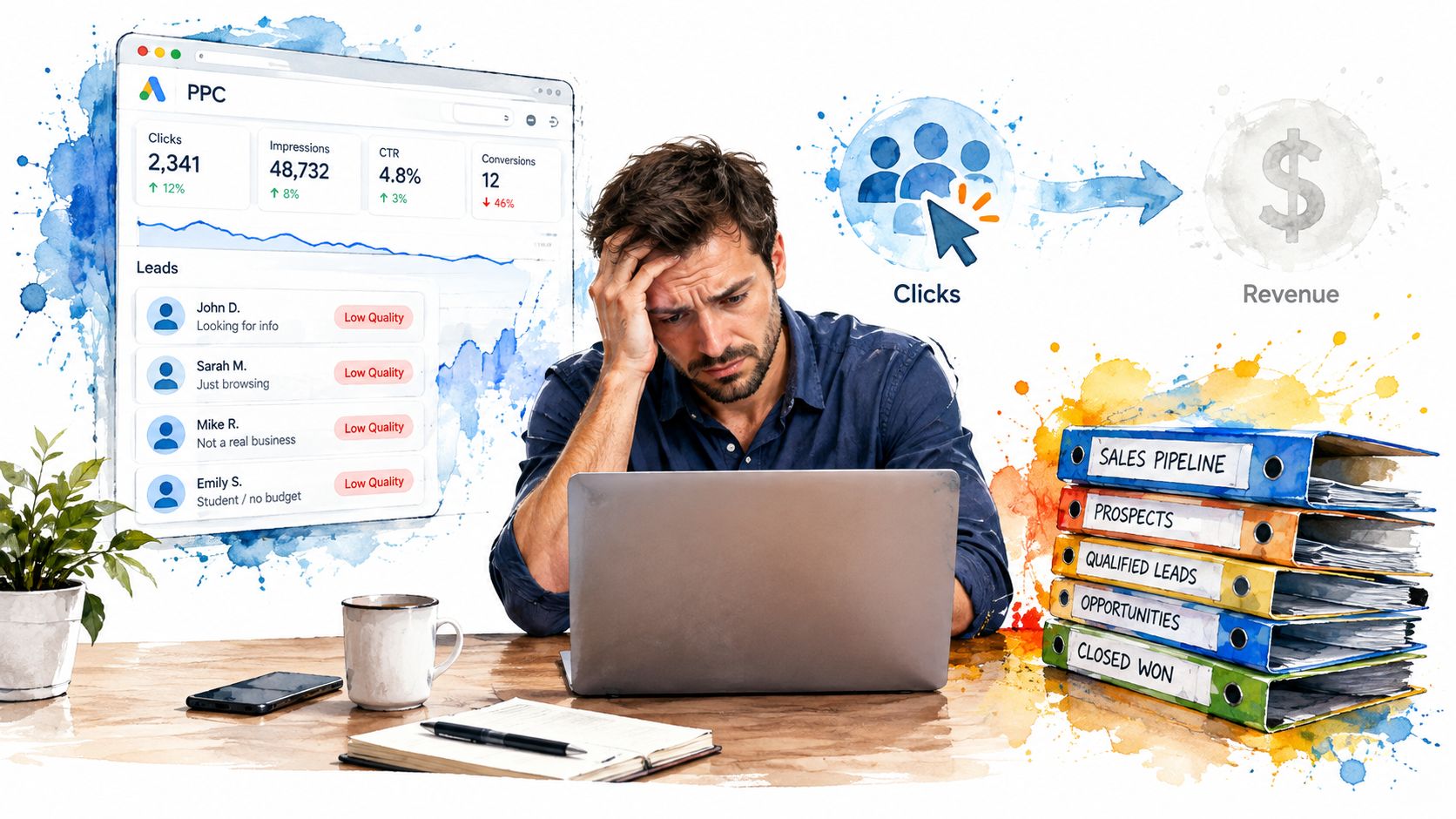
A low cost per lead isn't proof that a campaign is working. It may mean the ads are attracting people who are easy to convert but unlikely to buy. Before changing bids, check what happens to leads after they enter the pipeline.
A benchmark compilation covering 13,474 U.S. search campaigns from April 2025 through March 2026 reported a 6.64% median click-through rate, $5.42 average cost per click, 8.18% conversion rate, and $66.69 cost per lead. Those figures can give you context, not a target or a promise. The same compilation reports substantial industry variation, with conversion rates ranging from 2.64% to 16.22%. Finance and insurance, for example, had a 9.83% click-through rate but a 2.64% conversion rate. People clicked. Far fewer completed the measured action.
Find the leaks before you trust the averages
The budget leaks I look for first are:
- Broad intent: The campaign pays for research, DIY, employment, or unrelated searches alongside genuine buying intent.
- Weak post-click experience: The ad promises one thing, but the page makes visitors hunt for it, work through a mismatched offer, or abandon a complicated form.
- No link to closed deals: The account counts every form as a win, even when sales can't contact the lead or the lead never becomes an opportunity.
A high click-through rate can tell you the ad attracts attention. It can't tell you whether the people clicking are serviceable, qualified, or ready to talk. A form-fill count has the same blind spot. Connect lead records to sales outcomes before declaring a campaign efficient. A practical starting point is to define what separates an inquiry from a sales-ready marketing-qualified lead.
Stop trusting platform-reported lead volume as a complete performance score. Check search intent, lead contact and qualification rates, booked opportunities, and closed revenue. And don't reject a campaign just because its cost per lead is higher than another campaign's. A higher cost per lead can be the better result if those leads produce more gross profit.
Structuring Campaigns Around Lead Intent
Campaign structure should make it obvious what a visitor wants, what the ad promises, and where the click should land. When high-intent service searches share a budget with general research or brand terms, it gets harder to see what's working and easier for one type of traffic to consume money intended for another.
Map the account to the buying decision
Start by separating campaigns along the dimensions that change your offer or follow-up:
- Service line: Keep distinct services apart when they have different economics, landing pages, or sales teams. A legal consultation and a document review shouldn't have to share the same message just because the same firm offers both.
- Geography: Separate locations when coverage, staffing, or local competition changes where you can profitably take leads. For a multi-location business, make each service area visible in the account rather than burying it in one catch-all campaign.
- Intent: Give ready-to-hire searches their own budget and messaging. Keep educational searches separate, or exclude them if they don't support a useful lead path.
Within each campaign, keep ad groups focused on a single theme. That makes it easier to write a relevant ad and send the click to a page that answers the same question. When a group contains several unrelated services, the ad usually becomes vague and the landing page tries to do too much.
Use exclusions and budget rules deliberately
Negative keywords help block searches that don't fit the business. A service company might exclude job-seeking terms, DIY instructions, and locations outside its service area. Review the actual search terms regularly, then add exclusions based on clear evidence. Don't rule out a potentially valuable topic just because it sounds broad; check whether it has produced qualified leads.
Consider a local HVAC company. Emergency repair searches signal a different need from searches for general heating-system advice. The company can build a dedicated emergency campaign with a direct call option and a page focused on urgent service. It can keep informational searches separate and give them a smaller test budget, or exclude them if they rarely become customers. Budget should follow commercial value, not whichever campaign happens to collect the most forms.
For a franchise or service business, a useful audit map is simple: list each service area, the service offered there, the intent being targeted, the matching landing page, and the budget rule. If you can't explain why two different searches sit in the same ad group, they may not belong there.
Building Landing Pages and Lead Magnets That Qualify
The ad doesn't qualify a lead by itself. The landing page influences who submits, what they understand about the offer, and whether sales receives enough information to act. A page can generate plenty of forms while setting the wrong expectations.
Match the page to the visitor's next decision
Build one page around one primary offer. Repeat the search intent in the headline, explain what happens next, and make the main action easy to find. If the ad promotes an estimate, the page should make it clear how to request one. If it promises a consultation, the visitor shouldn't land on a generic service overview and have to work out where to go.
Choose the offer based on readiness:
- Direct consultation: Use this when the visitor is actively seeking a provider and a conversation is a sensible next step.
- Lead magnet: Offer a pricing guide, checklist, or other useful resource when someone is still comparing approaches and isn't ready to speak with sales.
A form should ask for enough information to route or qualify the inquiry, not every detail the business might someday want. For a home-service request, location and service need may be essential; a long questionnaire about household preferences probably isn't. For a professional service, a short question about the issue or timing can help sales prepare. Test whether each field changes follow-up. If it doesn't, remove it or make it optional.
A focused Google Ads landing page optimization process can help teams check message match, page clarity, and form friction without mistaking extra fields for better qualification.
Make trust visible and keep it honest
Reviews can help prospective customers assess a local or professional service, but reputation tactics need to stay authentic. The FTC's Consumer Reviews and Testimonials Rule took effect on October 21, 2024. It prohibits practices including buying fake reviews, using undisclosed insider testimonials, presenting a company-controlled review site as independent, and tying incentives to a particular sentiment (FTC guidance on the reviews and testimonials rule).
Ask customers for honest feedback without scripting a positive response. Don't hide unfavorable reviews to create a misleading impression. On the page, make it easy to see who provides the service, what the offer includes, and how to contact the business. Authentic proof supports a strong offer; manufactured praise creates risk and undermines trust.
Use this checklist before sending paid traffic:
- One clear offer that matches the ad.
- A headline and page copy that address the visitor's stated need.
- A short form with only useful qualification questions.
- A clear next step after submission.
- Authentic trust signals presented without misleading claims.
Tracking Leads from CRM Stage to Revenue
A form submission is a starting signal, not a complete account of business value. To understand which campaigns lead to revenue, agree on the meaningful actions first, capture those actions reliably, and connect them to what happens in the sales process.
Define the signals before importing outcomes
Google Ads supports conversion actions for events such as quote requests, phone calls, sign-ups, and purchases. After defining the action, an advertiser can use the Google tag or an approved measurement setup to record it. CRM data can then add the next part of the story: whether that inquiry was contacted, qualified, booked, or turned into a customer. Google explains how advertisers can track conversions across online and offline activity.
Use a map like this to decide what each CRM stage should communicate:
CRM stages mapped to campaign signals
| CRM Stage | Signal Sent Back | Value Assignment |
|---|---|---|
| Submitted | A new inquiry entered the system | No value, or a conservative value if the team has a defensible basis |
| Contacted | The team reached the prospect | A modest value if contact is a meaningful qualification step |
| Qualified | Sales confirmed the prospect fits the service and location | A value reflecting the expected economic contribution of this stage |
| Booked | The prospect scheduled a consultation, appointment, or estimate | A value tied to the opportunity's expected contribution |
| Won | The prospect became a customer | The realized value supported by the business's records |
| Retained | The customer continued the relationship | A value based on recorded retained business, where it can be attributed responsibly |
These values are decision signals, not decorations. Don't assign a large value to an early form just to make the campaign look more successful. If later outcomes carry no consistent economic meaning, automated bidding receives a distorted picture of what the business wants.
Make the handoff operational
The tracking map only works when sales and marketing use the same definitions. If one representative marks a lead “qualified” after a phone conversation and another uses the label only after a proposal, the import becomes hard to interpret. Write down each status, agree on the rules, and keep the team's CRM updates consistent.
Then check the mechanics: preserve eligible click identifiers where required, match imported records to the right ad interactions, and establish a regular import schedule. Assign an owner to monitor missing records and status changes. A useful offline conversion tracking setup should give you a path from campaign to CRM record to sale, not just a spreadsheet of disconnected totals.
Bidding and Attribution for Revenue, Not Form Fills
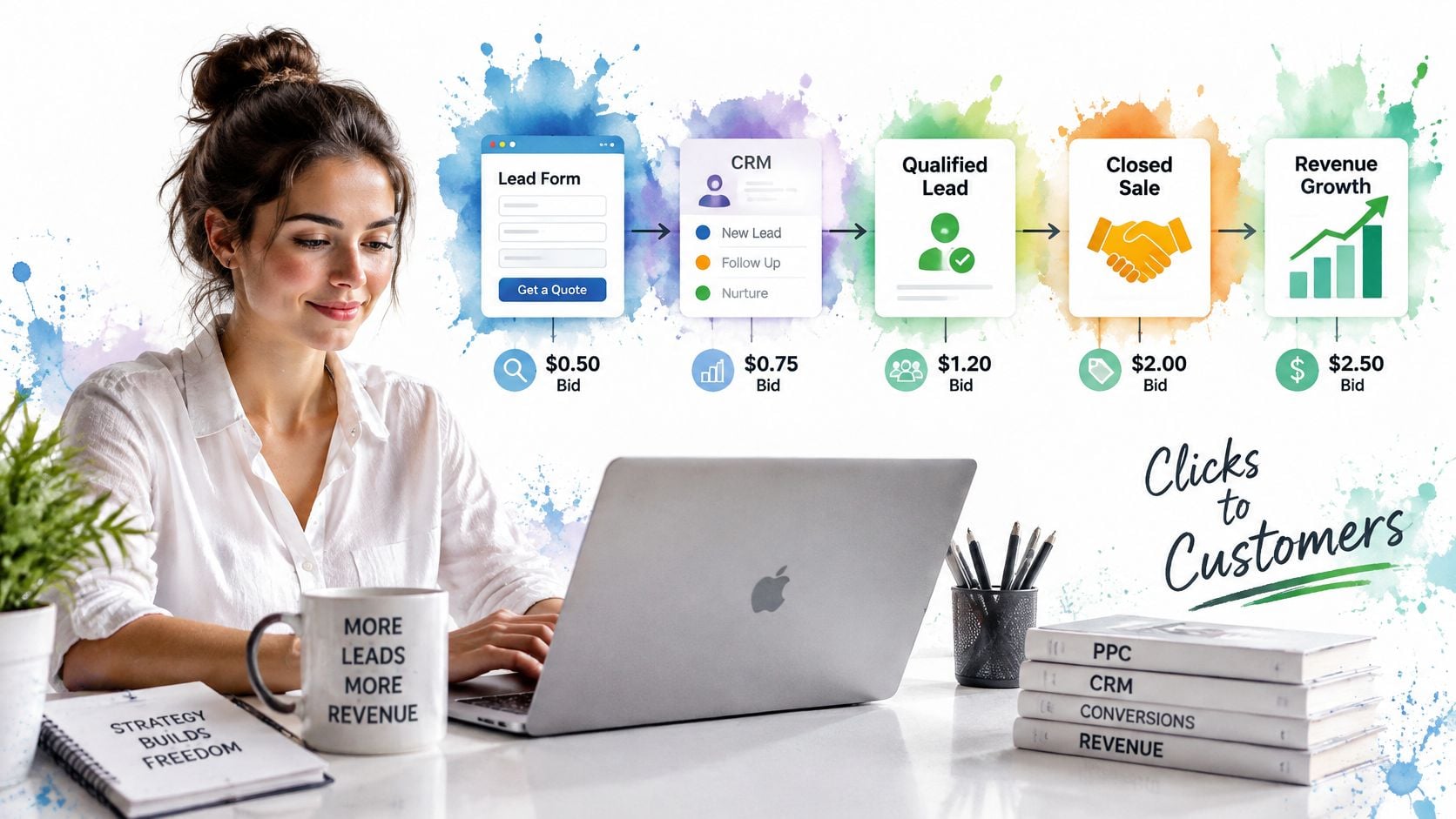
A low cost per lead can hide wasted spend. When bidding receives only a form submission signal, it cannot tell a serious prospect from an accidental inquiry or someone unlikely to buy. Revenue, not form volume, should guide campaign decisions.
Give bidding better evidence
Google's 2025 guidance recommends mapping the journey from lead submission to sale, assigning economic values to its stages, and importing offline or first-party outcomes so bidding can optimize for qualified or converted leads (Google's guidance on improving marketing outcomes). That gives bidding a better signal than treating every form as equally valuable.
Later-stage signals reflect commercial value more closely, but they arrive later and less often. Keep a reliable early event for troubleshooting while building a consistent flow of qualified and closed outcomes. Don't make a late-stage event the primary bidding signal until the CRM can return it reliably.
- Optimizing too early on form fills: Bidding may find people who submit forms, not customers.
- Sending inconsistent CRM statuses: Conflicting definitions give bidding a muddled picture of lead quality.
- Judging immature leads as losses: A prospect still in an active sales process has no final outcome yet.
Match reporting to the sales cycle
Attribution should reflect the time it takes the business to respond, qualify, and close. If calls influence sales, pass call outcomes into the CRM and distinguish meaningful conversations from unanswered calls. Use consistent definitions across channels, then compare early indicators with eventual sales outcomes rather than assigning all credit to a click or form. Multi-touch attribution modeling can help assess how different interactions contribute to a conversion.
Privacy rules limit what reports can show. Under Google Consent Mode, tags respond to each visitor's consent choices. When a visitor denies consent for advertising or analytics storage, tags do not store advertising cookies or comparable identifiers, though they may send cookieless measurement signals. Reported conversions can therefore include modeled results rather than direct, person-by-person observations (Google's explanation of Consent Mode). Use these reports as useful measurement, not as a complete record of individually observed journeys.
Use a practical rule: change bids when the underlying evidence is consistent, and wait when leads haven't had time to mature or the CRM signal is unreliable. For a 60-day sales cycle, wait at least two full cycles before judging a campaign by qualified-lead volume; use form-fill data for diagnostics in the meantime. A rushed read of incomplete outcomes can lead to cuts that sacrifice future revenue or bids that reward low-quality inquiries.
Choosing Between In-House PPC and a Growth Partner
The better setup is the one that connects ad decisions to sales outcomes. In-house teams often have closer access to sales staff and customer context. A growth partner can bring dedicated paid-media experience and a repeatable process. Neither can compensate for missing CRM records or unclear ownership of the sales funnel.
| Decision criterion | In-house team | Growth partner |
|---|---|---|
| CRM access | Works well when marketing can see sales stages and customer outcomes | Needs agreed access and a clear process for receiving CRM feedback |
| Offline outcomes | Can coordinate imports closely with internal sales operations | Can set up the workflow, but depends on consistent client-side records |
| Revenue accountability | Strong when leadership holds the team to customer outcomes | Strong when reporting and incentives focus on qualified and closed business |
| Reputation and conversion work | Easier to coordinate when those functions already work together | Useful when the partner can connect ad execution, page improvements, and reputation workflows |
Choose based on operating capability
Keep PPC in-house if the team has the time, skills, data access, and authority to act on lead quality. The trade-off is divided attention: the same people may need to manage campaigns, reporting, landing-page issues, and CRM coordination. A growth partner can provide focused execution and an outside perspective, but the client still needs to record sales outcomes and follow up promptly. For a fuller comparison, see this breakdown of agency vs. in-house marketing.
The Advertising Suite describes its model as human-led strategy across Google and Meta, conversion rate optimization, and an integrated CRM and review management system for Ad Suite Members. Membership pricing, including a service discount, matters only if those CRM and review workflows address a coordination problem the business has.
Choose the arrangement that can show which campaigns produce qualified opportunities and customers. If that answer is unavailable, assign clear ownership for CRM stages, conversion imports, and revenue reporting before adding another layer of execution. A partner earns its place by working within that accountability and helping connect campaign decisions to sales outcomes, not by reporting clicks and form counts alone.
Your Next Step Is a Funnel Audit Before More Spend
Increasing budget before checking the funnel can scale the wrong thing. Start by gathering the records that show what happens after someone responds to an ad. An audit should connect campaign structure and landing-page experience to the sales process, then identify where a worthwhile prospect gets lost.
Bring together:
- CRM lead-to-sale records with the stages your team uses.
- Current conversion action definitions and the events each campaign reports.
- Call logs that show whether calls were answered and what happened next.
- Campaign and ad group structure, including location, service, and intent splits.
- Landing pages and offers so someone can compare each page with the ads that send traffic.
Ask questions the account can answer
A useful audit should show which campaigns bring leads that close, not merely which campaigns produce the most forms. It should also reveal where visitors drop out after the click, whether qualification fields help sales, and whether review and trust signals are presented clearly.
The audit should end with specific operational decisions: which searches to exclude, which services or locations deserve separate budgets, which landing pages need a closer message match, and which CRM stages can be returned to the ad account reliably. If lead outcomes aren't mature or imports are inconsistent, fix that measurement process before making aggressive bid changes.
Book a Growth Consult when you want a working review of the campaign-to-revenue path and a practical list of what to fix first. Request a Demo if your team wants to see how an integrated CRM and review management system can support that work. You can also explore the Membership if ongoing access to the CRM and its service discount are a fit.
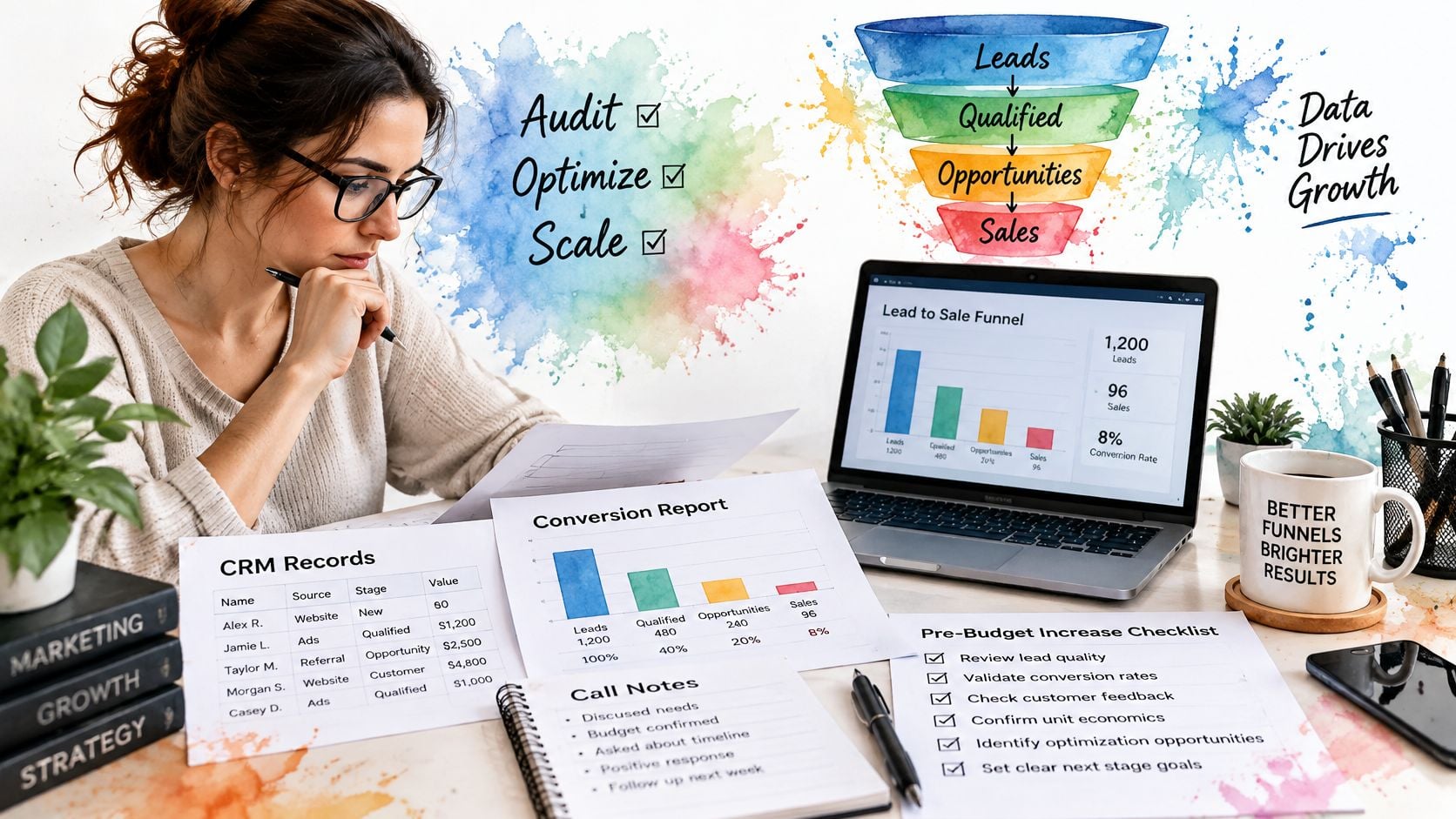
A good audit doesn't end with a new budget recommendation. It ends with a shared view of which leads became customers, what evidence supports the next campaign decision, and who owns each fix. That's how a growth partner becomes an extension of your team, accountable for revenue in the same records your business already keeps.
The Advertising Suite combines paid-media strategy, conversion optimization, and CRM and reputation workflows to help connect PPC activity with sales outcomes. Visit The Advertising Suite to book a Growth Consult, request a Demo, or explore the Membership and its CRM access and service discount.