The most popular advice about conversion rates is also the least useful: compare your number with an industry average and decide whether you're winning. That can send a business in exactly the wrong direction. A high rate can still produce unprofitable customers, while a lower rate can be healthy if each customer is valuable and acquisition costs stay under control.
So, what is a good conversion rate? It's a rate tied to a clearly defined action that produces profitable growth for your business. To judge yours, you need to know what counts as a conversion, how the rate is measured, which benchmarks fit your funnel, and whether your tracking reflects real customer outcomes. The point isn't to chase a flattering percentage. It's to make better decisions about revenue.
Why a Single Conversion Rate Number Misleads
A conversion rate without context is a scoreboard without a scorecard. A purchase, a booked appointment, a phone call, and a lead form submission are different business outcomes. Treating them as interchangeable makes comparisons look precise while hiding what the business needs to know.
The denominator matters too. A rate based on eligible ad interactions isn't automatically comparable with one based on website sessions. The attribution window, traffic source, device mix, and geography can all change the result. Even the same company can report different rates depending on which event it counts and how it defines the audience.
Optimize for valuable outcomes, not easy ones
A higher percentage doesn't guarantee better performance. A lead form can convert well while attracting people who aren't ready to buy, can't afford the service, or require costly follow-up. A lower lead rate may produce more qualified opportunities and a stronger return. The same principle applies to ecommerce: a rate achieved through heavy discounts may increase order volume while weakening contribution profit.
That's why the practical question isn't, “Is this rate good?” Ask instead: Does this conversion action produce customers worth acquiring at a cost the business can sustain? Evaluate the rate alongside customer quality, acquisition cost, margin, and customer value. The key advertising performance metrics matter as a set, not as isolated numbers.
Define “good” around your economics
A useful target starts with the business model. A business with high margins may be able to profit from a different conversion rate than one with thin margins and expensive follow-up. A service provider should distinguish a completed form from a qualified lead or booked job. An online store should care about profitable purchases, not just completed checkouts.
Benchmarks can help identify a question worth investigating, but they can't answer whether your customers are profitable. First establish what you count, then check whether the resulting customers support sustainable growth. A good conversion rate is one that contributes to profitable customers, not one that looks impressive in a report.
How to Calculate Conversion Rate Correctly
Start by choosing one conversion action and one denominator that match the question you're trying to answer. Google Ads defines conversion rate as conversions divided by total eligible ad interactions during the same period. That definition is useful for paid advertising, but don't assume its denominator matches a website conversion rate based on visits. Google's conversion-rate definition makes the comparison basis explicit.

Work through the calculation
Use the same period for the numerator and denominator. If you record 50 conversions from 1,000 eligible interactions, the rate is 5%. The arithmetic is simple. The harder part is making sure those conversions and interactions represent the same thing every time you calculate the figure.
Pick the primary action that matters for the analysis:
- Purchases: Count completed orders when assessing sales conversion.
- Lead forms: Count submissions for a form-conversion view, then check whether those leads qualify.
- Calls or bookings: Track the relevant customer action, not just a click on a phone number or booking button.
Keep comparisons consistent
Count rules can change the answer. Google notes that when an advertiser counts multiple conversions from one interaction, the reported rate can exceed 100%. That may be appropriate for some reporting goals, but it shouldn't be confused with the share of interactions that produced at least one customer action.
Before comparing periods, keep the conversion action, traffic source, device mix, geography, and attribution window consistent. If you changed any of those, separate the results or label the comparison clearly. Otherwise, a movement in the percentage may reflect a measurement change rather than a real shift in customer behavior.
Use this quick reliability check before benchmarking:
- Name the event. Can everyone agree what counts as a conversion?
- Confirm the denominator. Are you using eligible interactions, sessions, or another defined base?
- Match the period and settings. Are the dates and attribution rules consistent?
If you can't answer those questions cleanly, fix the definition before judging the rate.
Benchmarks That Define a Good Conversion Rate
Benchmarks are useful for setting a reference point, not for declaring victory or failure. For landing pages across multiple industries, a benchmark reports a 6.6% median, with industry medians ranging from 3.8% to 12.3%. The landing-page conversion benchmark uses the median, which is more useful than the mean when a small number of exceptional pages can skew an average.
Ecommerce has its own context. IRP Commerce reported a 1.84% average conversion rate for Northern Ireland ecommerce merchants in 2024, while session conversion rates ranged from 0.56% to 5.28%. Those figures show why one store's result shouldn't become another store's target. IRP Commerce's ecommerce benchmark data offers a useful reference, but it represents a particular market and dataset.
| Benchmark Type | Reported Figure | How to Use It |
|---|---|---|
| Landing pages across industries | 6.6% median; industry medians from 3.8% to 12.3% | Compare with a landing page serving a similar audience and action. |
| Northern Ireland ecommerce merchants in 2024 | 1.84% average; session rates from 0.56% to 5.28% | Use as market context, not a universal store target. |
Match the comparison to the business
Before you use a benchmark, segment your own data by campaign, audience, device, geography, and new versus returning visitors. A broad site average can blend high-intent returning customers with first-time visitors who are still evaluating. The combined number may be mathematically correct and still be useless for deciding what to fix.
Choose a reference that matches both the business model and the conversion action. A landing-page median is not a direct yardstick for completed ecommerce purchases. An ecommerce figure doesn't tell a local service company whether its calls are qualified. For more ecommerce-specific context, use this guide to ecommerce conversion rates.
A rate above the relevant median is a reasonable starting signal, not proof that performance is good. The better test is whether the rate produces valuable customers without sacrificing margin, lead quality, or the ability to scale. Use benchmarks to find gaps. Use your own business economics to set the target.
Pitfalls That Distort Your Conversion Data
A platform can report a healthy-looking conversion rate while your confirmed sales or qualified leads tell a different story. Don't assume the number is wrong, but don't treat it as a complete record either. Consent choices, browser limits, and cross-device journeys can prevent some customer actions from being directly observed or linked to an ad interaction.
The W3C's 2025 proposal focuses on measuring advertising outcomes such as purchases and sign-ups without exposing individual users, reflecting a move toward aggregated attribution. The W3C proposal on privacy-preserving attribution describes that measurement direction. For businesses, the practical implication is clear: reported conversions may not capture every customer journey in the same way.

Separate measured events from business outcomes
Ad platforms, website analytics, customer records, and sales systems may report different totals because they observe or attribute events differently. Modeled conversions are estimates of actions that couldn't be linked directly under the measurement setup; they aren't the same as individually observed purchases or qualified leads. A change in modeled reporting shouldn't automatically be read as a change in customer behavior.
Use a measurement hierarchy to keep decisions grounded:
- Primary outcome: Confirmed revenue, completed sales, or qualified pipeline.
- Funnel diagnostics: Landing-page actions, form completion, checkout progress, and payment errors.
- Attribution context: Platform-reported and modeled conversions, clearly distinguished from confirmed outcomes.
That hierarchy gives you a business result to optimize toward while preserving useful signals about where customers hesitate. A conversion funnel analysis can help identify where reported activity stops progressing toward a sale.
Reconcile before you react
Compare advertising reports with first-party records such as CRM entries, confirmed orders, call outcomes, and booked appointments. Check whether the sources use the same conversion event, time window, and attribution rules. If they don't, document the difference before changing a campaign based on the discrepancy.
Where direct attribution is unreliable, controlled experiments or geo-based tests can help evaluate whether marketing activity is contributing to outcomes. A lower observable conversion rate can coexist with stable or improving business performance. Optimizing toward one platform's number alone may reward better tracking rather than better customer acquisition.
CRO Tactics That Lift Conversion Rate Profitably
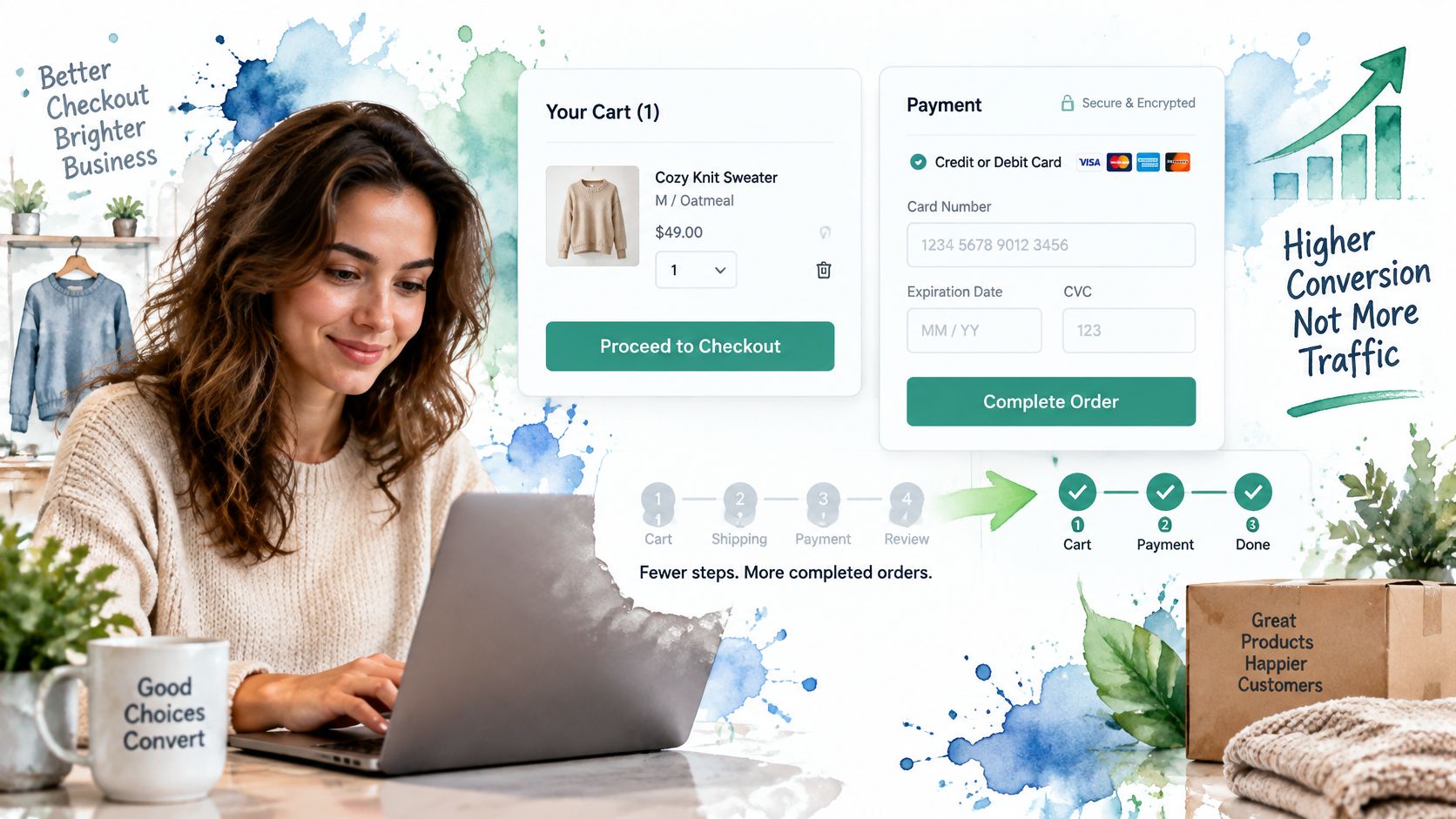
For ecommerce, don't assume that more traffic is the fastest route to more purchases. The checkout itself may be leaking demand. Baymard puts average cart abandonment at approximately 70.19%, and its testing indicates that the average large ecommerce site could achieve about a 35.26% relative increase in conversion rate through solvable checkout-usability improvements. The checkout-usability research describes the opportunity.
A relative increase isn't a percentage-point jump. For example, a 2.0% conversion rate improved by a relative 35.26% would become approximately 2.71%, not 37.26%. That distinction matters when you're forecasting impact or setting expectations.
Find the friction before buying more traffic
A visitor who intends to buy can still abandon when the process creates unnecessary work or uncertainty. Check for forced account creation, unclear total costs, weak error handling, and limited payment options. These are concrete usability problems, not abstract calls to “improve the experience.”
Trace the path from product view through cart, checkout initiation, payment errors, and purchase. Look for where customers stop progressing, then estimate the business value of fixing that point. The goal isn't to remove every step at any cost. It's to remove friction that blocks qualified demand while preserving the information and controls your business needs.
Prioritize fixes by expected value
Rank potential changes using lost sessions × expected recovery × contribution margin. This is a prioritization method, not a promise of a particular result. A checkout issue affecting many valuable sessions may deserve attention before a cosmetic change on a low-traffic page.
A disciplined CRO cycle looks like this:
- Locate the drop-off. Find the step where customers stop moving toward purchase.
- Form a specific hypothesis. Tie the suspected friction to an observable behavior.
- Test the fix. Use a statistically valid experiment rather than relying on a few anecdotes.
- Check segment results. Review performance by device, browser, country, and acquisition source.
An aggregate improvement can conceal a decline among valuable customers, so don't stop at the headline rate. For paid traffic, this Google Ads landing-page optimization guidance can help connect the campaign promise to the page experience. Keep the final decision tied to qualified outcomes and contribution profit, not just a winning test percentage.
Choosing a Partner for Conversion Gains
There are three practical routes to conversion improvement: handle the work in-house, buy software without outside execution, or work with an integrated growth partner. None is automatically right. Choose based on your team's measurement skills, capacity to implement fixes, and willingness to be accountable for revenue outcomes rather than activity reports.
| Approach | Measurement depth | Execution capacity | Revenue accountability |
|---|---|---|---|
| In-house team | Depends on internal analytics and data discipline | Strong when the team has time and relevant skills | Can connect closely to business goals |
| Software alone | Can support tracking and reporting | Your team still has to interpret and act | Doesn't, by itself, own the business outcome |
| Integrated growth partner | Can connect campaign, funnel, and customer data | Combines strategy with implementation support | Should be judged by qualified outcomes and revenue focus |
Include reputation in the conversion environment
For local businesses, prospects don't assess a website in isolation. They may compare providers using review scores and the way each business responds to feedback. BrightLocal's 2024 Local Consumer Review Survey reports that 93% of consumers expect a business to respond to its reviews. The local consumer review survey establishes a customer expectation, not a guaranteed conversion lift.
That expectation makes review response a practical part of customer experience, especially for service businesses and multi-location operators. Track whether reviews receive timely, consistent responses, then assess that work alongside the quality of incoming calls, bookings, and leads. If you're evaluating outside support, use these criteria for choosing a digital marketing partner.
Choose the model your team can sustain
An internal team may be the right fit when it has the expertise and capacity to measure, test, and implement changes. Software can help teams organize work, but a dashboard won't diagnose the business problem or make the fix. A partner can connect strategy, execution, and customer follow-up when the business needs more hands-on support.
The Advertising Suite combines human-led strategy, omnichannel advertising execution, conversion optimization, and a built-in CRM and review-management ecosystem for members. Its membership offers a 25% discount on services and access to the proprietary CRM; the company reports that more than 10,000 customers have validated its methodology. Evaluate the fit by asking how the work will connect ad performance to qualified leads, sales, and customer experience, not by counting clicks.
Your Next Step Toward Profitable Conversions
Take one conversion action and calculate its current rate using a consistent denominator and time window. Then compare it with a benchmark that matches your business model and audience, and estimate whether the resulting customers can cover acquisition costs while preserving margin. If your tracking doesn't connect marketing activity to confirmed sales or qualified pipeline, make measurement the first fix.
For a practical review of your funnel and growth priorities, book a growth consult or request a demo. If access to integrated software and the membership discount matter to your team, explore the membership as part of the decision. The right partner should work as an extension of your team, connecting the marketing plan to the customer experience and the bottom line.
The Advertising Suite connects advertising strategy, conversion optimization, CRM, and review management to help businesses turn more of their marketing into profitable customer outcomes. Visit The Advertising Suite to request a demo or book a growth consult, and find a growth-focused partner who can work as an extension of your team.