Most businesses don't lose marketing performance because customers dislike personalization. They lose it because customers don't trust how their data is collected or used. In Cisco's 2024 Consumer Privacy Survey, 75% of respondents said they wouldn't buy from an organization they don't trust with their data, while 81% said they care about how companies collect and use personal data. Cisco's global privacy survey makes the commercial consequence clear: privacy affects conversion before an ad ever earns a click.
For an SMB, data privacy in marketing isn't a legal footnote. It's a measurement infrastructure problem, a customer-experience problem, and a revenue problem. The rebuild order matters: fix consent UX, build first-party data, move critical measurement server-side, then establish governance that keeps the system usable as laws and browser policies change.
Why Privacy Is Now a Revenue Problem, Not a Legal One
Privacy is often treated as paperwork that sits between the marketing team and launch day. That's the wrong diagnosis. When customers withhold consent, tracking disappears, attribution weakens, bidding systems receive poorer signals, and your team starts making budget decisions with incomplete evidence.
The trust issue is already visible in buying behavior. Cisco found that 75% of surveyed consumers won't buy from organizations they don't trust with their data, and 53% said their privacy concerns had grown compared with the previous year. The survey's findings apply across more than 2,600 participants in 12 countries, so this isn't merely a single-market complaint.
The three revenue leaks
- Attribution loss: Consent refusal can leave conversions unattributed or force platforms to rely on modeled signals.
- Bidding weakness: Automated campaigns perform best when event quality and consent states are clear. Missing events give optimization systems less useful feedback.
- Acquisition-cost pressure: When reporting undercounts outcomes, teams may pause profitable campaigns, overfund weak ones, or chase cheaper clicks that never become customers.
GDPR took effect on 25 May 2018, and its influence pushed consent, preference management, and tracking controls into everyday marketing operations. By mid-2024, 72% of EU respondents had heard of GDPR and 40% said they knew what it was, according to the European Commission data summarized by the IAB's consumer privacy research. Enforcement tracking cited there reported cumulative GDPR fines above $6 billion since 2018, with more than $1 billion added in 2024.
| Privacy Signal | What Changed | Revenue Impact |
|---|---|---|
| Consent refusal | Fewer identifiers and fewer client-side events | Less complete attribution |
| Data distrust | Customers hesitate to identify themselves | Smaller usable audiences |
| Regulatory enforcement | Unlawful collection creates financial exposure | Budget diverted to remediation |
| Browser and platform controls | Tracking methods keep changing | More measurement debt |
The practical response is an ordered rebuild, not another analytics dashboard. Start with cross-channel attribution, then repair consent, strengthen owned data, implement privacy-safe event routing, and document the rules that govern every downstream use.
What Data Privacy in Marketing Means
Data privacy in marketing governs any collection, sharing, or activation of customer data used to target, personalize, communicate, or measure marketing. A newsletter form, product quiz, customer list uploaded for audience matching, support interaction used for segmentation, and analytics event tied to an identifiable visitor all belong in the same operating model.
Treat customer data like warehouse inventory. Consent is the shipping label that states what may move, where it may go, and which purpose permits the shipment. Platforms act as carriers with different handling rules. If the label is missing or inaccurate, sending the inventory creates exposure, even when the campaign goal is legitimate.

The four actors in every data flow
- The user generates signals, submits information, expresses preferences, and holds rights over personal data.
- The marketer decides what to collect, why to collect it, how long to retain it, and which campaigns may use it.
- The platform processes, stores, enriches, or activates data on the marketer's behalf.
- The regulator establishes guardrails and can require evidence that the business followed them.
The data falls into four practical categories:
- Zero-party data: Information a customer deliberately declares, such as a preferred product type or service need.
- First-party data: Behavior collected directly through your own customer relationship, with an appropriate legal basis.
- Second-party data: Data received from a partner under a defined sharing arrangement.
- Third-party data: Data acquired from an outside provider rather than generated through a direct customer relationship.
Use one rule for every activation decision: lawful basis, purpose limitation, and data minimization must govern every activation decision. If you cannot explain why a field was collected, where it goes, and which customer-facing purpose it serves, remove it from the process.
Build owned data deliberately. A clear first-party data strategy connects permission to the customer experience instead of burying it in technical metadata. That foundation makes consent, measurement, and downstream governance easier to manage.
The Laws That Shape Modern Marketing Stacks
Privacy law now sets the operating rules for your marketing stack. It determines what you may collect, what you must disclose, and how you prove your process. Requirements vary by jurisdiction, but the work reaches the same systems: forms, cookies, CRM records, advertising integrations, access controls, and retention schedules.
GDPR sets the operational floor
GDPR took effect on 25 May 2018 and remains the key privacy framework for international marketing. It can apply to organizations outside Europe when they process data connected to people in the EU. Your stack needs a defensible legal basis, clear privacy notices, consent records where consent is the basis, a process for rights requests, and vendor controls that block data use beyond the stated purpose.
A banner alone does not prove compliance. Valid consent must be freely given, specific, informed, and unambiguous. Pre-checked boxes, cookie walls, and unclear language can invalidate consent. Your business and its agency partners must be able to show when consent was collected, what the person agreed to, and how that choice reached downstream systems. See this GDPR compliance guidance for marketing agencies.
Enforcement tracking reported cumulative GDPR fines above $6 billion since 2018, per the IAB's consumer privacy research. Treat that record as an operating signal. Consent logging, vendor reviews, and deletion workflows belong in the marketing system, not in a legal folder that nobody checks.
US state laws create a second control layer
California's privacy framework emphasizes consumer rights and opt-out controls, including limits on certain sharing and selling practices. Other state laws use different definitions, thresholds, sensitive-data rules, and appeal procedures. Virginia's VCDPA and Texas's TDPSA form part of a wider state-level patchwork, so a California-only setup can fail outside California.
For an SMB, configure controls around region, purpose, data category, and consent state. Store the decision record once, then enforce it across forms, CRM workflows, analytics, and advertising destinations. Do not create a new manual process whenever a state changes its wording.
Sector rules add further requirements:
- Health-related marketing may involve HIPAA obligations and stricter handling expectations.
- Audiences under 13 raise COPPA concerns.
- Email marketing must account for CAN-SPAM requirements and unsubscribe handling.
| Law | Scope | Key Marketing Requirement | Penalty Ceiling |
|---|---|---|---|
| GDPR | Personal data connected to people in the EU | Lawful processing, transparent notice, rights handling, and defensible consent where required | Up to €20 million or 4% of global annual turnover, whichever is higher |
| CCPA and CPRA | Covered businesses handling California residents' personal information | Notice, consumer rights, and opt-out controls for relevant selling or sharing | Varies by violation and enforcement context |
| Virginia VCDPA | Covered processing involving Virginia residents | Consumer rights, sensitive-data controls, and defined processing obligations | Varies by violation and enforcement context |
| Texas TDPSA | Covered processing involving Texas residents | Consumer rights, notice, and controls for sensitive data and targeted activity | Varies by violation and enforcement context |
| HIPAA | Covered health information and applicable entities | Restrict use and disclosure of protected health information | Depends on violation and enforcement context |
| COPPA | Online services directed to children under 13 | Verified parental consent and child-focused data controls | Depends on violation and enforcement context |
| CAN-SPAM | Commercial email in the United States | Accurate sender information, disclosures, and working opt-out mechanisms | Depends on violation and enforcement context |
Your strictest audience sets the practical floor. If you serve Europe, build for GDPR-grade consent. If you serve multiple US states, implement flexible opt-out and rights workflows instead of a California-only process. Put consent UX first, then establish first-party data controls, server-side measurement, and governance that keeps every change auditable.
How Consent UX Affects Your Conversion Data
Consent UX changes how much marketing data your business can collect before a visitor reaches a product page. A five-year GDPR study reported average cookie acceptance of about 31%, with results ranging from 4% to 85% depending on design. When the first layer shows a clear Reject all option, roughly 60% of users reject, according to the cookie banner study summary.
Treat that result as a measurement constraint, not a reason to hide rejection. A transparent banner can reduce available identifiers, while giving you a cleaner permission signal and a customer relationship you can defend. The rebuild starts with consent UX, then moves into owned data, server-side measurement, and governance.
Wire the consent state before campaign logic
Consent settings must reach the measurement layer before campaign tags run. Advanced Consent Mode v2 uses states such as ad_storage, analytics_storage, ad_user_data, and ad_personalization to determine what data can be sent and whether aggregated or modeled measurement may remain available. Clean server-side tagging implementations report recovery of about 10% to 30% of lost conversion data, according to this server-side tracking playbook.
Set up the sequence correctly:
- Set a default state before non-essential tags fire.
- Give accept and reject choices equal visual weight.
- Provide category controls without burying the main decision.
- Attach the consent state to each relevant event.
- Add a persistent preference center for changes or revocation.
Avoid pre-checked boxes, double negatives, and cookie walls that block access until visitors agree. These patterns can raise apparent acceptance while weakening trust and creating invalid consent.
Practical rule: Consent UX belongs in the measurement specification, not only in legal review.
Use a conversion rate optimization audit to check both sides: whether the banner respects user choice and whether the analytics layer interprets that choice correctly. A polished banner that fires tags too early remains broken.
Building a First-Party Data Engine That Survives 2026
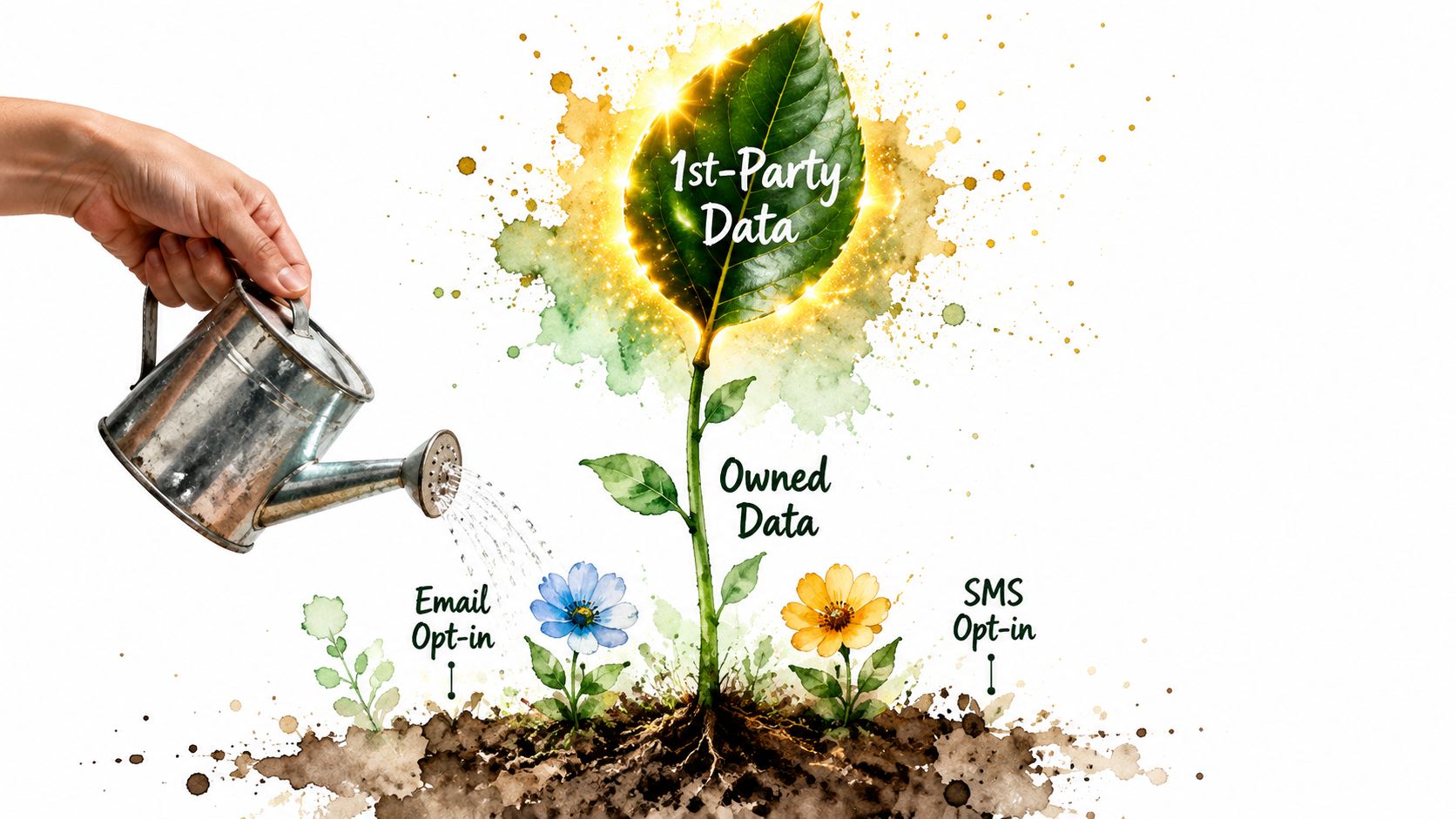
Third-party signals are rented. First-party data is an owned business asset, provided you collect it transparently and use it for a purpose customers understand. The goal isn't to gather every possible field. The goal is to create a reliable customer record that improves service, lifecycle communication, suppression, and measurement.
Start with useful collection
Ask for information at moments where the value is obvious:
- Email and SMS opt-ins: Explain what the customer will receive and let them choose the channel.
- Post-purchase questions: Ask about use case, preferences, satisfaction, and future needs.
- Progressive profiling: Request one additional field when the customer has a reason to provide it.
- Account creation: Connect future behavior to a customer relationship only after presenting clear notice and choices.
A short preference question can be more useful than a large form that nobody completes. For an online retailer, a post-purchase survey can reveal why someone bought, what they considered, and what they may need next. For a local service business, the same principle applies to service type, property details, urgency, and preferred contact method.
Unify the record before you activate it
Your CRM or customer-data layer should connect the customer's permitted interactions across the website, point of sale, support inbox, and sales process. Use a stable internal customer ID, document source and consent, and separate operational communication from advertising activation.
Then activate only what the business can explain:
- Send lifecycle messages based on a declared need or recent transaction.
- Suppress existing customers from acquisition campaigns when the objective is new business.
- Build audience seeds from customers who represent profitable relationships, not merely high order volume.
- Give sales and support teams the context needed to improve the customer experience.
The collection test: If you can't name the campaign, service improvement, or operational decision that will use a field soon, don't collect it.
A durable first-party data strategy also includes deletion, correction, and retention rules. Data hoarding creates more exposure without guaranteeing better performance. The strongest system is selective, consent-aware, and connected to revenue-producing actions.
Server-Side Tracking and Privacy-Safe Measurement for SMBs
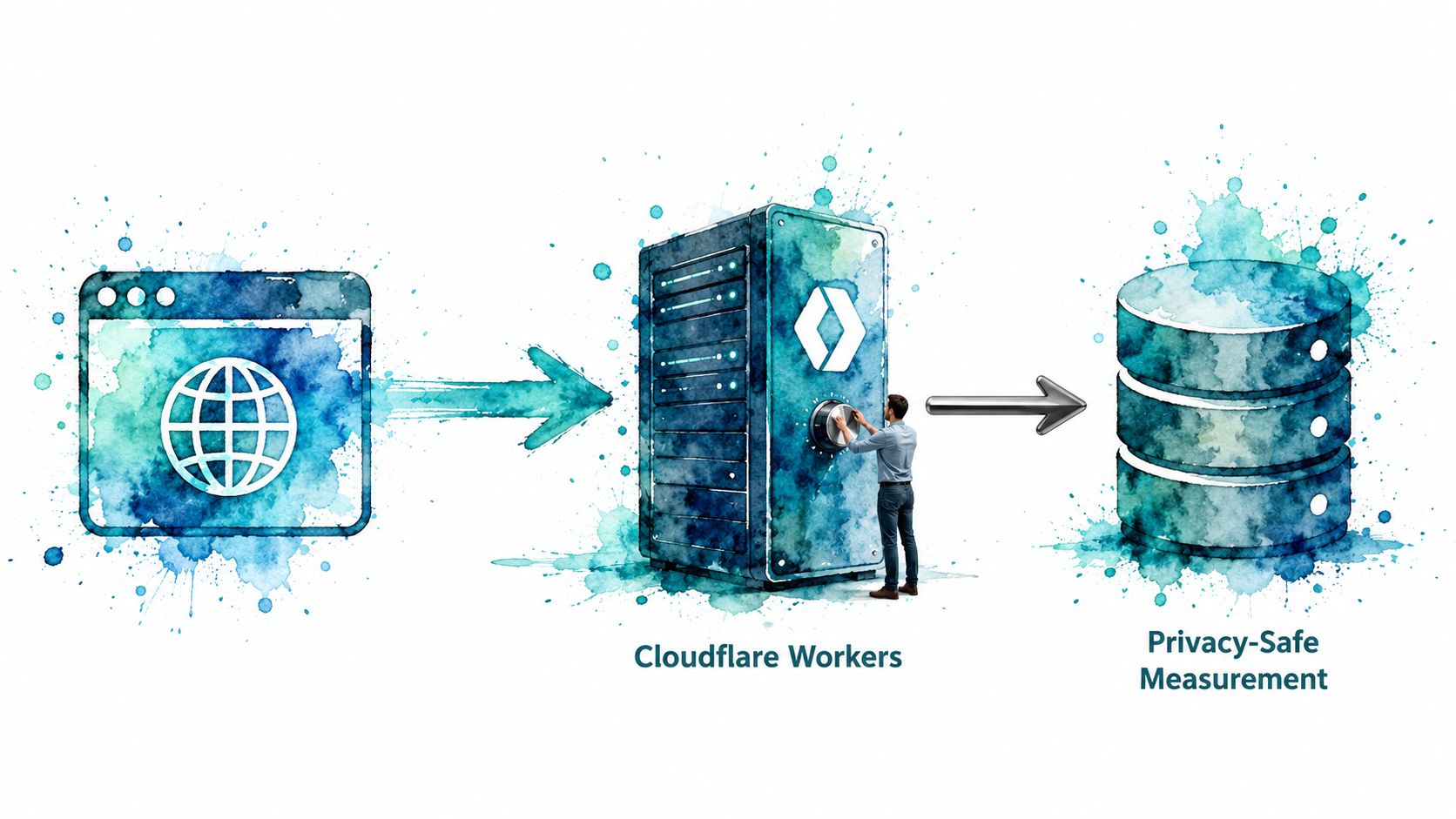
Server-side tracking doesn't mean an SMB needs an enterprise data warehouse or a team of engineers. It means the browser sends approved events to a first-party gateway, and that gateway decides what each destination may receive.
A practical flow looks like this:
- The browser or app sends an event to your first-party endpoint.
- The gateway checks consent and validates the event.
- The system removes or scrubs unnecessary personal information.
- The server forwards permitted fields to analytics, advertising, and internal reporting destinations.
- A warehouse or CRM receives the clean event for reconciliation and lifecycle use.
The gateway may run through a managed server container or an edge function. The exact vendor matters less than the boundaries. Raw personal information shouldn't be forwarded to advertising pixels, IP addresses should be minimized or truncated where appropriate, and the consent state should travel with the event so downstream systems don't guess.
Build for deduplication and event quality
Send a transaction identifier with browser and server events so the receiving platform can recognize duplicates. Standardize event names, required fields, timestamps, and customer identifiers before you connect multiple destinations. A server-side setup that sends the same purchase twice can make a cleaner pipeline less trustworthy than the messy one it replaced.
The architecture can support analytics, advertising conversion APIs, enhanced conversion signals, and internal reporting. It can also improve resilience against client-side blocking and browser restrictions. But it doesn't create permission where permission is absent.
Server-side tracking is a filter, not a loophole. It improves control and data hygiene. It doesn't replace consent or make modeled measurement unlimited.
Use offline conversion tracking when revenue closes after the initial lead event. A qualified call, booked appointment, signed contract, or completed service can be more valuable than the form submission that started the journey. Send only the event and fields you're allowed to use, with documented consent and retention rules.
Choosing a Consent and Privacy Stack Without Overbuying
SMBs don't need the largest privacy platform. They need a system that blocks unauthorized tags, records consent, supports regional choices, and can be maintained by the people who run the website.
Evaluate four dimensions before comparing feature lists:
- Consent maturity: Look for support for regional controls, clear preference records, and recognized consent standards when your advertising destinations require them.
- Analytics compatibility: Confirm that the consent layer works with your analytics setup, server-side event routing, and conversion integrations.
- Pricing transparency: Identify whether fees depend on sessions, domains, page views, seats, or flat subscription tiers.
- Onboarding burden: Ask who will classify cookies, maintain vendor mappings, troubleshoot scripts, and handle policy changes.
Match the stack to the operating reality
Established brands with legal review and complex international operations may need a full enterprise consent and privacy platform. Mid-market SMBs generally need a capable consent management platform with regional rules, audit records, and practical integrations. Early-stage stores can often start with a lightweight consent tool and basic analytics, provided they don't pretend that a free setup solves governance.
| Platform Category | Starting Price | Key Capabilities | Best Fit |
|---|---|---|---|
| Enterprise privacy suite | Custom pricing | Broad governance, regional controls, rights workflows, and legal-team collaboration | Established brands with complex processing |
| Mid-market consent platform | Subscription pricing | Consent records, banner controls, regional configuration, and common marketing integrations | Growing SMBs and multi-region operators |
| Lightweight consent layer | Free or low-cost tiers may be available | Basic banner management and essential preference controls | Early-stage stores with limited tracking complexity |
| Custom server-side setup | Infrastructure and implementation dependent | Event filtering, consent-aware routing, deduplication, and destination control | SMBs with a clear measurement owner |
Don't pay for analytics features your existing reporting already covers. Don't buy geographic routing you don't need. Review whether pricing rises with paid traffic, because a campaign spike can turn per-session billing into an unpleasant renewal surprise.
A sensible buying heuristic is to stay under $200 per month unless you process EU health or children's data, then reassess when you reach 500,000 monthly sessions. Those thresholds are editorial guidance, not legal limits. Complexity, risk, and operational capacity matter more than a badge-filled sales presentation.
Your 30-Day Privacy-First Implementation Checklist
A privacy rebuild fails when every task depends on every other task. Use a fixed sequence, assign one owner, and document decisions as you go.
Week one, map the actual system
Audit every script, tag, cookie, form, CRM connection, and advertising destination. Record what fires before consent, what touches EU or California traffic, which vendors receive data, and who can approve a change.
Assign one accountable owner. Legal can advise, engineering can implement, and marketing can define business purpose, but one person must maintain the inventory and sign off on releases.
Week two, repair consent and notice
Install a consent management platform that fits your regions and advertising destinations. Configure a clear first-layer choice, prevent non-essential tags from firing before the relevant signal, and connect consent states to your analytics and advertising events.
Publish a plain-English privacy policy with a real contact channel. Include what you collect, why you collect it, who processes it, how customers can exercise rights, and how they can change their preferences.
Week three, connect owned data
Add CRM-integrated email forms, post-purchase questions, and an identity layer for logged-in customers where it serves a clear purpose. Record the source, purpose, timestamp, and permission state for each marketing subscription.
Then connect privacy-safe server-side event routing, conversion APIs, and enhanced conversion signals. Test the full path with consent granted, consent refused, and consent withdrawn. The system should behave differently in each case.
Week four, validate and govern
Compare modeled conversion reporting with a holdout or an internal source of truth. Look for duplicate events, unexplained gaps, and campaigns that rely on signals you can't legally or technically support.
Create guardrails for vendors and AI use:
- Vendor review: Recheck processors, data-sharing terms, retention, and deletion workflows.
- AI review: Don't send customer data to an AI system until purpose, lawful basis, access, retention, and human oversight are documented.
- Incident response: Maintain a breach workflow with a 72-hour notification plan where applicable.
- Recurring controls: Review policy quarterly, re-vet vendors every 12 months, and keep a one-page DPIA template ready before launching a new data-intensive campaign.
The sequence matters. Audit first, consent second, owned data third, server-side measurement fourth, and governance throughout. That order prevents you from polishing dashboards built on unauthorized or unreliable inputs.
The Advertising Suite helps SMBs rebuild privacy-aware acquisition around consent UX, first-party data, CRM operations, reputation management, and revenue-focused measurement. Request a growth consult with The Advertising Suite to turn your marketing system into a privacy-safe extension of your team, not another disconnected vendor stack.