Most advice about conversion rate optimization is shallow. It tells you to tweak a button, test a headline, and hope the graph moves.
That's not why most companies struggle.
The issue is simpler and more expensive. You're paying to acquire attention, then sending that attention into a messy experience that leaks trust, intent, and revenue. If your ads are producing traffic but not cash, your problem usually isn't reach. It's conversion.
More Traffic Is Not the Answer
More traffic is the favorite excuse of underperforming marketing teams.
It sounds productive. It keeps campaigns running. It gives everyone a number to point at. But if paid clicks are landing on a weak customer journey, higher traffic just buys you more drop-off, more unqualified leads, and more wasted spend.

The leaky bucket problem
You have seen this play out before. Ads generate visits. The site gets attention. Sales still misses target.
The usual response is predictable:
- Buy more traffic: Raise spend before fixing the path from click to customer.
- Launch another campaign: Add channels instead of addressing conversion friction.
- Blame the algorithm: Use platform changes to avoid admitting the funnel is weak.
That is not strategy. It is avoidance.
If prospects click and then stall, your bottleneck is not reach. It is the experience after the click. Your offer is unclear. Your proof is weak. Your forms ask for too much. Your follow-up is slow, inconsistent, or disconnected from the source that generated the lead.
For many companies, the failure runs deeper than the page itself. Marketing drives the visit. The website captures partial intent. The CRM is messy or underused. Reviews and reputation are ignored. Sales follows up without context. Then leadership wonders why return on ad spend keeps slipping.
Practical rule: Do not scale acquisition until you can explain where prospects drop off, why they lose confidence, and who owns the fix.
The real problems CRO fixes
CRO fixes revenue leaks across the full buying path. That includes the landing page, the form, the offer, the handoff into your CRM, the speed of follow-up, and the trust signals buyers check before they reply or book.
This is why treating CRO as a set of website tweaks misses the point. A higher-converting business is built on connected systems. If your ad platform, site, CRM, and reputation management do not work together, you cannot diagnose friction clearly or recover lost demand fast enough.
Traffic is rented. Conversion is earned.
Before you increase spend, get clear on your economics with target cost per acquisition benchmarks and how to use them. That shifts the conversation from vanity metrics to margin, sales capacity, and revenue.
Defining Conversion Rate Optimization Beyond the Buzzwords
Most definitions of conversion rate optimization are technically correct and strategically incomplete.
They reduce CRO to a website metric. Founders then treat it like a design exercise. Swap a button color. Shorten a form. Test a headline. None of that fixes the underlying problem if your traffic, website, CRM, follow-up, and reputation signals are disconnected.
Conversion rate optimization is the process of increasing the share of visitors who take a revenue-producing action, and making sure that action can be tracked, followed up, and turned into pipeline.
That last part matters. A form fill that never reaches the CRM cleanly is not a conversion worth celebrating. A booked call that no-shows because trust was weak is not a win either. CRO only counts when it improves revenue efficiency.
What actually counts as a conversion
The answer depends on how your business makes money, but the standard is simple. The action should have a clear path to pipeline or closed revenue.
Examples include:
- Lead generation: A qualified prospect submits a form or books a consultation.
- Sales: A buyer completes a purchase.
- Pipeline creation: A visitor requests a demo, quote, or estimate.
- Buying intent: A returning visitor takes a step that shows real commercial interest.
Plenty of actions matter without being the main KPI. Video views, scroll depth, and time on page can help diagnose behavior. They do not pay the bills.
Why this definition matters
Founders get misled when CRO is framed as a page-level tactic. The objective is to improve conversion across the full path from click to customer.
That means message match between ad and page. It means a clear offer. It means a form that captures enough context for sales to act fast. It means a CRM that records source, stage, and follow-up. It means trust signals strong enough to keep buyers from stalling after they submit.
As noted earlier, average website conversion rates are often lower than owners expect. That is why small gains matter so much. If you can turn more of the traffic you already paid for into qualified opportunities, you improve revenue without raising ad spend.
The math founders usually ignore
Here is the difference between vanity marketing and revenue-focused marketing:
| Focus | Bad question | Better question |
|---|---|---|
| Traffic | How do we get more clicks? | How do we convert the clicks we already bought into qualified demand? |
| Leads | How many form fills came in? | Which form fills became real opportunities in the CRM? |
| Website | Does the page look modern? | Does the page remove friction, strengthen trust, and increase sales conversations? |
A campaign that produces traffic without conversion discipline is expensive theater.
A business that wants predictable growth needs acquisition and conversion working as one system. That is why lead generation for local businesses only works when the click, the page, the CRM, and the follow-up process are connected. Without that stack, you are guessing. With it, you can find the leak, fix it, and recover revenue fast.
The Four-Step Framework for Turning Insights Into Revenue
CRO fails when teams treat it like a design exercise. It works when you run it like a revenue system.
That means a disciplined loop. Audit the friction. Write a sharp hypothesis. Run a controlled test. Measure the revenue impact. Repeat with better inputs each round.
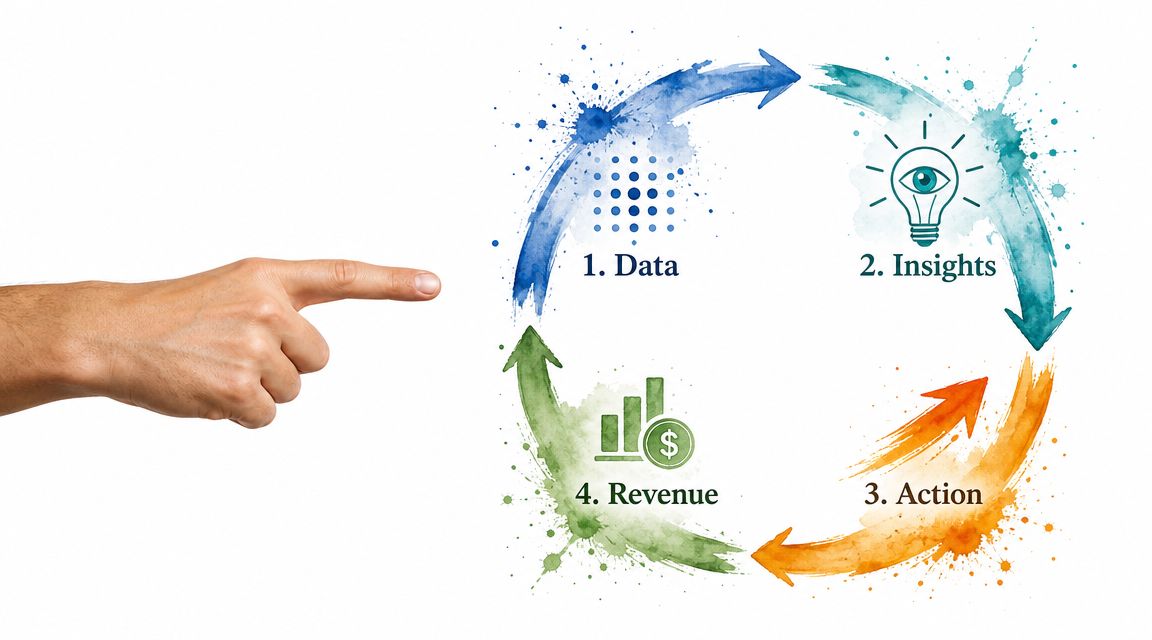
Step 1 Audit the real friction
A single site-wide conversion rate hides the problem more often than it reveals it.
You need to break performance apart by segment. Paid social traffic behaves differently from branded search traffic. Mobile visitors hit different obstacles than desktop users. New visitors need more proof than returning visitors. If you lump them together, you miss the leak and keep spending into it.
Start by reviewing drop-off points across:
- Device: Mobile users often abandon forms that desktop users can finish.
- Traffic source: Paid clicks often fail because the landing page does not match the promise in the ad.
- Visitor type: New visitors hesitate when trust is weak. Returning visitors hesitate when the next step feels slow or unclear.
Then connect behavior to business outcomes. If you cannot tie the visit, the conversion event, and the sales result together, your testing program is guesswork. A clear marketing attribution model should drive CRO priorities, and that only works when your site, CRM, and follow-up systems share the same picture of the buyer.
Step 2 Write a useful hypothesis
Weak hypotheses produce useless tests.
“Improve the page” is not a hypothesis. “Reduce mobile form fields from seven to four so more high-intent visitors request a quote and sales gets more qualified conversations” is a hypothesis.
A strong hypothesis includes three parts:
- The audience: Who is hitting the problem.
- The friction: What is stopping them from taking the next step.
- The business outcome: What should improve if you remove that friction.
If the expected outcome is only “more conversions,” the hypothesis is still too soft. Tie it to pipeline quality, close rate, or booked revenue.
Step 3 Test with control
Sloppy testing wastes traffic.
If you rewrite the headline, shorten the form, change the layout, swap the offer, and add a popup all at once, you learn nothing. You might get more leads, but you will not know what caused the lift or whether those leads were worth anything once sales touched them.
Controlled testing fixes that. Change one meaningful variable at a time. Keep the rest stable. Judge the result by conversion quality and downstream revenue, not just lead volume.
The right question is simple: which specific change improved buyer behavior and produced more revenue?
Step 4 Analyze and iterate
Every test should end with a decision, not a slide deck.
You will get one of three outcomes:
- Clear win: Keep it, document why it worked, and apply the lesson to similar pages or campaigns.
- Clear loss: Remove it, record what failed, and stop repeating the same bad idea elsewhere.
- Mixed result: Review the segments. A change that hurts low-intent traffic might still improve qualified leads.
Weak tech stacks often break the process. If your CRM is missing source data, your follow-up is inconsistent, or your reputation signals are hurting trust after the click, your CRO analysis will point at the wrong problem. Real optimization does not stop at the page. It connects spend, on-site behavior, lead handling, and customer trust into one system that gets sharper every time you run it.
Beyond A/B Testing Where to Focus Your CRO Efforts
A/B testing gets too much credit.
If the offer is unclear, the buying path is annoying, or the page feels untrustworthy, testing headline variations will not fix the underlying problem. It will only help you lose money with more confidence. The highest-return CRO work usually sits in three areas: friction, value clarity, and trust.
Fix friction before you test creative
Prospects drop when the next step feels harder than the outcome is worth. That happens fast, especially on mobile and high-intent pages where buyers expect speed.
Common friction points include:
- Clunky forms: Too many fields before the buyer is ready.
- Mobile issues: Small tap targets, awkward spacing, slow load times, or broken form behavior.
- Checkout or booking drag: Extra steps, unclear instructions, or weak next-step cues.
- Message mismatch: The ad promises one thing, the page delivers something else.
Founders often blame the offer first. That is a mistake. A strong offer can still underperform if the path to claim it feels confusing, slow, or risky.
Clarify value in seconds
Buyers should not have to decode your page.
They need immediate answers to three questions:
| Question in the buyer's head | What your page must answer |
|---|---|
| What is this? | The offer and the outcome |
| Why should I care? | The problem you solve and the result you create |
| Why should I trust you? | Proof, credibility, and customer evidence |
Clear pages beat clever pages. Strong CRO usually looks boring to creative teams because it removes ambiguity, sharpens the promise, and makes the next step obvious.
Trust drives more revenue than cosmetic tests
Weak CRO programs fail by optimizing layout and ignoring believability.
Buyers do not convert because a button looks nice. They convert because the claim feels credible, the risk feels manageable, and the business looks real. Reviews, testimonials, before-and-after examples, case evidence, and visible customer outcomes belong near forms, pricing, quote requests, and purchase steps.
Prioritize trust builders that support action:
- Place proof at decision points: Put reviews, ratings, and testimonials next to forms, pricing, and checkout actions.
- Use real customer language: Plain buyer language beats polished brand copy.
- Strengthen high-intent pages first: Service pages, product pages, and quote pages deserve your best proof.
- Use proof that matches the promise: If you claim speed, show delivery speed. If you claim ROI, show customer results.
If visitors hesitate, ask a harder question. Is the page easy to use, and is the claim strong enough to believe?
If you already have strong customer stories, videos for advertising can reinforce proof and explain value faster than static copy alone. Use them to reduce doubt and support conversion. Do not use them as decoration.
Good CRO work goes beyond page edits. It aligns the promise in your ads, the experience on the page, and the follow-up after the form. If those parts are disconnected, test results will look inconsistent because the revenue system is inconsistent.
The Growth-Tech Advantage Your Old Agency Was Missing
Most CRO initiatives fail for a dull reason. They stop at the website.
The page gets redesigned. The form gets shorter. Conversion rate improves. Everyone pats themselves on the back. Then nobody can answer the question that matters most: Did those conversions turn into revenue?
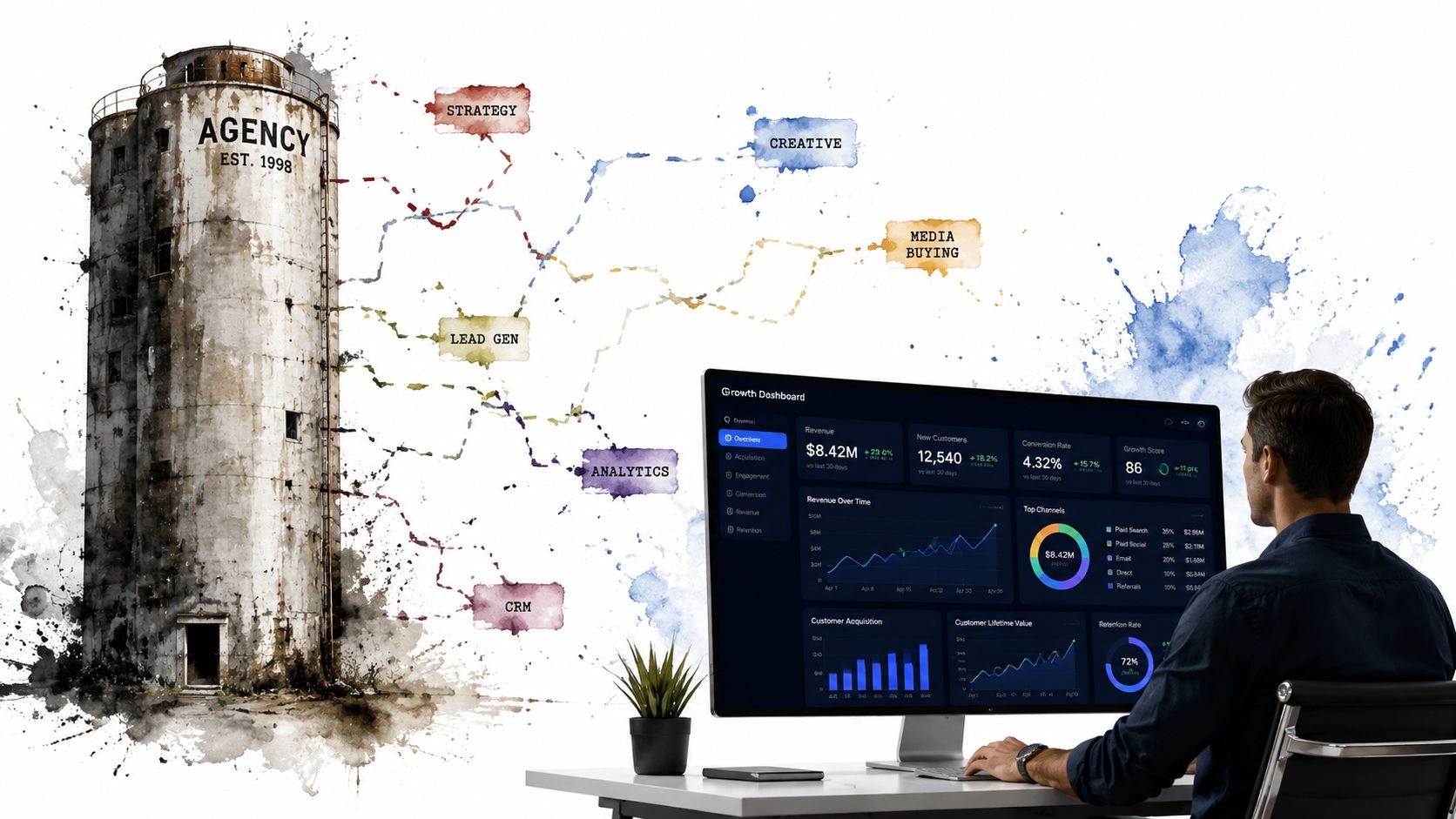
Why siloed CRO breaks
A disconnected setup creates predictable blind spots:
- Lead without outcome: Marketing reports form fills, but sales knows half of them went nowhere.
- Traffic without follow-up: Visitors convert, then sit in a slow or messy pipeline.
- Proof without system: Reviews and customer feedback exist, but nobody operationalizes them across high-intent pages.
That's the old agency model. Drive traffic. report activity. blame sales when revenue doesn't show up.
A real growth system doesn't stop at the click or the form submission. It connects acquisition, conversion, follow-up, and reputation into one operating model.
CRO needs a full-funnel stack
If you want conversion optimization to affect the bottom line, you need infrastructure that does three jobs well.
First, track the source. You need to know which campaigns and messages produce qualified demand.
Second, manage the handoff. A lead that enters a weak follow-up process is just another leak in the funnel.
Third, build trust continuously. Reputation isn't a side project. It's conversion fuel. The strongest pages often win because they show clear customer proof at the moment the buyer needs reassurance.
What founders should demand instead
When you evaluate a partner, don't ask whether they “do CRO.” Everyone says they do.
Ask these questions:
- Can you connect ad spend to actual customer outcomes?
- Can you improve trust signals, not just page layout?
- Can you close the loop between marketing, sales, and reputation?
If the answer is no, then they're not running conversion optimization. They're decorating a funnel.
That's why the future of CRO isn't a bag of isolated tactics. It's a revenue discipline supported by an integrated CRM and reputation system that turns marketing activity into measurable business performance.
Stop Renting Traffic Start Owning Your Growth
Most businesses rent growth. They buy attention month after month and hope enough of it sticks.
That works for a while, until costs rise, competition tightens, and your funnel starts exposing every weak link in the customer experience. Then the old playbook breaks.
Conversion rate optimization is how you stop renting traffic and start owning your growth. It forces you to improve the economics of the traffic you already earned. It pushes your team to diagnose friction, sharpen value, build trust, and fix follow-up instead of hiding behind top-line metrics.
The shift that matters
Founders who scale well usually make three mindset changes:
- From campaigns to systems: They stop treating each ad launch like a lottery ticket.
- From clicks to revenue: They judge marketing by business outcomes.
- From isolated tactics to connected operations: They align website experience, lead handling, and reputation.
That last point matters more than is often acknowledged. A better landing page helps. A connected operating system helps more. If your follow-up is weak or your trust signals are thin, the funnel still leaks.
One of the clearest ways to support that handoff is with a strong marketing automation workflow. Not because automation is trendy, but because speed, consistency, and accountability are what keep leads from going cold.
The businesses that win don't just buy demand. They build a machine that converts demand into revenue.
If you're tired of guessing, stop asking how to get more traffic. Start asking why your existing traffic isn't producing enough money.
The Advertising Suite helps businesses turn paid traffic into measurable revenue with a growth-tech hybrid model built for the full funnel. That means strategy, execution, CRM visibility, and reputation management working together instead of fighting each other. If you want a partner that operates like an extension of your team, request a demo with The Advertising Suite or explore the Membership for a 25% discount on services plus access to the proprietary CRM and review management software.