Most omnichannel advice gets this backwards. Founders are told to add more channels, buy more software, and call it strategy, even though customers don't care how many icons you support. They care whether they can start on one channel and finish on another without repeating themselves, losing context, or getting bounced between teams.
That's the omni channel customer experience problem. It's not channel count. It's continuity, and continuity only matters when it's tied to the journeys that drive revenue.
If you've been burned by agencies chasing vanity metrics, be blunt about this: a bigger channel footprint with broken handoffs is just a more expensive mess. The better move is to prioritize the few cross-channel journeys that matter most, then build the stack around them. That's the playbook here.
Why Most Omnichannel Programs Stall Before They Start
Most programs fail because teams confuse presence with integration. They launch chat, SMS, social, email, and maybe a loyalty app, then celebrate the added surface area while the customer still has to repeat the same issue three times. That's not omnichannel, that's channel sprawl with better branding.
The customer doesn't experience your org chart. They experience friction. And the clearest sign of friction is when the story changes every time the customer switches from Instagram to email to support.
Continuity beats channel count
A strong omnichannel customer experience means the conversation carries across touchpoints with context intact, not just that the brand shows up in a lot of places. Research summarized in the brief says customers expect consistent interactions regardless of channel, and retail shoppers increasingly see themselves as omnichannel buyers. The practical lesson is simple, the journey must feel continuous or it's already broken.
Practical rule: If the customer has to restate the problem after a channel switch, your system failed, even if every channel looked “active.”
That's why prioritization matters. Not every touchpoint deserves full integration on day one. The journeys worth fixing first are the ones that combine high customer importance with high multi-channel usage, because that's where continuity has the biggest revenue effect. McKinsey's guidance is clear on this point, focus on the top-right quadrant instead of trying to unify every touchpoint at once (McKinsey on focusing omnichannel efforts where it matters).
The job is to remove repeat work
Siloed systems make customers repeat themselves, and repetition kills trust. It also creates internal drag, because agents spend time hunting for context instead of resolving the issue. In plain English, the business is paying for customer frustration twice, once in lost revenue, and again in wasted labor.
If your current plan starts with “what channels should we add,” stop. Start with “which journeys do customers already use across channels, and which ones directly affect conversion, retention, or support cost.” That question changes the entire build.
The Five Building Blocks of a Real Omni Channel Customer Experience
A real omni channel customer experience stack is not a pile of apps. It's a system that keeps context alive from first touch to final resolution. If any layer is missing, the customer feels it immediately, even if your internal dashboards look busy.
Start with one customer record
The foundation is a unified customer record. Behavioral, transactional, and interaction signals need to live together so the business can recognize the same person whether they arrive from web, email, support, or paid media. That's what keeps the journey from fragmenting into disconnected mini-conversations.
A useful restaurant analogy makes this obvious. The kitchen is your data layer, it holds the order correctly. The waitstaff is your orchestration layer, it passes the order to the right place. The menu is your personalization layer, it shapes the recommendation. The receipt and review card are your measurement layer, they tell you whether the experience worked.
Add orchestration before you add more channels
Once the record exists, route by intent and context. A customer asking about an order update shouldn't be treated the same as a customer who's still deciding what to buy. The system should move them to the right place without forcing them to explain themselves again.
Build personalization on top of context
Personalization without shared data is just guesswork. With a unified record, the business can keep pricing, product information, transaction status, and fulfillment aligned across touchpoints, which is exactly where channel integration influences the customer experience most directly. A 2024 study found that integrating pricing and product information, transaction information, and order fulfillment significantly improves the affective and cognitive experience of omnichannel customers, while promotion integration affects relational and sensorial experience (channel integration study).
Learn how unified customer profiles support continuity
Close the loop with journey measurement
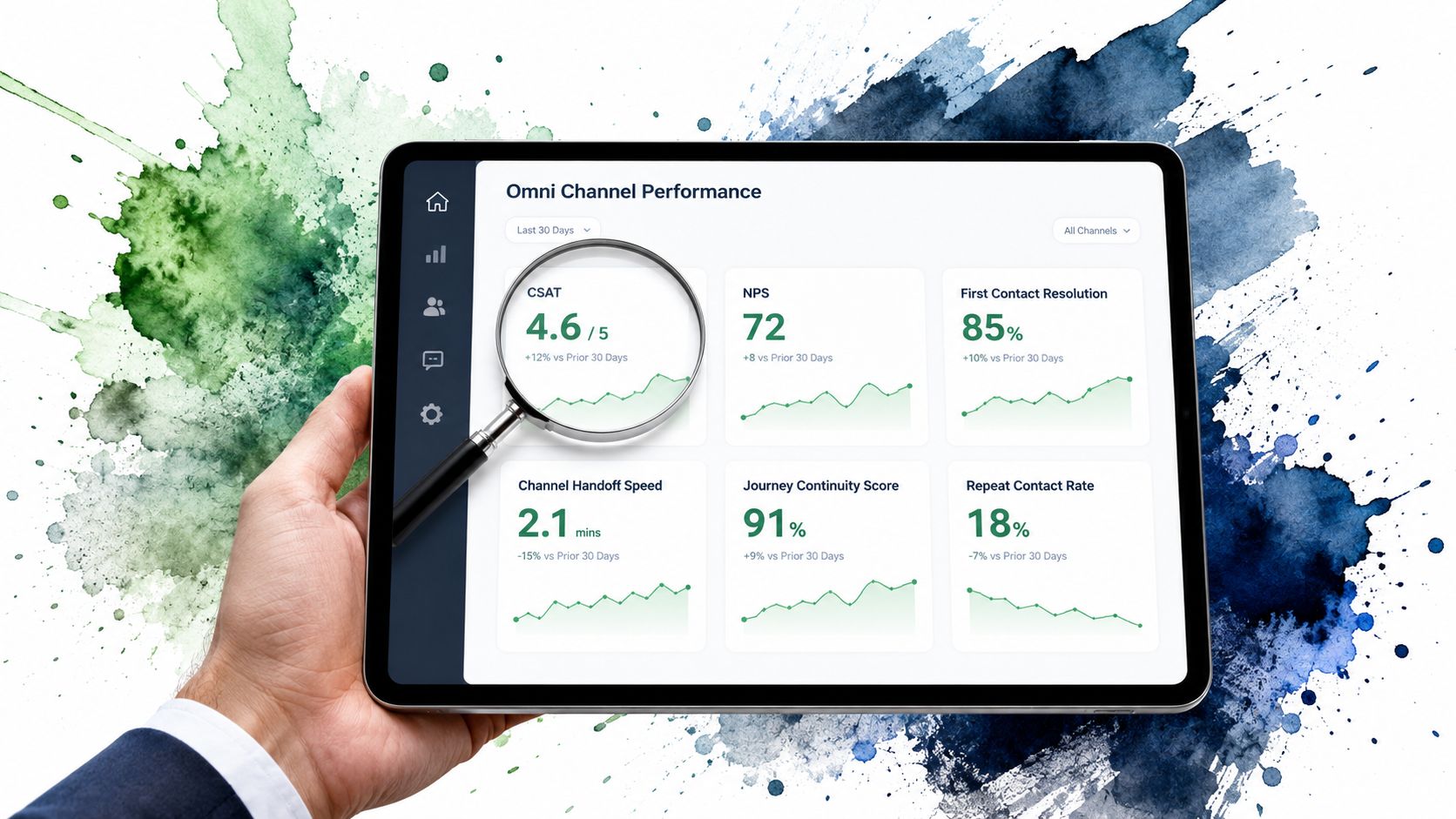
The last layer is measurement, and it can't stop at campaign metrics. If the customer journey breaks in handoff, the dashboard needs to expose that. That means measuring completion, repeat contact, transfer quality, and synchronization, not just clicks and open rates. The stack is only “real” when it proves the journey survived the switch.
The KPIs That Actually Prove Omnichannel Is Working
Many organizations track the easy stuff because it looks tidy in a monthly report. CSAT and NPS are fine as sentiment checks, but they won't tell you where the experience is breaking. If you want proof, measure the system itself.

Track the handoff, not just the headline score
Use customer journey completion rate to see whether people finish what they started. Use repeat-contact rate to catch situations where a customer had to come back because the first interaction didn't resolve the issue. Use cross-channel resolution time to see whether your team can solve problems without forcing a reset.
Those three metrics tell you whether continuity is real or imagined. If completion is up and repeat contact is down, the system is getting cleaner. If the numbers move the other way, the customer is carrying the cost of your internal silos.
Watch the technical layer directly
The rest of the scorecard should include transfer quality, integration success rate, and data synchronization accuracy. Transfer quality tells you whether the handoff preserved the customer's context. Integration success rate tells you whether the systems are connected the way your team thinks they are. Data synchronization accuracy tells you whether the record is current enough to be useful.
A dashboard that blends containment, satisfaction, and resolution by channel is harder to build, but it's the only one worth trusting.
That's the point the better guidance keeps making, report the journey in one place instead of reconciling separate dashboards after the fact. The moment support, marketing, and operations are looking at different versions of truth, the customer experience starts slipping between cracks. Recent guidance on omnichannel measurement argues for unified reporting across CSAT, containment, and resolution by channel, especially as AI changes how service gets handled (Zoom on omnichannel customer experience measurement).
Don't measure what's convenient
A smooth omnichannel program should show up in the numbers that reflect actual customer effort. That means fewer recontacts, fewer failed transfers, and cleaner synchronization. If the only thing improving is campaign traffic, you've built a prettier dashboard, not a better experience.
See how attribution and journey measurement connect
A 90-Day Implementation Roadmap for SMBs and E-Commerce
The fastest way to waste money is to try to build everything at once. SMBs don't need an enterprise science project. They need a sequence that protects cash flow, reduces risk, and gets the first revenue-critical journeys under control.
Days 1 to 30, choose the journeys worth fixing first
Start by mapping the journeys that already drive the most money or the most service load. Then rank them by two filters, customer importance and multi-channel usage. The ones that sit in the top-right quadrant are the first candidates for true omnichannel treatment.
A lot of teams get lazy. They pick the noisiest channel instead of the most valuable journey. Don't do that. If a journey doesn't move revenue or retention, it doesn't deserve first-priority engineering attention.
A good 30-day output is a short list, not a giant roadmap. You want clarity on which journeys need continuity, where customers switch channels, and which breakpoints create repeat work.
Days 31 to 60, assemble the minimum viable stack
Once the journeys are chosen, build the smallest stack that can support them. At minimum, that means a CRM as the customer record, a messaging layer for real-time interactions, a reputation layer for service-based businesses, and connectors that keep the whole thing synchronized. For e-commerce teams, the stack also has to talk cleanly to email flows and order status so service doesn't drift away from commerce.
Use this CRM and automation integration guide as a practical reference
This stage is about removing the excuse that “the tools don't talk to each other.” If they don't talk, the customer pays for it. If they do talk, the team gets context fast enough to act on it.
Days 61 to 90, orchestrate and test
Now the business can start routing based on intent, personalizing based on behavior, and measuring whether the journey improved. Don't launch five experiments at once. Pick one or two high-value flows and test whether context survives the switch.
Exit criteria matter here. Move on only when the chosen journeys are integrated, the team can see the shared record, and the first measurement cycle shows the data is trustworthy. If the record is still messy, don't pretend orchestration will fix it. It won't.
Connecting the Stack to Revenue With CRM, Reviews, and CRO
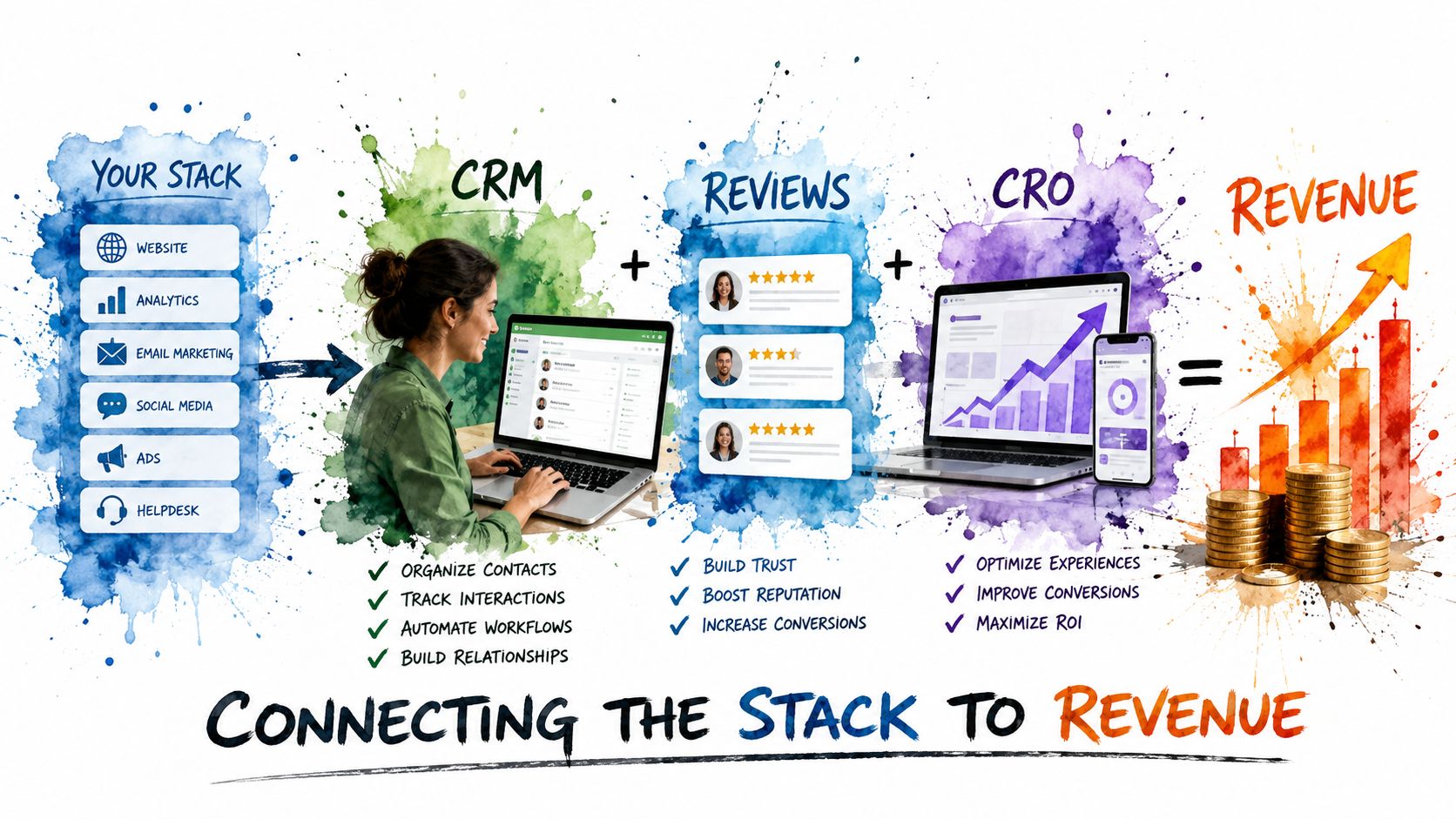
Omnichannel earns its keep when the stack drives revenue, not when it makes operations look tidy. A unified CRM, reputation management, and conversion rate optimization belong in the same revenue conversation because they all touch the same leak points. If the journey feels smooth but the offer still underperforms, the business is still bleeding money.
CRM turns interaction history into revenue context
CRM is where customer history becomes useful. It lets the business segment by behavior, prior purchase, service history, and engagement pattern, so paid and owned channels stop blasting the same generic message at everyone.
Retention compounds when the record is clean. Strong omnichannel programs are associated with 89% customer retention, while weak omnichannel engagement sits at 33% (omnichannel customer support statistics). That gap is the point. Continuity changes whether customers come back.
Reviews feed ad creative and service priorities
Reputation data should not live off to the side. It should shape ad copy, service priorities, and the way objections get handled. If the same complaint keeps showing up in feedback, that is a product or process problem showing up in marketing clothes.
See how CRM and email integration support the revenue loop
CRO closes the leaks the stack exposes
Once the journey is visible, CRO finds the friction that still blocks conversion. Better handoffs do not save a pricing page that confuses buyers, a checkout flow that drops intent, or a support process that reacts too late. Omnichannel without measurement is plumbing. Measurement without optimization is reporting.
Service economics make the case harder to ignore. The brief's data says self-service can cost roughly $0.10 to $0.25 per resolution, while phone support costs about $8 to $12 per contact, and integrated omnichannel solutions can reduce first-resolution times and wait times versus siloed operations (support economics and resolution data, omnichannel support performance data). Cleaner operations matter, but better targeting is what drives revenue. The stack should reduce friction, improve conversion, and protect margin at the same time.
What Good Omnichannel Execution Looks Like in Practice
A mid-market e-commerce brand with a Shopify storefront, Meta and Google ads, and email flows usually does not need a giant transformation. It needs three revenue-critical journeys cleaned up, first-time buyer conversion, abandoned cart recovery, and post-purchase support. Once those are stable, the rest of the experience gets easier to manage.
The customer story becomes one record
A healthy setup lets the shopper click an ad, browse a product, ask a question, and later receive a follow-up without the team acting blind. The CRM ties the paid audience, site behavior, email engagement, and support history into one view. That stops the brand from treating each touchpoint like a separate universe.
After the first 90 days, the dashboard should show whether customers are finishing more journeys, coming back less often for the same issue, and moving through channels without the support team losing context. The hard proof is not “we added SMS.” The proof is that the handoff stopped breaking.
The improvement shows up in service and loyalty
The brief makes the direction clear. Customers using multiple channels in a smooth support journey can reach 67% CSAT, compared with 28% for disconnected multichannel support (support CSAT comparison). As noted earlier, integrated omnichannel setups also improve first-resolution times and customer wait times versus siloed operations, which is the part that changes how customers feel after a problem.
That is what good execution looks like. The customer gets continuity, the support team gets context, and the business gets fewer repeat contacts.
The founder view is simpler than the agency pitch
A founder does not need a fancy narrative here. They need fewer handoffs, cleaner data, and better revenue from the journeys that matter. Anything else is decoration. Good omnichannel execution improves the one thing agencies love to avoid discussing, margin.
The Five Pitfalls That Kill Omnichannel ROI
Omnichannel budgets disappear fastest when vanity logic drives the build. Teams add another channel, then act surprised when the customer still complains. The problem is usually simple, the system looks busy, but the experience still feels split.
Silo thinking
When marketing, sales, and support each keep their own version of the customer, the experience breaks apart. Set shared customer records and shared handoff rules before you add more touchpoints. Otherwise, every new channel just gives the team another place to lose context.
Vanity KPI obsession
If your team keeps celebrating impressions, clicks, or opens while repeat contacts stay high, you are measuring theater. Replace those dashboards with journey-integrity metrics and make them the scoreboard. That forces the conversation back to what matters, whether customers finish the journey, return less often with the same issue, and move between channels without friction.
Dirty data
Bad data kills personalization and breaks routing. If contact details, order records, or status fields drift out of sync, customers read that as incompetence. Clean the record before you automate harder. A broken database does not become a better customer experience because you added more workflows.
Enterprise copycatting
A small or mid-sized business does not need an enterprise architecture with enterprise overhead. It needs a focused build around the journeys that drive revenue. Copying a giant company's playbook usually creates complexity before it creates value, and that complexity shows up in slower handoffs, more manual fixes, and more internal debate.
Ignoring support
Support is part of the experience, not a separate department. If service does not share the same customer context as marketing and commerce, the brand keeps leaking trust after the sale. That is where revenue slips away, because unresolved issues, repeated explanations, and poor follow-up turn one bad moment into a lost customer.
If you want to judge the cost of those leaks, start with contribution margin analysis.
Turning the Playbook Into a Predictable Profit Center
The playbook is straightforward. First, prioritize the journeys that matter. Second, unify the stack around those journeys. Third, measure what moves revenue, not what merely looks active. That's the difference between omnichannel as a tech project and omnichannel as an operating model.
If you want that operating model without turning your team into system integrators, The Advertising Suite is built for exactly that. The combination of a built-in CRM, reputation management software, and revenue-first execution is designed to keep continuity, measurement, and growth connected instead of scattered. The Membership Loop also gives a 25% discount on services and provides access to the proprietary CRM, which makes the whole setup easier to sustain.
Use this as your filter when you review your own stack, does it help you resolve faster, recover cleaner, and convert better? If it doesn't, it's not helping the business, it's just adding noise. For a sharper view of what's leaking and where the margin is being lost, start with contribution margin analysis.
If you want a partner that treats omnichannel as a revenue system, not a buzzword, The Advertising Suite can help you map the journeys that matter, unify the stack, and measure the result without the vanity-metric theater. Book a growth consult, or explore the Membership if you want the CRM and reputation software working as an extension of your team.