You're probably staring at ad results that look busy but don't feel profitable. Clicks are coming in, maybe even leads, but the messaging is too generic to achieve its primary purpose, which is to move the right person from curiosity to action without wasting spend. That's where copywriting in advertising earns its keep, because the words aren't decoration, they're the mechanism that turns attention into revenue.
At its best, copywriting is a disciplined way to persuade a specific audience to take a specific action, not just a way to sound polished. That matters because the market rewards message precision, not cleverness for its own sake, and small wording changes can create outsized shifts in engagement and conversion. The practical question isn't whether your ads sound good, it's whether they're built to convert the next qualified buyer.
What Is Copywriting in Advertising Really
Copywriting in advertising is persuasive text built to move someone toward a measurable action. In plain terms, it's the message work that makes ad spend worth paying for, because the copy has to earn the click, the lead, the booking, or the sale. That's different from brand writing that only tries to sound impressive or memorable.
The standard definition backs this up, copywriting is persuasive text written for advertising or other marketing purposes, and it's meant to persuade a person or group to take a particular action rather than merely inform them Wikipedia's definition of copywriting. The revenue-first lens is more useful, though. Good ad copy doesn't just describe an offer, it shapes intent, reduces doubt, and creates a reason to act now.
Why revenue beats vanity
A lot of underperforming campaigns fail for a simple reason, the copy was written to be broad enough for everyone and useful enough for no one. That's how you get vague promises, fuzzy positioning, and “brand voice” that sounds nice but doesn't move a buyer. In practice, the best ad copy is narrow, specific, and tied to an outcome the audience already wants.
One useful internal lens is to ask whether the ad is doing three jobs at once.
- Attracting the right person. The copy should speak to the exact problem, offer, or moment that matters.
- Creating belief. The message needs proof, specificity, or mechanism so it doesn't feel like another empty pitch.
- Triggering action. A clear next step has to be obvious, because confused users don't convert.
Practical rule: if the copy sounds like it could be pasted onto any competitor's ad, it's too weak to carry budget.
That's why a revenue-first approach beats slogan-first writing. The best campaigns don't ask, “Does this sound clever?” They ask, “Does this make the right buyer act?”
The Advertising Suite's broader perspective on persuasive messaging fits here, because strong ad copy is never isolated from strategy. It should connect to the promise, the proof, and the next step in a way that feels coherent to the buyer and measurable to the team. See the related thinking on persuasive techniques of advertising.
How Copy Fuels Every Stage of the Conversion Funnel
A buyer doesn't read your ad in a vacuum. They encounter it at a specific point in their journey, and the copy has to match that stage or the budget leaks out through friction. Picture a salesperson walking someone through a store, not shouting the same line from the doorway, the aisle, and the checkout counter.
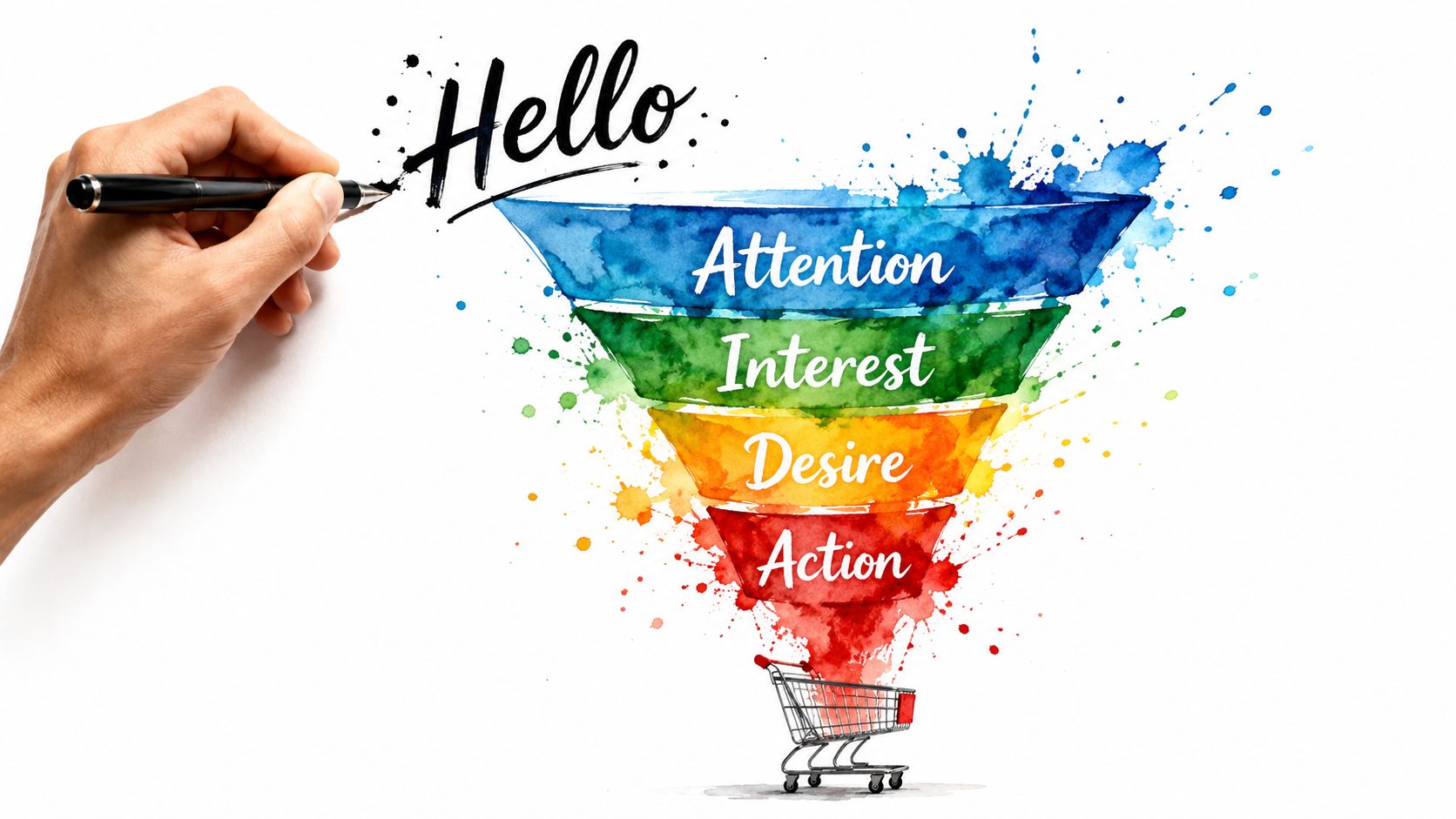
Top, middle, and bottom need different words
At the top of the funnel, copy has one job, stop the scroll. That means the hook needs to be sharp, relevant, and easy to understand fast. If the audience doesn't recognize themselves in the first line, they're gone.
In the middle of the funnel, copy shifts into explanation and reassurance. The reader is no longer asking only, “What is this?” They're asking, “Why this one, and why should I believe it?” That's where proof, clarity, and objection handling matter more than hype.
At the bottom of the funnel, copy should make the action feel simple. The CTA has to be obvious, and the page should remove as much uncertainty as possible. A strong offer can still stall if the final words are vague or overloaded with options.
If the stage is wrong, the message is wrong. Broad awareness copy used on high-intent traffic feels shallow, while aggressive close-the-deal copy used too early feels pushy.
The cleanest way to think about this is:
- Attention. Use a relevant hook that makes the right person pause.
- Interest. Explain the problem or opportunity in terms they already recognize.
- Desire. Show why your solution is the better fit.
- Action. Tell them exactly what to do next.
The conversion funnel analysis framework becomes especially useful once campaigns start scaling, because it exposes where the message is doing its job and where it's creating drag. When copy matches the funnel stage, the ad feels natural. When it doesn't, the user feels like they've been handed the wrong conversation.
Battle-Tested Copywriting Frameworks That Convert
The fastest way to write better ads is not to stare at a blank page longer. It's to use a structure that forces clarity. The best frameworks don't make copy rigid, they keep the message from wandering into vague, self-congratulatory nonsense.
AIDA PAS and FAB in practice
AIDA organizes persuasion in sequence, Attention, Interest, Desire, Action. It's useful when the ad needs a complete arc, especially for messages that have to carry a cold audience from curiosity to commitment. A practical template looks like this, [attention-grabbing hook], [interest-building context], [desire-driven proof], [action CTA].
PAS is sharper when the audience already feels a pain point. Start with the Problem, enlarge the cost of staying stuck by Agitating it, then Solve it with a specific offer. A simple working template is, [problem the buyer already knows], [what happens if it stays unresolved], [your clear answer].
FAB translates features into buyer value. The Feature is what something is, the Advantage is why that matters compared with an alternative, and the Benefit is the outcome the customer gets FAB framework guide. If the feature is “same-day service,” the advantage might be speed over delayed scheduling, and the benefit is less downtime or fewer missed opportunities.
Useful distinction: a feature describes the thing, a benefit describes the result, and ads convert more cleanly when the result is what leads the sentence.
The primary value of these frameworks is that they force prioritization. You don't need to say everything. You need to say the one thing that moves the buyer forward.
A few practical guardrails make them work better:
- Use one core angle. Don't stack three different stories into one ad.
- Lead with the buyer's world. The copy should start where they already are, not where you wish they were.
- End with one action. Multiple CTAs dilute the pressure to respond.
The point isn't to memorize formulas. It's to use them as drafting tools so the ad has a clear persuasive spine.
Ad Copy Examples Good Bad and Profitable
Weak ad copy usually fails in familiar ways. It leans on generic praise, hides the offer, and asks the reader to do too much work. Strong copy does the opposite, it names the outcome, tightens the wording, and gives the buyer a reason to act now.
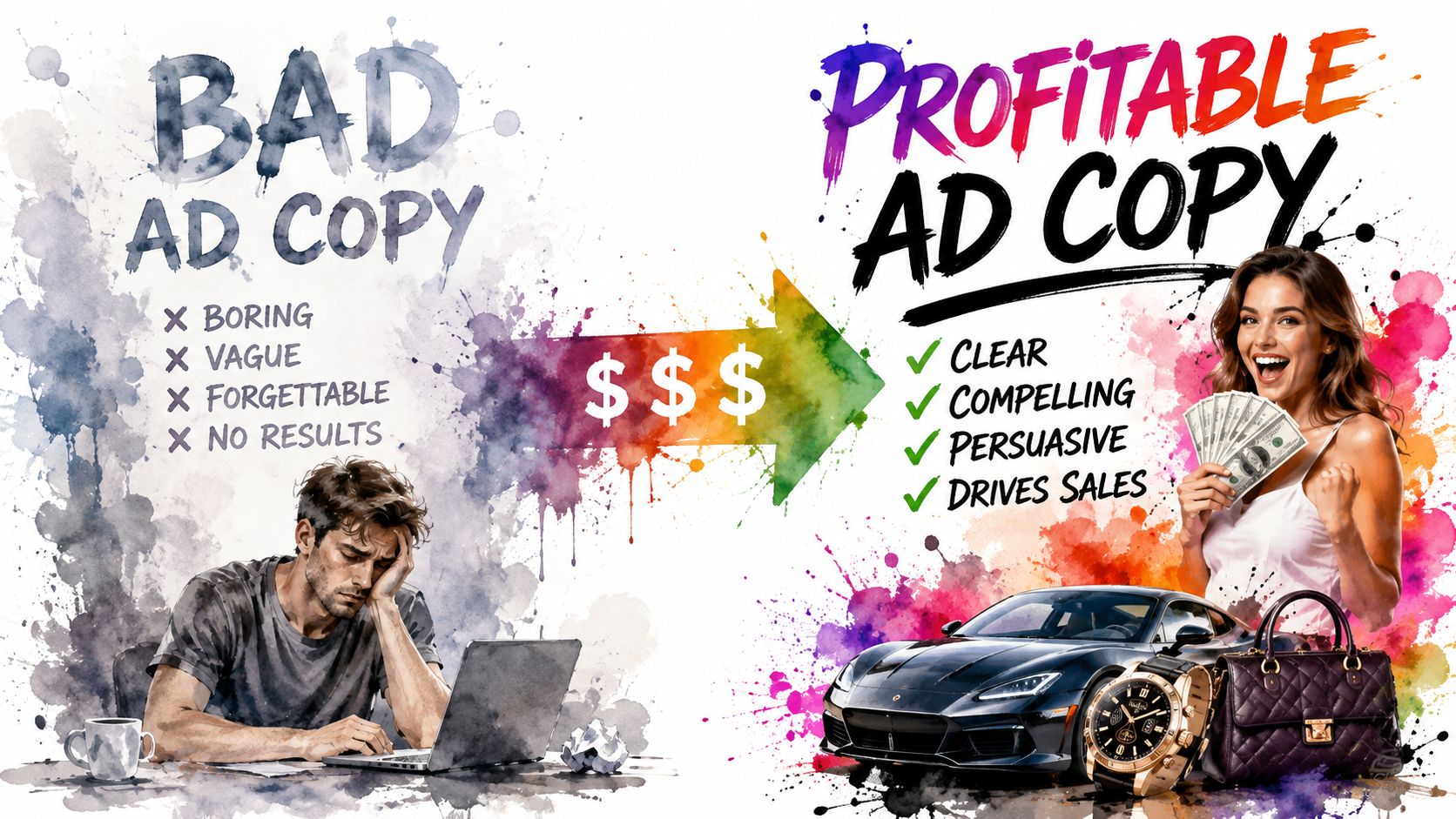
Before and after in plain language
Weak version:
“We're an expert team providing quality service for businesses that want better results. Contact us today for help with your marketing needs.”
Stronger version:
“Need more qualified leads from your ads? Get clear messaging, one strong CTA, and a landing page that matches the offer. Book a growth consult.”
The first version sounds safe, but it says almost nothing. “Expert,” “quality,” and “better results” are filler words, not proof. The second version names the pain point, states the mechanism, and makes the action obvious.
That's where specificity changes the game. Guidance on persuasive ad copy consistently recommends replacing vague descriptors like “fast,” “experienced,” or “trusted” with verifiable detail, because specific claims sound more credible than polished generalities best practices for ad copywriting. Falsifiability matters too, claims should be written so they can be proven true or false, using numbers, dates, and concrete evidence instead of mushy praise Harry Dry's copywriting rules.
The practical test is simple. If the sentence can't be challenged, it probably can't be trusted. If it can't be trusted, it won't carry the click.
Personalization also matters at the micro level. Personalized calls to action are reported to be 202% more effective than standard CTAs, and ads with 1 to 15 words have been reported to perform 50% better than longer ads copywriting statistics. That doesn't mean every ad should be tiny. It means the best ad copy respects attention span and removes waste.
For a quick rewrite pass, use this filter:
- Remove filler. Delete anything that sounds like a brochure.
- Add one concrete proof point. Even a small one is better than none.
- Shorten the CTA. Make the next step feel easy, not ceremonial.
The ad copy example guide is useful as a mental model here, because profitable copy usually looks less dramatic and more precise than people expect. That's the point. Precision sells better than performance.
Adapting Your Copy for Google Meta and Display Ads
One message won't work everywhere. Google, Meta, and Display each reward a different style of persuasion, and copying the same ad text across all three is a fast way to flatten performance. The channel is part of the message, whether the team wants to admit it or not.
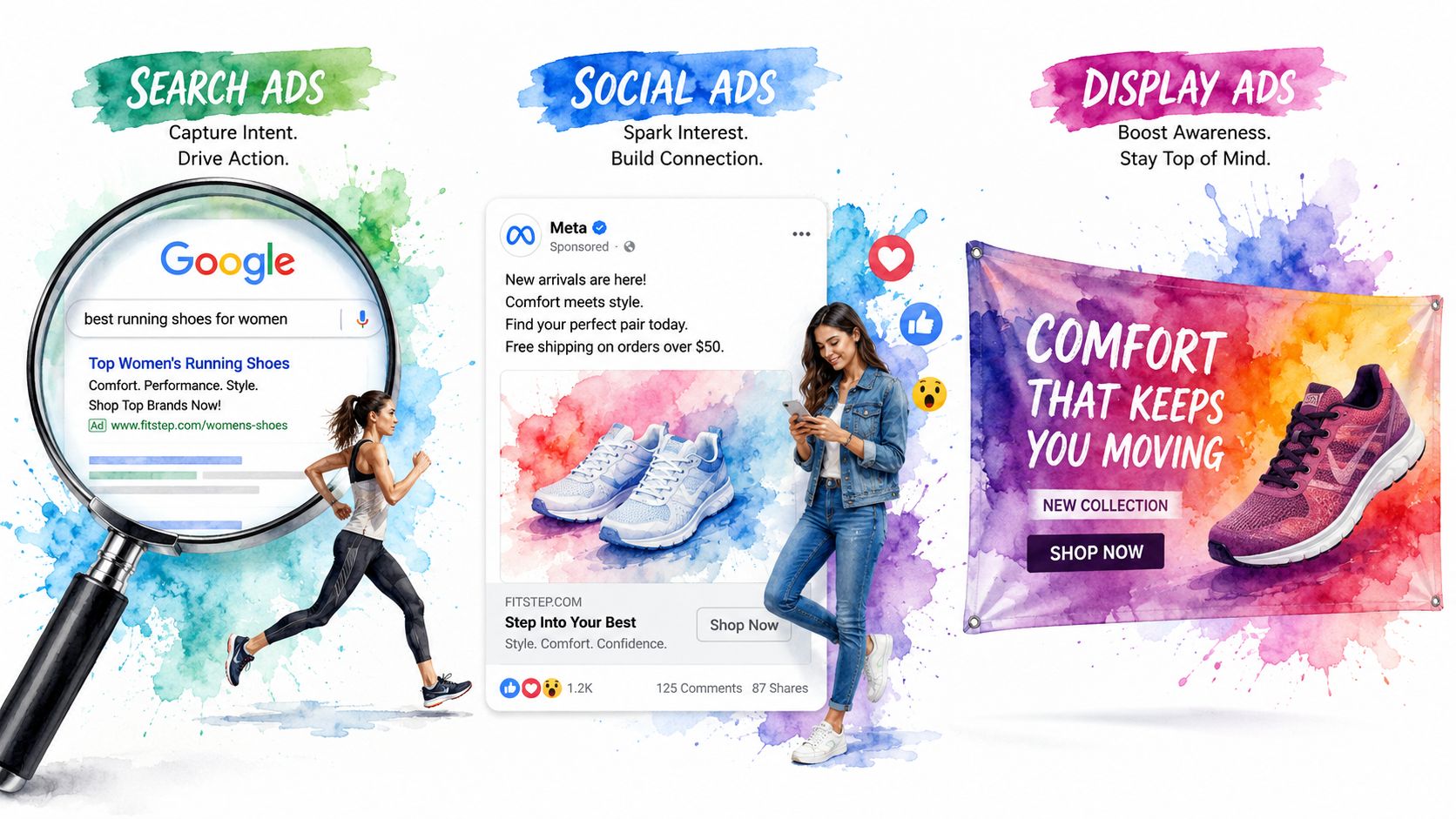
Search social and display each ask for something different
Google Ads is intent-driven. The searcher is already expressing a need, so the copy should mirror that need as closely as possible. That means headline alignment, keyword relevance, and a direct promise that feels like the obvious next click.
Meta Ads is interruption-driven. People aren't actively searching for you, so the copy has to earn attention with a strong hook, an angle they haven't already seen, and a first line that feels relevant before the scroll moves on. Story-driven framing works better here than a stiff pitch.
Display Ads is awareness-driven. The text has less room, so every word has to support the visual and reinforce recognition, retargeting, or simple memory. Overwriting a display ad usually weakens it.
A few channel-level rules keep campaigns from turning into mush:
- Google. Match search intent, lead with the core term, and avoid clever detours.
- Meta. Test angles, pain points, and hooks quickly, because the first line has to interrupt behavior.
- Display. Keep it short, readable, and visually coherent with the creative.
AI can help here, but it doesn't solve the strategic part. It can accelerate volume testing of ad copy, yet it also increases the risk that advertisers converge on the same phrasing, which makes original framing more valuable in crowded markets AI and ad copy discussion. That's the trade-off. Speed goes up, sameness goes up too.
The strongest channel strategy uses AI for variation, not for identity. Human judgment still has to decide which angle actually sounds distinct enough to win attention.
The dynamic creative optimization approach is most useful when the team treats copy as a testing system. Don't ask whether one line is “best” in the abstract. Ask which line wins for this channel, this audience, and this stage of intent.
Measuring Copy Performance and Integrating with CRO
Good copy that isn't measured is just expensive writing. If the team can't trace the words to outcomes, the campaign turns into opinion theater, and opinion theater rarely pays the bills. The work only gets real when the copy is connected to conversion data.
Track the right signals
Clicks matter, but they don't tell the full story. A strong ad can get attention and still fail if the landing page confuses the buyer or the offer doesn't match what was promised. That's why copy has to be judged alongside downstream behavior, not in isolation.
The most important technical variable is message match, when the headline, body copy, and CTA all align with the landing page's promise, the ad reduces cognitive friction and increases conversion probability message match guidance. In practice, that means the ad and the page should use the same core promise, the same terminology, and the same proof path.
A simple measurement stack looks like this:
- Lead quality. Are the people responding a fit?
- Conversion rate. Does the message get the action you want?
- Cost per lead or acquisition. Is the copy helping the budget work harder?
- Downstream outcome. Did the lead become a customer, not just a form fill?
That's also where a connected CRM changes the game. When lead source, ad copy, and customer outcome live in one workflow, the team can see which messages create real opportunities and which ones just collect polite traffic. The ad isn't finished when the click happens. It's finished when the customer experience matches the promise.
Bottom line: copywriting and CRO are the same conversation at different points in the funnel. If the words don't align with the page, the system leaks.
The web conversion optimization framework becomes the natural next layer because it forces the team to fix the page, not just the ad. That's a significant advantage of treating copy as a performance lever. It gives the team a way to test messaging, diagnose friction, and improve the whole path to revenue.
Your Revenue-First Copywriting Checklist
Before any ad goes live, the copy should pass a fast, ruthless audit. If it doesn't, the budget is going to do free labor for the wrong people. Use this checklist to catch the usual leaks before they become expensive.
A practical preflight list
- Define one action. The ad should ask for one thing, not three.
- Lead with the benefit. The headline should state the result, not a bland feature list.
- Keep the stage clear. Match the wording to where the buyer is in the funnel.
- Check message match. The landing page should repeat the same promise and language.
- Use proof, not praise. Swap empty adjectives for concrete evidence where possible.
- Trim the excess. If a word doesn't move the buyer forward, cut it.
- Test one variable at a time. Change the hook, CTA, or angle, not everything at once.
- Track outcomes past the click. A lead only matters if it turns into pipeline or revenue.
The best copywriters don't just write ads. They build a tighter conversion system around them. That means the message, the page, and the follow-up all work together instead of fighting each other.
If you're tired of guessing which words will convert, treat copy as part of a broader growth process, not a creative side quest. The right partner should help shape the message, connect it to the customer journey, and make sure the numbers tell the truth.
If you want a team that treats ad copy as a revenue lever instead of a branding exercise, The Advertising Suite can help you tighten the message, improve message match, and connect your campaigns to the rest of the conversion system. Visit The Advertising Suite to book a Growth Consult and see how a growth-focused partner can plug into your team.