Most advice about market research for advertising gets the order wrong. It treats research like a nice-to-have discovery phase, then asks creative teams to somehow convert a stack of charts into revenue. That's backwards. If the research doesn't change message choice, channel mix, budget allocation, or measurement, it's just expensive note-taking.
The better approach is blunt: research should answer the exact decisions that move money. The market research industry itself has become large because companies are under pressure to make sharper calls before they spend media dollars, with the worldwide market valued at $67.5 billion in 2023 and projected to grow at a 7.4% CAGR from 2024 to 2032. In the U.S., the industry generated $25.3 billion in revenue in 2022, which tells you something simple, advertisers are buying intelligence because guesswork is costly (global market size and growth data).
Why Most Advertising Research Fails to Drive Revenue
A lot of advertising research misses the mark for the same reason a weak campaign does, it optimizes the wrong thing. Teams collect broad sentiment, assemble polished personas, and then wonder why performance does not change. If the work never shapes a real decision, like whether to shift spend, rewrite the offer, or stop targeting a weak segment, it will not improve revenue.
The deeper problem is that many teams treat research as a reporting exercise instead of an operating input. That gets more expensive when attention is fragmented, tracking is messy, and ad recall is weak. Recent industry data show 41% of U.S. survey respondents remember only 1% to 10% of ads they saw in the previous 24 hours, which is a blunt reminder that impressions are not the same thing as memory, and memory is not the same thing as demand (ad recall and tracking behavior data).
Vanity research versus decision research
The difference is straightforward. Vanity research tells you what sounds interesting. Decision research tells you what to do next. One produces decks. The other produces better campaigns.
Practical rule: if a research question does not change a media decision, a creative decision, or a measurement decision, do not field it.
That is why the most useful advertising research starts with a business problem, not a survey template. You are not asking people what they “like” in the abstract. You are asking which audience segment deserves a bigger budget, which message should get a live test, and which channel should get cut.
Research has to connect to revenue operations
Many teams break down here. They collect enough data to confirm the obvious, then hand it off without a decision framework. Strong research programs use the findings to shape budget pacing, creative iteration, and incrementality checks. Weak programs stop at description.
The operational mindset matters even more when privacy and ad blocking create blind spots. In North America, an estimated $24 billion in revenue was lost in 2024 to ad blocking alone, which makes it harder to rely on simplistic tracking or broad reach assumptions (ad blocking impact data). Research has to fill the gap, not decorate the slide deck.
If attribution already exists in your stack, the test is whether it changes spend decisions. Marketing attribution fundamentals matter only when they influence how media gets bought, not when they sit beside a dashboard.
Defining Research Objectives That Map to Ad Decisions
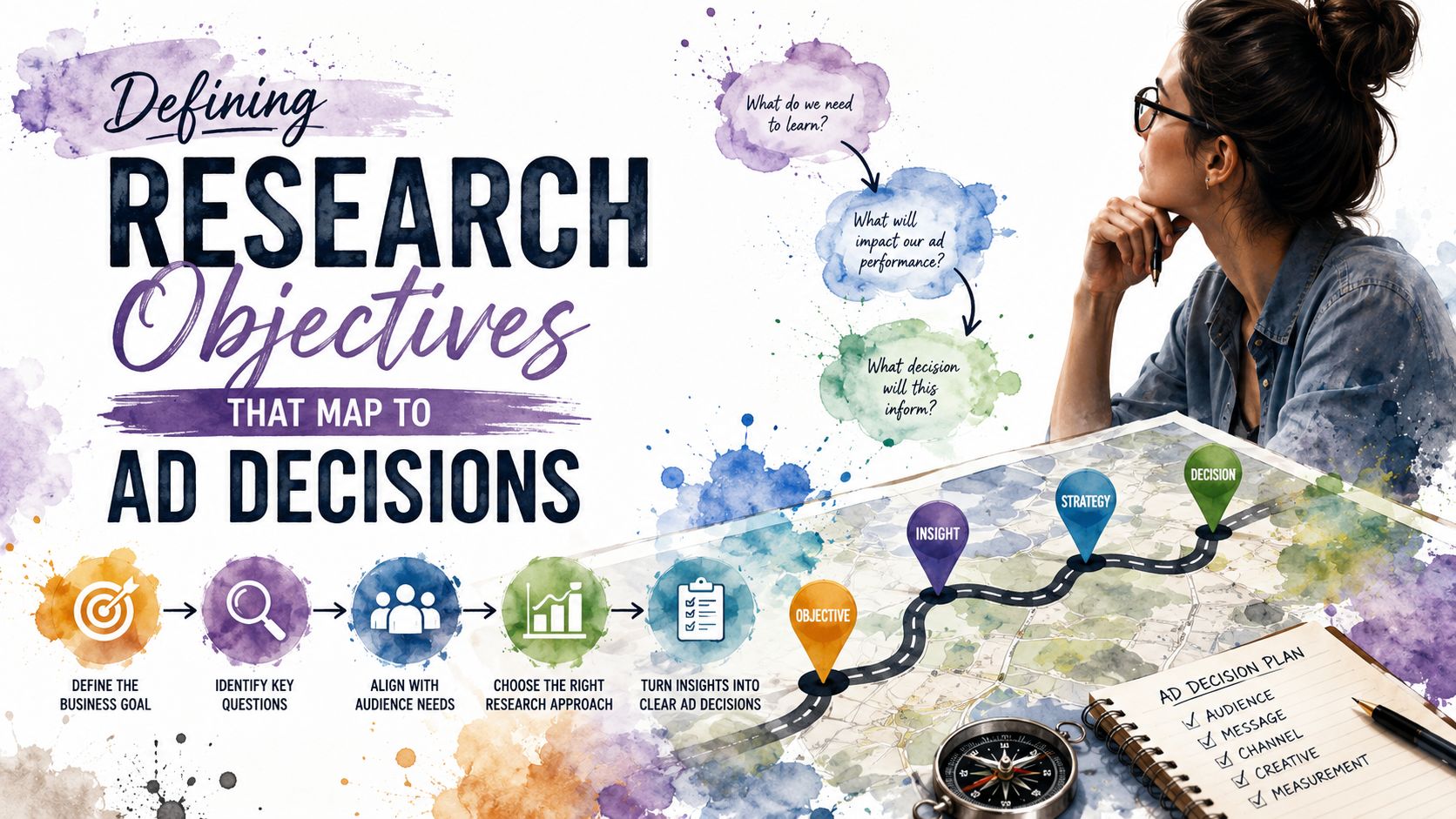
Start with the decision. Most weak research begins with a survey idea and works backward from there. A better brief names the exact choice the research has to support, then picks the method that can answer it without creating noise.
Write the objective as a business decision
Use this structure.
- Decision to make. Should spend move from one channel to another, should the message angle change, or should the audience definition tighten?
- Information needed. What do you need to know to make that call with confidence?
- Method fit. Which method can produce that information without overcomplicating the project?
- Success criteria. What would count as a useful answer, even if it is not the answer you hoped for?
That format keeps scope from drifting. It also forces the people requesting the research and the people using it to agree on the same outcome.
The common failure points are plain once you know where to look. The research challenge guidance from Greenbook points to unclear objectives, poor method fit, weak sample quality, poor questionnaire design, and hastily programmed logic as recurring breakdowns in market research workflows (research challenge guidance). A separate error taxonomy breaks technical failure into sampling error, non-sampling error, non-response error, response error, sample-design error, questionnaire-scale error, interviewer error, and respondent error. Those labels sound academic, but the practical lesson is simple. Bad inputs create confident decisions that waste media dollars.
A clean brief prevents expensive nonsense
A useful advertising research brief does not say “understand the customer.” It says something like this in plain English, “Identify which audience segment is most likely to respond to a lower-friction offer, then tell us which message frame gets the clearest recall.” That is a decision, and it is actionable.
If the brief cannot survive a five-minute read by a media buyer, a copywriter, and a finance lead, it is not specific enough.
Quality controls belong in the brief too. Screening criteria, attention checks, validated scales, and strict skip logic are what keep false confidence out of the room. If the research is meant to guide budget and creative choices, the instrument has to be built for those choices.
The same logic applies when you build buyer profiles. A sharper buyer persona process only matters if it helps you choose what to test and what to ignore.
Choosing the Right Research Methods for Advertising Questions
The wrong research method produces clean charts and weak decisions. Advertising work needs methods that match the decision on the table, the level of risk, and how much certainty you need before money goes into media.
Match the method to the question
Use qualitative research when the problem is language, friction, or motivation. Use quantitative research when you need to size a segment, compare response across audiences, or verify a pattern before you spend. Strong programs use both, but they do not ask the same method to do the same job.
| Advertising Question | Best Method | Expected Output |
|---|---|---|
| What objections stop people from responding to the ad? | One-on-one interviews | Clear language around friction, confusion, and trust gaps |
| Which audience segments respond most favorably? | Broad demographic survey | Segment prioritization for targeting and spend |
| What emotional triggers drive conversion in the best segment? | Psychographic survey on promising groups | Message angles tied to motivations |
| What are competitors promising that buyers keep noticing? | Review and competitor messaging analysis | A map of repeated claims and missing angles |
| Which messages deserve live spend? | Pre-test plus ad recall tracking | Shortlist of concepts worth scaling |
That order matters. Start wide enough to spot likely winners, then narrow the work toward the groups that justify deeper analysis. Otherwise, you end up overtesting weak segments and starving the ones that deserve budget.
The Australian government's business portal recommends methods that go beyond generic surveys, including one-on-one interviews, focus groups, product testing, and analysis of online reviews of similar products. It also recommends reviewing competitor ads, websites, social accounts, email lists, catalogues, flyers, in-person visits, product use, online reviews, and customer conversations to build competitive intelligence (business research methods guidance).
Sequence qualitative and quantitative work
The practical sequence is usually straightforward. Start with a few real prospects and listen to the words they use, the objections they raise, and the moments they hesitate. Then run a broader survey to see whether those themes hold across the market. After that, shape ad concepts from the strongest findings and test them before launch.
A similar workflow for advertising research is described as moving from broad demographic surveys to psychographic surveys on promising groups, then using channel research to see where response is strongest, and finally running primary research to refine messaging and segment-specific ad exposure (advertising research workflow).
That sequence keeps the work tied to execution. Qualitative research explains why people react. Quantitative research shows how many react. Live testing still decides what earns spend, because a convincing insight is not the same thing as a profitable ad.
The right method also depends on the decision inside the funnel. Customer behavior analysis matters only when it points to a concrete creative choice, channel choice, or budget shift.
Finding Behavioral White Spaces Your Competitors Miss
Demographics alone won't tell you where to win. Age, income, and location can describe a market, but they do not reveal the buying patterns that matter most. The bigger opportunity is usually in behavioral white spaces, places where demand exists but current ads, offers, or messaging do not address it well enough.
Look for patterns in what people actually do
The useful signals are often buried in basket behavior, cross-purchase patterns, and repeated objections. Guidance on behavioral white space analysis points to looking at total basket and cross-purchase behavior to find gaps, while behavioral data, audience insights, and qualitative research help surface underserved parts of the market (behavioral white space guidance). That is the work, not just asking people what they want in a survey.
Competitor analysis should be practical, not performative. Review the claims on their ads, the structure of their landing pages, the language in their social posts, the themes in their email offers, and the complaints in customer conversations. Then ask one sharp question, what are they not saying that your best buyers keep looking for?
Build a competitive map from lived behavior
A good market map has three layers.
- Audience behavior. What people buy together, repeat, abandon, or upgrade.
- Competitor messaging. What every player keeps repeating, and where that repetition creates sameness.
- Underserved needs. What buyers mention, but current ads do not answer well.
That map is more useful than a generic persona deck because it shows where to aim spend. It also keeps you from chasing the same broad promise as everyone else in the category.
The most valuable gap is often the one competitors ignore because it does not fit their current campaign template.
Customer conversations matter. Sales calls, support logs, reviews, and direct interviews can reveal the language buyers use when they are close to converting. That language becomes the raw material for ad angles, hooks, and objection handling.
The same logic applies when you are defining segments. Audience segmentation should follow behavior, not just demographics, if you want the ad budget to land where intent is highest.
Translating Findings Into Creative Tests and Channel Strategy
Research only earns its keep when it changes the live plan. If the findings do not alter the creative brief, the channel mix, or the budget split, they will not move revenue. Too many teams do the hard part of uncovering insight, then keep running the same ad structure and hope the numbers improve on their own.
Turn insight into testable hypotheses
Start by turning findings into statements you can test. If interviews show that buyers need reassurance, the creative hypothesis might be that trust-led copy performs better than feature-led copy. If survey work shows one segment responds to lower-friction offers, then the hypothesis becomes that a simpler call to action will produce stronger engagement than a heavier commitment.
That is a cleaner way to build A/B tests than scattering random variations into market. Each test should answer one question. If it answers three questions, it probably answers none of them well.
A stepwise research workflow helps keep the process tied to execution. Define the campaign goal, identify the target market, pre-test the ad concept, then launch with a tracking study that measures recall and message salience. That structure works because it connects concept testing to live measurement instead of treating them as separate exercises.
Choose channels from behavior, not habit
Channel selection should follow audience behavior, not platform loyalty. If people are more likely to engage after they have already done research, you need a different plan than if they respond to short, interruptive creative. If the segment needs repeated exposure before acting, frequency becomes part of the research question, not just a media setting.
Budget allocation should follow the same logic. Spend more where the audience is reachable and responsive. Cut spend where the segment looks broad but weak, even if the channel is fashionable.
A practical launch workflow looks like this.
- Write the creative hypothesis. State what the message should achieve.
- Pre-test the concept. Check for recall, clarity, and relevance before spend ramps.
- Set audience exposure rules. Define how often the audience should see the message.
- Launch with a tracking study. Measure what stands out and what gets ignored.
- Reallocate based on evidence. Move budget toward the combinations that produce useful response.
Practical rule: do not increase budget because a campaign feels promising. Increase it when the research and the live data point in the same direction.
Offline conversion tracking helps connect ad exposure to revenue when digital signals are incomplete. That matters because many teams confuse early clicks with durable demand, or mistake platform activity for product-market fit. Research should keep you honest long before the finance team asks for proof.
Measuring What Actually Proves Advertising Works
The hardest part of advertising research is proving causality. A campaign can line up with sales without causing them, and a dashboard can look healthy while the lift comes from somewhere else. Measurement has to be designed, not improvised.
Don't trust simple before and after comparisons
Advertising effects are often nonlinear, and they can decay when ads stop running. The marginal lift from extra spend is not constant, and a clean-looking before-and-after chart can mislead you if you ignore carryover or other marketing variables. Independent research on ad measurement also shows that no single method is definitive, and stronger programs compare experiments, attribution, and econometric or market-mix techniques instead of leaning on one dashboard metric (measurement approach comparison).
The practical takeaway is simple. Short-term lift is only one signal. It needs to be checked against longer-window incrementality and carryover analysis before anyone treats it as proof.
Account for privacy restrictions and missing signals
Modern measurement also has a visibility problem. Ad blocking, browser restrictions, and privacy settings create gaps that wishful thinking cannot fix. Earlier in this article, the scale of that problem was clear, and it's one reason first-party data matters much more than it used to.
Offline conversion tracking and first-party data close part of that gap. If you can't see the full path in-platform, you need a cleaner view of what happened after the click, the call, the form fill, or the visit. Offline conversion tracking becomes necessary when the goal is to tie ad exposure back to real revenue, not just on-site activity.
A strong measurement stack usually does three things.
- Tests incrementality. Checks whether the campaign created lift that would not have happened otherwise.
- Tracks response over time. Watches for decay, not just the first burst of activity.
- Cross-checks signals. Compares experiments, attribution, and broader market patterns.
If the measurement plan cannot survive privacy loss and platform bias, it is not a measurement plan. It is a reporting habit.
Stakeholder trust comes from that discipline. Finance teams do not need perfect certainty. They need a defensible method, a clear logic chain, and a measurement process that does not overclaim what the data can prove.
Building a Continuous Research Loop That Compounds ROI
The highest-performing brands don't treat research like a one-off project. They run it as a loop. Each campaign creates new evidence about audience behavior, creative resonance, channel efficiency, and measurement gaps, then that evidence shapes the next round of decisions.
A simple operating loop looks like this, define the objective, choose the method, collect behavioral data, translate the findings into creative and channel choices, measure lift, then feed the results back into the next cycle. That sounds basic because it is. The hard part is enforcing it when teams want to jump straight to launch.
The brands that win with advertising are usually the ones that make learning routine. They don't wait for a major failure to revisit the research. They use every campaign to sharpen targeting, improve recall, and remove waste from the budget.
Research compounds when the same team owns the question, the execution, and the measurement.
That's the key advantage of a revenue-first approach. It keeps research tied to actual outcomes instead of abstract reporting. It also stops the cycle of spending more just to learn less.
If you want that loop built into your campaigns instead of bolted on after the fact, work with a team that treats research, creative, and measurement as one system. The Advertising Suite helps brands turn market research into sharper ads, cleaner attribution, and smarter budget decisions, so your team can stop guessing and start growing with a partner that acts like an extension of your own.