The most repeated advice in pay per click marketing is still "get the click cheaper." That advice is how a founder spends a quarter and walks away with a prettier dashboard and an empty calendar. A low cost per click is not proof the buy was smart. It is only proof the visit was discounted. If the person was not real, the offer did not match, or nobody recorded what happened next, you paid for a door opening and nothing else.
Pay per click marketing rents attention at the moment of a click. It does not buy a customer. Treat the click as a rented visit, then make the visit earn its keep.
Pay-Per-Click Marketing Buys a Visit Not a Customer
Picture a storefront. An impression is someone walking past the window. A click is someone stepping inside. Revenue is the sale, the booked job, or the qualified conversation after they are in the room. Popular reports stop at the doorway and call that a win. Owners who have already paid for vanity metrics know the difference. The phone did not ring. The form filled with people who wanted a free estimate you do not offer. The "cheap" traffic never became a customer.
This is for founders tired of slide decks that celebrate reach, and for local service businesses that live on calls: HVAC, legal, medical, and any franchise that has to show up in a specific city. If a report cannot name a person you can serve, it is a traffic story, not a growth story.
Three filters before a click counts
A click has to clear three filters before it belongs on a scorecard.
- A real person: The visit comes from someone who can buy or book, not from an automated, duplicated, or incentivized click.
- A relevant offer: The query, the ad, and the page describe a job you sell, in a place you serve.
- A tracked outcome: You can tie the visit to a qualified lead, a purchase, or a booked appointment, not merely to a session.
Miss one filter and the invoice still arrives. The customer does not.
Weak readouts versus money
Three numbers look busy and prove little: impressions, raw click volume, and a low cost per click. They describe how often you were seen and how little you paid to be visited. They do not describe whether the visit was worth having.
Three economic readouts do the job instead.
- Qualified pipeline: Opportunities a salesperson or owner would pursue.
- Customer value: What a closed job or order is worth after the cost to deliver it.
- Return on ad spend: Revenue you can defend, set against the media that produced it.
Practical rule: If a metric would still look "good" on a day when no one bought, booked, or qualified, stop managing to it.
U.S. search advertising generated approximately $114.2 billion in 2025, about 38.8% of a $294.6 billion digital advertising market, and grew about 11% year over year, according to market intelligence on U.S. search advertising. That scale explains why the channel keeps attracting budget. It is not your benchmark. Industry competition, keyword intent, landing-page quality, geography, bidding, and conversion tracking change what a click is worth in your account. A national total cannot tell a clinic in one metro whether yesterday's spend paid for itself.
Price signals, auction fit, channel choice, and tracking all sit downstream of one rule. A click is an intermediate event. Qualified leads, purchases, lifetime value, and return on ad spend decide whether the rent was worth it.
How the Search Auction Sets Your Real Price
Google does not hand the top spot to the highest bidder. For every search that triggers competing ads, Google calculates Ad Rank from the bid plus auction-time quality, including expected click-through rate, ad relevance, and landing-page experience. A U.S. Department of Justice record of how Google scores search ads makes the commercial point plain: Ad Rank decides both whether an ad is eligible to appear and where it sits against other eligible ads.
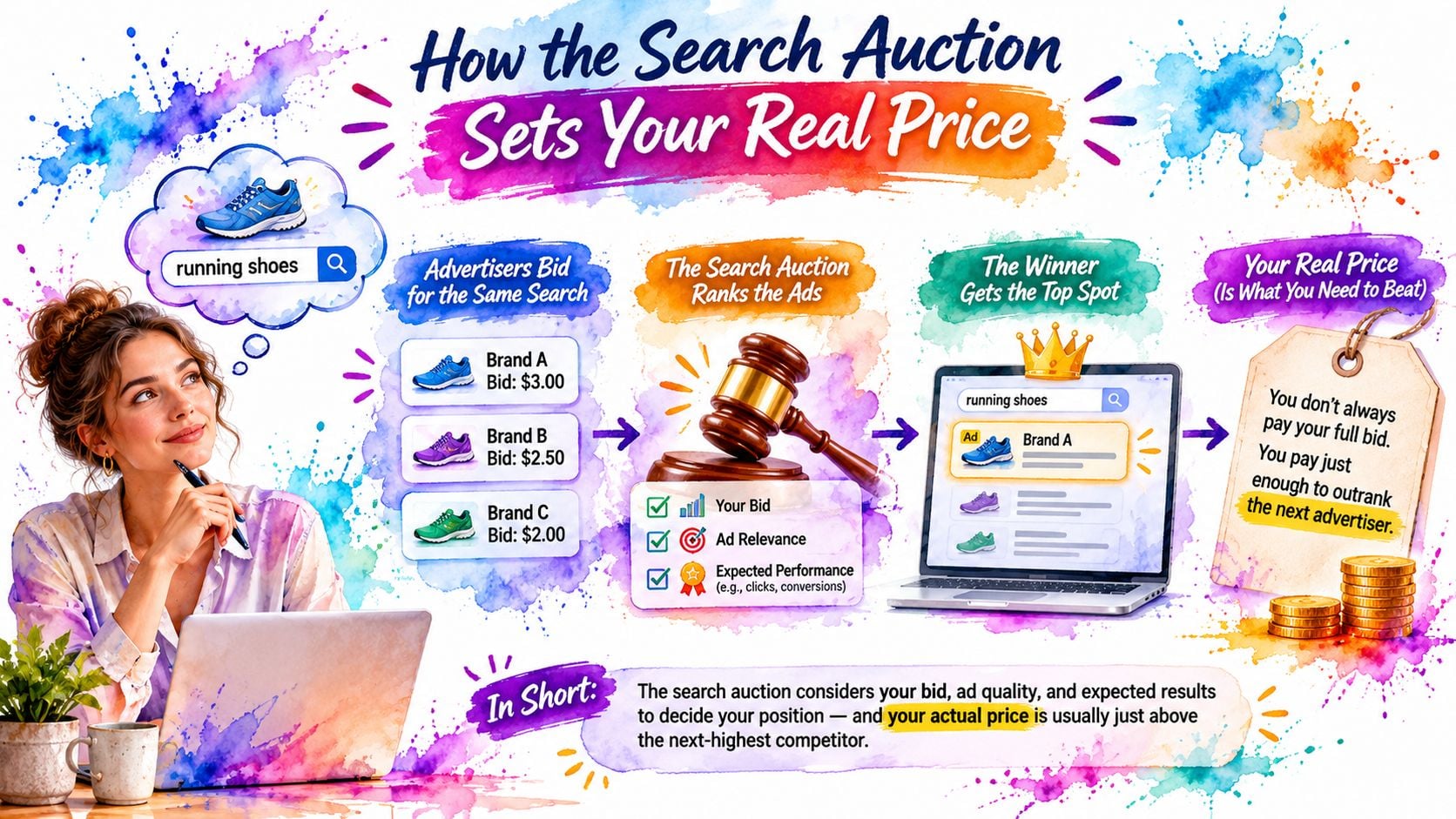
Think of a sealed bid between two shops offering the same amount. The shop with the clearer sign and the easier door still wins the visit. You can lose to a lower bidder, or you can win and still overpay, because the auction prices the relationship between spend, creative relevance, and what happens after the click.
The page is part of the bid
Google also weighs whether the landing page is relevant, transparent, useful, and easy to use. Conversion work is not a chore you do after the media "works." It is part of paid-search competitiveness. A page that hides the price, buries the phone number, or wanders off the query makes every future auction more expensive.
How Google Ads Quality Score ties message, expected click behavior, and page experience to what you pay is the practical version of that same idea. Fix the fit before you buy your way up the page.
Three consequences owners feel on the invoice
- A lower bid can still win when the ad and the page match the query better than a louder competitor.
- Buying the top slot can raise cost without raising qualified leads. Position is not pipeline.
- A slow or vague page taxes every future auction. You pay the penalty on the next search, not only on today's bounce.
Do not copy this logic onto display or video buying. Those units are often a view, not a search click. Awareness inventory answers a different question, and a search bid strategy pasted onto it will buy the wrong event.
Bid models and what you pay for
The auction sets eligibility and rank. The bid model sets which event the platform charges you for. Pick the model from the outcome you can measure, not from the lowest headline price.
| Bid model | You pay when | Best used when | Main risk |
|---|---|---|---|
| Cost per click (CPC) | someone clicks the ad | you need traffic on a defined set of queries | clicks can be invalid or unqualified |
| Cost per thousand impressions (CPM) | 1,000 impressions are served | you are building awareness on social or video | impressions prove no intent |
| Target cost per acquisition (CPA) | the platform bids toward a set cost per conversion | you have steady conversion volume | automation learns from junk leads |
| Target return on ad spend (ROAS) | the platform bids toward a revenue multiple | revenue values are accurate | wrong values distort every bid |
Cost per click charges when someone clicks. Cost per thousand impressions charges per 1,000 views, which can suit awareness and proves no intent. Target CPA and target ROAS let the platform bid toward a cost per conversion or a revenue multiple. Automated targets only work once conversion volume exists, because the system optimizes to whatever it counts. Feed it junk leads and it will get efficient at buying more junk.
If rank is weak, fix the message and the page before you add budget. More money on a mismatched ad is a faster way to lose the same argument.
The Cost Signals That Show Whether a Click Is Worth It
A cheap click can still be a bad buy. A 2026 report that analyzed more than 2.7 billion paid-ad clicks across Google, Meta, TikTok, LinkedIn, and Bing estimated that 8.51% of paid traffic was invalid, about $63 billion in global digital-ad waste in 2025, as covered by Advanced Television's report on invalid traffic. Automated, incentivized, duplicated, or otherwise non-human clicks still hit the card. A low CPC does not refund them.
Do not paste 8.51% onto every campaign and call it your fraud rate. Exposure changes by channel, inventory type, device, and buying model. A tight exact-match search campaign in one city is not the same risk as broad social inventory. Use the figure as a warning that platform-reported clicks are not cash, then measure your own leakage.
Three uses before you touch a bid
- Reconcile the click path. Match ad-platform clicks to analytics sessions, calls, form submissions, and sales records. A gap that repeats by placement is budget leaving the building.
- Watch anomalies by placement and geography. Sudden spikes from one app, one region, or one device, with no matching calls, are a reason to pause that slice, not a reason to "scale what is working."
- Cut junk demand before you raise bids or add creative. More ads on unqualified or fraudulent traffic make the waste louder. Improving return on ad spend often starts by refusing bad demand.
Server-side or CRM checks, conversion-delay patterns, and blocked-referrer reviews help you separate a genuine low-intent person from traffic that should never have been billed. The goal is not to reject real customers who browse slowly. The goal is to stop paying for visits that cannot become revenue.
What moves a real invoice
Commercial intent usually costs more than a research query, and it should. Someone searching for an emergency repair is closer to a job than someone searching for "how a furnace works." Weak pages force higher bids to win the same query, so a sloppy site inflates CPC even when the keyword is right. Dense local markets, especially legal, medical, and home services, bid the price up because the job is worth winning.
A costly click can still be rational. Say one after-hours repair covers dozens of clicks. You are not buying visits. You are buying a shot at that job, and the math can work. A cheap click can still be irrational. Branded queries you would have received anyway, or "free" and "DIY" searches you cannot fulfill, look efficient on a CPC chart and add nothing to new revenue.
Write the dollar outcome that must repay the click before you raise a bid. If you cannot say what a qualified job contributes after delivery cost, you cannot know whether the visit was a buy or a leak. A contribution margin view does that job: media cost against what the closed work leaves in the business.
A click is worth it only when the dollars it must repay are named in advance, and the tracking can show whether those dollars arrived.
Targeting That Matches Search Social and Local Demand
Demand does not show up in one place, and the cheapest click is a terrible way to choose a channel. Match the channel to the action you need.
Search captures a named problem
Search reaches people who already type a service or a problem. Keywords, negatives, and a location radius do the filtering. "Water heater replacement near me" is a different person from "why is my water lukewarm." Keep those intents apart or one blended cost will hide which query pays.
Social and video interrupt a feed
Social and video do not wait for a search. They interrupt someone who was doing something else, so intent is weaker at the start. The audience, the offer, and the creative have to qualify the click. If the ad promises a discount you do not honor, or targets a metro you do not serve, you will buy curiosity and call it demand. Use this channel when you need to reach a defined customer who is not searching yet, and judge it on qualified responses, not on how inexpensive the tap was.
Local results add a third filter
For local-service businesses, the ad account is not the whole shelf. Google's explanation of local ranking says local results are primarily based on relevance, distance, and prominence. Relevance is how closely a Business Profile matches the search. Distance is how far the business is from the searcher. Prominence is how well-known the business is. Google also states that review count and review score can affect local ranking, and that more reviews and positive ratings may help a business appear more prominently.
On an HVAC, legal, or medical search, the ad can earn the click while a thin or poorly rated profile loses the call. Reputation sits in the funnel.
- Accurate categories and service area tell the platform, and the customer, what you do and where.
- A page that matches the query keeps the promise the ad just made.
- Genuine reviews, asked through a transparent process, support prominence without inventing a reputation.
Do not buy or invent praise. The Federal Trade Commission's August 2024 final rule prohibits the sale or purchase of fake reviews and testimonials and authorizes civil penalties against knowing violators. A review push that fabricates feedback is a legal and trust problem, not a growth tactic. Ask real customers. Skip incentives or setups that create a deceptive impression.
Three fit rules
- Use search when the query is commercial and you can serve that intent today.
- Use social to reach a defined customer who is not searching yet, with an offer that qualifies them.
- Use local prominence when the next step is a call or a visit, because the profile can win or lose that step after the ad click.
Multi-location brands should not share one radius and one review story across every city. A strong rating in one market does not make a new location prominent, and a single wide radius will pay for clicks you cannot reach in a reasonable drive time. Audience segmentation is how you keep each market's demand, offer, and proof separate.
Pick the channel from the action you need. A cheap click in the wrong place is still the wrong buy.
How to Build a Campaign You Can Actually Judge
Build in an order you can audit. If you cannot judge the campaign, you cannot improve it, and you will end up "optimizing" whatever the platform happens to count.

1. Name the paid outcome and the value that makes a click acceptable
Write down one outcome: a qualified lead, a booked job, or a sale, plus the value that makes the visit worth paying for. The usual slip is launching on "more traffic" and discovering, after the invoice, that nobody agreed what success was.
2. Install tracking before spend, and pass consent
Track forms, calls, and purchases before the first dollar. Privacy rules do not make measurement impossible. They change how it works. Google's Consent Mode guidance lets a site pass a visitor's consent status to Google tags so tags adjust. When someone denies storage, consent-aware tags do not store web cookies or app identifiers. They send consent-aware, cookie-free signals that Google can use for conversion modeling. Custom banners should default to denied and switch to granted only after affirmative consent. Skip this and you get the two classic failures: tracking added after spend started, or modeled conversions built on a refusal the visitor already gave.
3. Split campaigns by intent
Brand terms, high-intent service terms, and research queries each get their own campaign. Blending them produces one average cost that hides both your winner and your leak. The slip is running one campaign for every service because it was faster to build.
4. Start tight, then add negatives
Begin with a short keyword or audience list. Add negatives for jobs you do not sell, wrong locations, and freebie searches before launch, then keep adding them from real search terms every week. The slip is broad reach on day one, then a month of paying for "jobs near me" you cannot fulfill.
5. Match the ad and the page to the next step
Write ads that repeat the offer and the next step. Send each group to a matching page, not a generic homepage. A strong page states the service, the area, the proof, and one action. Use a landing page built for the click you bought rather than hoping the homepage sorts it out. The slip is clever headlines that land on a page about something else.
6. Cap the learning budget and the map
Set a daily budget you can afford to learn on. Choose an automated bid strategy only after real conversions exist, because the algorithm chases whatever you feed it. Cap geography to where you can serve. The slip is handing a target CPA a pile of junk conversions and calling the result "smart bidding."
7. Wait for enough actions before you judge
Launch, then wait. A handful of clicks is not a verdict. For a rough sanity check, Cropink's Google Ads statistics report an average search click-through rate of 6.42% in 2024 across 17,998 U.S. campaigns. Treat that as a comparison inside similar intent, not a pass-fail score. A research query will sit under it. An emergency service query may sit over it. Neither number replaces qualified outcomes.
Pre-launch list
- Outcome defined: one paid result and the value that justifies a click.
- Tracking firing: forms, calls, and purchases, with consent passed correctly.
- Negatives in: wrong jobs, wrong places, freebie intent.
- Page matched: each ad group lands on the offer it describes.
- Budget capped: a daily amount and a service area you can afford to learn inside.
If any line is missing, you are not ready to judge the campaign. You are only ready to spend.
How to Measure Revenue When Reports Go Dark
Query-level reporting is no longer a complete map. A 2026 analysis of more than 400 Google Ads accounts found that AI-search activity was not identifiable in standard Search terms reports, and Google does not separately disclose performance from traditional search versus AI-generated results, according to Search Engine Land's look at invisible AI-search activity. Keyword conversion rate, search-term relevance, and platform ROAS can miss where demand started.
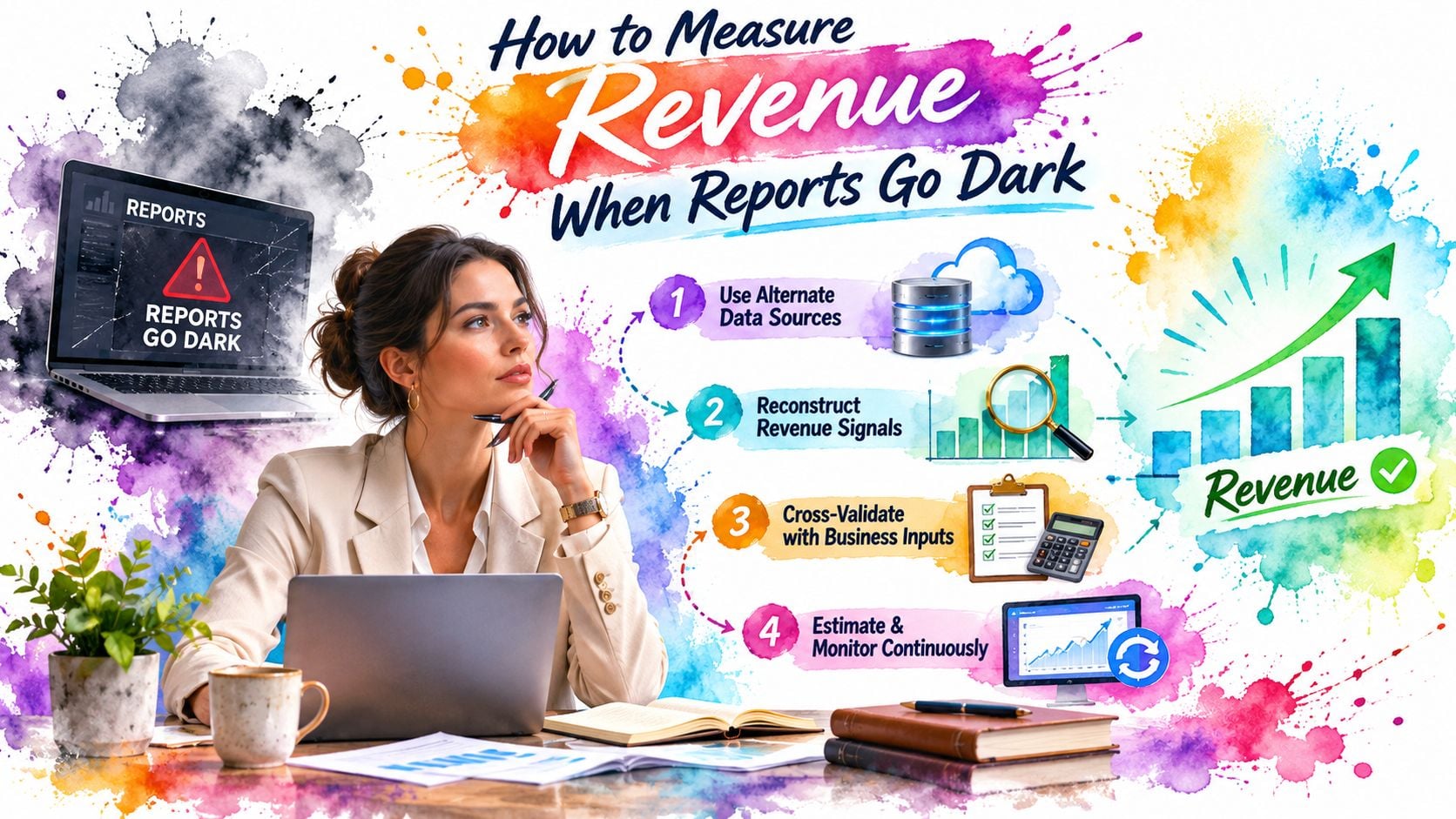
Stop asking only which keyword to bid. Ask whether the spend caused revenue. That question matters most when the sales cycle is long, the conversion happens offline, or volume is too thin for a platform model to be trusted.
A four-part operating check
Define one primary outcome in the customer system. A qualified opportunity or collected revenue, not every platform conversion. Import that signal back so the ad account learns from the business, not from a form fill that nobody wanted.
Separate reported efficiency from lift. Use a geographic holdout, a branded-search control, or a period when spend was paused. If results do not move when spend moves, the platform's ROAS is a story about attribution, not a story about new customers.
Reconcile clicks to sessions, calls, forms, and closed sales. Duplicate and low-quality actions fall out when the customer record is the referee. Offline conversion tracking is how a booked job gets back to the click that started it, instead of dying in a spreadsheet.
Report a range when volume is thin. Long cycles and offline jobs do not support a single precise ROAS. Say what you know, say what you do not, and do not present modeled attribution as fact.
Two cases where the dashboard lied
A clinic's form fills looked cheap. Call recordings showed people asking for a service the clinic does not provide. Cost per lead was a fiction. Cost per qualified appointment was the number that should have steered the budget.
A retailer's blended ROAS rose while new-customer orders did not. Brand queries and returning buyers were doing the work. The "win" was the business counting revenue it was likely to get anyway.
Optimization then means shifting budget toward queries, audiences, and pages that create qualified pipeline, and pausing the rest. The weekly scorecard is three lines: spend, qualified outcomes, and revenue. Click totals can sit in an appendix. They do not run the meeting.
Turn Ad Spend Into a Revenue System
Before you spend more, keep a campaign only if you can name three things: a qualified outcome, a trustworthy tracking path, and a page or profile that deserves the click. If one is missing, fix it. Do not scale it.
Decide the next dollar in three moves. Cut invalid or low-intent demand first. Let relevance and the landing experience compete in the auction. Judge the week on pipeline or sales, not on click price.
We work as an extension of your team, not as a distant vendor handing back a click report. The Ad Suite Membership costs $400 per year, paid once. Members automatically receive a 25% discount on products and services, and membership includes our in-house CRM and Review Management Software, so ad leads and genuine customer feedback sit in the same system as the media. More than 10,000 brands have used that results-first frame instead of guesswork. Strategy, media, and the customer record stay under one roof, and the next dollar of ad spend stays tied to revenue you can see.
Request a demo or book a growth consult if you want that accountability on a live account. Explore the membership if you want the discount and the software access first.
The Advertising Suite is a growth-tech partner that ties pay per click marketing to qualified pipeline, reputation, and revenue you can audit, instead of cheaper clicks. If your reports celebrate visits while the jobs do not show up, The Advertising Suite will sit with your team, fix the measurement, and put the next dollar on outcomes you can see. Request a demo or book a growth consult, or explore the membership for the yearly discount and the CRM and review tools.