You're probably paying for more software than you need, logging into less of it than you should, and getting weaker revenue signals than you expected.
That's the modern marketing technology stack problem in plain English. A business buys tools to fix lead flow, follow-up, reporting, attribution, reviews, and retention. A year later, the team has a pile of subscriptions, three dashboards no one trusts, and no clean answer to one simple question: which marketing activity produced revenue?
That isn't a software problem. It's an architecture problem. And if you've been burned by agencies that sold clicks, impressions, and busywork instead of bottom-line growth, you already know how expensive that confusion gets.
Your Marketing Technology Stack Is Broken Not Bloated
Most founders assume the issue is bloat. Sometimes it is. But more often, the stack is broken before it's bloated.
A marketing technology stack should function like a revenue system. It should capture demand, route leads, track follow-up, connect campaigns to sales outcomes, and help your team improve customer experience after the click. If it doesn't do that, it's not a stack. It's a junk drawer with monthly billing.

The scale of the problem is obvious. The global martech market grew 100 times since 2011 to 15,384 distinct solutions in 2025, up 9% over the previous year, according to Chiefmartec's 2025 marketing technology landscape analysis. That's not a market you “figure out” by adding apps whenever a new problem appears.
More tools don't create more revenue
When software gets layered in without a plan, teams create three predictable failures:
- Data gets trapped because one system captures leads, another sends campaigns, and a third reports conversions.
- Follow-up gets sloppy because sales and marketing work from different records.
- Reporting turns into theater because nobody can trace the path from ad spend to closed revenue.
That's why smart operators build around one customer record, not around feature lists. A stack should make it easy to see who the buyer is, what they did, what happened next, and whether the business made money.
If your current setup can't do that, start by tightening your unified customer profiles strategy.
Practical rule: If a tool doesn't improve lead quality, conversion speed, retention, or measurement, it doesn't belong in a revenue-first stack.
What a healthy stack actually looks like
A healthy stack is lean, connected, and used. It's built to answer operational questions fast:
| Revenue question | Stack should answer it with |
|---|---|
| Which campaigns create qualified demand? | Clean source tracking tied to lead records |
| Which leads convert? | Shared CRM status and sales outcomes |
| Where do deals stall? | Pipeline visibility and follow-up data |
| What should we fix first? | Reliable measurement, not vanity metrics |
That's the shift. Stop asking, “What tool should we buy next?” Start asking, “What system will help us drive high-intent revenue and prove it?”
The Five Foundational Pillars of a Revenue-Focused Stack
You don't need a giant stack. You need the right foundation.
Expert benchmarking identifies five foundational pillars in a revenue-focused martech stack: CRM, marketing automation, CMS, data tooling, and AI/ML. It also makes the critical point that weak data tooling creates a measurement gap that blocks accurate attribution from ad spend to pipeline growth, as noted in this benchmark on foundational martech elements.

Pillar one is the system of record
CRM comes first because every serious growth system needs a source of truth. It houses lead records, sales activity, lifecycle stages, and customer history.
Without a reliable CRM, marketing reports drift away from revenue. Sales starts using spreadsheets. Service teams work from memory. Attribution becomes guesswork dressed up as reporting.
Pillar two and three run execution
Marketing automation handles the repeatable work your team shouldn't do by hand. Follow-up sequences, segmentation, reactivation, reminders, and nurture all belong here. The goal isn't automation for its own sake. The goal is faster, cleaner movement from inquiry to sale.
CMS controls the digital experience buyers see. Landing pages, service pages, forms, and content aren't branding accessories. They're conversion infrastructure.
A weak website plus strong media buying is just an expensive way to send people to friction.
Pillar four is where most teams quietly fail
Data tooling sounds technical, so owners often push it aside. Bad move.
This pillar is the plumbing that keeps measurement honest. It organizes data, cleans records, and helps the business connect touchpoints across the funnel. If this layer is weak, you'll still get dashboards. They just won't tell the truth.
A solid first-party data strategy usually matters more than another flashy front-end tool because it protects measurement as privacy rules tighten and tracking gets messier.
Pillar five should optimize, not distract
AI/ML belongs in the stack, but in a supporting role. Use it to improve prioritization, routing, analysis, forecasting, and personalization. Don't use it as an excuse to bolt on random software that nobody understands.
Here's the clean way to think about the five pillars:
- CRM keeps one customer record.
- Automation moves leads without manual chaos.
- CMS turns attention into action.
- Data tooling connects activity to revenue outcomes.
- AI/ML helps the team act faster and smarter.
Build functions first, then tools
Founders get into trouble when they shop by category hype instead of business function. Flip that.
Ask these three questions before anything gets added:
- Does this help generate, convert, or retain revenue?
- Does it connect to the rest of the stack cleanly?
- Will the team use it weekly?
If the answer is shaky, skip it. A revenue-first stack is built on essential functions working together, not on software accumulation.
Stack Blueprints for Real Businesses
The best marketing technology stack isn't the most advanced one. It's the one your team can run consistently without losing visibility into revenue.
A lot of businesses don't need a sprawling system. They need a lean blueprint that fits their sales motion, customer journey, and operational reality.
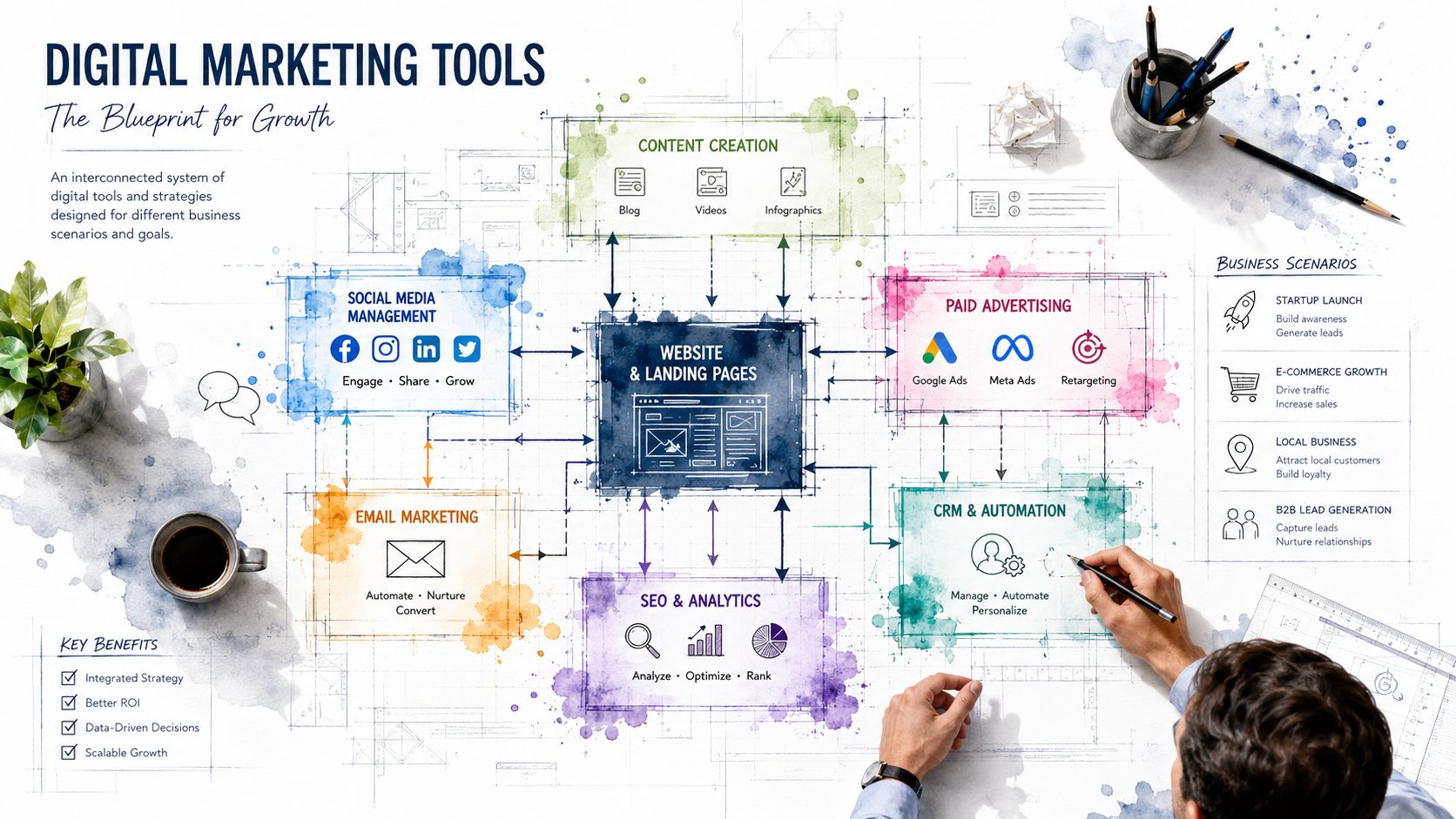
Blueprint for a scale-ready SMB
This business usually has a familiar problem. Leads come in, but handoff breaks. Reporting is fragmented. Marketing and sales disagree on what's working.
That's why the market has converged around a simpler setup. The dominant B2B configuration in Q4 2025 was a trifecta stack adopted by 28.5% of mid-market companies: a CRM, an ad platform, and an analytics layer working together for inbound growth, according to Digital Bloom's B2B martech stack benchmark.
The lesson isn't “copy that exact combo.” The lesson is that a focused core wins. For an SMB, the blueprint looks like this:
- Central CRM for every lead and customer interaction
- One primary paid acquisition channel to drive qualified demand
- One analytics layer tied to form fills, calls, and sales outcomes
- Simple automation for lead routing and follow-up
- Client management software to keep teams aligned across the journey, like this approach to client management software
Blueprint for an e-commerce brand
An e-commerce operator usually struggles with a different issue. Traffic is coming, but margin gets eaten by poor tracking, weak retention, and disconnected campaign signals.
That stack should stay lean. Focus on a commerce-enabled CRM record, lifecycle messaging, analytics tied to purchase events, and a clean content layer that supports landing pages, product pages, and offers. Add AI only where it improves merchandising, segmentation, or customer support speed.
What doesn't belong? Random add-ons for every channel. Most stores don't have a traffic problem. They have a signal problem.
The strongest commerce stack is the one that shows which campaigns bring buyers back, not just which campaigns create a first click.
Blueprint for a multi-location or franchise brand
This operator lives or dies by operational consistency. If locations answer leads differently, collect reviews inconsistently, or track performance in separate systems, the brand bleeds trust and revenue at the local level.
A lean stack here should emphasize:
- One CRM standard across locations
- Shared lead handling workflows
- Review and reputation operations
- Location-level reporting tied to real inquiries and booked business
The priority isn't sophistication. It's control. Multi-location growth comes from tight systems that make every branch easier to monitor, coach, and improve.
Three business models. Three stack blueprints. Same principle. Build around revenue flow, not software excitement.
How Disconnected Tools Destroy Your Advertising ROI
Disconnected tools don't fail loudly. They fail through delay, duplication, and bad decisions.
A lead fills out a form, but the CRM doesn't update correctly. The sales team calls too late. The audience list in your ad account never reflects recent buyers. Your creative team keeps pushing the same offer to people who already converted. On paper, every system exists. In practice, nobody's working from the same reality.
A mature marketing technology stack needs a unified data architecture where each tool reads from and writes to a central CRM record. Without that connected system, data, media execution, and creative stay fragmented, which reduces ROAS through weaker targeting and inefficient execution, as explained in HubSpot's guide to building a connected marketing stack.
The difference between a pile of tools and a working system
Think of a disconnected stack like a sales floor where marketing, sales, and service all keep separate notes and never compare them. Nobody sees the full customer story. Every department reacts late.
A connected stack works like a shared nervous system. One update changes what the rest of the operation does next.
- A new lead enters and gets routed immediately.
- A sales outcome changes and campaign reporting reflects it.
- A closed customer gets tagged and excluded from wasteful retargeting.
- A missed appointment or stalled lead appears and triggers follow-up.
That's not “nice to have” functionality. That's the difference between investing in scalable growth and paying a hidden tax on every campaign.
Revenue-first measurement needs the full loop
Most reporting problems come from one bad habit. Teams measure the top of funnel in one place and revenue somewhere else.
That's why clean offline conversion tracking matters. It closes the loop between marketing activity and actual business outcomes. Without that loop, ad platforms optimize toward shallow actions, not valuable ones.
When your tools don't share the same customer record, your ad spend gets optimized for convenience, not revenue.
If your current stack can't connect first touch, lead status, sales follow-up, and final outcome, you don't have attribution. You have fragments. And fragments don't scale.
The Hidden Costs and Privacy Traps to Avoid
A team buys a new tool to improve reporting. Six months later, reporting is slower, lead handling is messier, and nobody trusts the numbers. The license was the smallest cost.
The true expense shows up in setup delays, brittle integrations, admin work, retraining, workflow changes, reporting cleanup, and lost revenue from missed follow-up. A low sticker price means nothing if the tool adds friction to the system. In a revenue-first stack, every tool must earn its place through use, integration, and better decisions.
Underuse drains more margin than teams expect
Underuse is where stack waste hides.
Marketers often blame overspending when the bigger problem is poor adoption. Tools sit half-configured, nobody owns enablement, and the team tracks logins instead of revenue impact. That is how a decent stack turns into a license graveyard.
Ask harder questions before you cut software:
- Who owns adoption for this tool?
- Which workflows depend on it every week?
- What revenue decision did it improve in the last quarter?
If nobody can answer those questions, the problem is not your stack size. It is weak utilization.
Heavy identity projects break fast under privacy pressure
A lot of stack advice pushes identity resolution as the answer to everything. For many SMBs, that approach burns time, creates compliance risk, and produces little operational value.
Privacy rules limit what data you can collect, match, store, and activate. Integration costs add another layer of drag. If your team cannot support a complex identity model end to end, do not buy one. Build a stack your team can run with confidence and defend under consent and data-use scrutiny.
A privacy-safe revenue stack usually includes:
- A CRM as the source of truth
- Consent-based email and nurture workflows
- Analytics built on aggregated behavior and sales outcomes
- An integration layer that passes only approved data where it needs to go
That structure gives you usable measurement without building a system your team will avoid or your legal process will slow to a crawl.
Protect margin, not just compliance
Privacy is an operating constraint. Treat it like one.
If a tool increases manual handling, muddies attribution, or traps customer data in a silo, it cuts into decision quality and operating margin. Review stack choices through the lens of contribution margin analysis. That keeps the conversation focused on profitable growth, not software sprawl.
The best stack is lean, connected, privacy-safe, and used every day. Anything else is overhead.
The 5-Question Audit to Fix Your Leaky Stack
It's Monday morning. Paid media says lead volume is up. Sales says pipeline quality is down. Operations is cleaning duplicate records again. Your stack is not giving you clarity. It is leaking revenue.
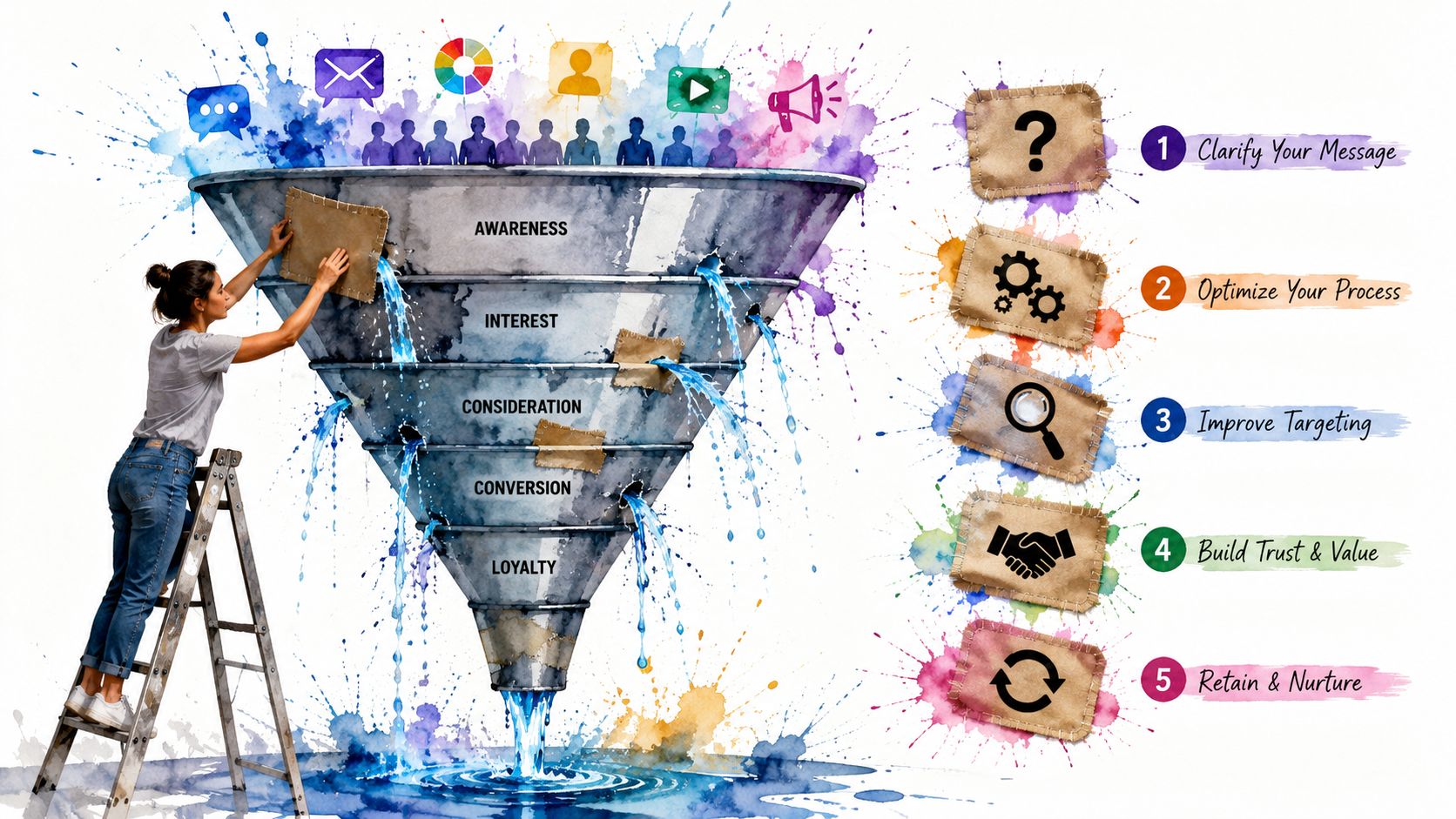
A useful audit measures revenue flow, handoffs, and adoption. A tool inventory does none of that. If a system does not help your team generate demand, route leads, follow up fast, and tie activity to closed revenue, it is overhead.
Start with five hard questions. Get sales, marketing, and operations in the same room and force one answer to each.
The audit questions
Can we trace a lead from first click to final sale in one connected view?
If you cannot, your team is optimizing channels in isolation. That leads to bad budget calls, weak attribution, and inflated confidence in metrics that never turn into revenue.Which tools changed a business decision in the last quarter?
Keep the standard high. A tool earns its place when your team uses it to improve targeting, speed, conversion, retention, or reporting tied to revenue. If nobody can name a decision it informed, cut it.Where does follow-up break after a lead comes in?
Check routing, response time, duplicate creation, lifecycle stage updates, and triggered actions. Revenue leaks usually show up in the handoff, not in the dashboard.Do we have adoption goals tied to business use?
Audits that count licenses and logins miss the point. Measure whether reps, marketers, and operators are completing the actions that drive revenue. Are leads assigned correctly? Are nurture sequences live? Are opportunity stages current? Usage without business action is noise.Can we remove one tool tomorrow without losing core capability?
A healthy stack has clear ownership and low redundancy. If one removal changes nothing, you are paying for overlap. If several tools do the same job and none can be removed cleanly, your stack is fragile and poorly integrated.
What strong answers look like
Use this benchmark:
| Audit area | Healthy answer | Warning sign |
|---|---|---|
| Attribution | Lead to sale is visible | Marketing and sales report separately |
| Adoption | Team has role-based use cases | Tool use depends on one person |
| Follow-up | Fast, automated, tracked | Manual handoff and missed leads |
| Redundancy | Clear purpose per tool | Overlapping subscriptions |
| Optimization | Decisions tied to revenue | Decisions tied to clicks and traffic |
Audit behavior. Audit handoffs. Audit whether the system gets used to drive revenue.
A stack with impressive features and weak adoption is still waste. An integrated stack that your team uses every day will outperform a larger stack full of unused licenses every time.
Stop Buying Software Start Investing in Growth
A marketing technology stack should do one job well. It should help your business generate demand, convert it efficiently, and measure what creates revenue.
That's why the winning move isn't buying more software. It's building a lean system your team will use. One source of truth. Tight integrations. Clear follow-up. Privacy-safe measurement. No vanity metrics. No dashboard theater.
The revenue-first standard
If you want a stack that performs, keep the standard simple:
- Integrated systems beat siloed tools
- Adoption beats accumulation
- Revenue visibility beats surface-level reporting
That's the shift most businesses need. Stop investing in disconnected subscriptions and calling it digital transformation. Start investing in infrastructure that supports scalable growth.
What to do next
If your stack feels noisy, the answer isn't another trial account. Audit what you already have. Remove duplication. Tighten the handoffs. Rebuild around the customer record. Then make sure every piece of the system helps your team drive high-intent revenue.
And if you're tired of vendors selling activity instead of outcomes, raise your standard. Your stack should support your business model, your margin, and your customer experience. If it doesn't, it's costing you twice. Once in software fees. Again in missed revenue.
If you want a growth-focused partner that treats your marketing technology stack like a revenue engine, not a software collection, The Advertising Suite is worth a closer look. Their growth-tech hybrid model combines strategy with built-in CRM and review management software, so your campaigns, lead handling, and customer experience work together. You can Book a Growth Consult if you want a direct assessment of what's leaking in your current stack, or Explore the Membership if you want the 25% discount on services plus access to the proprietary software. If you're serious about scalable growth, bring in a team that can operate like an extension of your business, not another vendor adding noise.