

Is a junk removal truck a real business, or an expensive way to buy yourself a physically demanding job?
The answer depends less on startup simplicity than on customer mix. A vehicle, basic equipment, insurance, quoting process, and steady inquiries can get you operating. They do not guarantee profit after labor, fuel, disposal, insurance, marketing, and empty driving time.
A revenue-first operator checks five points before buying equipment:
- Demand: Does the local market produce steady work beyond occasional residential cleanouts?
- Costs: Can you control labor, fuel, tipping fees, and route inefficiency?
- Margins: Does each job leave enough contribution after variable costs?
- Customer mix: Are you building recurring commercial routes, or chasing isolated pickups?
- Acquisition: Can you generate high-intent leads predictably without paying for vanity metrics?
The customer mix determines whether the truck builds a company or creates a job. One-off residential pickups can fill a calendar, but recurring commercial work, denser routes, and scheduled service usually create better operating efficiency. A busy truck still loses money when crews spend too much time driving, lifting low-value loads, or waiting at disposal sites.
The model can work. A typical job is reported around $150 to $400 in revenue, while landfill or transfer-station tipping fees are commonly cited at roughly $40 to $100 per ton, depending on the region, according to this junk removal business economics overview. That spread supports healthy economics only when crews stay productive and operators control deadhead miles, payroll, and dump costs.
Before committing capital, test whether nearby property managers, contractors, retailers, offices, and other commercial customers can support repeat routes. Apply these small business growth strategies to test demand, measure lead quality, and build a customer base beyond isolated household jobs.
The decision is straightforward: pursue junk removal when your market supports dense service areas, repeat accounts, disciplined disposal control, and high-intent acquisition. Without those conditions, you may be buying demanding self-employment rather than a scalable business.
Why Demand Makes Junk Removal Look Attractive
Junk removal benefits from problems that don't disappear when a season ends. Home renovation creates debris and unwanted fixtures. Downsizing forces households to clear furniture and possessions. Estate cleanouts, foreclosure turnover, aging demographics, and e-commerce packaging waste all create removal needs that municipal collection often doesn't handle conveniently.
That variety gives the category a stronger demand base than a business dependent on one narrow customer event. A homeowner may call after a remodel, while a property manager needs repeated cleanouts and a retailer may need packaging removed on a dependable schedule.

Where durable demand comes from
Residential work is visible, but it isn't the whole opportunity. Commercial and multi-location customers often care less about the cheapest single pickup and more about response time, documentation, professional conduct, and consistent service.
Useful demand signals include:
- Renovation activity: Contractors and homeowners need material, fixtures, and old furnishings removed as projects progress.
- Property turnover: Landlords, real estate professionals, and property managers face recurring cleanouts between occupants or after distressed-property events.
- Life transitions: Downsizing, estate administration, and household changes create larger jobs where convenience matters.
- Business operations: Offices, retailers, warehouses, and apartment communities can generate repeat removal needs.
Independent operators with 1 to 5 trucks are reported to generate about $350,000 to $800,000 in annual revenue, with SDE margins of 25% to 35% and net profit margins of 18% to 25% for well-run businesses, according to this junk removal market-size analysis. Those figures don't make success automatic. They show that local demand can support meaningful scale when the operator controls dispatch, labor, and dump costs.
Market test: A healthy territory produces repeat inquiries from several customer groups. A weak territory produces price shoppers who compare every truck by the lowest quote.
How to distinguish opportunity from saturation
Don't judge demand by search volume alone. Speak with contractors, property managers, estate professionals, and local businesses. Ask how they currently handle unwanted materials, how quickly they need service, and what frustrates them about existing providers.
A market may be busy yet unattractive if operators compete only on price. Another market may have fewer visible providers but strong commercial demand, poor response times, or limited recurring service. Your local search marketing strategy should reflect that distinction by targeting customers and service areas that produce dense, profitable routes, not merely more inquiries.
Startup and Operating Costs That Determine Profit
Can the business support itself after the launch cash runs out? A solo operation can typically launch for $7,500 to $28,000, while a franchise version may require roughly $96,000 to $350,000 or more, according to this junk removal startup cost guide.
The independent range generally covers a truck or trailer, insurance, branding, basic equipment, permits where required, and initial operating capital. A franchise may add fees, required branding, training, systems, and larger equipment commitments. Neither structure fixes weak customer economics.
The cost structure behind each job
The truck is only the capacity. Profit comes from the contribution left after completing each job.
Start with the customer price. Subtract labor, fuel, disposal, payment processing, and every other expense that rises with the job. Then subtract fixed overhead, including insurance, software, rent, financing, and administration. This sequence separates a busy schedule from a profitable operation.
| Cost Component | Typical Range | Impact on Margin |
|---|---|---|
| Customer revenue per job | $150 to $400 | Creates the available spread before job costs, as reported in the business economics reference |
| Tipping fees | $40 to $100 per ton | Reduces contribution when loads are heavy or disposal options are limited |
| Disposal fees as a share of revenue | 10% to 20% | Makes load estimation and sorting discipline important, according to junk removal cost research |
| Fuel as a share of revenue | 5% to 10% | Penalizes long-distance jobs and low-density scheduling |
| Labor and hauling | Variable by job | Becomes the central risk when crews wait, travel, or handle difficult access |
Independent operators commonly report gross margins of about 60% to 80% before overhead. Those margins can disappear quickly after disposal, fuel, idle crew time, insurance, financing, and administration. A route with recurring commercial stops can outperform a higher-priced residential schedule if it reduces travel and keeps crews productive.
Build the calculator before launch
Create one worksheet with separate lines for:
- Quoted customer price.
- Estimated labor time and crew cost.
- Expected disposal weight and fee.
- Fuel and route distance.
- Payment processing and other job-specific costs.
- Contribution left for overhead and owner earnings.
Test the worksheet against small, medium, heavy, stairs-heavy, and distant jobs. If a quote works only when the load weighs less than expected or the crew finishes unusually fast, raise the price or reject the job.
Track route density as closely as revenue. A one-off pickup that sends a truck across town can produce sales while weakening the day's contribution. Recurring commercial routes, clustered appointments, and reliable access improve the economics because the same crew and vehicle complete more paid work with less unproductive travel.
Use contribution margin analysis to rank jobs and customer types by profit contribution. The right question is not how much revenue a truck produced. Ask how much contribution the route created after the costs required to serve it. That customer mix, not startup simplicity, determines whether junk removal becomes a durable business.
Pros and Cons You Must Weigh Before You Start
Is junk removal a good business because it is simple to start, or because the customer mix can produce profitable routes? The service has a low technical barrier, but the work demands disciplined execution. You do not need specialized credentials to quote a load or dispatch a crew. You do need to control physical work, safety, disposal rules, customer expectations, and route economics every day.
The upside appears when jobs are well-priced and geographically dense. The downside begins when an owner treats gross revenue as profit or builds the schedule around scattered, one-off pickups.
The advantages that support the model
Low technical complexity keeps the category accessible. Customers understand the service, and many jobs can be quoted from volume, access, labor, and disposal requirements.
Fast payment cycles can support cash flow. Residential customers often pay at the service event, while commercial accounts may require invoices and longer collection timelines. Immediate payment helps fund operations, but only when the quote covers the actual labor, travel, and disposal plan.
Value recovery can reduce disposal expense. Scrap metal, reusable furniture, and donated items may create additional value when crews sort materials responsibly. Treat that recovery as a bonus, not as money the quote depends on.
High gross margins before overhead attract new operators. Reported margins can reach 60% to 80% before overhead, according to this junk removal margin reference. That qualifier matters. Labor, fuel, tipping fees, insurance, administration, and idle capacity still come out of the remaining spread.
The risks that can erase the upside
| Advantage | Matching risk |
|---|---|
| Simple service to explain | Easy for single-truck operators to enter and compete on price |
| Same-day customer payment potential | Heavy dependence on steady lead flow |
| Recoverable scrap or reusable items | Sorting takes time and resale value is not guaranteed |
| Strong gross margin potential | Labor, fuel, and tipping fees can absorb the spread |
Disposal costs can consume 10% to 20% of revenue, and fuel can consume 5% to 10%, according to the same cost breakdown. Those costs leave little room for weak quoting. Long drives, heavy materials, poor loading, and repeat dump trips can turn a job that looks profitable into a low-contribution job.
Labor creates another operating risk. Employees and subcontractors affect safety, speed, service quality, and retention. Injuries, turnover, no-shows, and inconsistent loading practices can reduce margin while damaging reviews.
Route density should influence customer selection as much as price. A recurring commercial stop near other paid work can outperform a higher-priced residential pickup across town because the crew spends more time producing and less time traveling.
Owner standard: Accept a job only when the price, route, labor requirement, and disposal plan leave a worthwhile contribution.
Start this business only if you will manage operations as aggressively as sales. It is field service with a truck attached, not passive income. Sustainable profit comes from the right customer mix, especially dense recurring work, rather than from booking the greatest number of isolated jobs.
How Scaling to Recurring Revenue Changes the Math
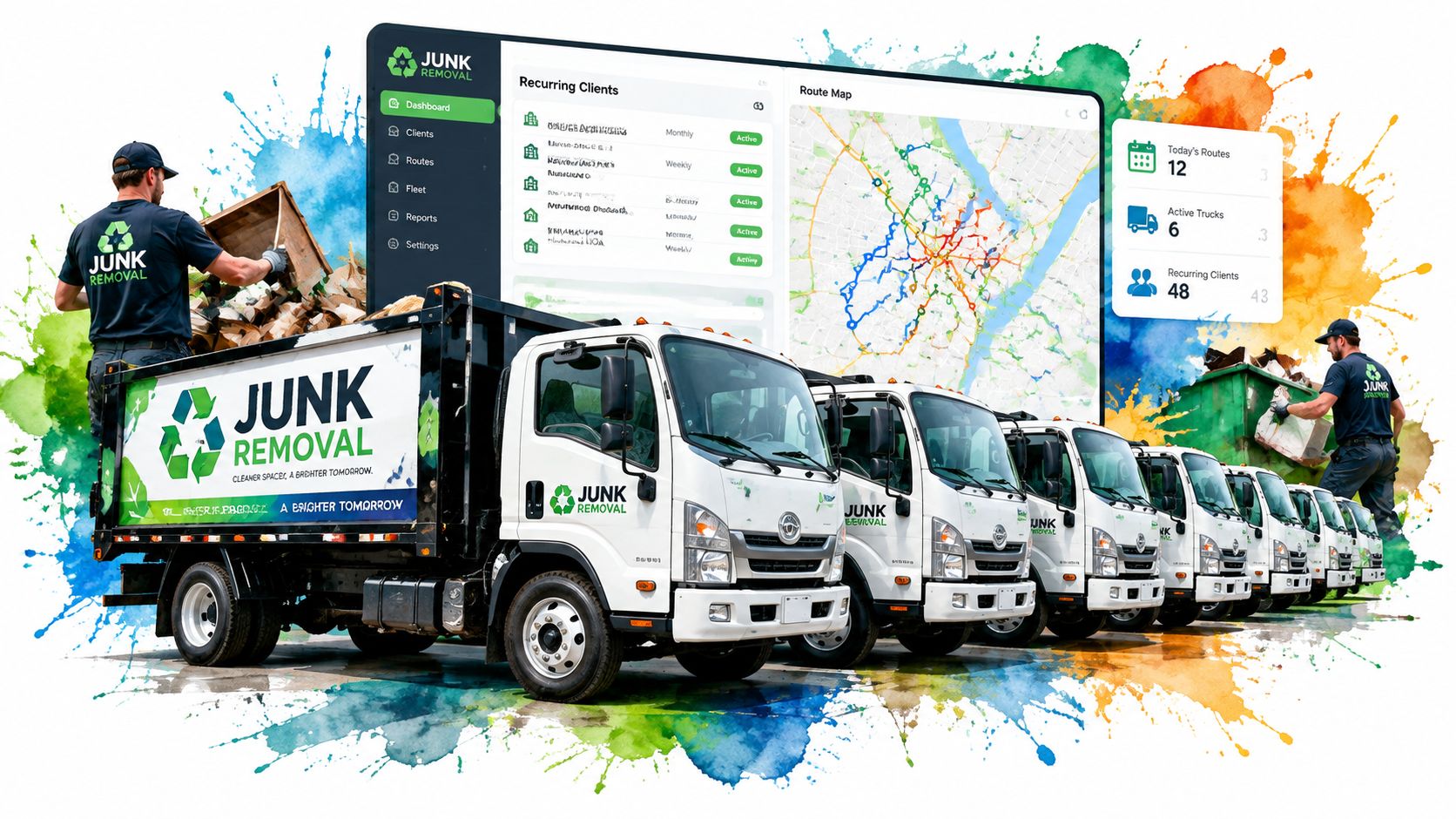
Is growth really about booking more random residential pickups? No. The stronger model builds dense, recurring commercial routes, reducing the time and money required to find each next job.
One-off residential work provides cash flow and local visibility, but it remains labor-heavy and unpredictable. Commercial accounts can require scheduled service across properties, locations, construction phases, or tenant turnovers. That repeat demand makes route planning and crew utilization more reliable.
Move from isolated jobs to route economics
Choose customer types with a clear reason to call repeatedly. Property managers may need turnover cleanouts. Contractors may need debris removed at defined project stages. Retailers, warehouses, and apartment communities may require regular pickup windows.
Use this operating sequence:
- Map demand clusters. Group prospects by neighborhoods, commercial districts, apartment communities, and contractor service areas.
- Sell service windows. Offer scheduled pickups or recurring arrangements instead of waiting for emergency calls.
- Bundle work. Place multiple jobs on one route so the truck spends less time empty.
- Control dispatch. Schedule the crew, vehicle, disposal destination, and promised arrival time together.
- Review contribution. Measure each route after labor, fuel, and tipping costs, not only by stop count.
Profit improves when operators raise truck utilization, combine pickups, reduce deadhead time, and recover value from scrap or reusable materials, as described in this junk removal profitability analysis.
What scale actually requires
Commercial accounts, route density, and subscription-style service provide the clearest path to scale. Single-truck residential models remain exposed to thin margins and labor dependence, according to this junk removal profitability benchmark.
A solo operator may clear $90,000 to $150,000 in owner earnings, while two-truck or multi-truck businesses can reach much higher EBITDA only after shifting toward commercial and recurring work, according to the same benchmark. Adding trucks does not automatically create wealth. It multiplies the existing system, including wasted miles, weak pricing, and poor dispatch.
A recurring customer also changes acquisition economics. Retention, consistent service, review generation, and account expansion become more valuable than replacing every completed job with a new lead. Apply a structured customer lifetime value approach to decide which accounts deserve faster response, account reviews, and service agreements.
The bottom line is clear: density and repeat demand beat raw job volume. Build the customer mix before adding vehicles.
Lead Generation That Drives High Intent Revenue
A junk removal company doesn't need the most clicks. It needs profitable calls from customers who have a real removal problem, live inside the service area, and accept the operating price.
That requires a connected acquisition and conversion process. Search campaigns can capture immediate demand. Local service placements can reinforce trust when customers compare providers. Social retargeting can bring back people who visited but weren't ready to call. Reputation management and follow-up determine whether that attention turns into booked work.

Build the funnel around booked revenue
Your marketing and operations need to answer three questions quickly:
- Can the customer find you? Create service pages and local profiles for the specific jobs and locations you want.
- Can the customer trust you? Show clear service scope, arrival expectations, disposal practices, and recent customer feedback.
- Can the customer book you? Make phone response, online quoting, scheduling, and follow-up fast and consistent.
A review isn't decoration. It reduces uncertainty around entering a home, handling heavy items, protecting property, and showing up as promised. Ask for feedback after completed jobs, respond professionally, and use recurring service quality as the source of better reviews.
A CRM should connect lead source, contact details, quote status, scheduled job, outcome, review request, and future follow-up. Without that connection, owners often pay for leads they never contact quickly, quote without following up, or lose commercial opportunities because no one remembers to check back.
Target density, not just geography
Broad service areas create expensive routes. Start with locations where residential demand, commercial properties, contractors, and disposal access overlap. Then create separate campaigns for profitable job types rather than placing every service under one generic message.
For commercial outreach, build a focused list of property managers, renovation firms, estate professionals, retailers, and facility operators. Offer a clear response process, recurring scheduling, documented completion, and one accountable contact. Those details sell reliability better than a slogan.
Use lead generation for local businesses as a revenue system, not a traffic project. Track booked jobs, accepted quotes, average route contribution, repeat accounts, and unprofitable lead sources. If a channel produces attention but not profitable work, change the channel, offer, or follow-up process.
Final Verdict Should You Start a Junk Removal Business
Yes, junk removal can be a good business, but only for an owner who treats it as an operating system rather than a truck-and-phone side hustle.
You should consider starting if you can answer “yes” to these three tests:
- Cost control: Can you price labor, fuel, and disposal accurately enough to protect contribution?
- Route density: Can you concentrate jobs geographically and build commercial or recurring demand?
- Predictable acquisition: Can you generate high-intent inquiries, respond quickly, and turn completed work into reviews and repeat business?
You should wait if your plan depends on underpricing competitors, working every job personally forever, or hoping random residential calls will create scale. The startup range is manageable for an independent operator, but working capital disappears quickly when trucks sit idle, crews travel too far, or loads cost more to dispose of than expected.
The best first move is a local validation sprint. Interview commercial prospects, price disposal options, calculate contribution by job type, test demand in a tight service area, and track booked revenue rather than clicks or impressions. Then decide whether to remain a focused solo operation, build recurring commercial routes, or invest in additional capacity.
A growth partner should help you connect acquisition to customer experience, not hand you a report filled with vanity metrics. The Advertising Suite combines agency strategy with an integrated CRM and reputation ecosystem, helping service businesses align advertising, follow-up, reviews, and retention. Its Membership provides a 25% discount on all services and grants access to the proprietary CRM, while the company reports serving more than 10,000 satisfied customers.
If you're evaluating junk removal as a serious growth vehicle, The Advertising Suite can help you audit demand, fix conversion leaks, and build a revenue-first acquisition system. Book a growth consult or explore the Membership to access the 25% discount and proprietary CRM as an extension of your team.
