Only about 1.4% of website visitors become leads in SMB and mid-market funnels, while enterprise sites average roughly 0.7%. Across B2B, only about 2.7% to 2.9% of raw leads become customers, so traffic and contact volume are poor substitutes for a functioning revenue system. (B2B lead conversion benchmarks)
That's the uncomfortable truth about small business lead generation. Most companies don't need another list of channels. They need better qualification, faster routing, sharper offers, and a CRM that tells the team what happened after someone raised a hand.
The practical standard is simple: attract the right people, capture useful intent, respond immediately, and measure the path to revenue. Everything else is decoration.
What Small Business Lead Generation Really Means in 2026
Lead generation isn't a form on your website. It's the complete operating loop from first interaction to qualified opportunity and, ultimately, customer revenue.
That loop has three parts:
- Capture channels, such as search, advertising, outbound outreach, referrals, and partnerships.
- Qualification logic, which separates serious buyers from poor-fit contacts.
- Conversion mechanics, including landing pages, routing, follow-up, sales acceptance, and nurture.
A company can perform well in one area and still lose money overall. Strong traffic with weak forms creates anonymous interest. Good forms with slow follow-up create abandoned demand. Fast responses to unqualified contacts waste sales capacity.
The benchmark data makes the problem clear. A practical SMB expectation is 2% to 5% visitor-to-lead conversion, while forms average about 1.7% and phone calls about 1.2% across a broad benchmark. (Small business lead generation benchmarks) Another multi-industry dataset reports an average lead conversion rate of 5.13%, with the same 1.7% form and 1.2% phone-call split. (Lead generation conversion research)
Operating rule: A lead has no business value until somebody can identify its fit, contact it, and move it toward a commercial next step.
That's why a cheap lead can be expensive. A contact that never receives a call, lacks buying intent, or can't afford the service still consumes ad spend and administrative time. A higher-cost lead can be economically sound if it matches the ideal customer profile and reaches sales quickly.
Build the funnel around decisions
Start by defining what counts as a lead. For a local provider, it might be a qualified call, quote request, or booked appointment. For a B2B service firm, it might be a form submission containing company size, problem type, budget context, and buying timeframe.
Then define the next decisions:
- Should marketing nurture this person?
- Should sales contact them now?
- Should the system disqualify or suppress them?
The rest of the system should support those decisions. Use channel-specific acquisition, conversion rate optimization, CRM automation, and a KPI dashboard that connects activity to booked revenue.
The Advertising Suite follows this revenue-first logic by combining human-led advertising strategy with CRM and reputation-management capabilities. That combination matters because customer experience begins immediately after the lead submits a form, not after the sales call.
The Four Channels That Still Drive Qualified Leads
Four channel groups continue to provide a practical foundation for small business lead generation: organic search, paid acquisition, outbound outreach, and partnerships or referrals. They don't behave the same way, and treating them as interchangeable is how small teams spread themselves thin.
The channel economics also vary sharply. Independent benchmark data places SEO at about $31 per lead, email marketing at about $53 per lead, and webinars at about $72 per lead. (2026 lead generation statistics) Those figures support a clear conclusion: owned and permission-based channels can be efficient, but only when the business has the patience and operating discipline to nurture demand.
Organic search captures existing intent
SEO works best when your pages answer commercial questions from buyers who already know they need help. Build pages around services, locations, use cases, costs, comparisons, and urgent problems.
The advantage is compounding visibility and durable first-party demand. The drawback is timing. Organic search rarely satisfies a business that needs immediate pipeline, so pair it with a faster channel rather than pretending patience is a strategy.
Paid search and social create immediate reach
Paid search captures active demand. Social advertising creates demand among people who may fit the audience but aren't currently searching. The first requires tight keyword and geographic discipline. The second requires strong creative, a clear offer, and enough feedback to distinguish attention from intent.
Paid campaigns fail when owners optimize for clicks instead of qualified actions. A click is an interaction. A qualified call, booked meeting, or sales-accepted opportunity is a business event.
Outbound gives you targeting control
Outbound email and professional-network outreach are useful when the ideal customer profile is narrow and identifiable. Start with a defined audience, a specific business problem, and a relevant reason to contact that prospect now.
Mass outreach is not a growth strategy. It's a fast way to produce poor-fit replies and damage trust. Small teams should prioritize relevance, clear opt-out handling, and disciplined follow-up over volume.
Partnerships borrow trust instead of renting attention
Referrals, local relationships, events, and co-marketing often produce warmer conversations because another person or organization has already supplied context. The cost is mostly coordination and consistency rather than media spend.
Partnerships become more valuable when both parties serve the same audience without selling the same service. A legal provider might collaborate with an accountant. A home-service company might work with a complementary contractor. The offer should make the introduction easy to understand and easy to track.
| Channel | Typical CPL | Time to First Lead | Best For |
|---|---|---|---|
| Organic search and SEO | Varies by market, with SEO benchmarked at about $31 per lead | Gradual | High-intent, evergreen demand |
| Paid search and social | Varies by audience, offer, and competition | Fast | Urgent local demand and campaign testing |
| Outbound email and professional networking | Email benchmarked at about $53 per lead | Controlled and direct | Narrow B2B targeting |
| Partnerships, events, and co-marketing | Varies by effort and incentive | Relationship-dependent | Trust-heavy, high-consideration services |
Use the omnichannel marketing strategy framework to decide how channels should work together, not merely to collect a longer channel list.
Pick two channels, not six
Choose based on three questions:
- Where does your buyer already look?
- How quickly must pipeline appear?
- How much follow-up can your team handle?
A local emergency service may prioritize demand capture and referrals. A B2B consultancy may combine outbound with SEO. The correct mix is the one your team can run consistently while measuring qualified outcomes.
Turning Website Traffic Into Captured Leads
Your website has one job in a lead-generation funnel. It must make the next step obvious and easy for the right visitor.
Start by matching the page to the traffic source. Someone clicking an ad for a specific service should land on a page about that service, with the same promise, proof, and call to action. A generic homepage forces the visitor to interpret and decide whether your business is relevant. Many visitors won't bother.

Remove friction without removing qualification
Short forms usually create less resistance, but a form that asks for no useful information creates routing problems. Ask only what the sales or service team needs to decide the next action.
Useful qualification questions might identify:
- Service need, such as repair, consultation, installation, or ongoing support.
- Timing, such as urgent, evaluating, or planning.
- Context, such as location, business type, or project scope.
Use progressive profiling for returning visitors. The first interaction can collect basic contact information. Later interactions can add detail without presenting the same long interrogation every time.
Your conversion page also needs trust at the moment of decision. Put relevant reviews near the primary call to action, explain what happens after submission, and make the next step specific. “We'll be in touch” is vague. “A specialist will review your request and contact you about the next available appointment” is operationally useful.
Treat speed as a conversion feature
The first response should happen immediately through an automated confirmation. The human response should follow within five minutes, because leads contacted within five minutes convert about 8 to 9 times better than leads contacted after 30 to 60 minutes. One benchmark also reports that qualification odds are roughly 21 times higher when the first response happens within five minutes rather than after 30 minutes. (Speed-to-lead benchmark)
Use this weekly checklist:
- Dedicated landing page
- Short, purposeful form
- Instant internal notification
- Automated confirmation message
- Human response within five minutes during operating hours
- Calendar or appointment option
- CRM source and intent tags
A conversion rate optimization process helps turn those items into a repeatable operating standard instead of a one-time website project.
Reviews Referrals and Partnerships as a Lead Engine
A realistic example shows why warm channels deserve more attention. Consider a 12-person HVAC company in Phoenix that stops buying broad display advertising and builds its acquisition process around three assets it already owns: customer trust, completed work, and relationships with complementary providers.
The first asset is the company's business profile and review process. After each completed job, the office sends a direct review request while the customer still remembers the technician's work. The request isn't buried in a general newsletter. It's tied to the service outcome and sent as part of the completion workflow.

Turn happy customers into an introduction path
The referral program follows the same principle. The company asks at a natural moment, after the customer confirms the work is complete and the immediate problem is resolved. The message identifies the type of person who may need help, provides a trackable referral link, and explains the reward clearly.
The reward doesn't need to be complicated. It could benefit the referring customer, the new customer, or both, as long as the team records who made the introduction and whether the lead became a real opportunity.
The intake record should preserve the source:
- Review-driven lead: Found the company through local search and referenced customer feedback.
- Referral lead: Arrived through a named customer or personal introduction.
- Partner lead: Came from a complementary home-service business.
That source information changes the sales conversation. A referred homeowner may already trust the company. A partner-introduced lead may have a specific problem and an expected handoff. A review-influenced lead may need proof that the company serves their neighborhood and situation.
Make partnerships concrete
The HVAC company works with two complementary home-service brands. Instead of promising vague “lead sharing,” the owners agree on a specific exchange, such as a co-hosted educational session, a bundled maintenance offer, or permission-based promotion to each audience.
Warm sources often close more efficiently than cold traffic because trust and context arrive before the first call. Reviews also support every other channel. A paid-search visitor, an organic visitor, and a referral prospect all encounter stronger proof when the company consistently earns and displays customer feedback.
Use the review management guide to connect customer feedback with local visibility, intake quality, and the broader customer experience.
Automating Follow Up So Leads Do Not Go Cold
A captured lead should enter a defined workflow before anyone has time to forget it. The CRM record needs source, service interest, location, contact details, owner, stage, and next action. If those fields aren't mapped at intake, the team will spend its time reconstructing context instead of selling.
Routing should reflect how the business operates. Use round-robin assignment when representatives serve the same market. Use territory or service-area rules when geography matters. For specialized firms, route by service type or buyer segment.
Score for fit and intent
Lead scoring should reward useful signals, such as a relevant service request, an active buying timeframe, or a target location. It should also subtract points for clear mismatches, including job-seekers, students, vendors, and requests outside the service area.
Keep the model understandable. If sales can't explain why a lead received its score, they won't trust the score. Review the model against outcomes and adjust the criteria when accepted leads repeatedly fail to become opportunities.
The follow-up sequence should combine automation with human judgment:
| Touch # | Timing | Channel | Goal |
|---|---|---|---|
| 1 | Immediately | SMS or email | Confirm receipt and set expectations |
| 2 | Within five minutes during business hours | Human call or reply | Establish contact and assess urgency |
| 3 | Later the same day | Provide a useful next step or resource | |
| 4 | Following business day | Call or voicemail | Reopen the conversation |
| 5 | After a short interval | Email or SMS | Offer a final clear path to continue |
The exact timing should reflect your operating hours and buying cycle. Outside business hours, the system can acknowledge the request and set the next response expectation. During operating hours, the five-minute target is the standard supported by the speed-to-lead benchmarks cited earlier.
Fix the plumbing before adding sophistication
Common breakdowns are easy to spot:
- Leads stuck in “New”: Add an owner, due date, and escalation rule.
- Duplicate contacts: Match on reliable identity fields before creating a new record.
- Untrusted scores: Show the signals behind each score and compare them with sales outcomes.
- Missing attribution: Preserve the original source through every stage.
- No next action: Prevent stage changes unless a follow-up task exists.
A documented marketing automation workflow can connect capture, routing, nurture, reminders, and reporting without requiring a dedicated sales-operations hire.
The KPIs That Tell You Lead Generation Is Working
Founders should review lead generation by funnel stage, not by dashboard activity. A high number of form fills can hide poor fit. A low lead count can still support healthy growth if the contacts become qualified opportunities at an acceptable acquisition cost.
Track these eight measures:
- Cost per lead by channel: Pull spend from campaign records and lead counts from the CRM. Intervene when a source produces contacts that sales repeatedly rejects.
- Lead-to-MQL rate: Use qualification fields and scoring history. Investigate when acquisition produces volume but little marketing-qualified demand.
- MQL-to-SQL rate: Compare marketing acceptance with sales acceptance. The broader 2026 benchmark places average MQL-to-SQL conversion at 9.8%, while programs using intent signals can reach 16.4%. (B2B lead generation benchmarks)
- Speed-to-lead: Pull timestamps from form submission and first human response. Treat missed response targets as an operational failure.
- Opportunity-to-close rate: Use opportunity and customer stages. Change qualification or sales process when opportunities consistently stall.
- Customer acquisition cost: Combine marketing and sales costs with new customers. Compare CAC with customer value and expected payback.
- Pipeline coverage ratio: Compare qualified pipeline value with the revenue target. A weak ratio calls for more qualified opportunities, not more impressions.
- Lead source concentration: Review the share of pipeline and customers from each channel. Heavy dependence on one source creates avoidable risk.
| KPI | Healthy Range (SMB) | Warning Sign | Where It Lives |
|---|---|---|---|
| Visitor-to-lead | About 2% to 5% | Traffic rises while captures remain flat | Analytics and CRM |
| Form conversion | About 1.7% | Forms underperform relevant traffic | Form and event records |
| Phone-lead conversion | About 1.2% | Calls aren't tracked or qualified | Call and CRM records |
| MQL-to-SQL | About 9.8% average, up to 16.4% with intent signals | Sales rejects most MQLs | CRM stage history |
| Speed-to-lead | Under five minutes during business hours | First response is delayed | Activity timestamps |
| Lead-to-customer | About 10% to 20% with strong qualification and follow-up | Contacts accumulate without sales | CRM opportunity history |
Use weekly reviews for speed, routing, source quality, and stage movement. Use a monthly report for CAC, pipeline, and channel economics. A quarterly business review should tie campaigns to booked revenue and payback, not celebrate reach. The marketing ROI framework is useful when the conversation needs to move from activity to financial performance.
Your 90 Day Small Business Lead Generation Plan
A small team doesn't need a sprawling transformation project. It needs a sequence that fixes the biggest leaks first and assigns one accountable owner to each workstream.
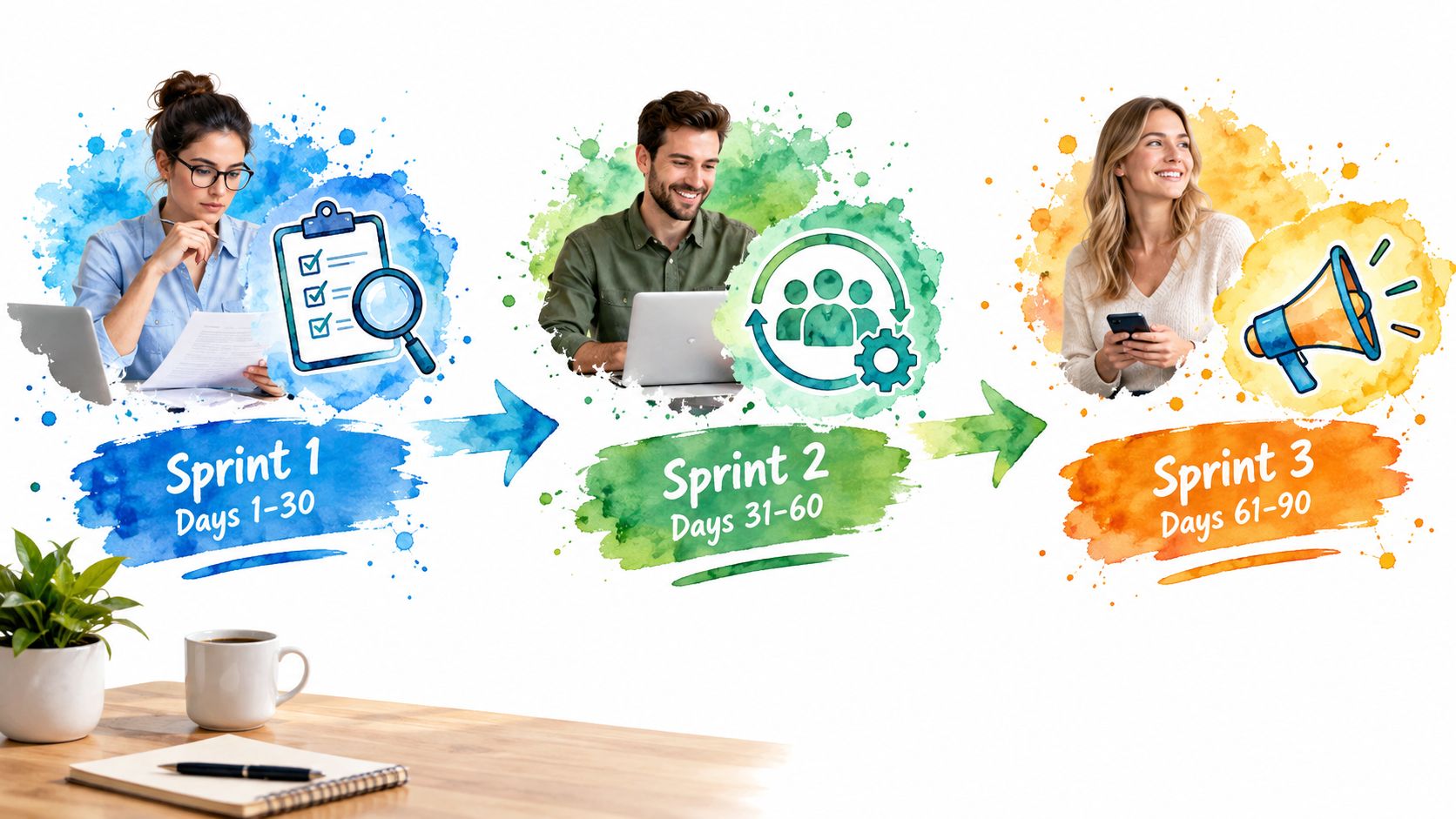
Days 1 to 30 build the foundation
Audit the current path from click to customer. Test every form, phone number, booking route, notification, CRM record, source tag, and follow-up task.
During this sprint:
- Website owner: Build or revise dedicated landing pages and clarify the primary offer.
- CRM owner: Map fields, stages, routing rules, and attribution.
- Content owner: Publish two cornerstone SEO assets aimed at commercial intent.
- Revenue owner: Define what qualifies as an MQL, SQL, opportunity, and customer.
The exit criteria are simple. A test lead must create a complete CRM record, reach the correct owner, trigger an immediate confirmation, and produce a visible next action.
Days 31 to 60 activate demand and nurture
Launch paid search or social around the highest-intent offer once tracking works. Don't fund a campaign that counts clicks while ignoring qualified calls or form submissions.
Add review and referral requests to existing customer-completion workflows. Turn on the first nurture sequence, and set the human response target to under five minutes during business hours. The sprint is complete when the team can show where a new lead came from, who owns it, and what happened after the first contact.
If CPL exceeds the target by 25%, don't immediately increase spend. First inspect search terms or audience quality, landing-page alignment, qualification fields, and sales acceptance. Reduce waste before buying more traffic.
Days 61 to 90 optimize for revenue
Score leads using fit and intent, then cut the bottom quartile of traffic sources by CPL only after checking customer quality and close potential. Scale sources that produce accepted opportunities, not sources that merely produce inexpensive contacts.
Hold a final 30-minute readout with four items:
- Pipeline value created by source
- CAC payback and notable quality differences
- Funnel stage with the largest leakage
- The next quarter's top three experiments
That meeting should end with named owners and dates. A plan without ownership is just a shared document waiting to become historical fiction.
The Advertising Suite can support this operating model through strategic creative, omnichannel execution, conversion optimization, CRM access, and automated review management. Visit The Advertising Suite to request a growth consult, diagnose your funnel leaks, and build a revenue-first system that operates as an extension of your team.