Review management is the structured process of collecting, monitoring, responding to, amplifying, and analyzing customer reviews across platforms to protect revenue, SEO visibility, and brand trust. By 2026, 96% to 97% of consumers checked online reviews before choosing a first-time or local business, so reviews now influence the sale long before a customer speaks with your team.
A five-star average alone won't fix a weak customer experience or a leaky conversion funnel. Businesses need a repeatable operating system that turns customer feedback into proof, service improvements, search visibility, and faster revenue decisions.
Why Review Management Has Become a Revenue Discipline
Reviews once lived in the customer-service queue, activated mainly after a complaint. That approach leaves revenue exposed. Modern review management covers the full feedback lifecycle, from requesting honest feedback to identifying why customers buy, hesitate, return, or leave.
The commercial stakes are clear. 96% to 97% of consumers check online reviews before choosing a first-time or local business, according to 2026 online review statistics. Thin, outdated, unanswered, or inconsistent reviews create friction before a sales conversation begins. AI-driven discovery also depends on clear, current customer language to understand what a business offers and whether its claims match real experiences.

The three business outcomes that matter
Review management should improve three connected outcomes:
- Revenue: Specific reviews answer objections, reduce perceived risk, and support conversion.
- Visibility: Customer language gives search and discovery systems context about products, services, locations, and experiences.
- Trust: Public, specific responses show that the business addresses problems instead of hiding from them.
Google's concentration in the review ecosystem makes priority coverage more valuable than collecting listings for appearances. One 2026 source reported that Google hosts around 73% of all online reviews. Businesses should monitor relevant industry and first-party channels, but platform count is a vanity metric if important feedback remains unanswered.
A revenue discipline assigns ownership, response standards, escalation rules, and reporting. It connects recurring review themes to training, complaints to recovery, and strong testimonials to conversion assets. A practical reputation management strategy measures more than star ratings. It tracks response economics, recurring service failures, review freshness, and whether feedback helps customers choose, teams improve, and leaders allocate effort. Star averages look tidy on a dashboard. They do not explain lost demand.
Defining Review Management and Its Five Core Components
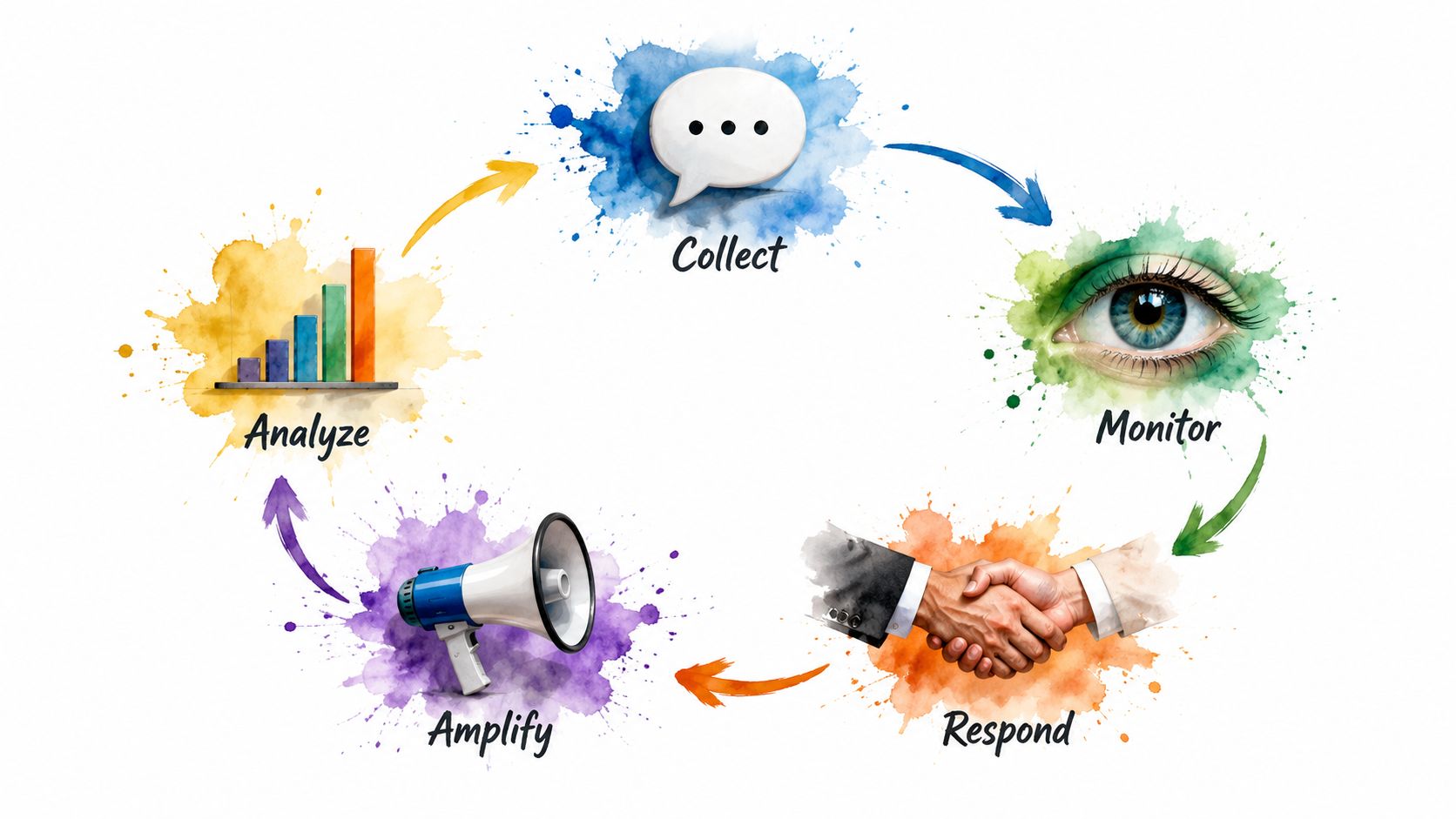
The answer to what is review management becomes clearer when you treat reviews as operating signals rather than isolated comments. The system has five connected components: collect, monitor, respond, amplify, and analyze.
Collect honest feedback
Collection means inviting customers to share feedback at a useful point in the journey. A completed service, successful delivery, resolved support issue, or positive account check-in can provide a natural prompt. Keep the request neutral. Asking for an honest review protects credibility better than coaching customers toward a preferred rating.
The workflow should make participation simple while preserving customer choice. A business can route customers to the most relevant review channel, but it shouldn't suppress criticism or manufacture praise.
Monitor the channels that influence buyers
Monitoring means watching priority platforms, locations, products, and recurring themes. The right scope depends on the business, but the process should identify new reviews, rating changes, unanswered questions, and repeated complaints before they become public surprises.
The 2026 business survey found that 55% of businesses monitored only two to three review platforms, while 22% monitored four to five, and very few tracked six or more, as reported in the state of online reputation management. That pattern suggests a clear recommendation: start with the channels that carry the most buying influence, then expand when ownership and response quality are stable.
Respond with judgment
A response has two audiences, the reviewer and every future prospect reading the exchange. Positive replies should show appreciation and reference something specific. Negative replies should acknowledge the concern, avoid defensiveness, and move sensitive details into a private resolution path.
Amplify useful customer language
Strong feedback can support landing pages, sales collateral, email, social content, and advertising. Preserve the customer's meaning, follow platform rules, and request permission where needed. Reusing real language beats inventing brand adjectives that customers never use.
Analyze patterns and outcomes
Analysis turns review volume, themes, sentiment, recency, and response performance into decisions. A recurring complaint may belong to operations, onboarding, fulfillment, or product design, not marketing. The best programs close that loop instead of celebrating a dashboard while the same problem keeps generating criticism.
Operating principle: Reviews aren't a trophy cabinet. They're customer evidence that should change how the business sells and delivers.
How the Review Management Operating Loop Works Day to Day
Review management works when people follow a rhythm. Automation can remove repetitive handling, but it can't decide whether a complaint involves a safety issue, a privacy concern, or a failure that requires leadership attention.
Start with the right collection moment
Trigger a short, neutral request after a completed service, successful delivery, resolved support interaction, or positive check-in. Email, text, and account messages can all work when the timing reflects the customer's experience rather than the company's reporting calendar.
Use the process for getting more Google reviews as a starting point, then adapt the request to your industry, customer journey, and platform policies. The request should invite honest feedback, not promise rewards for positive sentiment or pressure customers to change what they think.
Monitor and route every signal
Check the Google Business Profile and other priority channels at least daily. Set alerts for new reviews, unusual rating movement, competitor activity, and repeated complaints, then route each item to the person who can act:
- Customer service: Handles service questions and relationship recovery.
- Operations: Investigates fulfillment, scheduling, quality, or delivery failures.
- Marketing: Identifies approved customer language for campaigns and sales assets.
- Leadership: Reviews legal, safety, privacy, or repeated-failure escalations.
Response timing should reflect customer expectations. The 2026 business survey found that 47% of businesses checked reviews daily, 41% checked weekly, 45% responded within one to two days, and 34% responded within a few hours, according to review management survey data. Treat a few hours as the standard for urgent negative feedback, while routine replies should still happen quickly enough to show active ownership.
Learn on a weekly and monthly cadence
Each week, identify useful excerpts for approved amplification without changing their meaning. Each month, compare review themes, rating movement, volume, and response performance by location, product, or service line.
Automation can trigger requests, reminders, alerts, routing, and reports. People should retain control over empathy, tone, escalation, and resolution. A machine can draft a reply. It shouldn't decide whether a customer has been treated fairly.
The Revenue, SEO, and Trust Impact of Review Management
Review management affects revenue through three connected signals. Conversion depends on evidence, search visibility depends on clear and current language, and trust depends on authenticity plus visible accountability. Treating reviews as a passive reputation chore leaves measurable demand on the table.
Conversion improves when evidence reduces risk
Northwestern University's Spiegel Research Center found that displaying verified-buyer reviews increased the odds of purchase by 15%, while products with five reviews had a 270% higher purchase probability than products with none, according to research on how online reviews influence sales. The figures do not guarantee the same outcome for every business. They do establish the commercial problem: thin evidence makes an unfamiliar or expensive purchase feel riskier.
Volume and rating quality solve different problems. Customers need enough fresh, credible detail to answer practical questions. Operators need to fix the service failures that keep generating low ratings. A larger review count cannot rescue a weak customer experience.
Rating quality has a measurable commercial connection
Research cited by MIT found an average response rate of 27.9% across major hotel review sites. It also reported that a 1% increase in online customer rating increased sales per room by up to 2.68% in Paris and 2.62% in London, as documented in this MIT-cited review response study.
The operating lesson is direct: manage response coverage and customer experience quality together. A reply can acknowledge a failure, clarify next steps, and recover a relationship. It cannot compensate for repeated operational breakdowns. Ignoring reviews throws away customer insight and recovery opportunities at the same time.
Search and trust require different signals
Reviews give discovery systems useful context about service categories, locations, product attributes, and recurring customer experiences. Responses should reflect natural customer language where it fits. Forced keywords make the business sound less credible, not more visible.
Trust grows through public accountability. Public responses, verified-buyer labels, detailed experiences, and current feedback work together as social proof in advertising. A polished rating without visible ownership is weaker than a credible profile where the business handles praise and criticism responsibly. Customers can see whether the company merely collects approval or responds to what people report.
A review profile should therefore be judged by business outcomes, not vanity metrics alone. Track whether stronger evidence supports conversion, whether customer language improves discovery, and whether public responses reinforce confidence before purchase.

Authenticity, Recency, and AI-Legible Reviews in 2026
The lazy definition of review management is “ask for more five-star reviews.” That approach is both strategically weak and dangerous. It optimizes the visible score while neglecting whether the underlying evidence looks real, current, specific, and useful.
Local discovery is changing fast. BrightLocal reported that the share of consumers using AI tools to discover local businesses rose from 6% in 2025 to 45% in 2026, according to its local consumer review survey. When an AI system summarizes a business, it needs more than a high average. It needs understandable signals about what the business does, who it serves, how recently customers experienced it, and whether the feedback appears credible.
Build an authenticity stack
A responsible collection system should include:
- Natural timing: Send requests after meaningful customer moments, not in a mass burst disconnected from delivery or service.
- Transaction context: Use receipt, order, appointment, or account confirmation where appropriate.
- Specific prompts: Invite customers to describe what they bought, what happened, and what stood out.
- Media options: Let customers add photos or video when that helps future buyers.
- Policy controls: Prohibit self-generated reviews, undisclosed incentives, review suppression, and copied language.
Skepticism is not theoretical. One consumer survey found that 50% of consumers lose trust when owners or employees appear to review their own business, while another found that 75% worry about fake reviews when shopping online, according to the local business review survey report. At the same time, 94% of consumers place some degree of trust in local business reviews, which shows that credibility remains valuable but fragile.
Keep the evidence fresh and readable
About 73% of consumers trust reviews only when they were written within the last month, based on 2026 review freshness data. That makes ongoing collection a maintenance responsibility, not a one-time cleanup project.
Structure review content so humans and discovery systems can interpret it. Use clear service and product language, accurate business information, appropriate structured data, and consistent attributes across owned pages and profiles. Don't fabricate detail for the sake of search visibility. AI-legible content still has to be customer-legible first.
Manual Workflows vs Automated Review Management Software
Manual review handling looks inexpensive because the invoice is often zero. The cost appears elsewhere, through missed responses, inconsistent tone, delayed escalation, and customer language that never reaches the CRM or operating team.
In a manual workflow, a front-desk employee or marketer checks separate tabs, copies reviews into a spreadsheet, drafts replies between other tasks, and notices serious complaints only after they spread. That model can work at a very small scale, but it becomes fragile as locations, products, and channels multiply.
The shift toward software is already clear. 78% of businesses use tools or software to manage online reviews, while only one in five still handles them manually, according to the 2026 reputation management survey. The question isn't whether automation is fashionable. It's whether the workflow gives people enough visibility and control to act before reputation problems become acquisition problems.
| Dimension | Manual Workflow | Automated Review Management Software |
|---|---|---|
| Monitoring | Separate tabs and periodic checks | Centralized monitoring across priority channels |
| Collection | Individual reminders and inconsistent timing | Requests triggered by service or order milestones |
| Response | Copy-and-paste drafts with uneven ownership | Suggested replies, approval controls, and routing |
| Escalation | Complaints move through informal messages | Alerts based on sentiment, terms, location, or severity |
| Customer data | Reviews remain in spreadsheets | Feedback can connect with CRM records and segments |
| Reporting | Delayed, incomplete snapshots | Ongoing views by channel, location, product, and theme |
Automation shouldn't remove judgment. It should reserve human attention for decisions that require context, empathy, and accountability. Businesses evaluating platforms can use this guide to choose review management software based on integration, approval controls, reporting, and workflow ownership rather than a long feature list.
Metrics to Track and the Review Management Scorecard
A review dashboard earns its place when every metric answers a business question. Track whether the team responds, whether customers are adding fresh evidence, whether recurring problems are declining, and whether prospects see credible proof. Activity without a decision attached is vanity reporting.
Use a weekly scorecard across six categories. Set clear operating standards, then adjust them for location, channel, and service complexity.
| Metric | Recommended Target | Data Source | Business Impact |
|---|---|---|---|
| Response rate | 90% or higher | Review platforms and response log | Shows coverage and public accountability |
| Response time | Under 24 hours, with urgent negatives handled within a few hours | Platform timestamps | Protects trust and supports timely recovery |
| Average star rating | Track direction by location and channel | Platform analytics | Indicates perceived experience quality |
| Review velocity | Establish a consistent monthly baseline per location | Collection workflow and platforms | Supports current evidence and discovery |
| Sentiment mix | Monitor positive and negative themes, not just the average | Theme and sentiment analysis | Identifies operational fixes and conversion objections |
| AI-discoverability signals | Improve verified-buyer context, specificity, natural keywords, and recency | Review content and profile audits | Makes reputation evidence easier to interpret |
Response speed deserves its own management rule. Research found that 34% of businesses responded within a few hours, while 45% responded within one to two days, according to review response timing research. Treat those figures as market context, not a reason to leave a serious complaint unanswered for two days. Slow recovery can turn a service failure into visible acquisition friction.
Turn reporting into decisions
Read the scorecard by location, service line, and channel. A strong overall rating can conceal one struggling branch. A weak average can also hide a recent improvement worth reinforcing, so review direction matters as much as the headline number.
Connect review themes to operating outcomes. If customers repeatedly mention scheduling, packaging, communication, or staff expertise, assign an owner, document the response, and monitor whether the theme changes. Then test whether improved review language aligns with inquiry quality, conversion activity, or reduced objections.
Leadership should leave the meeting with three decisions: what to fix, what customer language to promote, and what experiment to run next. That turns review management into a revenue discipline, not a monthly report that collects dust.
Your Next Steps and the Ad Suite Membership Loop
A practical review program can start with a focused 30-day rollout. The first month should create control, not bury the team under an elaborate process nobody maintains.
Week one creates visibility
Audit every active profile, identify the channels that matter most, and confirm ownership for each location or product line. Record baseline review volume, rating direction, response rate, response time, recurring themes, and freshness. Remove duplicate workflows and document escalation contacts for service, operations, legal, privacy, and safety concerns.
Week two makes collection consistent
Create neutral request templates for email, text, and account messages. Connect the request to meaningful customer milestones, then test the timing and destination. Make the process easy for satisfied and dissatisfied customers alike. Suppressing criticism may make a dashboard look cleaner, but it deprives the business of the information needed to improve.
Week three establishes response discipline
Set a daily monitoring rhythm and a response policy for positive, negative, and sensitive reviews. Give frontline teams approved guidance, but require human review for complex complaints and promises about remedies. Track response ownership so a public question doesn't sit untouched while several people assume someone else handled it.
Week four turns feedback into growth assets
Select approved customer language for landing pages, sales enablement, email, and advertising. Review themes with operations, then update onboarding, service recovery, and customer communication where the evidence supports a change. Build the reporting workflow into a broader marketing automation workflow so review signals can inform follow-up instead of remaining trapped in a reputation inbox.
The strongest model links three functions: CRM data, review-management software, and ongoing optimization. That membership loop connects customer experience to acquisition and retention, with reporting tied to the scorecard rather than vanity metrics. The Advertising Suite membership also provides a 25% discount on services and access to a proprietary CRM, giving growing businesses one operating layer instead of disconnected tools and handoffs.
Don't judge review management by how many replies a team posts. Judge it by whether the business earns credible, current feedback, resolves recurring friction, converts more qualified prospects, and gives every location a repeatable standard. The Advertising Suite works as an extension of your team, with strategy and technology aligned around measurable growth rather than activity theater.
If reviews are influencing your acquisition and conversion funnel, The Advertising Suite can connect review management, CRM workflows, advertising, and conversion optimization into one revenue-first system. Request a demo or book a growth consult to audit your current review operation, establish the scorecard, and build the next 30 days with an embedded growth partner.