Most advice on what is Meta advertising starts with targeting, lookalike audiences, and placement selection. That framing is outdated. Meta advertising is a real-time auction and revenue system that prices attention, predicts who may act, and reallocates delivery toward the ads and signals it trusts.
That distinction matters if you've already spent money on clicks, impressions, or audience segments that never became revenue. Meta can generate enormous reach, but it won't repair a weak offer, poor follow-up, slow landing page, or unreliable conversion data. In 2026, performance depends on four connected shifts: stronger server-side signals, machine-led delivery through Advantage+, privacy-protected measurement, and a clean CRM loop that tells the platform which leads and customers matter.
The Real Question Behind What Is Meta Advertising
Meta advertising isn't simply a targeting tool. Meta runs an auction whenever there's an opportunity to show an ad, then evaluates which ad should win based on the campaign objective, predicted action, advertiser value, and ad quality. Meta describes the auction as a system designed to pair ads with people most likely to be interested, not as a directory where advertisers manually select every buyer. You can review Meta's ad auction explanation for the platform's own description of that mechanism.
The operator's question isn't, “Can I reach my audience?” You can. The better questions are:
- Can Meta identify a valuable conversion?
- Can your creative earn attention in a crowded auction?
- Can your website or sales team convert the response?
- Can your CRM return qualified outcomes to the system?
Those questions expose why founders often misdiagnose weak performance. They blame audience size when the issue is fragmented conversion data. They blame CPM when the offer lacks proof. They blame the algorithm when a lead sits untouched in a shared inbox.
Practical rule: Treat Meta as a demand allocation machine, not a vending machine for guaranteed customers.
The platform's scale makes that machine important. Meta reported $200.97 billion in full-year 2025 revenue, up 22% year over year, while ad impressions across its family of apps increased 12% for the full year and 18% in Q4 2025. Its average family daily active people reached 3.58 billion in December 2025, up 7% year over year, according to Meta advertising statistics compiled from the company's disclosures.
That scale creates opportunity, but it also creates a trade-off. You get access to an immense pool of attention, while competing with advertisers whose creative, data quality, and conversion systems may be stronger. The winning approach is therefore not endless audience tinkering. It's a connected loop of signal quality, creative testing, conversion rate optimization, and customer feedback.
Meta Advertising as a Family of Apps Ad Business
Meta advertising refers to paid inventory sold across Meta's family of apps and technologies. In practical terms, that includes Facebook, Instagram, Messenger, WhatsApp-related commercial experiences, and eligible network placements managed through Meta's advertising infrastructure.
Meta's business is now much larger than a single social platform. Industry data reported advertising revenue rising from $39.94 billion in 2017 to $84.17 billion in 2020, then $114.93 billion in 2021, before exceeding $160 billion in 2024, as reported by Marketing Brew's coverage of Meta's advertising revenue and AI investment. A separate forecast in that source projects $243.46 billion in global net ad revenue for 2026, with a projected 26.8% share of global digital ad spending, compared with Google's projected 26.4%.
The delivery stack businesses actually use
Ads Manager still presents a familiar hierarchy:
- Campaigns define the commercial objective.
- Ad sets establish audience, budget, schedule, and delivery controls.
- Ads contain the creative, message, format, and call to action.
That structure remains useful for organization, but Meta increasingly handles delivery decisions inside automated campaign products. Advantage+ placements can search across eligible placements for cost-effective opportunities, while Advantage+ audience allows Meta's system to expand beyond initial audience suggestions. Meta's help content reports that Sales and App promotion objectives could receive 7.2% lower cost per result with Advantage+ audience, based on Meta's own comparison. The feature details are available in Meta's Advantage+ audience and placements guidance.
| Surface | Primary inventory | Best-fit campaign type |
|---|---|---|
| Feed, video, Marketplace, and community-adjacent inventory | Broad reach, lead generation, local services, and retargeting | |
| Feed, Stories, Reels, and visual discovery inventory | Product discovery, creator-led creative, and brand demand | |
| Messenger | Inbox and conversation-oriented placements | Lead qualification, consultations, and customer conversations |
| Business messaging experiences where eligible | High-intent inquiries and relationship-led service journeys | |
| Audience Network | Eligible third-party apps and sites | Additional reach when creative and brand controls support it |
Don't treat those surfaces as separate businesses with separate strategies by default. Let the objective, creative format, and conversion quality determine where delivery should go, then inspect outcomes by placement. Meta advertising performs best as one channel inside a broader system that includes your offer, website, CRM, reputation, and lifecycle follow-up.
How the Auction, Learning Phase, and Advantage+ Actually Decide Who Sees Your Ad
Every impression is contested. Meta evaluates the competing ads and selects a delivery outcome using the campaign's objective, targeting, budget, duration, and creative quality. Those are the five practical components Meta names in its auction guidance, and each one gives a founder a lever to pull.
Translate platform mechanics into operating decisions
- Objective: Choose Sales when you need purchases, or Leads when you need inquiries. Optimizing for Traffic and judging success by revenue creates a mismatch.
- Targeting: Give the system a useful starting point, but don't assume a narrow audience is automatically superior. Excessive restrictions can starve event volume.
- Budget: Fund enough conversion activity for the system to learn. Splitting modest spend across many ad sets creates statistical crumbs.
- Duration: Avoid constant resets. Frequent edits interrupt the system before it can identify reliable patterns.
- Creative: Make the promise clear, demonstrate the product or service, and provide enough variation for delivery to find a fit.
The auction doesn't reward the ad with the prettiest brand treatment. It rewards the ad Meta predicts will produce the desired action at an acceptable value while meeting quality requirements. That makes creative variety more important than manual audience micromanagement.

Why learning phase fragmentation hurts
Meta advertising campaigns need enough optimization events to build dependable predictions. One industry guide estimates that campaigns typically need about 50 optimization events within a 7-day window to exit the learning phase, and estimates that campaigns stuck in learning can experience 20% to 40% higher CPAs. Those figures and the operational recommendations around consolidation are discussed in this Meta bidding and learning-phase guide.
That doesn't mean every business should force an arbitrary event target. It does mean you should consolidate where possible, protect budget stability, and stop making changes merely because yesterday's result looked uncomfortable. For a service business, that may mean optimizing toward qualified lead or booked appointment events instead of low-value form completions. For e-commerce, it means using purchase or value signals when the account can support them.
Use automation when it solves a real allocation problem:
- Advantage+ placements can distribute delivery across eligible Meta technologies and placements.
- Advantage+ audience can expand beyond your initial audience suggestions.
- Consolidated campaign structures give the system more event volume to learn from.
- Creative breadth gives the auction more combinations of hook, format, proof, and offer.
Your main lever isn't an endless sequence of tiny targeting edits. It's event volume, reliable conversion data, and a steady supply of different creative. A campaign with one audience and weak ads won't be rescued by automation. A campaign with useful signals and strong creative gives automation something worth optimizing.
For a practical framework on building more adaptable ad assets, see dynamic creative optimization.
Privacy, the Pixel to Conversions API Shift, and Aggregated Event Measurement
Browser tracking no longer provides the complete customer journey advertisers once expected. Privacy restrictions, operating-system consent requirements, browser changes, and ad blockers can remove or delay parts of the path between impression, visit, lead, and purchase.
That doesn't make measurement impossible. It changes the architecture. The pixel can still capture browser-side events, but Conversions API sends event data directly from an advertiser's server to Meta, reducing dependence on browser signals. The server-side approach is especially relevant after iOS privacy changes, where opt-in tracking and shorter attribution windows make cross-app and cross-site measurement less complete. A plain-language explanation of this shift appears in the Conversions API overview.
Aggregated measurement changes what you can see
Meta's Aggregated Event Measurement is designed to measure web and app events from people using iOS 14 and later devices while applying privacy protections. Meta says the system removes identifiers, adds differential privacy, and aggregates data across users before using it for conversion reporting and ad optimization. The platform's Aggregated Event Measurement guidance explains those protections.
Your reporting may therefore look less precise than your internal customer records. That isn't a reason to abandon paid acquisition. It's a reason to reconcile platform reporting with consented first-party data, CRM stages, revenue, and customer quality.
The measurement checklist for operators
- Consent handling: Collect and respect the permissions required in the markets where you operate.
- Event mapping: Define the events that represent genuine business value, not every possible interaction.
- Deduplication: Configure browser and server events so Meta doesn't count the same action twice.
- Customer matching: Pass appropriate customer information parameters through approved, consented workflows.
- CRM feedback: Send qualified and converted outcomes back so Meta learns which leads deserve more delivery.
Privacy is now the baseline, not a temporary obstacle. Your competitive advantage comes from combining clean consented data with strong creative, clear landing pages, and a CRM that records what happened after the lead arrived. For broader operational considerations, review data privacy in marketing.
Creative, Funnel Mapping, and the CRO Loop That Turns Ad Spend Into Revenue
Meta's machine needs choices. Give it one polished brand video and it has little room to discover which hook, presenter, proof point, or format resonates. Give it a structured range of creative that reflects buyer intent, and the platform can allocate delivery more intelligently.
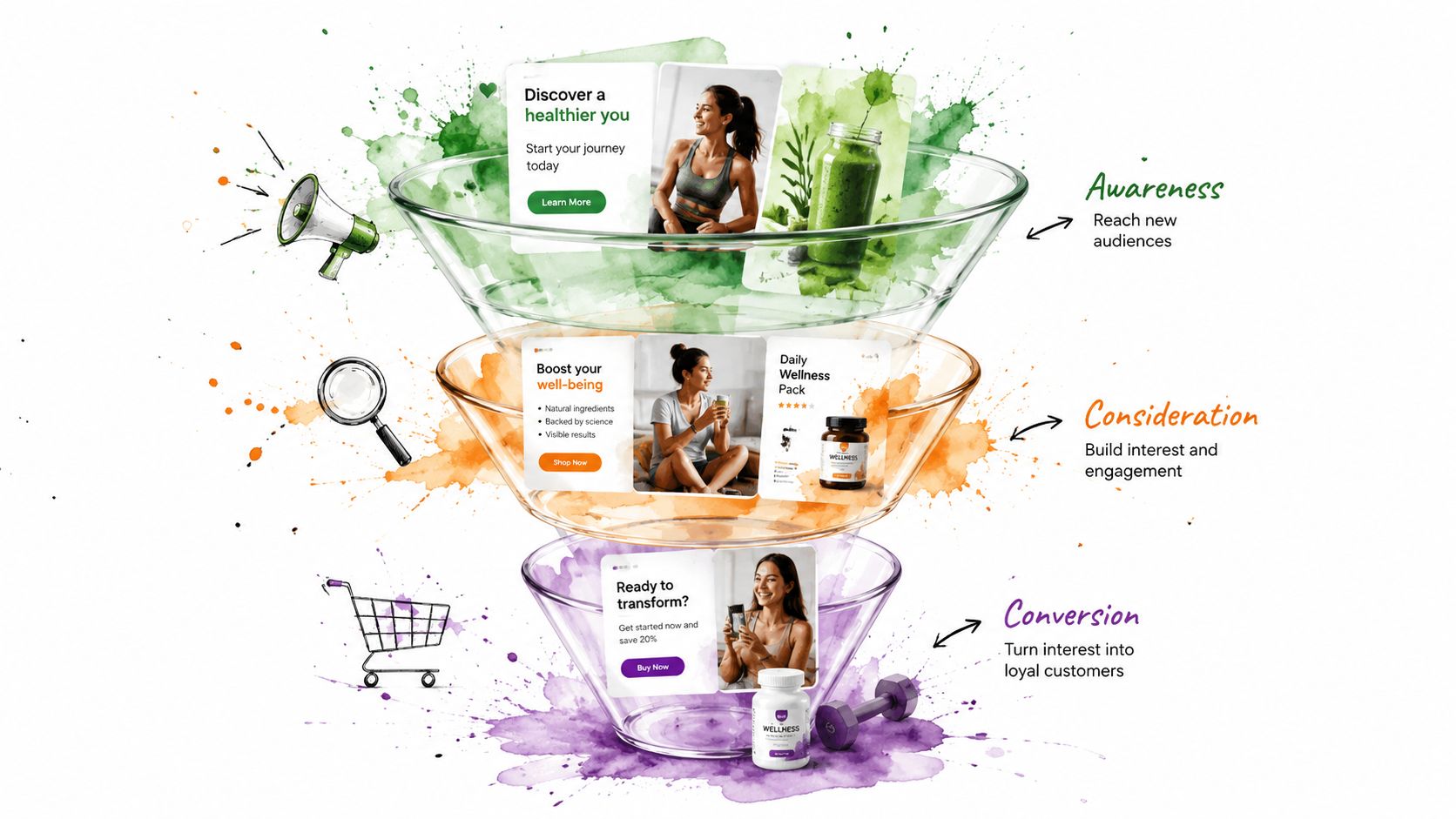
A useful funnel map has three stages:
- TOF, or top of funnel: Introduce the problem, category, or desired outcome. Measure qualified attention and movement into a meaningful next step.
- MOF, or middle of funnel: Address objections, explain the mechanism, and show proof. Measure engaged inquiries, product consideration, or returning visits.
- BOF, or bottom of funnel: Make the decision easy with a clear offer, relevant product, appointment path, or direct purchase action. Measure revenue, booked appointments, and qualified opportunities.
Creative should match the buyer's question
Short-form, creator-style, founder-led, testimonial, and product-demonstration assets often give Meta more useful variation than branding-only executions. The point isn't to make every ad look casual. The point is to show the product in use, make the problem recognizable, and answer the objection that blocks action.
For a local service provider, that could mean a technician explaining the inspection process, a customer describing the experience, and a simple offer that removes uncertainty. For an e-commerce brand, it could mean a product demonstration, a comparison, a routine, and a customer reaction.
The ad is only the first conversion surface. After the click, inspect:
- Message match: Does the landing page repeat the promise the ad made?
- Load experience: Does the page become usable quickly on mobile?
- Proof: Are reviews, guarantees, qualifications, or product evidence visible near the decision point?
- Friction: Can a buyer book, buy, or submit details without unnecessary steps?
Revenue test: If the ad produces attention but the landing page loses intent, the campaign isn't efficient. The funnel is simply charging you for the privilege of finding the leak.
Your CRM should route leads, record sales status, and trigger appropriate follow-up. Lifecycle email or messaging can nurture people who aren't ready today. Reviews and reputation management can create proof for future creative. That loop turns one response into reusable commercial intelligence.
Run the system on a cadence:
- Weekly: Refresh or rotate creative before fatigue becomes obvious.
- Monthly: Test landing-page messaging, form friction, offer presentation, or checkout experience.
- Quarterly: Review funnel economics, lead quality, repeat revenue, and channel contribution.
Use landing page split testing to make post-click improvements deliberate rather than anecdotal.
Choosing the Right Meta Strategy for SMBs Versus E-Commerce Brands
A local service company and an e-commerce brand shouldn't inherit the same Meta campaign structure. One sells conversations, appointments, and trust. The other sells products, margin, repeat purchase behavior, and catalog breadth.
For service businesses, start with a conversion path that the sales team can handle. Lead Ads, click-to-message, and WhatsApp-oriented flows can work when the business responds quickly and qualifies consistently. Use geographic boundaries that reflect serviceability, then let creative do more of the qualification by naming the problem, customer type, urgency, or service area.
E-commerce teams need a different operating model. Catalog quality, product economics, landing-page relevance, checkout performance, and post-purchase retention determine whether acquisition can scale. Advantage+ shopping and catalog-led campaigns can reduce manual allocation work, but they won't compensate for poor product feed data or creative that fails to explain why the product deserves attention.
The following matrix is a starting point, not a rigid rulebook.
| Dimension | SMB / Service Business | E-Commerce Brand |
|---|---|---|
| Budget tier | Start with a controlled budget that can generate usable lead volume without overwhelming sales capacity | Fund enough activity to evaluate purchase and value signals without risking core operating cash |
| Creative cadence | Refresh local proof, offer framing, objections, and service explanations regularly | Maintain a steady pipeline of UGC-style, product-demo, comparison, and offer creative |
| Funnel stage | Prioritize MOF and BOF when demand is intent-led, then add TOF education | Combine broad prospecting with product discovery, retargeting, and post-purchase retention |
| Primary KPI | Qualified leads, response speed, and booked appointments | Contribution margin, ROAS, average order value, repeat purchase, and blended efficiency |
| Automation level | Use automation for placement and lead routing, retain human qualification | Use catalog, automated placements, audience expansion, and value-oriented optimization |
| Risk tolerance | Protect service capacity and reputation. More leads aren't useful if nobody follows up | Protect margin and cash flow. Revenue growth without contribution economics is expensive theater |
SMBs should resist vanity metrics such as cheap form fills. E-commerce brands should resist treating platform-attributed revenue as the entire financial truth. Both need a CRM or customer database that connects the ad response to the outcome. A practical guide to building that foundation is advertising strategy for small business.
Service Business and E-Commerce Case Scenarios in Practice
The following scenarios are planning examples, not reported case studies. They show how the operating logic changes by business model, and they avoid pretending that one account's outcome transfers neatly to another.
Scenario one for a local service business
A residential HVAC company allocates $1,500 per month to lead generation. The team limits delivery to its serviceable geography, tests lead-form creative around urgent repairs and seasonal maintenance, and routes each inquiry into a CRM with clear ownership.
The business judges performance by qualified leads and booked appointments, not form-fill rate. A fast response workflow asks basic qualification questions, assigns the inquiry to the right representative, and records whether the appointment occurred. The company accepts that a narrower service area may reduce raw volume because an out-of-area lead has no commercial value.
Scenario two for an e-commerce brand
A mid-market skincare brand allocates $25,000 monthly to Advantage+ Shopping. It operates with a $45 average order value and a 1.8% baseline conversion rate, then aligns its catalog structure, creator-led UGC, landing pages, and post-purchase email and SMS flows.
The team rotates creative regularly, separates product education from offer-led assets, and uses the CRM to identify repeat buyers and customer concerns. It accepts that broader delivery reduces manual control, while the catalog and conversion system must become more disciplined. The team reviews performance by product economics and blended revenue, not only by the platform's reported return.
| Dimension | Local Service Business | E-Commerce Brand |
|---|---|---|
| Commercial action | Lead, call, message, or booked appointment | Product view, checkout, purchase, or repeat order |
| Primary constraint | Service area, staff capacity, response speed, and reputation | Margin, inventory, feed quality, creative fatigue, and retention |
| Best feedback loop | CRM stage, appointment outcome, close status, and review request | Purchase value, product margin, repeat behavior, email and SMS revenue |
| Creative emphasis | Local proof, urgency, expertise, and objection handling | Demonstration, creator use, comparison, product benefits, and offer |
| Main trade-off | Accept less raw lead volume to protect qualification and capacity | Accept less manual audience control to gain broader algorithmic discovery |
The lesson is straightforward. A campaign isn't “working” because it generated the cheapest event. It works when the event moves through the business and produces an outcome your economics can support.
Turning Meta Advertising Into a Predictable Growth Engine
Meta advertising compounds only when it sits inside a connected growth loop. The media account creates opportunities, but four operating systems determine whether those opportunities become profit:
- CRM: Captures every lead, records status, scores quality, and returns meaningful outcomes.
- Reputation: Requests and manages reviews, then feeds authentic proof back into ads and landing pages.
- CRO: Improves message match, page clarity, form completion, checkout flow, and trust.
- Lifecycle marketing: Follows up with undecided prospects and creates repeat revenue from existing customers.
Without those connections, increasing spend can expose operational weakness. More leads can overwhelm a sales team. More traffic can amplify a slow page. More purchases can create support issues that damage reviews. The account may show growth while the owner sees little improvement in cash generation.
The metric that matters is the revenue your business can keep, not the activity Meta can report.
A growth-tech hybrid approach makes the handoff explicit. Strategy, creative, media buying, CRM operations, reputation management, and CRO should share ownership of one commercial number. The Advertising Suite's membership is designed to provide that connective layer, with a proprietary CRM and automated review management software, plus a 25% discount on all services for members. The broader predictable profit framework reflects the same principle, connect acquisition to customer experience instead of managing channels in isolation.

The Advertising Suite combines human-led growth strategy, Meta and broader paid acquisition, creative development, CRO, CRM infrastructure, and reputation management into one revenue-first operating system. Visit The Advertising Suite to request a demo or book a growth consult, and turn your Meta spend into an accountable extension of your team rather than another vanity-metric experiment.