The most popular Instagram advertising advice is to chase the placement with the cheapest clicks or the most reach. That's a quick way to spend money without learning whether the people who saw your ad became customers.
A better first campaign starts with the revenue event you can measure, then tests audiences and creative against qualified leads or sales. Reels and Feed can serve different jobs in the funnel, so the fastest-growing placement doesn't automatically deserve the biggest budget.
Choose the Objective That Matches Your Revenue Goal
A wrong campaign objective can waste budget before the creative gets a fair test. The objective tells Meta what kind of result to seek, so choosing engagement when you need booked appointments can steer delivery toward people who interact with posts rather than people likely to inquire.
| Objective | Optimizes for | Best used when | Judge it by |
|---|---|---|---|
| Awareness | People likely to see or recall the ad | Launching a new brand or entering a new market | CPM, reach, frequency |
| Traffic | Link clicks or landing page views | Sending visitors to an offer page | Cost per landing page view, page conversion rate |
| Engagement | Post engagements, profile visits, saves | Building social proof before retargeting | Cost per engagement, saves, profile visits |
| Leads | Form submissions or call and message leads | Local services and consultations | Cost per qualified lead |
| Sales | Purchases tracked by the Meta Pixel or catalog | Stores with a working purchase pixel and steady order volume | ROAS, cost per purchase |
| App promotion | Installs or in-app actions | Mobile apps with a tracked SDK | Cost per install, cost per in-app event |
A local HVAC company that needs service calls should start with Leads, using a call or form goal. A post with plenty of likes might look lively, but it doesn't fill the appointment calendar unless it leads to qualified inquiries.
An online skincare brand with a functioning purchase event should choose Sales and assess cost per purchase and return on ad spend. Optimizing a revenue campaign for inexpensive clicks or reach can attract curious visitors who don't buy. For a broader explanation of how Meta advertising works, see this guide to Meta advertising.
Practical rule: Choose the objective closest to the revenue event you can already track. Move up the funnel only when there isn't enough conversion activity to optimize reliably.
Audiences That Match How Buyers Actually Decide
Broad targeting paired with relevant creative can outperform a hand-built stack of interests. The delivery system needs useful conversion signals, and narrowing the audience too aggressively can make it harder to find people who are likely to take action.
Start with broad delivery, including Advantage+ audience, where available. Then build more specific audiences around actual customer behavior: website visitors, existing customers, and people who have already engaged with the business. Customer lists can support retention campaigns, while lookalikes can help find new prospects who resemble a valuable seed audience.
For local businesses, geography is a business constraint, not a creative preference. Target the actual service area and exclude places the team can't serve. For franchises and multi-location brands, separate ad sets by location so lead quality and revenue can be reviewed store by store instead of hidden in a blended total.
Age data can inform a test, but it can't choose a winner on its own. In January 2025, people aged 25–34 made up 33.0% of Instagram's reported adult advertising audience, and those aged 18–24 made up 31.6%. Together, the groups represented 64.6% of that audience, but those shares don't establish which group will buy a particular product or service (DataReportal's global overview report).
A family law firm, for example, may find that older prospects generate more qualified consultations than the platform's largest age segments. The person who sees an ad, the person who researches an offer, and the person who makes the purchase decision may be different people.
Judge each audience by qualified inquiries, completed purchases, and revenue, not by reach alone. Use audience segmentation strategies to structure comparisons around buyer behavior rather than assumptions.
Creative Formats and Placements That Earn Attention
Most ads lose attention before the offer is clear. Choose the format for the job the ad needs to do, not just because a placement is popular.
| Format | Aspect ratio | Main placement | Best use |
|---|---|---|---|
| Single image | 1:1 or 4:5 | Feed, Explore | Clear product shots and one offer |
| Carousel | 1:1 or 4:5 per card | Feed | Multi-product catalogs and step-by-step education |
| Reels video | 9:16 | Reels | Cold prospecting, short demos and low-cost reach |
| Stories video or image | 9:16 | Stories | Time-limited offers and direct response with a link sticker |
| Feed video | 4:5 or 1:1 | Feed | Testimonials, longer explainers and retargeting |
Reels deserves a deliberate test, but not an automatic budget increase. Sensor Tower data indicates that more than half of Instagram ads ran in Reels in 2025, compared with 35% in 2024; the same source says growth in Instagram daily active users was led by increased Reels usage (CNBC's report on Instagram ad placements). That shift makes Reels important inventory, not proof that its viewers are the most valuable prospects.
Compare placements with the offer, audience, attribution window, and conversion event held constant. Run a Reels-only ad set against Feed or Stories, then compare cost per qualified lead and booked revenue, not CPC alone. Reels may work as the prospecting engine, while Feed or Stories may close more efficiently. The account's own downstream results should decide.
Keep the creative simple:
- Lead with the hook: Put the reason to keep watching at the start.
- Add captions: Make the message clear with sound off.
- Use one offer: Give the viewer one straightforward next action.
For practical guidance on matching the message to the placement, see creative strategy for advertising.
Budget, Bidding and Measurement Benchmarks
Budget should support the event you're optimizing for. If an ad set doesn't get enough conversion activity to learn, splitting a limited budget across many audiences can leave every test underpowered. Consolidate before lowering the standard for a qualified result.

Start with the lowest-cost bid strategy while you learn what results the campaign can produce. Consider a cost cap only after you have a defensible target based on actual account performance. Then check the numbers that connect delivery to business outcomes:
| Metric | What it tells you | Formula | How to read it |
|---|---|---|---|
| CPM | Cost per thousand impressions, the price of reach | Spend ÷ impressions × 1,000 | A rising CPM with flat creative can signal audience saturation |
| Link CTR | Link clicks as a share of impressions | Link clicks ÷ impressions | Compare against your own past campaigns, not a universal benchmark |
| Link CPC | Cost per link click | Spend ÷ link clicks | Cheap clicks don't matter if the page doesn't convert |
| Cost per lead or purchase | Spend per conversion | Spend ÷ conversions | Compare it to customer margin |
| ROAS | Revenue returned per ad dollar | Attributed revenue ÷ spend | Read alongside CRM revenue and margin |
| Frequency | Average times each person saw the ad | Impressions ÷ reach | Rising frequency with falling CTR can signal fatigue |
Ads Manager attribution is useful for analyzing delivery, but it isn't the whole revenue record. Compare reported conversions with CRM revenue and treat platform ROAS as directional, especially when customers take time to decide or return through another channel. For more context on interpreting the numbers, use this guide to ad performance metrics.
Market reporting matters too. Meta's planning estimates put Instagram's January 2025 advertising audience at approximately 414 million in India, 172 million in the United States, and 141 million in Brazil. These are potential ad-reach estimates, not audited counts of unique active users (Instagram audience estimates by market). If a campaign spans countries with different languages, prices, currencies, and conversion rates, report results by country so blended figures don't disguise which market is working.
How to Build Your First Campaign Step by Step
A campaign has three levels: the campaign sets the objective and budget, the ad set controls audience, placements, and schedule, and each ad contains the creative and destination. Before setup, connect the business account to its Facebook Page and Instagram account, add a payment method to the ad account, and install the Meta Pixel on the website.
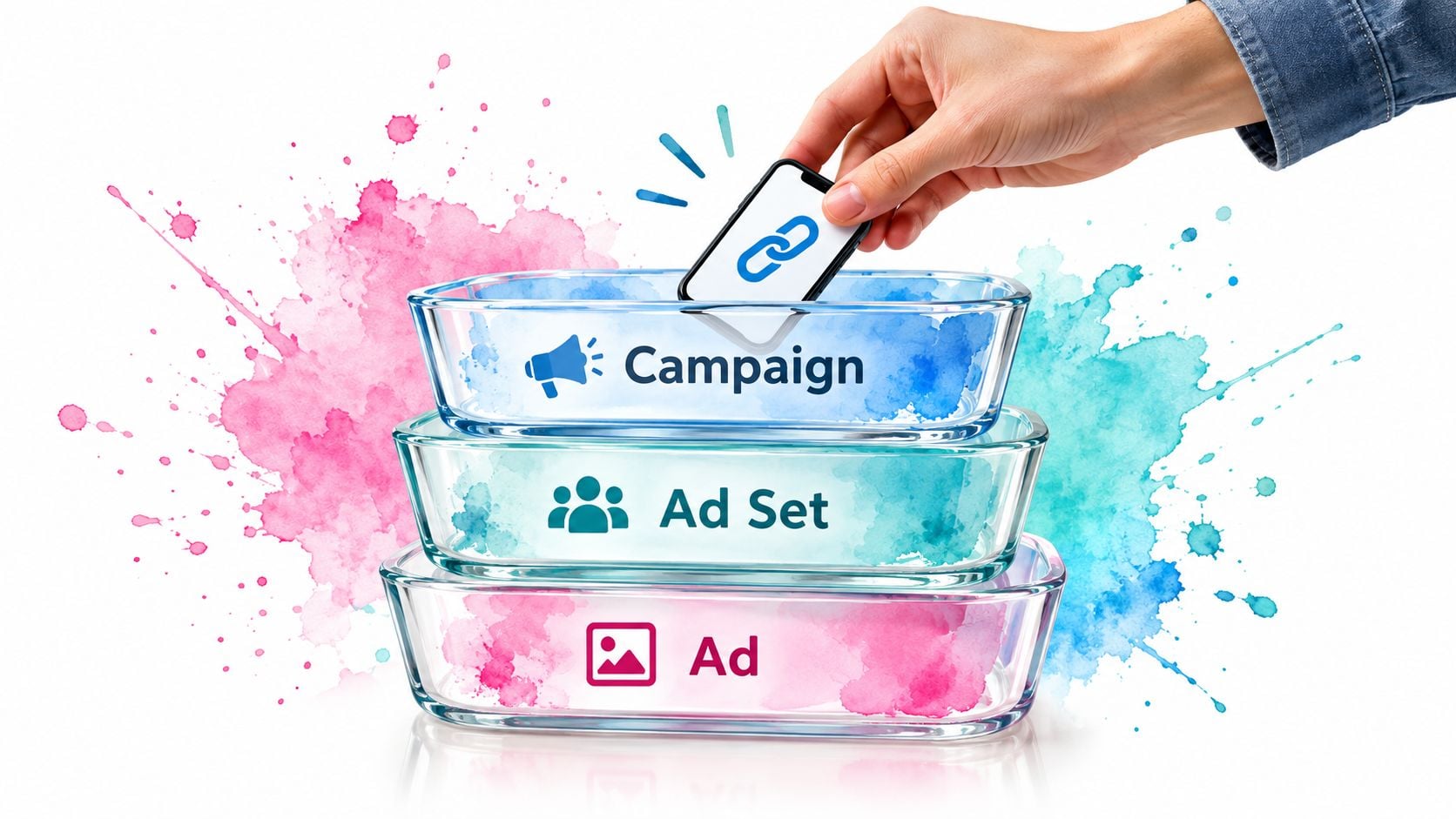
Create the campaign and choose its objective. In Meta Ads Manager, pick the objective that matches a revenue event you can measure. A sales campaign set to traffic optimizes for visits, not purchases, so it can deliver plenty of clicks without qualified leads or revenue.
Set the campaign budget. For an always-on campaign, use a daily budget and check that each ad set can collect enough conversion events to learn. If an ad set receives too few events, results may be hard to interpret and delivery may struggle to optimize.
Define the ad-set audience and conversion event. Set the location and age range, then choose an audience using the broad-to-specific approach that fits the business. Match the optimization event to the objective. Optimizing for an easier action can increase activity without producing the qualified outcome the business needs.
Choose placements with their funnel jobs in mind. Automatic placements are a reasonable starting point. Reels can introduce the offer to new prospects, while Feed may be more useful for evaluation or closing. Keep placements together unless results show a meaningful difference in cost per qualified lead and downstream revenue, not just cost per click.
Build the ad and destination. Connect the Instagram account, choose a format that suits the placement, write the primary text, select a call-to-action button, and add the destination URL with UTM tags. Tagged links make campaign traffic easier to separate in reports.
Test conversion tracking. Submit a form or complete a test purchase to confirm that the Meta Pixel and Conversions API record the intended event. If it does not register, the campaign cannot optimize reliably for that action.
Publish, then avoid unnecessary edits. Let the ad set gather results before repeatedly changing its targeting or creative. Significant edits can disrupt delivery and make it harder to judge whether the original setup worked.
Once the campaign is live, compare platform-reported results with qualified leads and revenue recorded after follow-up. Judge each placement by the value it contributes to the funnel, rather than assuming the cheapest clicks will produce the strongest business result.
Fix Weak Results Before You Scale
Read the funnel from the top down and find the first step that's failing. Strong link engagement paired with a weak cost per lead usually points to the landing page or form, not automatically to the ad. Changing everything at once hides the cause.
| Symptom | Likely cause | Fix |
|---|---|---|
| High CPM and low reach | Audience too narrow or ad sets overlapping | Broaden targeting and consolidate ad sets |
| Strong link CTR but weak cost per lead | Landing page message mismatch or slow load | Match the headline to the ad, cut load time and shorten the form |
| Clicks but few form fills | Form too long or unclear next step | Use a short form and one clear call to action |
| Frequency rising with falling CTR | Creative fatigue | Test new hooks and angles |
| Ad sets stuck in learning | Too few optimization events per ad set | Merge ad sets, increase the budget if viable, or use a higher-volume event |
| Reels spend rising while sales stay flat | Prospecting placement not closing | Test closing budget in retargeting through Feed or Stories |
Then inspect the page on a phone. Repeat the ad's promise in the first screen, make the next action obvious, and remove form questions that aren't needed to qualify or contact the lead.
A home-services page may lose submissions after the business replaces a short quote form with a long questionnaire. If the conversion rate drops from 2.1% to 0.9% after that change, the form is a plausible cause to investigate, not proof that the ad stopped working. Restore a shorter version, retest it, and compare cost per lead with the previous period before changing the creative.
Launch a 30-Day Test Before You Scale
A campaign that spends more is not necessarily a campaign worth scaling. Use the first month to test whether Instagram placements generate qualified leads and revenue, not just clicks.
Week one: Set one objective, two creatives, and two audiences. Apply the budget logic covered earlier.
Week two: Limit edits so you can compare ad sets once results have stabilized.
Week three: Pause the weaker creative and shift budget toward the ad set with the lowest cost per qualified lead.
Week four: Compare campaign results with CRM revenue, then decide whether to scale, hold, or rebuild.
Judge Reels and Feed by their funnel roles. Reels can introduce the offer to new prospects; Feed can support retargeting and conversion. Keep a placement only if its cost per qualified lead and downstream revenue justify the spend. Account results vary, so use your own sales data rather than treating clicks as the final measure.
If results stall, use the symptom-to-fix table rather than guessing. For a cleaner read, follow this guide to designing advertising experiments. Missing pixel setup, UTM tracking, or CRM attribution can make campaign results hard to assess. Review those gaps, your budget, and creative against your margins before launch. The Advertising Suite combines human-led advertising strategy with CRM and reputation-management software to support measurement and customer experience.
Connect Instagram campaigns to qualified leads, sales, and follow-up. Visit The Advertising Suite to book a Growth Consult.