Stop chasing vanity metrics with automation. If your “automated examples” only produce cleaner reports, prettier dashboards, and more clicks, they're not helping revenue, they're helping people feel busy. The hard truth is that automation is now a core operating layer, not a novelty, with McKinsey-estimated work-activity automation potential reaching 60% to 70% of all work activities using current technology and a market projected as high as $19.6 billion by 2026 in the cited enterprise automation reference (ServiceNow automation statistics). That scale is why the best workflows focus on pipeline, conversion, retention, and attribution.
A common mistake is automating the wrong thing first. Teams speed up bad processes, then wonder why the pipeline still leaks. The better move is to automate the moments that change revenue outcomes: lead qualification, follow-up, reputation, conversion, audience expansion, compliance, and reporting.
1. Automated Lead Scoring and CRM Segmentation
Lead scoring is where revenue-first automation starts because it stops sales teams from guessing. The best setups read behavior across website visits, ad interactions, and email engagement, then push the lead into the right path in real time. That means a high-intent prospect gets routed fast, while a lukewarm lead gets nurtured instead of clogging the sales queue.
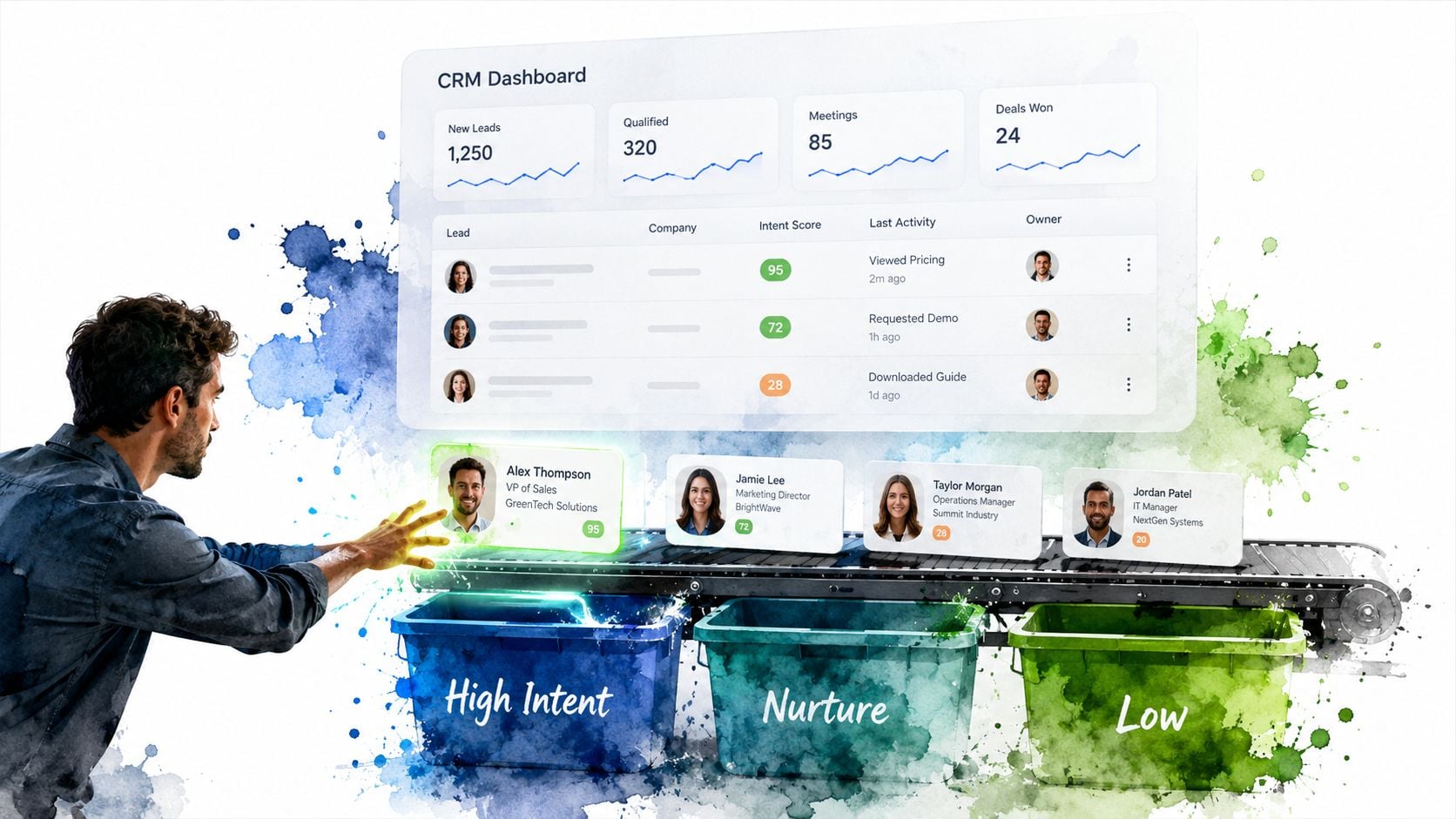
A battle-tested setup uses your CRM as the decision engine. The Advertising Suite's integrated CRM should ingest the signal stack, website behavior, ad clicks, email opens, and demo requests, then assign scores that reflect buying intent, not vanity engagement. That aligns with the implementation pattern seen in a 145+ case-study review of business process automation, where teams first map workflows, identify repetitive or error-prone steps, and define measurable KPIs before automating (Exactimo case-study review).
Practical rule: Start with your top three conversion signals, set thresholds your sales team can actually handle, and review the scoring logic monthly.
A useful real-world pattern looks like this:
- Demo request plus pricing page visit: route to sales immediately.
- Email open plus product-page browse: move into a nurture sequence.
- Low-fit role or industry: suppress direct outreach and protect rep time.
Many teams waste money. They score everything and prioritize nothing. Your CRM should make the next step obvious, because speed to the right conversation is what moves revenue.
For service businesses, this works especially well when paired with The Advertising Suite CRM for service businesses, because lead quality and follow-up discipline matter more than raw volume. If a franchise or local operator gets 100 “hot leads” a day but can only handle 20, the automation failed. Capacity has to shape the scoring model.
2. Omni-Channel Retargeting Sequences
Retargeting only works when the message matches the action. The usual approach blasts the same ad everywhere and labels it personalization. That is wasted spend, not strategy.
The better workflow tracks micro-actions, then coordinates the next touch across Google, Meta, email, and SMS. A product-page visitor, a cart abandoner, and a webinar attendee need different follow-up. The best retargeting systems use the exact behavior as the trigger, then connect the next touch to the next likely objection.
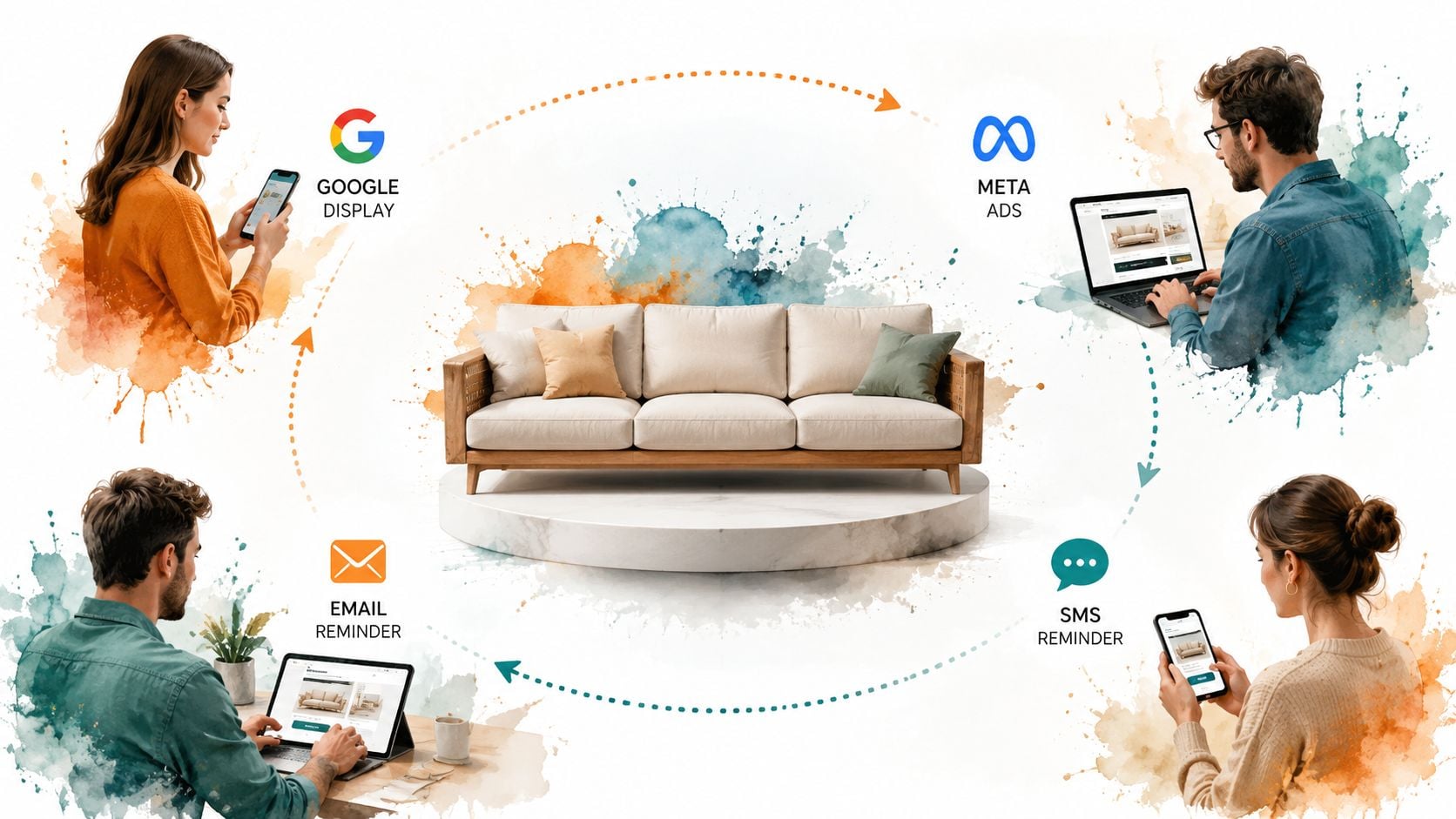
The logic should stay simple. If someone abandons a high-ticket item, they see the product again in a visual channel, proof in a social format, and a reminder in email. If someone attends a webinar but does not book, they get case-study content and a direct prompt. That is the kind of sequencing The Advertising Suite should build inside an omni-channel marketing strategy, because disconnected touches burn budget and weaken intent.
The point of automation is not more noise. It is better timing. As noted in Windward Studios automation statistics, marketing automation now sits at the center of customer interaction, which is exactly why retargeting has to be controlled, not random. Orchestration beats repetition.
Do not retarget every visitor. Retarget the people whose action signals a real buying step.
Keep the sequence disciplined:
- Segment by action: visited, abandoned, registered, or requested.
- Match creative to the item viewed: show the exact product or offer.
- Respect frequency caps: more exposure is not the same as more conversion.
- Exclude recent buyers: wasted spend is still wasted spend.
If you care about revenue, retargeting is not an awareness play. It is a timed recovery system for lost intent.
3. Automated Review Generation and Reputation Management
Reviews are not a branding side quest. For local service businesses and franchises, they drive revenue because they shape trust before a call ever happens. The right workflow asks at the right moment, catches negative feedback early, and turns reputation into a managed asset.
The best systems trigger right after a successful service or purchase, while satisfaction is still fresh. They route happy customers to public review platforms and send unhappy ones to your internal team before the issue spreads. The Advertising Suite should treat this as part of its reputation management strategy, because reputation and conversion move together.
A documented benchmark shows why this matters. One HVAC franchise network moved from 3.8 to 4.6 Google stars in 6 months, and qualified leads from search increased 34% in the same example set. A dental practice also automated post-appointment review requests and shifted from 2 to 3 new reviews monthly to 15 to 20. Use those numbers as proof that review flow changes downstream demand, not just star count.
Make the process dead simple:
- Ask immediately post-service: don't wait until excitement fades.
- Use one-click or SMS flows: friction kills response.
- Personalize the ask: name, service, and location matter.
- Respond within 24 hours: every review deserves an answer.
Negative reviews are not the crisis. Ignoring them is the crisis.
The value is operational. If customers complain about responsiveness, wait times, or follow-up quality, your review inbox becomes a signal system for training and process fixes. That is how reputation management stops being a cosmetic layer and starts improving retention, search performance, and close rates. Use The Advertising Suite marketing automation workflow to connect those alerts to the rest of the revenue path, so follow-up is fast and tied to what happened.
4. Dynamic Email Nurture Campaigns with Behavioral Triggers
Generic email nurture is just automated noise. The revenue version reacts to behavior, changes the message, and stops when the prospect stops behaving like a prospect. That's the difference between a sequence and a broadcast.
The best systems split audiences by what they did. A pricing-guide downloader needs different content than a webinar attendee. Someone who opened four emails without clicking deserves a different path than someone who ignored everything. The goal is to keep the message relevant enough to move a buyer forward without repeating what they already saw in ads.
A B2B SaaS example in the plan notes used separate sequences for whitepaper downloaders and free-trial clickers, and the trial-signup lift was 41%. Because that exact figure is part of the provided planning data, the lesson is simple, segmentation beats generic nurture every time. Pair that logic with your CRM and ad stack so email reinforces, not duplicates, the rest of the funnel.
The Advertising Suite marketing automation workflow should connect behavioral email to the rest of the revenue path. If a prospect clicks a case study but doesn't book, they should see a relevant follow-up email and a matching retargeting ad. If they open but don't click, send a different value angle, not the same pitch in a new wrapper.
A good sequence follows this order:
- Lead with value: make the email worth opening.
- Use behavioral branches: clicks, opens, and no-engagement paths should diverge.
- Keep it short: three to five emails is enough for most nurture tracks.
- Pair with visual reminders: ads can rescue prospects who ignore inboxes.
The sharper your segmentation, the less you have to push. That's why behavioral nurture drives revenue better than a scheduled drip that treats every contact like they're in the same buying mood.
5. Automated Conversion Rate Optimization Testing Framework
Traffic is expensive. Wasting it on weak landing pages is a tax on bad discipline. A strong CRO automation system tests the page, learns from the results, and keeps pushing traffic toward the better-performing variation without waiting for manual heroics.
The value isn't just testing button colors. It's testing the elements that change decisions, headlines, form fields, offer position, and call to action wording. One documented example in the plan notes shows an e-commerce site reducing form fields from 8 to 5 and lifting conversion by 18%. Another example says a SaaS landing page found “Stop Losing Leads” outperformed “Grow Faster” by 23%.
That's the right mindset for conversion rate optimization. You're not decorating pages, you're removing friction and raising the percentage of paid traffic that becomes pipeline.
Use a disciplined testing rhythm:
- Test the high-impact elements first: headline, CTA, form length, offer.
- Change one variable early on: don't create a guessing contest.
- Run tests long enough to stabilize: short tests often lie.
- Record winners in a living log: build institutional memory.
The best CRO teams don't chase cleverness. They protect conversion with repeatable tests.
The reporting piece matters too. If your CRM captures the conversion data, audience segmentation and retargeting get smarter after each test. That means the page isn't isolated from the rest of the stack. It feeds the whole revenue engine.
6. Automated Audience Expansion and Lookalike Modeling
When your core audience starts to saturate, CAC rises and growth gets sloppy. Automated audience expansion solves that by finding new prospects who resemble your best customers, not just your recent converters. That distinction matters because not all customers are equally profitable.
The strongest model starts with your top customers by lifetime value, margin, or speed to convert. Then it builds expanded audiences across Google, Meta, and other platforms based on the behavior patterns that matter most. A plan note example says one e-commerce brand found its 20% highest-margin customers shared specific browsing behavior, and the lookalike audience improved AOV by 12%. That's the kind of signal worth building from, because revenue quality matters more than raw volume.
A second example in the plan notes says a B2B SaaS company used lookalike modeling to expand into new industries and discovered its best customers came from mid-market tech, not enterprise. That's the real power of lookalikes, they can tell you where the market actually is, not where you assumed it was. For franchise and local operators, the same logic can show which secondary markets deserve expansion.
Use these rules:
- Build from best customers, not just buyers: margin beats vanity conversion.
- Create tiers of similarity: aggressive, balanced, and exploratory.
- Exclude existing customers: lookalikes are for acquisition, not overlap.
- Refresh monthly: stale seed data makes stale targeting.
The best audience expansion systems don't just scale spend. They scale the right spend. That's how you avoid paying more for worse customers.
7. Automated Compliance and Consent Management for Privacy-First Advertising
Privacy is not an admin issue anymore. It's a delivery issue, a legal issue, and a trust issue. If your CRM, email platform, and ad accounts don't sync consent correctly, you're creating risk every time someone opts out and still gets touched.
This workflow has one job, keep consent, preferences, and targeting rules aligned across the stack. That means your CRM needs to know what a user agreed to, your email platform needs to respect it, and your ad accounts need to stop reusing the data when the user withdraws consent. For The Advertising Suite, this should be part of the built-in integrated CRM and reputation ecosystem, not a bolt-on afterthought.
The provided examples are blunt. An e-commerce company avoided a $27K CCPA fine by implementing automated consent management before audit, and a multi-location service provider reduced email list churn by 8% after adding a transparent consent and preference center. A B2B SaaS example also used automated consent to support GDPR-compliant expansion into the EU. Those are real business outcomes, not compliance theater.
A good system does this:
- Capture consent at the right moment: signup and post-purchase, not buried in fine print.
- Store timestamps and decisions: proof matters during inspection.
- Sync daily: stale opt-out data creates unnecessary exposure.
- Make preferences easy to manage: trust improves when control is visible.
Over-communicate privacy. Customers forgive clarity. They don't forgive surprise retargeting.
Privacy-first automation also improves efficiency. When consent data is clean, the ad stack stops wasting spend on users who should've been excluded in the first place. That's not just safer. It's cleaner economics.
8. Automated Performance Reporting and Revenue Attribution
If reporting cannot tie spend to revenue, the team is guessing with expensive software. Automated attribution fixes that by connecting channel data, CRM activity, and sales outcomes into one operating view. The point is not prettier dashboards. The point is better decisions.
A solid setup maps the full path from ad spend to clicks, leads, customers, and revenue. Stronger versions go further and include contribution margin, customer lifetime value, and payback period, because ROAS alone can hide bad allocation. In the examples reviewed, one e-commerce brand found that Meta was driving 40% of revenue, not 15% as older reports showed, and after shifting budget, quarterly revenue grew 28%. Another example showed email nurture sequences contributing $340K/year in indirect revenue for a service business, while a SaaS founder paused campaigns when CAC hit $850.
That is why attribution belongs inside the revenue stack, not in a spreadsheet graveyard. The Advertising Suite should connect this directly to CRM data so leaders can see what produces profit, not just activity.
Use this reporting discipline:
- Pick one attribution model and stick with it: consistency beats chaos.
- Track leading indicators too: lead volume, stage progression, cycle length.
- Set alerts on key outliers: do not wait for month-end surprises.
- Review trends, not one-month spikes: noise is everywhere.
As noted earlier, marketing automation is already mainstream in retail and advertising, which is exactly why measurement has to mature with it. Once the channels are automated, the reporting has to become automated too. Otherwise, you are scaling confusion.
8-Point Automated Marketing Comparison
| Item | Implementation complexity | Resource requirements | Expected outcomes | Ideal use cases | Key advantages |
|---|---|---|---|---|---|
| Automated Lead Scoring & CRM Segmentation | Medium–High: integrations and custom scoring models | CRM integration, cross‑channel data, sales workflow mapping, model tuning | +25–35% conversion lift; faster lead routing; less low‑intent noise | B2B SaaS, franchises, high‑touch sales teams | Prioritizes high‑intent leads, clear ROI mapping, reduces manual admin |
| Omni‑Channel Retargeting Sequences | High: cross‑platform tracking and orchestration | Pixel/tagging, creative assets, ad spend, audience sync tools | +40–60% ROAS improvement; recovers warm prospects | E‑commerce, high‑ticket products, webinar funnels | Coordinated cross‑channel messaging, higher conversion from warm audiences |
| Automated Review Generation & Reputation Management | Medium: platform monitoring and workflow setup | CRM/transaction integration, review platform APIs, response templates | 3–5x more reviews; +20–30% qualified leads via local SEO | Local services, franchises, healthcare/dental practices | Boosts local SEO and trust, catches negative feedback early |
| Dynamic Email Nurture Campaigns with Behavioral Triggers | Medium: trigger logic and sequence design | Clean email lists, automation platform, copy/design, CRM sync | +35–60% email‑driven conversions; higher opens/CTR; lower unsub rates | SaaS trial nurturing, cart recovery, post‑consult follow‑ups | Timely personalized messages, adaptive sequences, strong A/B testing |
| Automated Conversion Rate Optimization (CRO) Testing Framework | Medium: test orchestration and analytics | Testing platform, sufficient traffic, UX/design and analytics resources | +20–50% conversion uplift; lower cost per conversion | Landing pages, checkout flows, SaaS signup funnels | Data‑driven wins, traffic efficiency, continuous improvement |
| Automated Audience Expansion & Lookalike Modeling | Medium: customer modeling and audience pipelines | Clean customer data (100+ conversions), ad platforms, modeling tools | Sustains 70–80% core CAC while expanding reach 200–400% | Scale‑ready SMBs, geographic expansion, e‑commerce growth | Scales prospecting profitably, multi‑tier lookalikes, cross‑platform reach |
| Automated Compliance & Consent Management | High: mapping consent across siloed systems and regs | Engineering to sync consent, legal/compliance support, preference center | Reduces regulatory risk; preserves channel health; prevents fines | International expansion, regulated industries, privacy‑sensitive brands | Automated legal protection, maintains deliverability, builds trust |
| Automated Performance Reporting & Revenue Attribution | High: multi‑source integration and attribution modeling | Data integration, clean CRM/transaction tracking, analytics expertise | +15–25% marketing efficiency; clear ROAS/CAC/LTV visibility | Multi‑channel marketers, executives/investor reporting, growth teams | Single source of truth, data‑driven budget allocation, automated alerts |
Your Growth Partner from Automation to Revenue
These automated examples work because they connect software to outcomes that matter, pipeline, retention, reputation, and margin. That's the difference between automation as a gimmick and automation as an operating system. The businesses that win don't automate everything. They automate the parts of the funnel that stop revenue from leaking.
The best implementations also share a pattern. They start with a clean trigger, use data that's useful, and keep a human in the loop where judgment still matters. That's especially true for teams that have been burned by agencies chasing impressions, dashboards, or buzzwords. What they need now is a partner that treats automation as part of a results-first framework, not a shiny add-on.
The Advertising Suite is built for that. With a proprietary CRM, review management software, omni-channel execution, and CRO discipline, the stack is designed to help you turn automated workflows into measurable revenue. If you're scaling a service business, eCommerce brand, or multi-location operation, the right automation should make your team faster, your pipeline cleaner, and your follow-up tighter.
For businesses that want more than generic marketing automation, the bar is simple, build systems that make money and stop wasting time on the rest. The partner you choose should feel like an extension of your team, not another vendor sending reports nobody reads. That's the standard.
If you're ready to turn automated examples into actual revenue, work with a team that builds the workflow, the CRM logic, and the reporting around the same goal. Visit The Advertising Suite to see how our growth-tech approach can plug into your funnel, tighten your follow-up, and turn automation into a predictable profit center.