

Your plumbing firm has a solid customer list, the ads are getting clicks, and the phone still isn't ringing enough. You've selected home improvement interests, narrowed the service area, and watched the potential audience shrink. None of that tells you whether the people seeing your ads will book a job.
Learning how to target an audience on Facebook starts with separating audience size from audience quality. Set the boundaries your business needs, give the platform a meaningful conversion signal, and judge the result against qualified leads and revenue. A cheap click is only useful if it helps someone become a customer.
Facebook Audience Types and When Each Earns Its Place
For that plumbing firm, adding another interest probably isn't the first move. The better question is whether the campaign should reach unfamiliar homeowners, previous website visitors, or customers who already know the business.
Facebook offers enough reach to make all of those approaches possible. The practical challenge is assigning each audience a job, rather than combining every available option into a complicated targeting recipe. Our guide to Meta advertising explains how that audience decision fits into the wider campaign setup.
Facebook audience types compared
| Audience type | Built from | Best for | Watch out for |
|---|---|---|---|
| Interest and demographic targeting | Profile signals you select | Testing a new market or offer with no data | Stacked interests can restrict delivery; estimates aren't precise reach |
| Customer-list Custom Audience | Hashed emails, phone numbers, addresses | Retargeting, excluding customers, new-customer campaigns | Missing identifiers can reduce matching |
| Website Custom Audience | Meta Pixel events on your site | Retargeting visitors by page or action | Short windows can create small pools and rising frequency |
| Lookalike Audience | People similar to a seed audience | Scaling a proven customer list | A weak seed produces a weak starting hypothesis |
| Broad or Advantage+ audience | Primarily location, minimum-age, and language controls | Accounts with steady conversion history | Requires useful conversion signals and offers less manual restriction |
| Exclusions | Audiences removed from delivery | Stopping acquisition spend on existing customers | Missing exclusions can leave unintended overlap |
Use interest targeting as a hypothesis, especially when you're entering a new area without customer history. Someone's interest in renovation doesn't establish that they need an emergency plumber today.
Customer lists and website audiences answer different questions. A customer list identifies people with an established relationship; website activity identifies people who took a particular action, such as viewing a service page without submitting an inquiry.
Lookalikes extend a customer-based hypothesis into prospecting. Broad delivery gives the system more discretion, which becomes useful when your conversion tracking distinguishes genuine business outcomes from casual engagement.
Practical rule: Choose the audience by the job it needs to do, not by how impressive its estimated size looks.
Exclusions deserve their own review because they're easy to overlook. Keep them visible in your campaign notes rather than assuming that separate ad sets automatically mean separate people.
Reliable first-party data reduces guesswork. It doesn't eliminate testing, but it gives you less reason to stack speculative interests.
Build Custom and Lookalike Audiences From Your Customer List
Start with your customer records, not the upload screen. Export the relevant contacts from your CRM or point-of-sale system, remove duplicates, and correct invalid email addresses and phone numbers.
Then separate customers by business value. Recent purchasers, repeat buyers, and customers above a revenue threshold you choose are more useful starting segments than an undifferentiated database containing customers, abandoned inquiries, and old competition entries.
Prepare a source that represents the customers you want
Meta's customer-list guidance recommends at least 1,000 customers in a customer-list Custom Audience, a practical benchmark rather than a universal minimum required to create every Custom Audience.
Don't pad a valuable list with poor-fit contacts just to make it bigger. If your best segment is small, improve record completeness and assess whether a broader group of genuine customers still represents the outcome you want.
- Clean the identifiers. Use consistent contact fields and remove records you can't lawfully use.
- Separate the purpose. Build distinct lists for customer retention, acquisition exclusions, and prospecting seeds.
- Preserve the business meaning. Label each export with its segment and refresh date so someone else can maintain it.
A disciplined first-party data advertising strategy starts with knowing where the records came from and what permission supports their use. Uploading a spreadsheet doesn't make its contents appropriate for advertising.
Lookalike similarity settings and their trade-offs
The following settings illustrate a hypothetical widening plan, not guaranteed performance thresholds. Where these similarity options are available, start close to a strong seed and widen only after the results justify it.
| Similarity | What it finds | When to use it |
|---|---|---|
| 1% | People closest to the seed, with the smallest pool | First test using a highest-value segment and a tight budget |
| 2% to 5% | A broader balance of similarity and reach | After the closest-match test produces qualified outcomes |
| 6% to 10% | Broadest matches, less similar to the seed | Larger-budget testing after narrower versions perform |
A lookalike built from low-quality inquiries gives you another way to pursue low-quality inquiries. Seed quality matters more than a reassuring audience label.
After upload, inspect available match information and delivery eligibility. If the usable audience is much smaller than expected, check missing identifiers and formatting before changing the campaign strategy. Customer information must have appropriate consent and be used only for permitted purposes.
How to Set Up Prospecting and Retargeting Ad Sets
Build the account so you can tell which audience is doing which job. A prospecting campaign should answer whether you can acquire new customers, while retargeting should address people who already showed relevant intent.
Build around the outcome you need
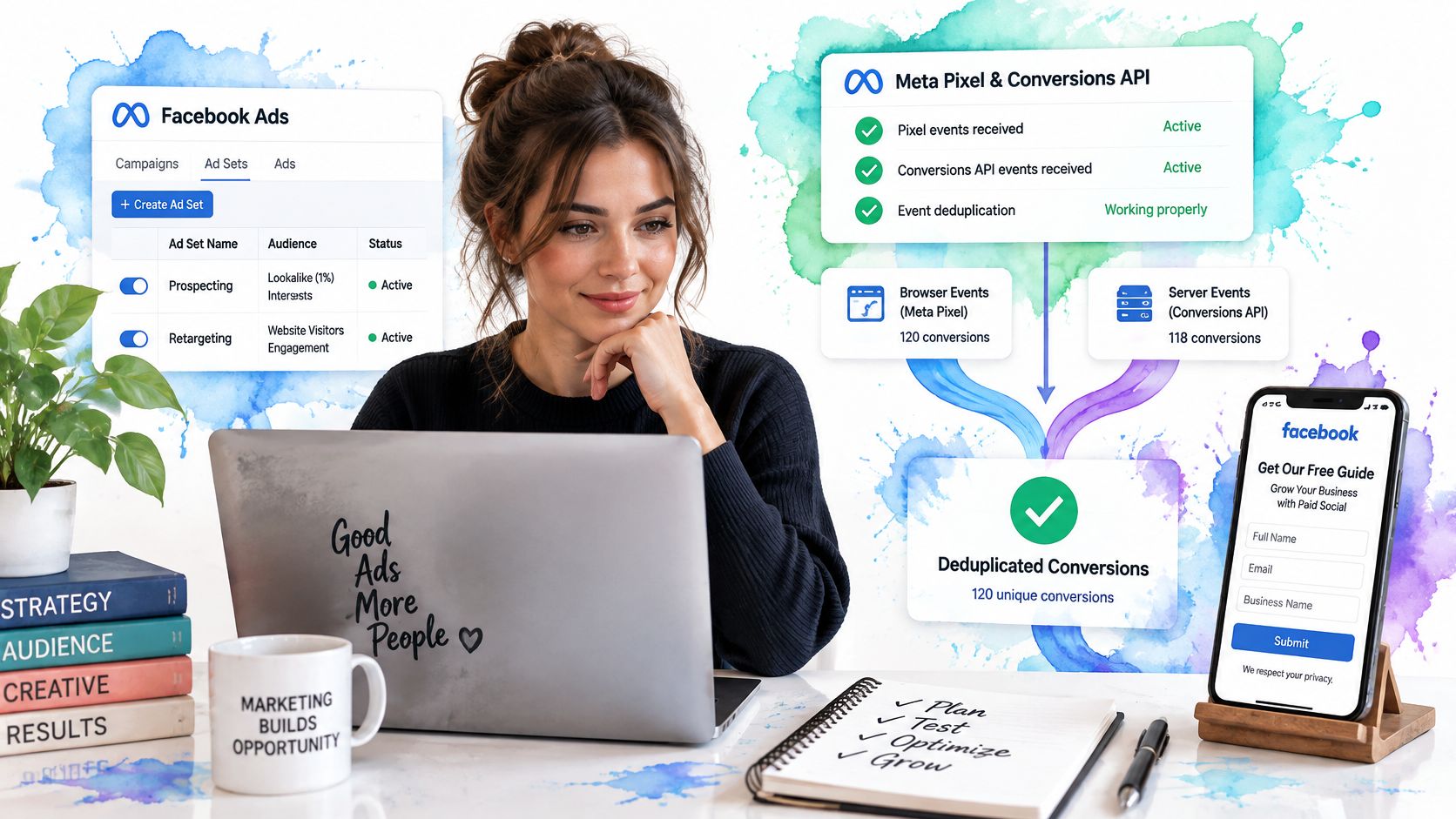
Verify the primary conversion event. Run a test inquiry or purchase and confirm that the Meta Pixel and Conversions API record it correctly. Check deduplication so browser and server reporting don't turn the same action into separate conversions.
Choose the matching objective. Use Sales for purchases or Leads for inquiries and booked-call workflows. Select the deepest reliable event you can measure, rather than choosing traffic because clicks look affordable.
Separate the audience jobs. Create prospecting and first-party retargeting ad sets, then prepare a customer-exclusion audience. Exclusion is a delivery rule applied to an ad set, not a standalone ad set that needs its own budget.
Set genuine business boundaries. Define the serviceable location, minimum age, and language requirements. A local contractor shouldn't pay to reach households the team can't serve, regardless of their apparent interest.
Check controls against suggestions. Meta's Advantage+ audience documentation distinguishes location, minimum age, language, and excluded Custom Audiences as controls, while other characteristics can function as suggestions. If strict qualification is essential, use the available option to further limit reach and verify which criteria restrict delivery.
Give retargeting enough room. As a hypothetical starting configuration, compare a 30-to-60-day visitor window with a very short three-day pool, adjusting for your buying cycle. Someone researching a planned installation needs a different message from someone seeking urgent repairs.
Apply the customer exclusion. Add the customer list to prospecting when the offer is for new customers. Keep repeat-purchase or maintenance promotions separate so the exclusion doesn't accidentally block a legitimate retention campaign.
Freeze the first comparison. Keep creative, offer, budget allocation, optimization event, and attribution window consistent. Record the launch configuration so later edits don't erase the explanation for a result.
Avoid edits that make the test unreadable
Changing budgets daily makes it harder to distinguish an audience effect from a delivery change. Optimizing for link clicks answers the wrong question when the business needs booked work, and forgetting exclusions can make acquisition reporting look stronger than it is.
Use a written launch checklist rather than memory. These Facebook advertising best practices are most useful when someone owns the checks and records what changed, not when they remain a document nobody opens.
Testing Interests Against Broad Targeting Without Fooling Yourself
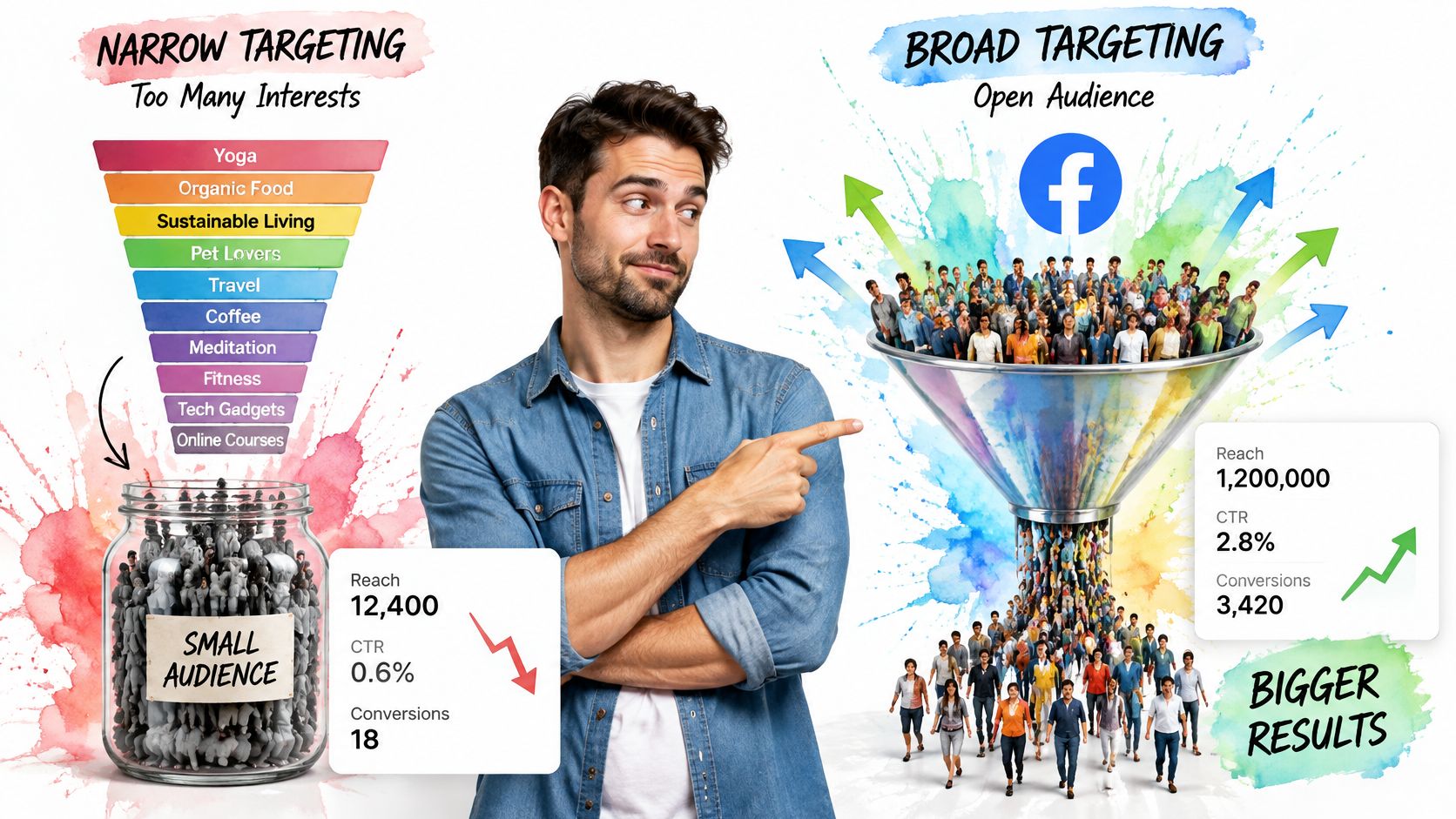
More specific does not mean more relevant. An elaborate stack of interests can exclude people who would buy while retaining people who merely enjoy the topic, which is why size and quality need separate tests.
Starting with audiences of roughly 2–10 million people is recommended in Meta's small-business advertising guidance, because larger pools give delivery more room to find buyers. That range is not a sensible geographic target for every local business. Use it to question unnecessary narrowing inside the market you can serve, then judge the result on qualified outcomes rather than clicks.
Compare audience strategies without changing the offer
Start with a broad cell and an interest-led cell. If the budget supports another meaningful comparison, add a customer-derived prospecting cell. Dividing a modest budget into too many fragments leaves every cell too thin to produce useful evidence.
- Hold the commercial proposition steady. Use the same creative, offer, destination, and follow-up process.
- Control delivery conditions. Keep budget allocation, optimization event, and attribution window comparable.
- Define qualification before launch. For a contractor, that might mean a serviceable address, a relevant job, and an accepted appointment.
- Choose a business winner. Compare cost per qualified lead or purchase, then check downstream revenue and margin.
- Record the stopping rule. Decide what evidence you need before launch instead of stopping when the preferred audience briefly moves ahead.
Meta's detailed-targeting guidance explains that automated expansion can extend beyond selected criteria and that displayed audience estimates may not represent the complete population eligible through expansion. Treat an estimate as planning guidance. Allow enough completed outcomes to distinguish a pattern from a lucky sale, since frequent audience or budget edits disrupt learning and leave you comparing different delivery conditions rather than different targeting choices.
Decide what the result proves
A higher click-through rate signals curiosity. Buying intent needs its own evidence, such as qualified appointments per dollar spent. If broad delivery produces fewer clicks but more accepted jobs, the broad audience did the better job.
The Advertising Suite tests, measures, and optimizes campaigns rather than guessing. That discipline calls for a documented hypothesis and a fair comparison built around the account, rather than a preference for whichever audience sounds most like the customer persona.
Use structured experiment design to separate a promising result from a persuasive-looking dashboard.
A narrower audience is only better if it produces cheaper qualified outcomes.
Measure Audience Results After Privacy Limits
Privacy limits change what you can observe and whom you can reach. A platform can lose visibility into a sale even when the customer still buys, so attributed conversions and business revenue will not always move together.
Apple introduced App Tracking Transparency in April 2021, requiring permission for cross-company tracking on iPhone and iPad. Meta's customer-list documentation provides historical context that reported tracking adoption fell from 73% to 32% between the start of that year and the end of June, while average e-commerce conversion costs rose 200% for tracked users and 155% for non-tracked users in that same reported period. Those historical figures are not a forecast for your account, but they show why signal quality and acquisition economics need separate attention.
A large audience with weak signal often looks efficient in the ad interface and soft in the bank account. Judge the audience on verified customer acquisition, not on audience size or click-through rate.
Connect advertising events to actual sales
Meta's Conversions API documentation explains that advertisers can send website, app, messaging, and offline conversion events from a server, website platform, mobile app, or CRM. Those events can support measurement, reporting, and delivery optimization. Offline events can also support attributed offline measurement and offline Custom Audiences.
For a plumbing business, that makes a completed job recorded in the CRM potentially useful beyond internal reporting. You do not have to treat a browser form submission as the final business outcome.
Size asks how many people the system can deliver to. Quality asks how many of those people become profitable jobs. Privacy limits weakened the connection between the two, so the CRM has to settle the argument.
- Validate the event chain. Check that inquiries, qualified opportunities, and completed transactions have distinct definitions.
- Inspect data quality. Verify deduplication, available matching diagnostics, and domain or event-priority settings where applicable.
- Reconcile monthly. Compare reported conversions with qualified leads, closed sales, refunds, and collected revenue.
Keep the event hierarchy short enough that the team can explain what each event means. Sending more events is not helpful if nobody can distinguish an appointment request from a confirmed booking.
Separate attribution from causation
A reported conversion means the platform attributed an outcome under its reporting rules. It does not automatically establish that the advertising caused an additional sale.
Use incrementality testing when you need to evaluate additional business generated, rather than assigning credit among recorded touchpoints.
Meta's advertising standards restrict advertising-data use and prohibit using it to build or augment individual user profiles. Keep permitted targeting, exclusion, and measurement uses distinct, minimize unnecessary data, and avoid sensitive-characteristic targeting.
Measurement check: The audience is earning its budget when verified customer acquisition improves, not when the reporting interface shows more conversions.
Fixing Audiences That Underperform
Cost per lead climbs from $18 to $31 in two weeks while signed jobs stay flat. The instinct is to add another interest. I recommend pausing that move until the optimization setting and the count behind the cost are checked, because audience size and audience quality answer different questions.
A campaign trained to produce cheap visits will produce cheap visits. That outcome looks like audience failure only when traffic delivery gets judged as customer acquisition.
Audience symptoms, likely causes and fixes
| Symptom | Likely cause | Fix |
|---|---|---|
| Cost per lead rising, revenue flat | Optimizing to link clicks | Switch optimization to purchase or a qualified-lead event already defined |
| Audience warns it is too small | Too many stacked layers | Keep one geographic control and one business control, drop the rest |
| Retargeting frequency climbing fast | Same message to the same pool | Rotate proof, objection handling, and next step in sequence |
| Lookalike not spending | Source segment falls below usable threshold | Rebuild using the eligibility rules covered under audience building |
| Platform conversions far above CRM sales | Duplicate firing or mismatched definitions | Run a single test inquiry and trace it to the CRM record |
| Customers seeing acquisition ads | Exclusion missing or incomplete | Apply the customer-list exclusion and check match coverage |
Take the $18 to $31 example. Leads rose, close rate fell from 22% to 9%, and the sales log showed shorter calls with out-of-area requests. The ad set was still optimizing to an upper-funnel form start. The fix was one change. Move optimization to the qualified inquiry event, hold budget and creative constant, then wait for 25 to 30 qualified inquiries before judging cost again. Click-through rate stayed lower throughout. Verified inquiries per $1,000 returned to target within the next cycle.
Use that order every time. Confirm the event first. Then confirm the exclusion is matching. Then assess commercial performance only after completed outcomes exist. Privacy limits reduce visibility into individual paths, so platform counts move faster than revenue truth. Judge the audience on qualified demand at an acceptable acquisition cost, not on early activity.
Decide When the Audience Plan Is Ready to Scale
Scale after the controlled comparison shows qualified demand at an acceptable acquisition cost. A large audience estimate measures capacity. It does not approve higher spend.
DataReportal's Digital 2025 Global Overview reported that Meta's planning tools estimated Facebook advertising reach at approximately 2.28 billion people worldwide at the beginning of 2025, up 93 million, or 4.3%, during the preceding year. The hard part is finding customers you can acquire profitably, not finding a large pool. Size answers whether you can spend more. Quality answers whether you should.
Set the commercial gate before increasing budget
Keep the winning ad set's creative, offer, optimization event, and attribution window unchanged during the initial scaling decision. Otherwise a budget increase gets mixed with a new message or a different measurement rule, and you cannot tell which change moved results.
Require enough completed conversions to support a stable conclusion before you act. Then check whether the sales team can handle additional inquiries without slower responses, missed calls, or weaker qualification. A short-staffed follow-up process will waste good targeting.
- Confirm the economics. Use closed revenue and contribution margin, not just the platform's cost per result. Click-through rate can look healthy while profit stays flat.
- Confirm operational capacity. Make sure appointments, stock, or service availability can support more demand in the next two to four weeks.
A cautious operating example is raising the winning ad set budget by 20% to 30%, then leaving several days for observation before another decision. Treat that range as an example for control, not a platform rule or a promised safe increase.
Keep accountability attached to the decision
If qualified acquisition cost rises after the increase, pause. Inspect which added segment drove the extra spend before you increase again. Broader reach often adds cheaper inquiries that never close.
If revenue has not arrived because your sales cycle runs long, wait for the cohort to mature. Early lead volume is not profit.
The Advertising Suite combines human-led strategy with an integrated CRM and reputation ecosystem because advertising performance does not stop at the form submission. The same team needs visibility into targeting, follow-up, customer experience, and revenue.
Book a Growth Consult to review the audience setup and establish a controlled test, or email info@advertisingsuite.com with your business goal and current measurement challenge. Start with a clear account of what counts as a customer, what you can afford to acquire one, and where today's handoff breaks down.
The Advertising Suite offers audience strategy, campaign testing, and CRM-connected measurement to help you tie Facebook advertising to qualified leads and revenue. Visit The Advertising Suite to Book a Growth Consult, or Explore the Membership for proprietary CRM access and priority access to our team of experts. We work as an extension of your team, with shared accountability for the numbers that matter.
