Most advice about target cost per acquisition is backwards.
It tells you to push CPA down, keep pushing, and celebrate every drop as if lower automatically means better. That's how businesses end up with “efficient” campaigns that produce less pipeline, fewer customers, and weaker revenue. You didn't build a company to win a spreadsheet beauty contest.
Target cost per acquisition is not a vanity setting. It's a profit control. If you treat it like a game of getting the cheapest possible lead or sale, you'll often choke off the very volume that drives growth. Good operators know the key question isn't “How low can CPA go?” It's “What can I afford to pay for a customer and still grow sustainably?”
That distinction matters even more for service businesses, local brands, and founders who've already been burned by reports full of clicks and impressions. Cheap leads that don't close are expensive. A higher CPA tied to strong close rates, healthy margins, and repeat revenue can be the smarter play every time.
Why Chasing the Lowest CPA Is Costing You Revenue
A low CPA can hide a bad growth strategy.
Plenty of campaigns look disciplined because the acquisition cost is falling. Meanwhile, lead volume drops, impression share shrinks, and the sales team has fewer real opportunities to work. The business owner sees “improvement” in the dashboard and a slowdown in revenue in the bank account. That's not optimization. That's self-inflicted scarcity.
Cheap acquisition is not the same as profitable acquisition
If you only reward your campaigns for being cheap, the system starts hunting for the easiest conversions. Sometimes those are low-intent buyers. Sometimes they're existing demand you would've captured anyway. Sometimes they're leads that fill out forms and disappear when your team calls.
Revenue-first businesses don't ask for the cheapest customer. They ask for the right customer at a sustainable cost.
That's why target cost per acquisition should sit inside a bigger business conversation:
- Margin matters: A customer isn't worth their top-line revenue. They're worth the profit left after fulfillment, labor, refunds, and operational drag.
- Lifetime value matters: Some customers buy once. Others renew, upgrade, refer, and stick.
- Volume matters too: If your target is too restrictive, you can accidentally cut off demand you want.
For local brands especially, this problem shows up fast. One campaign may produce a lower CPA by filtering harder, but total booked jobs can flatten. Another may run at a higher CPA while feeding enough qualified demand into the pipeline to create stronger monthly revenue. That's the tradeoff many owners miss when they focus only on efficiency instead of outcomes.
If your team is trying to build a healthier pipeline, this matters well beyond ad settings. Strong lead generation for local businesses depends on aligning traffic quality, conversion rate, follow-up, and close rate. CPA is only one piece.
Practical rule: If lowering your CPA also lowers qualified volume, you may be optimizing against growth.
The metric that deserves the final vote
CPA is useful. It just shouldn't be your dictator.
A campaign that acquires fewer customers at a lower cost can still lose to a campaign that acquires more customers at a slightly higher cost, especially when those customers have better retention or stronger deal value. Founders who've seen enough accounts learn this quickly: the lowest CPA often wins the report and loses the quarter.
That's why target cost per acquisition works best when you treat it as a business limit, not a trophy.
What Is Target CPA and How Do You Calculate It
Target CPA is the acquisition cost your business can afford while still producing healthy revenue.
That definition matters. Too many teams treat target CPA like a platform setting first and a business number second. That is backwards. If the number does not reflect margin, close rate, repeat purchase behavior, and customer value, it is useless no matter how clean the dashboard looks.
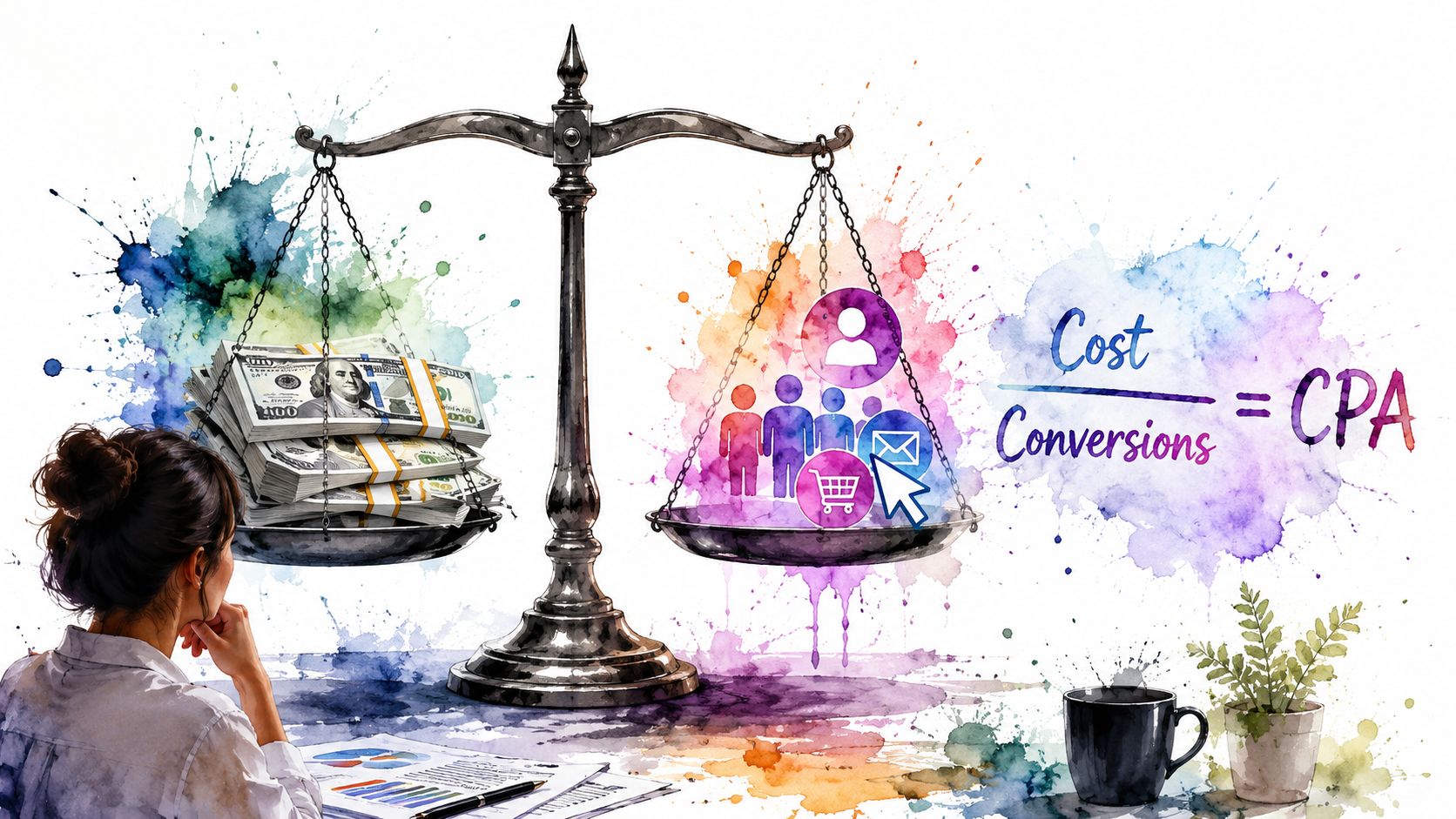
The basic math
The formula is simple:
| Calculation | Meaning |
|---|---|
| CPA = total campaign cost ÷ conversions | What you paid, on average, to generate a customer or conversion |
| Target CPA | The average amount you're willing to pay while still protecting the business |
If you spent $1,000 and generated 50 conversions, your CPA is $20.
The math is easy. Setting the right target is where businesses make bad decisions.
How to calculate a useful target
Start with the number your business can support, not the number you wish the ad account could hit.
A useful target CPA comes from unit economics. Revenue alone is not enough. You need to know what happens after the lead comes in, what it costs to fulfill, how many leads turn into paying customers, and whether those customers buy again.
Use this process:
- Define the conversion that creates revenue. If booked jobs or closed deals pay the bills, do not build your target around a softer action like a click, form fill, or add to cart.
- Calculate your real acquisition cost from recent performance. Use a clean date range and verified conversion tracking.
- Check customer value after real costs. Look at gross margin, retention, refunds, sales labor, and fulfillment.
- Set a target CPA your model can absorb repeatedly. If you hit that number at scale, the business should still make money.
A simple example makes this clearer. Say a lead costs $40, your sales team closes 25 percent of leads, and a new customer is worth $600 in gross profit over time. Your effective cost to acquire a customer is $160. If that leaves enough room for profit, a target below that range may work. If your margin is thin or retention is weak, that same target can wreck the economics fast.
This is also where attribution stops being a reporting debate and becomes an operating issue. If your account counts low-intent leads as conversions, your target CPA will be built on the wrong event. A clear marketing attribution model helps you tie ad spend to actual revenue, not just lead volume.
A target CPA should reflect what a profitable customer is worth to the business, not what makes the ad platform report look efficient.
What a good target actually looks like
A good target CPA does three jobs at once.
- Protects margin
- Leaves room for enough conversion volume
- Matches the value of the customer
That last point gets missed all the time. A business with repeat purchases, renewals, or strong upsells can often afford a higher target CPA than a business that sells once and never sees the customer again. That does not mean you should get sloppy. It means your target should match your revenue model.
If your current target produces cheap conversions that do not turn into profitable customers, the target is wrong. If it is so tight that volume dries up, the target is wrong. A good target CPA is not the lowest number you can force into the account. It is the highest number you can pay consistently while still growing sustainable revenue.
The Role of Target CPA in Modern Ad Platforms
Modern ad platforms use target cost per acquisition as a bidding instruction. You're not telling the system what to spend on every single auction. You're telling it the average acquisition cost you want it to work toward across many auctions.
That distinction matters because a lot of business owners expect target CPA to behave like a strict cap. It doesn't. The system may pay more in some moments and less in others while trying to land near your average.
What the bidding system is actually doing
At a practical level, the platform is making fast predictions.
It looks at signals tied to intent, context, device, audience behavior, and past conversion patterns. Then it decides whether a given impression or click is worth bidding on based on the probability of conversion at your target. If your target is grounded in reality and your conversion data is clean, this can work well. If your target is fantasy or your data is junk, the machine will still spend. It just won't spend intelligently.
Here's the plain-English version:
- You set the economic guardrail
- The system hunts for conversions within that guardrail
- Your data tells it what success looks like
If the wrong action is marked as a conversion, the bidding system will optimize toward the wrong outcome. That's how companies end up buying lots of leads and very little revenue.
Why data quality decides whether tCPA works
Many accounts falter at this juncture.
The platform only knows what you feed it. If you count every inquiry the same, even when some never answer the phone or never become customers, your target CPA strategy gets trained on noise. A booked appointment is not equal to a closed sale. A low-intent form fill is not equal to a high-value client.
That's also why businesses need to connect ad performance to downstream results. If you want a serious view of efficiency, you have to track beyond the click and compare CPA against broader profitability signals such as return on ad spend.
Better bidding starts with better conversion inputs. The platform can automate decisions. It cannot fix a broken definition of success.
Don't confuse automation with strategy
Automation is useful. It is not a substitute for judgment.
A strong target cost per acquisition strategy still depends on human decisions about business model, acceptable payback, offer quality, sales readiness, and customer value. The machine can react faster than your team. It can't decide what a customer is worth to your business.
If you don't answer that first, target CPA becomes a very efficient way to drift.
Strategic Tradeoffs The Other Guides Ignore
The worst target CPA strategy is the one that makes the dashboard look efficient while revenue stalls.
That happens all the time. A lower CPA can mean fewer impressions, fewer auctions entered, fewer conversions, and less total sales volume. Finance sees cheaper acquisitions. The business feels slower growth.

Lower CPA can shrink the business
Target CPA always forces a business decision. You are choosing where to sit on the curve between efficiency and scale.
A very low target usually buys control. It also limits reach and gives the system fewer chances to find new converting users. A wider target creates more room to compete for demand, but only works if the extra conversions still produce healthy margin and acceptable payback.
That distinction matters because sustainable revenue rarely comes from squeezing cost alone. It comes from buying enough of the right demand at a cost your business can support over time.
| Target choice | Likely effect |
|---|---|
| Aggressively low target | Lower reported CPA, less market coverage, slower growth |
| Moderate target | Better balance between efficiency and conversion volume |
| Higher target | More scale potential, higher spend tolerance required |
The mistake is obvious once you look at contribution, not just acquisition cost. If you cut CPA by 20% but lose 40% of conversion volume, you did not improve performance. You throttled demand.
Higher CPA often wins on profit
A customer is not worth the same amount in every business. That should shape your target more than a generic benchmark ever will.
If your buyers reorder, stay for months, expand into larger contracts, or refer new customers, you should be willing to pay more to acquire them. The company that knows its customer lifetime value can support a target CPA that would look expensive to a team still staring at lead cost alone.
A higher target often makes sense in cases like these:
- Recurring revenue businesses: The first sale starts the revenue stream, not ends it.
- High-ticket services: Lower close volume can still produce stronger profit per customer.
- Strong sales teams: Better close rates raise the value of each qualified lead.
- Reputation-sensitive categories: Trust affects conversion rates after the click, so improving your reputation management strategy can make a higher CPA profitable.
The right question is simple. Does the extra customer create more gross profit over time than it costs to acquire them? If yes, protecting an artificially low CPA is small thinking.
A target CPA should protect profit, not suppress growth.
Precision gets people into trouble
Reported CPA is an operating metric, not a verdict.
Attribution misses offline sales. Delayed conversions show up late. Cross-device paths get lost. Privacy restrictions blur the trail even more. If you tighten bids based on incomplete reporting, you can cut spend on campaigns that are creating real revenue the platform does not fully see.
Smart teams pressure-test CPA against closed revenue, sales-qualified rate, refund rate, retention, and payback period. That is how you keep bidding strategy tied to business reality instead of dashboard comfort.
How to Diagnose and Optimize Your tCPA Performance
A common approach to fixing target cost per acquisition involves touching the target first. That's usually lazy optimization.
If performance slips, you need to diagnose the whole system. The bid is one lever. Offer strength, audience quality, landing page conversion, follow-up speed, and sales discipline all influence whether your tCPA strategy works.

Start with a sane target
One practical guide recommends setting target CPA about 15–20% higher than your historical 30-day CPA to give the algorithm room to learn, then lowering it in 10–15% steps once performance stabilizes. The same guide gives a simple example: if your historical CPA is $40, an initial target of $48 is suggested. See that recommendation in this target CPA setup guide.
That approach is sensible because it respects how bidding systems learn. If you set the ceiling unrealistically low from the start, you can starve the campaign before it has enough signal to perform.
Diagnose the account before changing the bid
Use a simple triage process.
Check conversion quality
Ask whether your primary conversion reflects real business value. If you're optimizing to form submissions but the sales team says most are poor fits, your tCPA problem may be a tracking problem.
Look for signs like these:
- Lead quality drift: Volume is steady, but close rates are worse.
- Mixed conversion actions: The account treats weak and strong signals as equal.
- Delayed revenue feedback: The platform never learns which leads became customers.
Check offer and message fit
Sometimes the bidding strategy is fine and the market response is the issue.
If the ad promises one thing and the page delivers another, users bounce. If the offer is bland, generic, or hard to trust, the system has to pay more to find people willing to convert. In many accounts, CPA improves more from sharper positioning than from tighter bid settings.
Diagnostic shortcut: If traffic is arriving but not converting, don't blame the target before you inspect the message and page experience.
Check the page and funnel
A weak landing page can make a reasonable target look impossible.
That includes slow pages, cluttered layouts, weak calls to action, too many form fields, poor mobile experience, and a lack of trust elements. If you want better acquisition efficiency, work the conversion rate side of the equation. A lot of businesses can lower effective CPA more reliably by improving conversion rate than by forcing a lower target.
Separate on-platform fixes from off-platform fixes
Here, disciplined operators pull ahead.
| Area | What to inspect |
|---|---|
| On-platform | Audience relevance, creative fatigue, conversion settings, search intent quality |
| Landing experience | Relevance, friction, clarity, trust, mobile usability |
| Sales follow-up | Speed to lead, call quality, no-show handling, close process |
| Economics | Margin by customer type, repeat purchase behavior, acceptable payback |
That last line matters. Some campaigns don't need “better optimization.” They need a different target because the business has updated pricing, retention, or offer mix.
Make changes in the right order
Don't change five things at once. You'll lose the ability to tell what worked.
A cleaner order looks like this:
- Fix conversion definitions
- Improve the page and offer
- Review audience and traffic quality
- Adjust the target gradually
- Measure against qualified outcomes, not raw conversions
That sequence keeps you from using bidding changes to paper over bigger funnel problems.
Beyond Bidding The Ad Suite's Revenue-First Framework
Target cost per acquisition is useful. By itself, it's incomplete.
If your ad account is optimizing against weak conversion events, your website leaks intent, and your team follows up slowly, no bidding strategy will rescue the economics. You don't have a target CPA problem. You have a revenue system problem.
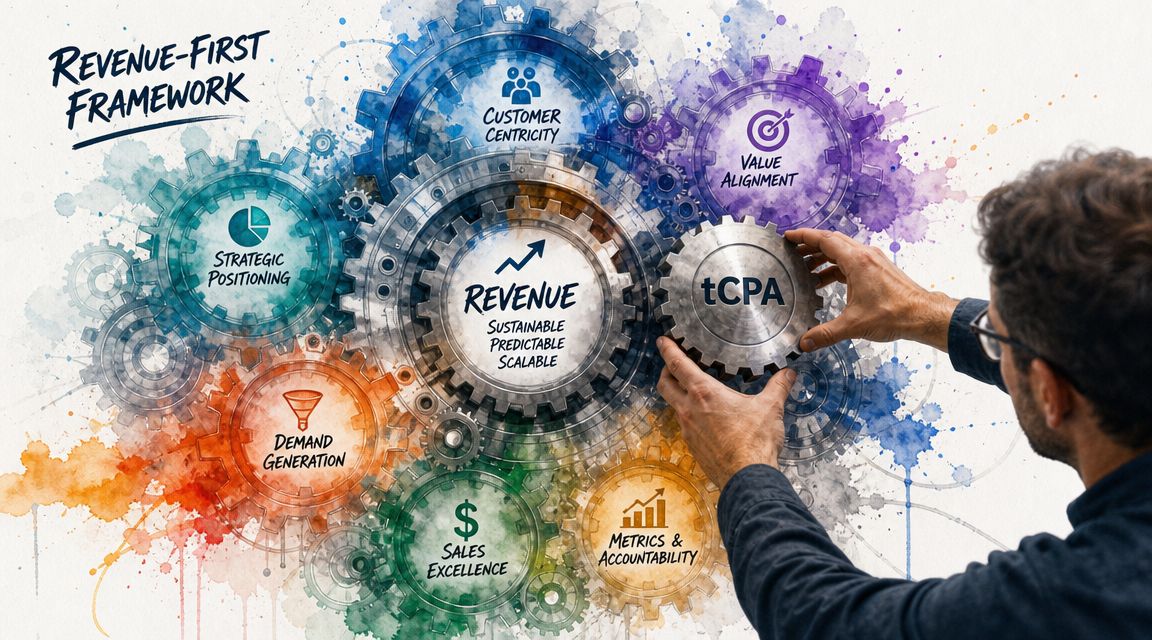
A stronger framework connects three things:
Acquisition that respects business math
The first job is still disciplined paid media.
You need targeting, creative, and bidding built around profitable customer acquisition, not vanity metrics. That means the target is tied to real customer value and adjusted with context, not panic.
Conversion systems that protect demand
The second job is making sure paid traffic has somewhere competent to land.
That includes clear offers, fast pages, strong trust signals, and a follow-up process that doesn't waste hard-won leads. Ad spend can create demand. Operations decide whether demand becomes revenue.
Customer experience that increases value after the click
The third job is extending customer value after acquisition.
A business with stronger retention, better reviews, cleaner follow-up, and tighter pipeline management can usually support a healthier target cost per acquisition. That's the part many “media-only” setups miss. They manage bids while ignoring the systems that determine customer value.
This is why the Growth-Tech Hybrid model makes sense. The Advertising Suite combines strategy with an integrated CRM and reputation ecosystem, so campaigns can optimize around real downstream performance instead of shallow front-end activity. It's also why the membership model matters. Members gain a 25% discount on services and access to the built-in software stack, which tightens the loop between acquisition, customer experience, and revenue. And there's real operating proof behind the framework, with 10,000+ satisfied customers using that model to move past guesswork.
If you want target cost per acquisition to drive sustainable growth, don't treat it like a lone dashboard setting. Put it inside a system that can turn demand into revenue.
Frequently Asked Questions About Target CPA
Is target cost per acquisition good for every business?
No. It works best when you have clear conversion tracking, enough conversion volume, and a solid understanding of what a customer is worth. If your tracking is messy or your sales cycle is highly offline, use it carefully.
Is lower target CPA always better?
No. A lower target can reduce delivery and limit learning. If volume drops and revenue weakens, the “better” target is hurting the business.
How is target CPA different from regular CPA?
Regular CPA is a reported outcome. Target CPA is the average acquisition cost you tell the platform to pursue.
Should B2B and local service businesses use the same target?
No. Business model matters. A higher-LTV customer can justify a higher target. A one-time, lower-margin sale usually can't.
When should you change your target?
Change it when you've confirmed the funnel is healthy and the current target is either too restrictive or too loose. Don't use bid changes as a shortcut for fixing bad offers, weak pages, or poor follow-up.
If you're tired of ad reports that look tidy while revenue stays messy, The Advertising Suite is built for that exact problem. We combine strategy, CRM, and reputation management into one growth system so your target cost per acquisition supports actual profit, not just prettier dashboards. If you want a partner that works like an extension of your team, book a growth consult, request a demo, or explore the Membership for the built-in software access and 25% discount on services.