Most business owners hear “social commerce” and think it's another shiny marketing phrase built to sell them more content packages.
It isn't.
It's a direct shift in how people buy. The global social commerce market reached about $2.11 trillion in 2026, up from $571 billion in 2023, and it's projected to hit $7.55 trillion by 2031 according to social commerce market projections. If you sell online and your social channels still act like billboards that push people somewhere else to buy, you're leaving money on the table.
For skeptical owners, the question isn't “Is social commerce trendy?” It's simpler. Does it reduce friction and make revenue easier to capture? Usually, yes.
What Is Social Commerce and Why It Matters for Revenue

What is social commerce? It's selling directly inside social platforms instead of using social media only to send people off-platform to your website.
That distinction matters more than most brands admit.
Traditional social media marketing often works like this: run an ad, get a click, send the visitor to a landing page, hope the page loads fast, hope the offer matches the post, hope the checkout works, then wonder why “engagement was strong” but sales were weak. Social commerce compresses that path. Discovery, trust-building, and purchase happen much closer together.
The real difference is where the sale happens
A lot of owners have been burned by campaigns that generated likes, comments, and traffic with no clean path to revenue. Social commerce fixes that by making social platforms part of the transaction, not just the introduction.
That means:
- Less drop-off: Fewer steps between interest and action.
- Cleaner buying intent: People can act while attention is still high.
- Better revenue alignment: The platform isn't just feeding awareness. It's helping close.
Practical rule: If your social strategy ends at “drive traffic,” you're still paying for attention instead of building a purchase path.
This is why a revenue-first business should care. You don't need more vague top-of-funnel activity. You need a buying experience that shortens the distance between “that looks interesting” and “I just bought it.”
Why this matters to your bottom line
Social commerce matters because it plugs leaks that most businesses have normalized. Every extra click, page load, form field, or redirect creates more abandonment. Owners often accept that waste as the cost of digital marketing. It isn't. It's usually a design problem.
If you want a clearer way to judge whether your marketing is producing business results, start with a more disciplined view of calculating marketing ROI. That lens makes social commerce easier to evaluate. You're not asking whether the post “performed.” You're asking whether the channel produced profitable transactions.
That's the right question.
How Social Commerce Turns Views Into Revenue

Old-school social marketing is a billboard. It catches attention, then tells people to go somewhere else.
Social commerce is a staffed kiosk inside the place where people are already browsing. They see the product, check proof, ask questions, and buy without breaking stride. That's why it works.
Three levers that drive actual sales
The easiest way to understand what social commerce does is to look at the three revenue levers it improves.
It cuts friction
The more steps you force between discovery and checkout, the more buyers disappear. Social commerce removes handoffs. Fewer redirects means fewer chances for the customer to change their mind, get distracted, or hit a broken experience.
It builds trust in context
People don't buy in a vacuum. They want proof. Reviews, comments, creator mentions, customer photos, and visible engagement all sit close to the product experience. That context matters because trust forms faster when the buyer doesn't have to leave the environment to verify what they're seeing.
It improves conversion efficiency
Live shopping formats can convert at up to 30%, compared with 2% to 3% for traditional ecommerce transactions, based on social commerce conversion benchmarks. That gap should get every serious operator's attention.
Social commerce works best when content, proof, and checkout sit close together. Pull them apart, and conversion usually drops.
What this means in practice
A strong social commerce setup doesn't look like endless promotional posts. It looks like a buying system hidden inside useful, persuasive content.
Use content that does one of these three jobs:
- Demonstrate the product: Show use, outcome, or transformation.
- Reduce objection: Answer the question that blocks purchase.
- Reinforce trust: Surface real customer experience and social proof.
If you're underusing customer proof, fix that first. A sharper user-generated content campaign strategy often does more for conversion than another round of polished brand creative.
Why skeptical owners should care
This isn't about chasing another platform feature. It's about closing the gap between attention and action.
If your current social strategy gets visibility but weak revenue, the problem usually isn't reach. It's that you're asking buyers to leave the environment where interest was created and complete the purchase somewhere less convenient. That handoff is where too many sales die.
Choosing Your Battleground Social Commerce Platforms
Picking a platform isn't a branding exercise. It's a distribution decision tied to product type, customer behavior, and how people prefer to buy.
A lot of businesses spread themselves thin by trying to “be everywhere.” That's lazy strategy. Choose the platform that matches buying intent, then build depth there.
Start where buying behavior is already strongest
In the United States, Facebook and Instagram remain the largest social commerce channels, with 67.8 million and 45.3 million consumers respectively expected to purchase through these networks in 2024. That fact was established earlier from the same Statista research, and it matters because it points to mature buyer behavior on those channels.
For most SMBs, that makes the decision less romantic and more practical. Start where shoppers already know how to transact.
Social Commerce Platform Comparison for SMBs
| Platform | Best For (Audience & Product Type) | Strategic Advantage | Revenue Focus |
|---|---|---|---|
| Meta ecosystems | Broad consumer audiences, repeat-purchase products, local and regional brands, visually clear offers | Familiar shopping behavior, strong storefront and discovery habits, useful for both prospecting and retargeting | Best when you need consistency and a wider base of ready buyers |
| Short-form video commerce | Fast-moving products, impulse-friendly offers, demonstration-heavy products, trend-responsive brands | Speed of discovery, strong product storytelling through short video, native momentum when content lands | Best when your offer wins on attention, demonstration, and quick action |
| Visual discovery platforms | Design-led products, home, style, gifting, seasonal collections, consideration-based browsing | Longer content shelf life and planning-oriented discovery | Best when buyers research visually before they buy |
How to choose without overcomplicating it
Use a simple filter.
- Choose broad-reach social storefronts if your business needs dependable volume and a familiar shopping experience.
- Choose short-form video commerce if your product sells best when people can see it in action fast.
- Choose visual discovery channels if the customer tends to save, compare, and return before buying.
The best platform isn't the one with the most hype. It's the one that matches how your customer decides.
A local service brand, for example, may still use social commerce principles through direct inquiry, social proof, and simplified conversion paths, even if the final sale happens after consultation. A product brand with a clear visual offer can push much harder into in-platform shopping.
If your team is trying to build stronger creator collaboration and social selling inside visual channels, this guide on how to collaborate on Instagram is a practical place to tighten execution.
One warning most businesses ignore
Don't choose a platform based on what your internal team likes creating.
Choose based on what buyers do there.
Those are not the same thing. Teams often prefer polished content and familiar formats. Buyers often respond to direct demos, plain-language proof, and content that feels native to the platform. Revenue comes from respecting buyer behavior, not your creative comfort zone.
The Metrics That Matter Beyond Vanity Numbers
If your team is still reporting likes, reach, and follower growth like they're business outcomes, the reporting is broken.
Those metrics can have context value. They're not useless. But they don't tell you whether social commerce is making you money. That's the gap that frustrates agency-burned founders the most. They paid for activity and got a slide deck.
Track the three numbers that actually matter
Start with these:
- In-app conversion rate: How often platform interactions turn into actual purchases or qualified sales actions inside the social journey.
- Average order value from social transactions: Whether social buyers purchase at a healthy ticket size.
- Customer lifetime value from social-acquired customers: Whether those buyers come back, buy again, and become profitable over time.
That third metric gets ignored constantly.
Most social commerce advice obsesses over storefront features and in-app checkout while missing the post-purchase layer. That's a costly mistake. As noted in this analysis of post-purchase engagement gaps in social commerce, many brands fail to use post-purchase engagement to turn one-time buyers into repeat customers and brand advocates.
Post-purchase is where margin gets healthier
A sale is not the finish line. It's the start of your second conversion cycle.
After purchase, smart brands use social touchpoints to do three things:
- Handle objections retroactively: Answer setup, sizing, usage, or delivery concerns before they become refunds or bad reviews.
- Prompt customer proof: Ask for photos, reactions, testimonials, or simple feedback that can become future social proof.
- Create the next purchase path: Recommend bundles, complementary offers, or a follow-up purchase based on what they just bought.
If you stop at checkout, you're leaving repeat revenue to chance.
A connected CRM is essential. Without one, your team can't properly connect social interactions, purchase history, review activity, and follow-up opportunities. You're stuck guessing which customers are valuable and which social efforts create durable revenue.
If your current reporting still centers on surface-level performance, recalibrate around what CVR means in digital marketing and apply that thinking to social commerce specifically.
What to stop celebrating
Stop celebrating metrics that don't correlate with buying behavior in your business.
A post can be popular and commercially useless. A quieter post with stronger intent, clearer proof, and a better offer can outperform it where it counts. Revenue-first operators know the difference. They don't confuse audience reaction with commercial performance.
A Practical Roadmap for SMBs to Get Started
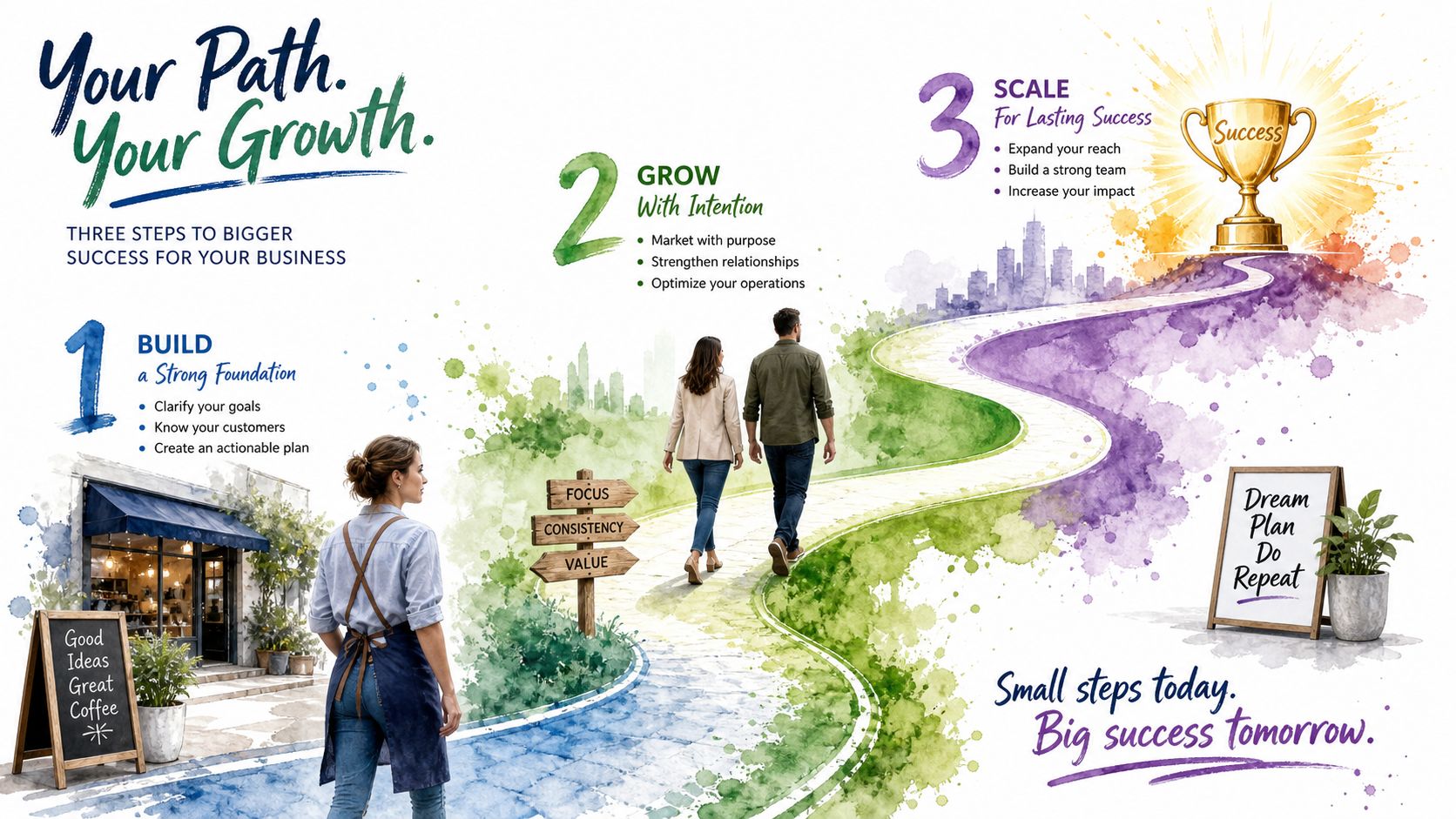
Most SMBs don't need a giant rollout. They need a clean first system that can prove revenue before they scale it.
The smartest approach is a three-phase build: foundation, activation, then optimization.
Phase one builds the foundation
Your first job is operational, not creative. Get the infrastructure right before you chase volume.
A headless commerce core can act as the single source of truth for catalog, pricing, and promotions, supporting multiple front ends through an API-first setup, according to this overview of social commerce architecture. In plain English, your product data needs one reliable home so every social storefront, chat flow, and shoppable experience pulls from the same source.
That matters because mismatched pricing, outdated inventory, and disconnected promotions kill trust fast.
Build phase one around these priorities:
- Unify product data: Keep catalog, pricing, and offer rules consistent across every social touchpoint.
- Connect customer records: Tie social interactions to contact history, purchases, and follow-up actions inside your CRM.
- Prepare attribution early: Decide how you'll track purchases, lead quality, and downstream sales before campaigns go live.
Privacy changes have made off-platform attribution less reliable. That's one reason in-platform checkout is gaining ground. It shortens the path and reduces some of the tracking leakage that happens when buyers move across channels and devices. For businesses that still need blended reporting, disciplined offline conversion tracking becomes essential.
Phase two activates the offer
Now you build your first revenue loop.
Don't start with ten campaigns and five product lines. Start narrow. Pick one audience, one offer, and one content angle that naturally fits social behavior.
A practical first test usually includes:
- A hero product or service offer that's easy to understand quickly
- A small set of shoppable creative built around demo, proof, and objection handling
- A direct follow-up path through comments, messages, or post-purchase communication
The content should feel native, not overproduced. If buyers need to work hard to understand the value, the creative is wrong. If they understand the value but can't buy smoothly, the system is wrong.
Start with one clean offer and one clean funnel. Complexity can wait.
Phase three optimizes and scales
Once transactions start coming in, the main work begins. You're looking for patterns, not just volume.
Review what content drives purchases, which objections show up repeatedly, what buyers ask before they convert, and which customers generate the strongest repeat value. Then improve the system in layers.
Here's a useful sequence:
- Refine the offer: Tighten messaging based on actual buyer questions.
- Improve merchandising: Group products or services based on what customers naturally buy together.
- Strengthen retention: Use post-purchase messages and customer proof to drive the next sale.
- Expand carefully: Add another audience, another product set, or another platform only after the first loop is stable.
What SMB owners usually get wrong
They jump to scale before they've earned clarity.
They assume more spend will fix weak conversion. It won't. Social commerce rewards businesses that simplify buying, capture intent fast, and follow up intelligently. If those pieces are loose, more traffic just makes the waste more expensive.
Get the system right first. Then pour fuel on it.
Your Partner in Profitable Growth Not Just an Agency
Analysts project social commerce to grow from $2.11 trillion in 2026 to $7.55 trillion by 2031, according to global social commerce market research. The opportunity is real. The waste is real too.
A lot of SMB owners already know that. They have paid for content, ads, and agency retainers, then ended up with traffic reports that looked busy and bank accounts that said otherwise. Skepticism is earned.
Social commerce works when the revenue system is tighter than the content calendar. That means your offer is clear, the buying path is easy, customer data flows into one place, and follow-up keeps working after the first sale. If any of those pieces break, revenue stalls fast.
That is the gap most agencies never close. They sell activity. You need accountability.
The Advertising Suite is built for that standard. We combine strategy, execution, CRM, and review management in one operating model so your social commerce effort does not stop at clicks or content production. It keeps going all the way to booked sales, repeat purchases, stronger retention, and clearer reporting on what pays off.
For an owner who has been burned before, this is the only frame that matters:
- Can we track what content and campaigns produce revenue?
- Can we capture leads and buyers without losing them between platforms?
- Can we improve customer experience enough to raise conversion and repeat purchase rate?
- Can we see results in numbers that affect cash flow, not just reach?
If the answer is no, you do not have a marketing partner. You have a cost center.
The businesses that win with social commerce are not the ones posting the most. They are the ones running the cleanest commercial system. They know what they are selling, who it is for, what converts, and what happens after the sale. That discipline is what turns social into a profit channel instead of another monthly expense.
If you're ready to turn social channels into a predictable revenue engine, book a Growth Consult with The Advertising Suite. We're a growth-tech hybrid built for owners who care about bottom-line results, not vanity metrics. You'll get a results-first framework backed by strategic execution, a proprietary CRM, and review management software that align marketing with customer experience. If you want a lower-friction entry point, explore the Membership through The Advertising Suite for a 25% discount on all services and access to the software stack. More than 10,000 satisfied customers have already traded guesswork for a scalable system, and we'd be glad to serve as an extension of your team.