Creative strategy is the documented framework that connects business objectives to creative output by deciding who to reach, what to say, how to say it, and how success will be measured before production begins. Research covering 93 datasets, 67 papers, and 878 effect sizes found positive effects from advertising creativity, with the strongest results when originality and appropriateness work together.
The popular advice is to “make better ads.” That's incomplete. A polished ad can still attract the wrong audience, promise the wrong outcome, or send interested prospects into a broken follow-up process. Creative strategy treats advertising as a revenue operating system, not a gallery of attractive assets.
For founders who've paid for clicks, impressions, or leads without seeing dependable growth, this distinction matters. The Advertising Suite's revenue-first philosophy focuses on connecting strategy, execution, customer experience, and measurable commercial outcomes. The question isn't whether an ad looks good. The question is whether the whole system gives the right person a compelling reason to act, then helps the business convert and retain that customer.
Why Most Ads Fail Before They Launch
Many campaigns fail before anyone sees the first impression. The team starts with a format, a trend, or a production request instead of a commercial decision. Someone asks for short videos, new graphics, or another set of headlines, but nobody has agreed on the audience problem, the offer's role, or the result that will determine success.
That process creates activity without direction. A campaign can generate attention while leaving the leak untouched. If sales follow-up is slow, the landing page is unclear, or the customer experience contradicts the ad, more traffic only sends more people into the same broken journey.
Practical rule: Don't increase media spend to compensate for an unclear message or an unfinished conversion path.
A revenue-first framework begins before production. It asks:
- Business outcome: Is the campaign meant to create qualified demand, support purchases, improve retention, or strengthen a specific part of the customer journey?
- Audience reality: What concern, motivation, objection, or decision trigger should the creative address?
- Message responsibility: What must the audience understand or believe before taking the next step?
- Measurement plan: Which signals will separate useful demand from superficial engagement?
market research for advertising earns its place. Research doesn't replace creative judgment. It gives that judgment something sturdier than personal taste, internal politics, or the latest format trend.
The agency-burned founder usually doesn't need another promise of “more visibility.” They need to know why the current spend isn't producing enough high-intent revenue. Creative strategy helps diagnose that gap by connecting the ad's promise to the offer, the channel, the conversion experience, and the follow-up process.
The Advertising Suite describes this as a Growth-Tech Hybrid approach. Human-led strategy shapes the commercial direction, while an integrated CRM and reputation ecosystem helps the business manage what happens after acquisition. That changes the assignment from “make an ad” to “design a customer path that can produce sustainable growth.”
What Creative Strategy Really Means
In plain language, creative strategy is the rule set for making marketing choices. It defines what a brand will communicate, to whom, and how, in service of a specific business objective. The framework sits between broad brand direction and the individual assets people see.
A useful hierarchy looks like this:
- Business strategy defines the commercial priorities.
- Marketing strategy addresses the market approach, including positioning and pricing.
- Creative strategy translates that direction into messaging, tone, visuals, content, and channel decisions.
- Creative execution turns those decisions into ads, landing pages, emails, videos, and other customer-facing assets.
Creative strategy is the structure that connects business objectives to creative output, and it should define the campaign's purpose, audience, intended outcome, and measurement approach before production begins.

Think blueprint, not decoration
A blueprint tells a builder what the structure must do before anyone chooses paint or fixtures. Creative strategy plays the same role. It tells the creative team what the message needs to accomplish, while leaving room for strong ideas and distinctive execution.
Without that blueprint, teams often debate whether an asset is “good” based on taste. With it, they can ask more useful questions:
- Does this headline address the audience's actual concern?
- Does the visual make the offer easier to understand?
- Does the format suit the platform and the buying context?
- Does the call to action match the customer's readiness?
- Can the claim be supported by the actual product or service experience?
The distinction also prevents a common mistake. Marketing strategy says where the business wants to compete and why. Creative strategy says how the business will communicate that position to a particular audience in a particular context.
That communication includes more than ad copy. Teams should document the central proposition, tone, visual direction, proof points, mandatory elements, channel adaptations, and success signals. A strong copywriting in advertising process then turns the strategic message into language that earns attention and moves the reader toward a relevant action.
The plan doesn't restrict creativity. It gives creativity a job.
The Four Building Blocks of Effective Creative Strategy
A practical framework has four connected building blocks: audience insight, message and positioning, format strategy, and testing. A documented framework defines what the brand will communicate, to whom, and how, so each decision supports a business objective, as described in this creative strategy definition.

Start with audience insight
Demographics can describe a person without explaining their decision. A useful audience insight identifies the problem they're trying to solve, the risk they want to avoid, the outcome they value, and the reason they might hesitate.
For a local service business, “homeowners in the area” isn't enough. The strategy may need to distinguish between someone seeking emergency help, someone comparing providers, and someone planning maintenance. Each situation calls for different urgency, proof, and calls to action. A disciplined audience segmentation process helps prevent one generic message from trying to serve every buyer.
Define the message and position
The message is the useful answer to the audience's problem. Positioning explains why this offer deserves consideration instead of the alternatives already in the buyer's mind.
A strong message usually clarifies three things:
- Problem: What does the customer need to resolve?
- Promise: What meaningful outcome does the offer support?
- Proof: What evidence makes the promise credible?
Novelty matters, but novelty without relevance becomes noise. Research on advertising creativity identifies originality and appropriateness as core dimensions. Originality helps a message stand out, while appropriateness helps the audience understand why it belongs in their situation. Chasing unusual ideas alone can produce memorable work that nobody finds useful.
Choose formats that serve the job
A format isn't a strategy. A short video, search ad, carousel, email, or landing page is a delivery vehicle for the message. Choose it based on the audience's context and the role the asset must play.
An early-stage asset may need to establish a problem or create curiosity. A comparison-stage asset may need to explain differences and provide proof. A conversion-stage asset may need to remove friction and make the next step obvious.
Build testing into the system
Testing should begin with a question, not random variation. A team might test whether a customer outcome beats a feature-led headline, whether proof near the call to action reduces hesitation, or whether a demonstration communicates value faster than a static visual.
The missing block is often measurement. If the team doesn't record the hypothesis, audience, message, format, and downstream result, it can't build a useful learning loop. It can only collect isolated winners and losers without knowing why they performed differently.
Why Creative Strategy Matters for Performance Marketing
Clicks are useful signals, but they aren't the business result. A person can click because an ad is confusing, sensational, or poorly matched to the landing page. Performance marketing needs creative that attracts the right attention, communicates value, and prepares the customer for the next experience.
The financial case is stronger than many founders expect. Nielsen found that 56% of advertising sales lift was driven by creative, compared with 38% from reach and 6% from brand in the cited model (Nielsen data summarized by Motion). Media delivery still matters, but reach can't rescue a message that fails to persuade or connect the brand to the offer.
| Driver | Share of sales lift | Implication for strategy |
|---|---|---|
| Creative | 56% | Improve the concept, message, proof, and execution before simply expanding delivery. |
| Reach | 38% | Reach the right audience, but don't assume distribution fixes weak creative. |
| Brand | 6% | Maintain brand linkage so attention contributes to recognizable commercial value. |
A separate meta-analysis synthesized 93 datasets from 67 papers and 878 effect sizes. It found stronger effects for ad reactions than brand reactions, with correlations of r = .491 versus r = .317, while memory outcomes were comparatively small, with all reported values below .140 (Journal of Marketing Research analysis). The practical lesson isn't to chase short-term reaction at the expense of the brand. It's to recognize that creative can influence several stages, and each stage needs its own measurement.
Why involvement and awareness change the equation
Creative strategy becomes especially important when the product requires consideration or when the brand isn't already familiar. In those situations, the ad must do more work. It needs to make the problem recognizable, provide a credible reason to choose the offer, and reduce the mental effort required to understand the next step.
The research describes three mechanisms behind creative effectiveness:
- Affect transfer: Positive emotional response can influence how people feel about the advertised brand.
- Processing: A distinctive but appropriate idea can encourage people to engage with the message.
- Signaling: Appropriate creative can communicate quality, relevance, and confidence.
That combination explains why “make it more interesting” is a weak brief. Strong creative is interesting for a reason. It earns attention, supports understanding, and reinforces a commercially useful association.
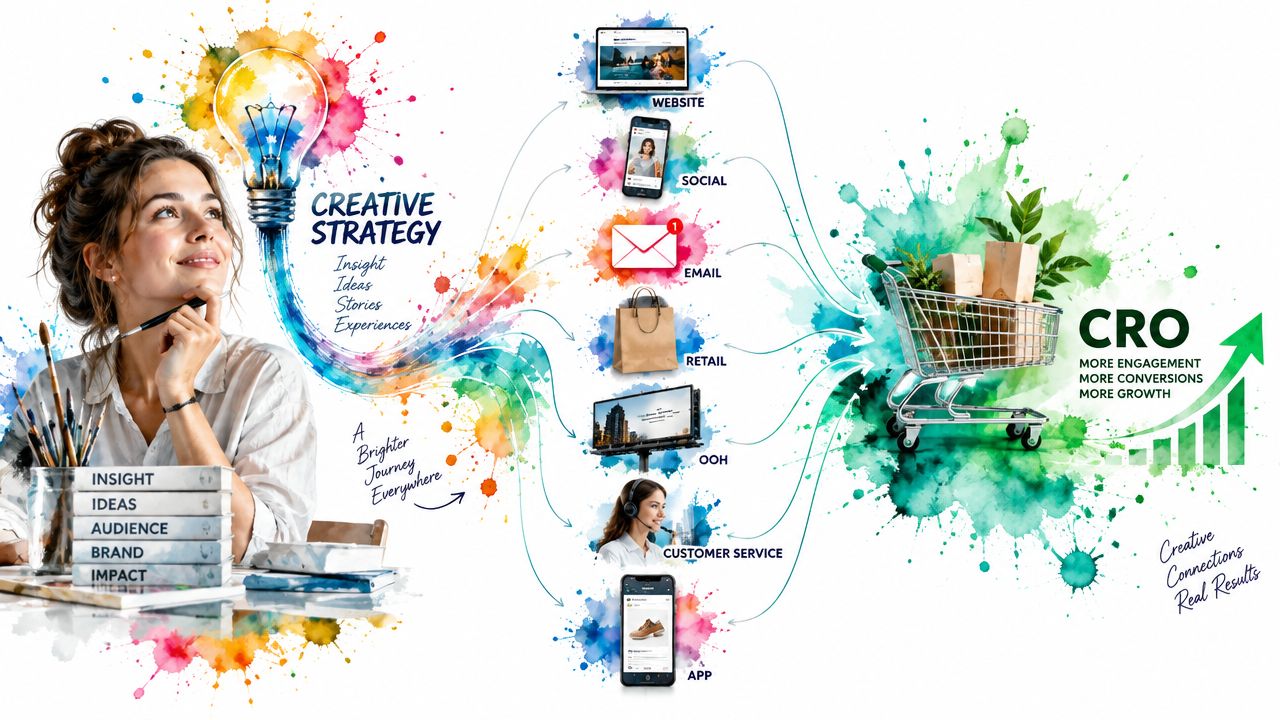
How Creative Strategy Powers Omni Channel Execution and CRO
Creative strategy shouldn't stop when the ad is approved. The central idea must travel through the customer journey while adapting to each channel's context. A search placement may need concise intent-matching language, while a social placement may need a visual demonstration or a problem-led opening. The execution changes, but the strategic promise remains recognizable.
Keep the promise consistent, not identical
Omni-channel consistency doesn't mean copying the same asset everywhere. It means preserving the essential relationship between audience, problem, promise, proof, and action.
A campaign might adapt like this:
- Discovery: Lead with the audience's problem and a clear point of difference.
- Evaluation: Add product benefits, demonstrations, comparisons, or customer proof.
- Conversion: Reduce friction with a direct offer, clear expectations, and a simple next step.
- Post-purchase: Reinforce the promise through onboarding, follow-up, review requests, and service communication.
The customer shouldn't feel that the ad promised one experience while the business delivered another. That gap damages conversion and reputation, especially for high-intent local services where trust often determines whether a prospect calls.
Close the loop after the click
A CRM gives the strategy somewhere to go after acquisition. It can help teams organize leads, coordinate follow-up, identify unanswered inquiries, and connect campaign messaging with the customer's status. Reputation management adds another layer by turning satisfied experiences into visible trust signals and surfacing service problems that need attention.
Conversion rate optimization belongs in the same loop. If an ad earns qualified interest but the landing page creates confusion, the issue isn't necessarily the media campaign. The team should inspect the full path, including the offer, form, response process, sales conversation, and customer experience.
Omni-channel marketing automation supports this joined-up view by connecting channel activity with operational follow-through. The Advertising Suite's model combines strategic advertising with a proprietary CRM and automated review management software, so acquisition and customer experience aren't treated as separate departments.
The commercial rationale is clear. Bain reports that companies delivering a superior customer experience can achieve revenue growth 4 to 8 percent above their market, while customers with the best experiences spend 140 percent more than customers with the poorest experiences (Bain findings summarized by Asana). The ad starts the relationship. The operating system determines whether the relationship becomes revenue, repeat business, and reputation.
Creative Strategy Examples and Formats That Convert
A service franchise promoting urgent repairs needs creative that answers the customer's immediate question: “Can this team restore normal life quickly?” An experiential concept can show that relief through a real-world situation. Cognitive content can explain the inspection process, service scope, and practical benefits. Affective cues can lower anxiety by making the brand feel calm, capable, and trustworthy.
These roles serve different customer needs. Someone facing an urgent problem may need reassurance and speed. Someone planning a purchase may need comparisons, evidence, and a clear explanation of value. Strategy sets the job first, then the team chooses the visual treatment, format, and channel.
Match the format to the customer's question
For an ecommerce offer, customers usually want to know whether the product fits their needs, how it works, and why it belongs in their routine. A useful creative system can include:
- Demonstration content: Show the product solving a recognizable problem.
- Benefit-led content: Explain the result in plain language, rather than listing specifications.
- Objection-handling content: Address common concerns before checkout.
- Retention content: Help buyers get value after purchase and give them a reason to return.
A professional service may need a different sequence. An educational video can build early trust, a proof-focused landing page can support evaluation, and a consultation invitation can serve high-intent prospects. The format follows the buying question. It should not exist only because a channel currently favors it.
A 2022 study analyzed 2,251 creatives from 91 consumer packaged goods brands over four years and found that an ad's function was the primary driver of marketplace performance. Experiential content produced the highest performance increase, followed by cognitive and affective content. Executional choices mainly amplified the effect of the content (Journal of Marketing study).
Treat execution as an amplifier
Production quality can improve a strong idea, but it cannot repair a weak proposition. A polished asset without a clear customer benefit still leaves the audience asking why they should act.
Kantar's creative effectiveness analysis found that ads incorporating product benefits were about 10 points more persuasive (Kantar creative effectiveness analysis). Use that principle to create variants around meaningful strategic questions, such as benefit versus feature, demonstration versus explanation, or reassurance versus urgency. Evaluate the variants through qualified actions and revenue signals, not engagement alone.
Creative strategy works like a revenue operating system: it connects the customer's question to the message, the execution, and the next business action. That connection also gives teams clearer inputs for testing and AI-based discovery, because the brand can repeat its core benefit consistently across formats without making every asset identical.
How to Measure Creative Strategy and Scale What Works
Creative strategy earns credibility when the team can connect a decision to a business result. Use a measurement ladder:
- Attention: Did the audience notice and engage with the asset?
- Understanding: Did they grasp the offer and its relevance?
- Response: Did they take the intended next step?
- Revenue: Did the interaction support qualified pipeline, sales, retention, or customer value?
Match the metric to the campaign's job. An awareness asset needs a different scorecard from a direct-response asset, yet both require a defined commercial role. Track creative variables beside downstream outcomes to identify which message, audience, and format combination deserves more investment.
Measure the hypothesis, not just the asset. If the idea is that a clearer benefit will improve qualified action, compare that benefit against a feature-led version and follow results beyond clicks.
Use incrementality testing to assess whether advertising created additional business activity, rather than claiming credit for actions that would have happened anyway. Review results regularly, record the winning hypothesis, and carry that learning into the next creative brief.
A useful creative measurement system also prepares the team for changing production and discovery workflows. Coverage of projected 2026 marketing trends describes dynamic creative optimization and AI-integrated pipelines as increasingly embedded in production workflows (Quad's 2026 outlook). Adobe's projected 2026 trend coverage identifies AI discovery as a growing imperative, with 48% optimizing content for interpretation and surfacing by AI-powered discovery tools (Adobe digital trends report).
Creative teams should preserve human distinctiveness and emotional clarity while making the offer consistent enough for machine-readable context. That turns testing into an operating loop: message, channel execution, customer response, CRM and reputation signals, then the next brief.
The Advertising Suite connects creative strategy with omni-channel advertising, conversion optimization, a proprietary CRM, and reputation management. Book a Growth Consult with The Advertising Suite to develop a measurable revenue system, or explore the Membership for a 25% discount on services and access to the software ecosystem as an extension of your team.