

You're paying for clicks, form fills, and booked calls. The spreadsheet looks busy. The CRM has activity. Your ad platform says the campaigns are working.
Then month-end arrives, and revenue tells a different story.
That gap is where most sales pipeline management breaks down. Teams treat the pipeline like a reporting tool instead of the operating system for growth. They measure lead volume, not deal quality. They look at campaign performance, not whether those campaigns create revenue that closes.
When the pipeline is built correctly, it does two jobs at once. It helps sales move opportunities forward, and it shows marketing which dollars are producing real business outcomes. That's the difference between a lead machine and a revenue engine.
Moving Beyond Leads to Build a Revenue Engine
A lot of businesses are stuck in the same loop. Marketing drives inquiries. Sales follows up unevenly. Some leads convert, some disappear, and nobody can say with confidence which parts of the system are working.
That's not a traffic problem. It's a systems problem.
Sales pipeline management matters because it connects ad spend to cash collected. Without that connection, you're left optimizing for surface-level activity. More leads feels productive, but if those leads don't move through qualification, conversation, proposal, and close, you're just buying noise.
The pipeline is the center of the revenue story
The pipeline should answer a hard question quickly: which lead sources produce sales, not just interest?
If it can't answer that, your team is operating on partial information. Marketing sees top-of-funnel numbers. Sales sees individual conversations. Leadership sees lagging revenue. Nobody sees the whole chain.
That's why the pipeline needs to become the central record of truth for:
- Lead origin so every opportunity is tied back to the campaign, audience, or offer that generated it
- Sales progression so managers know whether deals are advancing or stagnating in a stage with false optimism
- Revenue accountability so the business can compare spend against actual closed business, not platform-reported success
Most wasted ad spend doesn't look wasted at first. It looks like activity without follow-through.
This is especially important for local and service businesses where lead quality can swing hard by offer, geography, timing, and intake speed. If your team is investing in lead generation for local businesses, the pipeline can't just store names and phone numbers. It has to show which inquiries became qualified conversations and which turned into paying customers.
What changes when you run revenue-first
A revenue-first approach changes how teams judge performance.
Instead of asking, “How many leads did we get?” the better questions are:
- Which leads entered the right stage quickly?
- Which opportunities kept moving?
- Which source produced closed revenue with consistency?
That shift sounds simple, but it changes behavior across marketing and sales. Creative gets sharper. follow-up gets faster. qualification gets cleaner. Forecasting gets less political.
A healthy pipeline isn't a prettier tracker. It's the control system for the whole go-to-market motion.
Designing Your Pipeline Stages for Clarity and Action
A service business spends hard on ads, the phone rings, forms come in, and the CRM starts filling up. Two weeks later, leadership asks a basic question: which of those opportunities are moving toward revenue? If the stages are vague, nobody can answer with confidence.
That usually starts with labels that sound useful but mean different things to different reps. “Lead.” “Contacted.” “Qualified.” “Proposal Sent.” One salesperson moves a deal after a voicemail. Another waits for a real conversation. A manager reviews the same pipeline and gets three different versions of reality.
Forecast problems start there. So does wasted ad spend.
Pipeline stages should do one job well. They should show whether demand generated by marketing is turning into sales progress with enough consistency to justify continued spend. If a stage does not create that kind of clarity, it is decoration.
Build stages around proof, not optimism
A strong stage reflects a confirmed event, buyer commitment, or operational milestone. It should never reflect a rep's feeling about the deal.
I use a simple test. If two managers review the same opportunity, would they place it in the same stage without a debate? If the answer is no, the stage definition is too loose.
For many service-based SMBs, a practical structure looks like this:
| Stage Name | Entry Criteria | Key Action/Playbook |
|---|---|---|
| New Inquiry | Lead submits a form, calls, messages, or is imported from a campaign | Verify contact details, assign owner, tag source and campaign |
| Contact Attempted | Rep has made the first outreach attempt | Complete multi-touch follow-up and log every attempt |
| Connected | Two-way conversation has happened | Confirm need, timeline, and fit |
| Qualified Opportunity | Buyer fits service criteria and there is a real sales path | Book discovery, inspection, consultation, or next-step meeting |
| Solution Presented | Scope, recommendation, or offer has been delivered | Handle objections, confirm decision path, schedule follow-up |
| Decision Pending | Prospect is actively considering the offer | Keep momentum, resolve blockers, set a dated next action |
| Closed Won | Buyer agrees and becomes a customer | Trigger handoff, onboarding, and review request |
| Closed Lost | Opportunity is disqualified or lost | Record loss reason and recycle only if conditions change |
The right number of stages depends on sales complexity. Too few, and weak opportunities hide inside broad categories. Too many, and reps spend more time updating records than advancing deals. Generally, 6 to 8 stages is enough to show movement clearly without turning the CRM into admin work.
Make each stage enforceable in the CRM
Stage design is a revenue decision. CRM configuration is how you make that decision stick.
Every stage should have clear rules for what must be true before a deal enters, what the rep must do while it is there, and what must be captured before it moves forward. That usually means:
- Required fields before advancement, such as owner, source, estimated value, and next action
- Task creation tied to stage entry so follow-up does not depend on memory
- Exit conditions that stop reps from skipping key qualification steps
- Loss reason tracking so the business can separate poor lead quality from poor sales execution
“Qualified Opportunity” is where many pipelines break. Teams often treat interest as qualification. It is not. Qualification should mean the buyer fits the service, the need is confirmed, and there is an agreed next step. Without that threshold, marketing gets blamed for low-quality leads when the actual problem is stage inflation.
If ad spend is driving volume into the top of the funnel, inflated middle stages create false confidence fast. The pipeline looks healthy. Revenue does not.
Practical rule: If a manager cannot audit why a deal sits in a stage, that stage will eventually corrupt forecasting.
Post-sale stages matter too. Winning the deal is only part of the revenue system. Handoff quality affects refunds, retention, upsells, and reviews. Teams working on customer experience optimization should treat Closed Won as the start of delivery accountability, not the end of pipeline thinking.
Run stage reviews with standards, not stories
Weekly pipeline review should feel operational, not theatrical. The point is to inspect stage integrity and deal movement, not listen to polished explanations for why old deals are still alive.
A useful review focuses on five questions:
- What entered the pipeline this week
- What advanced with valid stage criteria
- What stalled and why
- What should move backward or close out
- What needs manager intervention now
The connection between marketing and sales solidifies. If paid campaigns are generating inquiries that never make it past Connected, the issue may be lead quality, offer quality, intake speed, or rep follow-up. Clean stage definitions help you identify the actual bottleneck instead of arguing about opinions.
That is the difference between a sales tracker and a growth machine. One stores activity. The other shows whether advertising dollars are becoming qualified opportunities, real buying conversations, and closed revenue.
Connecting Ads to CRM to Measure True ROI
If your ad platforms and CRM don't speak the same language, attribution breaks the moment a lead becomes real.
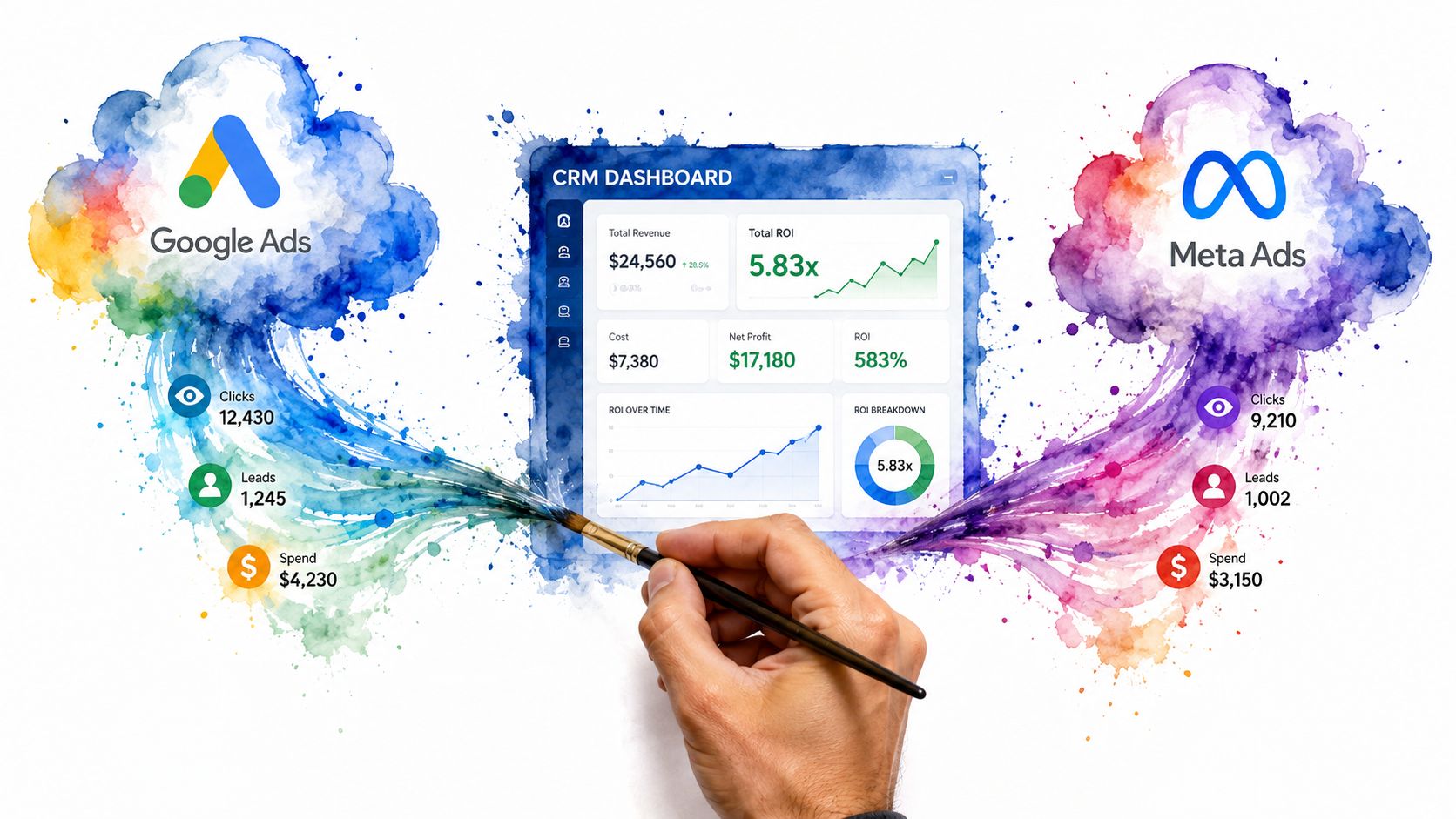
The handoff has to be automatic. Every new inquiry should enter the CRM with source detail attached from the start. Not later. Not after a rep remembers to type it in. At the moment of capture.
Capture the data that makes revenue traceable
A lead record should tell a complete acquisition story. At minimum, that means your CRM needs fields for:
- Channel source such as search, paid social, referral, or direct
- Campaign detail so you can separate one offer or audience from another
- Conversion path context such as the form, landing page, or call source that created the lead
That structure turns a contact record into a revenue record in progress.
Without it, you get the usual nonsense. Sales says one channel sends weak leads. Marketing says the campaigns are fine. Finance sees spend rising and asks harder questions. Everybody has a partial truth because the system never connected the first touch to the final outcome.
Build one line from click to close
A practical flow looks like this:
- Ad interaction happens and the visitor clicks to a page, form, or tracked call path.
- Lead submits or calls and the inquiry is created automatically in the CRM.
- Source data is written to the record so the opportunity carries origin data throughout the pipeline.
- Sales activity begins and every stage movement stays attached to that original acquisition source.
- Closed revenue is reported back by source so you can compare channels on actual business results.
That's the foundation behind better marketing attribution. Not theoretical attribution. Usable attribution.
If source data relies on manual entry, the reporting will fail the moment the team gets busy.
What good implementation looks like
This doesn't require exotic setup. It requires discipline in field mapping and process ownership.
The CRM should do three things well:
- Create records automatically from every paid and organic intake path
- Preserve source data through stage changes and handoffs
- Report on revenue outcomes by source, campaign, and offer
What doesn't work is exporting leads from one system, importing them into another, and asking reps to clean up the details. That process creates missing data, duplicate records, and false conclusions about channel performance.
Once the ad-to-CRM flow is clean, sales pipeline management stops being an internal sales exercise. It becomes the mechanism that proves which marketing investments deserve more budget.
Automating Your Pipeline to Free Up Your Sales Team
A paid campaign goes live on Monday. Leads start coming in. By Wednesday, some records still sit unassigned, two reps have called the same prospect, and half the opportunities in the pipeline have no next step. The problem is not effort. The system is asking salespeople to do work the CRM should handle.
That friction gets expensive fast. Every delayed follow-up wastes ad spend you already paid for, and every missing field weakens the reporting needed to judge channel ROI. If the pipeline is supposed to show which marketing dollars produce revenue, automation has to protect speed, ownership, and data quality from the first touch through closed business.
Automate the operational work around the rep
The best automation handles routing, reminders, validation, and handoffs. It gives reps a clean queue and gives leadership cleaner data. It does not try to fake human judgment or replace real sales conversations.
Use automation for jobs like:
- Lead assignment by territory, service line, or account owner
- Task creation after a form fill, inbound call, missed appointment, or quote request
- Stage aging alerts when an opportunity sits too long without activity
- Required field checks before a rep can advance or close a deal
- Client handoff workflows once a deal is won and fulfillment or onboarding takes over
That division matters. A CRM should remove admin load so reps can respond faster and managers can trust the pipeline.
Build the workflows that protect revenue first
Start with the points where delay or inconsistency costs money.
New lead response workflow
The moment a lead enters the CRM, assign an owner, create the follow-up task, and send the internal notification. Fast response matters more when the lead came from paid traffic because the acquisition cost is already fixed.Stale opportunity review
Flag deals that sit past your stage threshold with no call, email, note, or meeting logged. That keeps dead deals from overstating forecast health.Next-step enforcement
If a qualified opportunity has no dated next action, the CRM should block the stage move or alert the rep and manager. Pipelines break when deals drift without a clear commitment.Closed-lost discipline
Require a loss reason before closeout. That gives both sales and marketing something usable. You can spot weak offers, poor-fit lead sources, and objections that show up repeatedly in paid campaigns.
Teams that connect this logic across sales and marketing get much better control over lead handling. A structured marketing automation workflow keeps early-stage leads in nurture while sales stays focused on active opportunities with buying intent.
Avoid automation that creates noise
I see three failure patterns repeatedly.
The first is over-triggering. Too many notifications train people to ignore all of them.
The second is automating a messy process. If stage definitions are unclear, automation just helps bad records move faster.
The third is skipping ownership rules. Tasks without a named owner are clutter, not execution.
Good automation makes the pipeline easier to run and harder to corrupt. It protects response time, keeps opportunities moving, and preserves the data needed to connect closed revenue back to the campaigns that generated demand. That is how automation stops being a convenience feature and starts acting like part of the revenue engine.
Building a Truth Dashboard with Revenue-First KPIs
Monday morning. The ad platforms say leads are up, the sales team says pipeline feels light, and leadership wants to know whether this month's spend is producing revenue or just more records in the CRM.
That is the job of a truth dashboard.

A useful dashboard connects marketing inputs to sales outcomes. It shows whether budget is creating qualified pipeline, whether that pipeline is moving, and whether closed revenue justifies the spend. If those three answers are not clear, the dashboard is reporting activity, not helping anyone run the business.
Start with measures tied to revenue decisions
Leadership does not need more charts. Leadership needs fast answers to practical questions.
Use metrics that support decisions such as:
Lead-to-close rate by channel
This shows which sources produce customers instead of low-intent contacts.Sales cycle length
This shows how long it takes for demand to turn into cash.Average deal size
This helps you spot channels that create volume without creating enough revenue.Stage conversion rates
This shows where deals slow down and where the process needs work.Pipeline coverage ratio
This shows whether qualified opportunity value is strong enough to support the target.
Pipeline coverage matters because forecast risk usually starts long before the month ends. If qualified pipeline is thin, every delayed proposal, no-show call, or budget objection hits harder. Strong coverage gives the team room to absorb normal slip without missing the number.
Separate signal from vanity
Raw lead count belongs lower on the page unless it is paired with quality, progression, and revenue contribution. Paid media can make lead volume look healthy while the CRM shows a different story: weak qualification, low stage movement, and very little closed-won revenue.
Use a decision table that ties each pattern to an action:
| If you see this | It usually means | Likely action |
|---|---|---|
| Strong lead volume, weak qualification | Targeting or offer mismatch | Adjust campaign intent and tighten intake questions |
| Good qualification, weak stage progression | Sales process friction | Improve follow-up, scripts, or stage exit criteria |
| Healthy pipeline value, weak close rate | Deal quality or forecast inflation | Remove weak deals and inspect qualification standards |
| Long cycle with strong early engagement | Mid-pipeline bottleneck | Audit proposals, objection handling, and next-step control |
Teams using data-driven marketing solutions get more value from this view because it ties media decisions to CRM evidence. That connection is what turns ad spend into an accountable investment instead of a monthly guess.
Build one shared scoreboard
Sales, marketing, and leadership should review the same core numbers. Each team can have its own detailed view, but the top-level dashboard should stay consistent so performance discussions start from the same facts.
Keep it tight enough to answer three questions fast:
- Do we have enough qualified pipeline to support the target?
- Where are deals losing momentum?
- Which campaigns and channels are producing revenue, not just inquiries?
I have found that once a team sees paid traffic, pipeline movement, and closed revenue in one place, budget conversations get sharper. Weak channels are harder to defend. Strong channels earn more investment faster. The CRM stops being a sales admin tool and starts acting like the operating system for growth.
A dashboard earns trust when it helps people make a hard call quickly. If it cannot show whether marketing dollars are turning into pipeline and revenue, it is decoration.
Optimizing Your Growth Machine for Predictable Revenue
Once the pipeline is clean, connected, and measured properly, it starts paying you back in a different way. It tells you where to improve the whole go-to-market system.
That feedback loop is where predictable growth comes from.

Let pipeline data change your ad decisions
A lot of businesses keep spending based on habit. They know a campaign has “worked before,” so they keep funding it even when downstream results weaken.
The pipeline gives you a better standard. If one offer creates qualified opportunities that move and close, that message deserves more investment. If another source fills the CRM with records that stall early, it needs a fix or a cut.
Use pipeline evidence to review:
- Offer quality so you know whether the promise in the ad matches buyer intent
- Landing page fit so the conversion path attracts the right prospect, not just any prospect
- Channel mix so budget follows revenue contribution instead of platform-reported optimism
This is also where conversion work becomes practical. Better messaging, cleaner forms, stronger follow-up logic, and tighter qualification all improve the same machine.
Give reps stage-based playbooks
Optimization isn't only a marketing exercise. Sales needs structure too.
Each pipeline stage should have a short playbook that answers:
- What must happen in this stage
- What common objection appears here
- What proof or content helps move the buyer forward
- What next action is required before the deal can sit
That standard reduces rep-to-rep variation. It also makes coaching easier because managers can inspect execution against a known process instead of vague personal style.
A simple playbook often beats heroic improvisation.
Treat the pipeline like a living system
The best revenue teams don't “set up a pipeline” and walk away. They tune it.
They remove stages that create confusion. They tighten qualification when weak-fit leads pile up. They improve handoffs when customers arrive frustrated. They shift budget when closed revenue tells a clearer story than top-of-funnel reports.
That's the discipline behind predictable sales pipeline management. Not more software for its own sake. Not more dashboards for show. A cleaner operating system for revenue.
If your business is generating leads but struggling to turn advertising into reliable revenue, The Advertising Suite helps close that gap. As a growth-focused partner, the team combines strategy, CRM infrastructure, and reputation tools to build a pipeline that connects ad spend to real business outcomes. If you want a system that acts like an extension of your team, request a demo, book a growth consult, or explore the Membership for the built-in CRM and the 25% discount on all services.
