You pull up the monthly report and see the usual numbers. Clicks. Impressions. Cost per click. Maybe a few conversions. Finance asks what produced revenue, and the room goes quiet.
That gap is the core attribution problem.
A business can spend across search, social, email, local campaigns, and referrals, then still make budget decisions with incomplete crediting. The result is predictable. Channels that sit close to the sale get too much credit. Channels that create demand earlier get underfunded. Profit suffers because the budget follows platform metrics instead of buying behavior.
Marketing attribution is the method for assigning credit to the touches that influenced a lead, sale, or closed deal. Done well, it answers a revenue question, not a reporting question: which marketing efforts helped produce profitable customers, and which ones just looked busy.
If your reports have ever shown decent performance while cash flow told a different story, the model is the problem. A clean view of return on ad spend (ROAS) helps, but ROAS is only as trustworthy as the attribution behind it.
For a small or midsize business, that is the whole point. Attribution should help you cut wasted spend, protect the channels that create real pipeline, and make sharper decisions about where the next dollar goes.
Your Ad Spend Report Is Full of Clicks but Where Is the Revenue
You open the monthly ad report and see a page full of motion. Traffic is up. Cost per click looks fine. A few leads came in. Then finance asks a simple question. Which spend turned into profitable revenue?
That is where weak reporting falls apart.
A business can run search ads, paid social, email campaigns, local promotions, and referral programs all at once, then still have no clear answer on what drove sales. The result is predictable. Budget gets pushed toward the channels that show the cleanest platform metrics, not the channels that create the best customers.
What attribution actually solves
Marketing attribution assigns credit to the marketing touches that influenced a sale. That is the practical definition. Not clicks. Not reach. Sales.
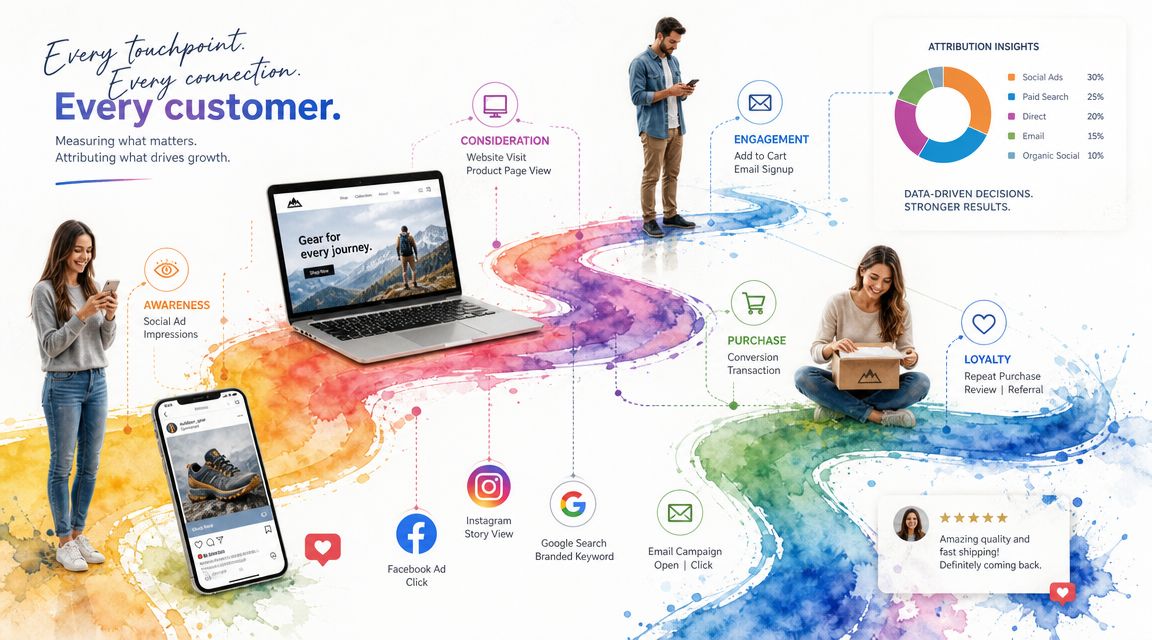
A real buyer journey usually looks messy. Someone sees an ad, ignores it, searches your brand a week later, reads reviews, opens an email, comes back direct, and finally calls your office. If your reporting gives all the credit to that last visit, you are not measuring performance in any useful business sense. You are rewarding the channel that happened to stand closest to the cash register.
That mistake costs money.
Why owners should care
Attribution matters because it changes budget decisions that affect margin.
It helps you:
- Cut wasted spend by spotting channels that generate activity without producing customers
- Protect demand creation by keeping budget in the campaigns that start the buying journey
- Judge performance by revenue instead of platform-reported conversions
- Make ROAS decisions tied to real revenue instead of inflated channel credit
This is the point many business owners miss after getting burned by vanity metrics. A campaign can look efficient inside the ad platform and still be a bad investment for the business. Attribution gives you a way to connect spend to closed revenue, customer quality, and profitability.
Without that connection, reporting stays cosmetic. You get charts, but not answers.
Why Your Default Reporting Is Probably Lying to You
Default reporting is convenient. It's also one of the fastest ways to misread your business.
Most SMBs still make budget decisions from whatever the platform shows by default. That usually means some version of last-click logic. The final touch gets the trophy, while everything that made the buyer care in the first place gets ignored.
That's not a minor flaw. It's a budgeting problem.

Three ways default reporting distorts reality
First, it over-credits the closer.
Brand search, retargeting, and direct visits often show up right before conversion. Last-click reporting gives them all the credit, even when another channel created the original demand.
Second, it hides assist value.
A prospect may discover you through a top-funnel campaign, leave, compare options, read your content, then return later to convert. If you only reward the final interaction, you'll underfund the channels that started the journey.
Third, it creates fake certainty.
The dashboard looks precise, so people trust it. That's the dangerous part.
The trust issue is real. Only 29% of marketers reported being extremely confident in their attribution accuracy, and 76% reported having limited customer-journey visibility, based on the research summarized in this attribution accuracy analysis.
What this does to your budget
Once bad reporting gets accepted as truth, teams make bad moves fast.
A business owner sees last-click results and decides to:
- Increase spend on branded demand capture
- Cut top-funnel campaigns that look weak
- Ignore the actual path buyers take
Then lead quality softens, pipeline dries up upstream, and nobody understands why “efficient” campaigns stopped producing growth.
Practical rule: If your reporting makes every sale look like it came from the final click, your reporting is not helping you allocate budget. It's helping you justify recency bias.
That's why local brands and service businesses need a broader view, especially when they're trying to improve lead generation for local businesses. If your buyers search, compare, ask around, read reviews, and come back later, simple reporting won't reflect what moved them.
Comparing the Most Common Attribution Models
The easiest way to understand attribution models is to stop thinking like a marketer and think like a coach.
A team scores a goal. Who gets credit?
Was it the first player who started the move? The midfielder who made the key pass? The striker who tapped it in? If you only credit the scorer, you miss how the goal was created. Attribution models work the same way.
Single-touch models
Single-touch models pick one winner. They're easy to understand and often too simplistic for real buying behavior.
First-click attribution gives all credit to the first known interaction.
Good for seeing which channels start awareness. Bad for understanding what helped close the deal.
Last-click attribution gives all credit to the final interaction before conversion.
Good for very short, simple paths. Bad for almost everything else.
This is why model choice can change budget decisions. Last-click tends to overvalue bottom-funnel brand and retargeting campaigns, while multi-touch or data-driven attribution can reveal the assist value of search, social, and email earlier in the funnel, as outlined in this explanation of attribution model differences.
Multi-touch models
Multi-touch models spread credit across more of the journey. They're usually more useful because most buyers don't convert from a single interaction.
Linear attribution
Every touchpoint gets equal credit. It's simple and often a decent starting point. Its weakness is obvious. Not every touch matters equally.
Time-decay attribution
Touches closer to conversion get more credit. This can make sense when late-stage interactions carry more weight, but it can still under-credit early demand generation.
U-shaped or position-based attribution
Heavier credit goes to the first touch and the conversion-triggering touch, with the middle touches sharing the rest. This often fits businesses that care about both discovery and conversion.
Data-driven attribution
This is the most advanced option in mainstream practice.
Data-driven attribution uses machine learning to compare converting and non-converting paths and estimate incremental lift, meaning how much a touchpoint changes the probability of conversion relative to similar paths without it. It's far more nuanced than giving all the credit to one click, but it still depends on the quality of the underlying data.
The model name matters less than people think. If your tracking is sloppy, your “advanced” attribution will still produce bad decisions.
Marketing Attribution Model Comparison
| Attribution Model | How It Works | Best For | Biggest Weakness |
|---|---|---|---|
| First-click | Gives all credit to the first interaction | Measuring what introduces buyers to the brand | Ignores everything that helped convert |
| Last-click | Gives all credit to the final interaction | Very short buying journeys | Overvalues closing touches |
| Linear | Splits credit evenly across all touches | Teams that need a simple multi-touch baseline | Assumes all touches matter equally |
| Time-decay | Gives more credit to touches closer to conversion | Journeys where recent interactions carry more weight | Can under-credit early influence |
| U-shaped | Gives heavier credit to first and conversion-driving touches | Businesses that want to balance awareness and conversion | Can still oversimplify the middle of the journey |
| Data-driven | Uses observed path patterns to estimate contribution | Teams with stronger data maturity | Only as good as the underlying tracking |
My recommendation for most SMBs
Don't overcomplicate this.
Start with a model that's more honest than last-click and easier to operationalize than a black-box setup. For many SMBs, that means:
- Use first-click and last-click together to see the extremes.
- Add a multi-touch view such as linear or position-based.
- Move toward data-driven attribution once your tracking and CRM discipline are stable.
If you jump straight to sophistication without fixing data hygiene, you'll just get more polished nonsense.
How Marketing Attribution Is Actually Measured
Attribution sounds abstract until you look at how it's built. At the ground level, it's just a system for collecting interaction data, matching it to people or accounts, and assigning credit according to rules or modeling.
That's the practical answer to what is marketing attribution. It's a measurement framework, not a magic report.
UTMs are the breadcrumbs
UTM parameters are the labels attached to campaign URLs. They tell your systems where traffic came from, what campaign drove it, and sometimes which ad or audience created the visit.
If your team names campaigns six different ways, attribution gets messy fast. One email becomes three. One paid source becomes five. Then your reporting turns into cleanup work.
A simple standard matters:
- Use one naming convention
- Keep source and medium consistent
- Document the rules and enforce them
That's boring work. It's also the kind of boring work that protects budget decisions.
Matching people to journeys
Once someone clicks, visits, calls, submits a form, or books an appointment, your systems try to connect those interactions.
There are two broad methods:
Deterministic matching links interactions using known identifiers, such as a submitted email, logged-in session, or CRM record. This is more reliable.
Probabilistic matching makes an educated guess based on patterns like behavior or device signals. It can be useful, but it's still a guess.
For a business owner, the takeaway is simple. If your CRM, lead forms, and conversion tracking are disconnected, attribution becomes less trustworthy. If your systems are integrated, your attribution becomes more grounded in known customer behavior.
Better attribution usually starts with better operations. Clean form tracking, clean CRM fields, and clean campaign naming beat fancy reporting every time.
This is especially important in channels like local search marketing, where buyers may discover you, leave, return later, and convert through a different path than the one that first introduced them.
The lookback window matters more than most teams realize
Attribution doesn't just ask who touched the deal. It asks when those touches still count.
A key setup choice is the lookback window. One common rule is to set the attribution window to roughly two sales cycles. Short windows systematically undercount upper-funnel channels, while overly long windows can dilute signal, as explained in this guide to attribution setup.
If your average sale takes time, platform defaults may be too short. If you use an overly long window, old touches can muddy the picture. Good attribution respects buying reality, not software convenience.
The New Reality of Attribution in a Privacy-First World
Attribution is getting harder. Not because the concept is broken, but because tracking every user across every site and device is no longer something you can assume.
That's a good thing for privacy. It also means lazy measurement is dead.

Third-party tracking is no longer the foundation
A lot of older attribution thinking was built around cookie-heavy tracking. That world is fading.
Google has said third-party cookie deprecation in Chrome is planned for 2025, and marketers are responding by shifting budget and measurement toward first-party data and modeled conversion systems, according to Amazon Ads' overview of marketing attribution.
That means you need to stop acting like user-level tracking will always be complete. It won't.
First-party data is now the asset that matters
First-party data is the information you collect directly from prospects and customers through your own forms, CRM, site interactions, calls, and customer records.
If you own that data and organize it well, you're in a stronger position to measure actual business outcomes. If you depend entirely on ad-platform reporting, you're building on rented land.
That's why businesses with strong CRM habits are better positioned for the next phase of measurement. They can connect inquiries, booked appointments, sales activity, repeat engagement, and customer experience signals. That's also why your reputation management strategy matters more than many owners realize. Reviews, trust signals, and follow-up quality influence conversion paths even when a platform can't perfectly trace every step.
Attribution and incrementality are not the same thing
This distinction matters.
Attribution assigns credit across observed touchpoints.
Incrementality asks a tougher question. Would the sale have happened anyway without that channel?
You need both.
A channel can show up in lots of conversions and still not be the reason those conversions happened. That's why smart operators use attribution for directional budget allocation and testing for deeper validation when a channel appears suspiciously strong.
Privacy changes didn't kill measurement. They killed the fantasy that one dashboard could tell the whole truth.
The right response isn't panic. It's better systems, stronger first-party data, and a more disciplined view of what your reporting can and can't prove.
Your Revenue-First Attribution Checklist and Next Steps
You log into your reports, see leads coming in, and still have no clear answer to a basic question. Which dollars produced profit, and which dollars just produced activity?
That is the point of attribution. It is not a reporting project. It is a decision system for where to put the next dollar.
For a small or mid-sized business, the goal is simple. Build enough measurement to cut waste, protect margin, and spot the channels that create customers.
Start with the basics that affect money
Use this checklist:
Define the conversion that matters
Pick the business outcome that deserves budget. That might be a qualified lead, a booked appointment, a closed sale, or recorded revenue. If you count low-intent actions as wins, your reporting will push money toward noise.Audit your tracking paths
Test your ads, forms, thank-you pages, phone numbers, and CRM handoff yourself. You are looking for one thing. Can the original source still be tied to revenue after the lead enters your pipeline?Standardize UTMs
Set one naming convention and enforce it. If one campaign uses three versions of the same source or medium, your reports split the data and hide what is working.Set a lookback window that matches your sales cycle
A business with same-day purchases should not measure the same way as a business with a 45-day sales process. Pick a window that reflects how customers buy.Compare at least two attribution views
Review a single-touch view and a multi-touch view side by side. Big gaps between them usually point to channels that assist conversions but rarely get final credit.Connect marketing to the CRM
Revenue decisions require revenue data. If campaign data stops at the lead stage, you will keep rewarding channels that create volume instead of customers.Review budget decisions every month
Attribution earns its keep when it changes spend, follow-up, and priorities. If no action comes out of the report, the report is decoration.
What to avoid
These mistakes cost real money:
- Trying to get perfect certainty: You need directional truth that helps you allocate budget better.
- Using only channel-level dashboards: They show fragments, not business outcomes.
- Optimizing for lead count alone: Ten weak leads can look better than three profitable customers.
- Changing naming conventions midstream: That destroys clean comparisons over time.
- Ignoring the sales team: If close rates differ sharply by source, attribution has to include that reality.
What to do next
Start small and get the plumbing right. A clean setup with disciplined definitions beats a messy stack of dashboards every time.
Then use attribution to answer revenue questions, not vanity questions. Which campaigns bring in customers who close faster? Which sources produce repeat buyers? Which channels fill the pipeline but drain margin because sales has to work twice as hard to convert them?
That is where this becomes useful. You stop asking which campaign got the most clicks and start asking which one deserves more budget.
A better attribution setup will not fix a bad offer or weak follow-up. It will expose both faster. If your funnel is getting traffic but not turning it into customers, start with a stronger conversion rate improvement plan.
The standard is straightforward. Attribution should change how you spend, how you sell, and how you measure profit. If it does not, you are still looking at marketing reports instead of running a revenue system.